Alibaba Qwen3.8-Max narrows open-weight frontier gap
Qwen3.8-Max is Alibaba's 2.4T open-weight model ranking fifth in text and second in vision on Arena. The gap with US frontier labs narrows but does not close.
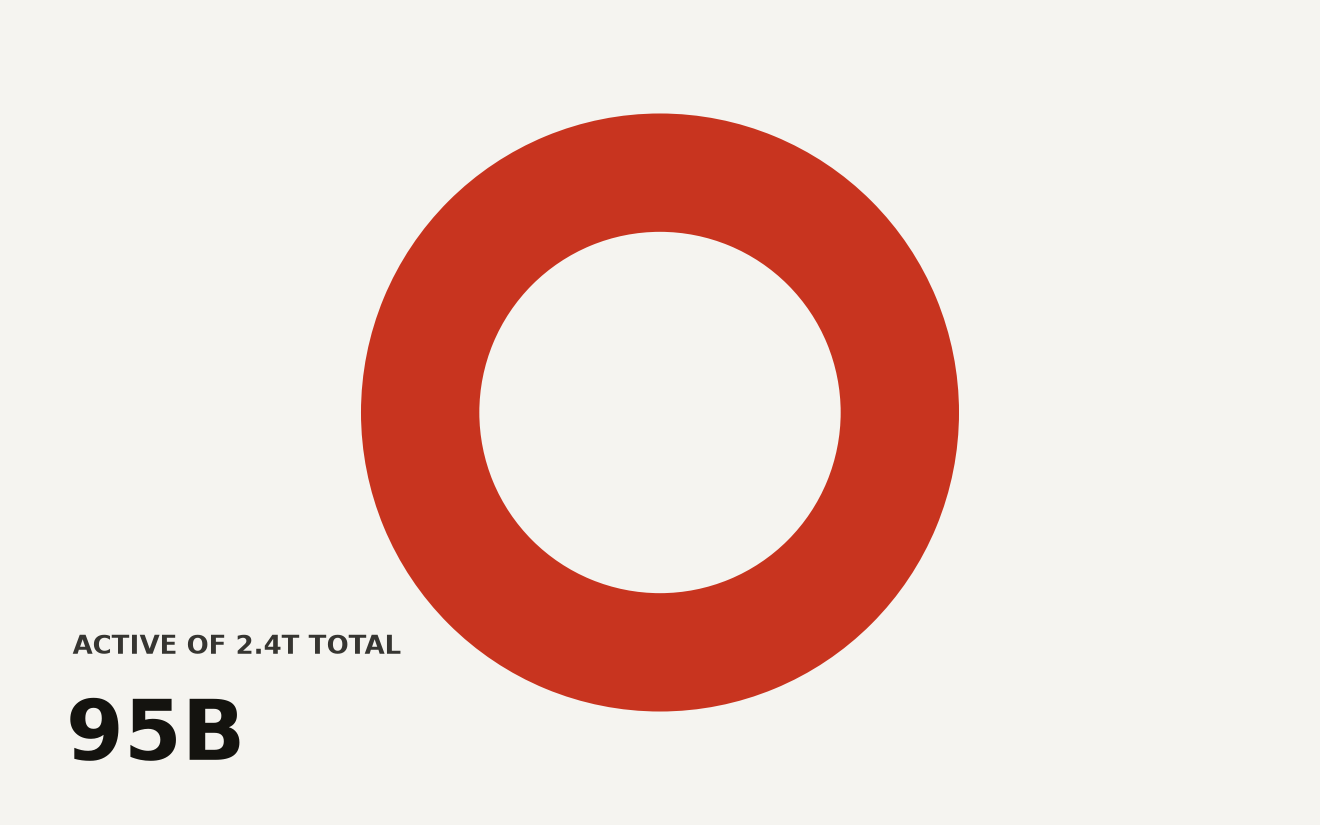
Qwen3.8-Max MoE parameter activation: 95B active of 2,400B total parameters. Source: Alibaba Cloud announcement.
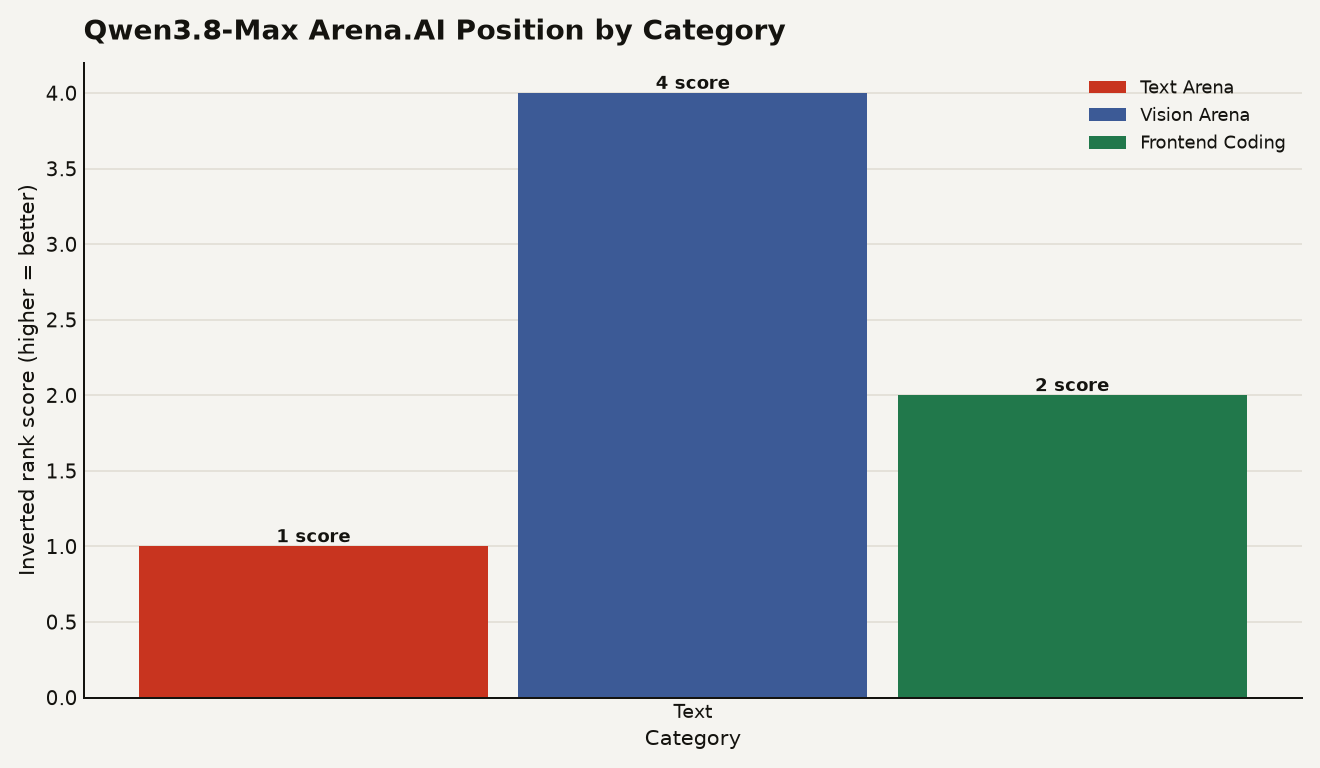
The open-weight frontier just got a new contender. Alibaba announced Qwen3.8-Max on Monday, a 2.4 trillion parameter mixture-of-experts model that the company says rivals the best from Anthropic and OpenAI. The model ranks fifth on Arena.AI's text leaderboard and second in vision, trailing only Anthropic's Fable 5 in the visual category. Weights ship next week, making it the largest open-weight model Alibaba has ever released and the latest sign that Chinese labs are turning open-weight releases into their primary competitive strategy against closed US frontier labs. The release comes weeks after Moonshot AI shipped Kimi K3, and on the same Friday that both ByteDance and MiniMax dropped capable new video generation models. The tempo is accelerating. Qwen3.8-Max also marks Alibaba's return to open-weight releases after the company briefly pivoted to proprietary releases for its advanced models earlier this year, a detour that clearly ended. Qwen3.8-Max is Alibaba's most capable open-weight model, and it is close enough to the frontier to matter for what you build. ## How does Qwen3.8-Max actually compare to US frontier models? Alibaba's own benchmarks claim Qwen3.8-Max broadly matches, and sometimes exceeds, Anthropic's Fable 5 on internal tests. External signals are less definitive but still strong. On Arena.AI's crowdsourced text leaderboard, Qwen3.8-Max ranks fifth globally, behind Fable 5 and three variants in Anthropic's Opus family. For frontend coding, only two Claude Opus models and Moonshot AI's Kimi K3 beat it. In the Vision Arena, which tests models on image and visual analysis tasks, Qwen3.8-Max ranks second, behind only a Fable 5 variant. That is a meaningful showing. A Chinese open-weight model sitting at rank five in text and rank two in vision on a crowdsourced leaderboard would have been hard to imagine eighteen months ago. But it also means Qwen3.8-Max is not leading any category. It is competitive, not dominant. The gap between the best Chinese open-weight model and the best US closed model has narrowed from "clearly behind" to "you would notice the difference but might not always care." The model handles multimodal input across text, images, and video with a context window of 1 million tokens, roughly 750,000 words per query, according to Alibaba's technical announcement. Alibaba says it can digest hundred-page documents, television series, or 100-hour livestreams and turn them into searchable knowledge bases. In one internal test, the company says the model spent 16 days autonomously building and improving a software engineering tool, writing code, testing, fixing errors, and refining its own work with minimal human input. That 16-day claim deserves skepticism. Vendor-reported agentic benchmarks have a track record of looking impressive in controlled demos and underperforming in messy production environments. The long-horizon terminal bench findings we covered earlier this year showed that even capable agents hit walls on extended tasks. Sixteen days of autonomous coding is a bold claim that needs third-party replication before it changes your architecture decisions. Qwen3.8-Max Arena.AI leaderboard positions inverted to scores (6 minus actual rank, higher is better). Vision rank 2, Frontend Coding rank 4, Text rank 5. Source: Arena.AI via The Verge. Data Today analysis. The chart above shows Qwen3.8-Max's Arena leaderboard positions across three categories, inverted so higher bars mean better performance. Vision is the model's strongest area at rank 2, followed by frontend coding at rank 4, with general text at rank 5 as the relative weak point. The pattern suggests Alibaba has invested heavily in multimodal capabilities, which aligns with the model's ability to process video and long visual streams. ## What does the open-weight release change for builders? The practical stakes of Qwen3.8-Max are less about benchmark scores and more about what open weights let you do. When Alibaba releases the weights next week, developers can download the model, run it on their own infrastructure, fine-tune it, and modify it without API dependencies. That is a fundamentally different deal than calling an Anthropic or OpenAI endpoint. For teams building AI products, here is what that opens up: - Data sovereignty. You run inference on your own servers. Sensitive data never leaves your environment. For healthcare, finance, or legal applications, this removes a procurement blocker that closed APIs make expensive to solve. - Fine-tuning control. You adapt the model to your domain with LoRA or full fine-tuning. Closed APIs offer limited customization through system prompts and tool definitions, which is a ceiling on how well the model can specialize. - No per-token costs at inference. Once you have the hardware loaded, marginal inference cost drops to electricity and depreciation. You stop paying per API call. - Vendor independence. No rate limits, no sudden price changes, no model deprecations. The model exists on your hardware and stays there. The tradeoffs are equally real. Running a 2.4 trillion parameter model is a serious infrastructure commitment. The open-weight release also comes with the regulatory baggage that Chinese open-weight models carry in Washington, which we have flagged before. If you are building for US government clients or regulated industries with strict supply chain requirements, adopting a Chinese model introduces compliance risk that no benchmark score will resolve. Alibaba also launched QwenWork alongside the model, an all-in-one productivity platform that competes with Claude Cowork, ChatGPT Work, Tencent's WorkBuddy, and Moonshot's Kimi Work. The platform entered public beta on Monday through web and desktop apps. This is Alibaba positioning Qwen3.8-Max not just as a model for developers but as a packaged product for businesses, which is a different competitive threat to US labs than raw model performance. Alibaba's Hong Kong-listed shares rose 7 percent to HK$125.20 on the news, closing at a level that suggests investors see this release as a competitive event, not a footnote. ## How feasible is self-hosting a 2.4 trillion parameter model? The mixture-of-experts architecture is the part that matters most for your infrastructure bill. Qwen3.8-Max has 2.4 trillion total parameters but only 95 billion active per request, according to Alibaba's technical blog post. The MoE design routes each token to a small subset of specialized expert networks rather than activating the full network for every computation. That 95B active figure tells you about compute cost per token, which is comparable to running a dense 95B model. Inference latency and per-token compute will feel like a mid-size model, not a 2.4T behemoth. But the total parameter count tells you about memory, and memory is where the real cost lives. Loading 2.4 trillion parameters into VRAM requires approximately 1.2 terabytes of GPU memory at 4-bit quantization, or roughly 16 H100 GPUs at 80GB each just for weight storage. At FP16, the footprint balloons to 4.8TB, requiring around 60 H100s. The MoE architecture saves you compute but does not save you memory. You still need to load every expert into VRAM even if only a fraction fires per token. This is the key calculus for any team considering self-hosting. The per-token inference cost is attractive because only 95B parameters activate. But the capital expenditure to stand up the infrastructure is substantial. A 16-GPU H100 cluster for inference represents roughly $500,000 in hardware alone, before networking, power, cooling, and operations. For comparison, Moonshot's Kimi K3 has 2.8 trillion parameters and is also open-weight, making it even more memory-hungry. The Kimi K3 release we covered shows the same pattern: Chinese labs are building very large MoE models that are cheap per token but expensive to host. The practical path for most teams will be API access through Alibaba Cloud's Model Studio rather than self-hosting. Alibaba is making the model available through APIs now, with open weights following next week. If your use case does not require data sovereignty or fine-tuning, the API route gives you frontier-class performance without the hardware bill. ## Should you bet your stack on Chinese open-weight models? Performance-wise, Qwen3.8-Max is close enough to frontier that swapping it in for a US closed model would not dramatically change your product quality for most use cases. Vision tasks are where it shines brightest. Text and coding are competitive but not leading. The 1 million token context window matches or exceeds what most US labs offer, which matters for document-heavy applications. The real questions are non-technical: - Regulatory exposure. If you operate in the US market, especially in government, defense, or regulated sectors, deploying a Chinese model creates compliance risk that your legal team will want to review before your engineering team writes any integration code. - Supply chain resilience. Alibaba controls the API endpoint and could restrict access based on Chinese regulatory decisions. Open weights mitigate this for self-hosters, but the model's training pipeline and future updates remain under Alibaba's control. - Ecosystem maturity. The tooling around Qwen models is growing but still trails the Claude and OpenAI ecosystems in agent frameworks, evaluation tools, and community support. If your stack is deeply integrated with Claude's tool use or OpenAI's function calling, migrating involves real engineering work. - Cost structure. API pricing through Alibaba Cloud will likely be competitive, but you are trading a known cost per token for a new vendor relationship with different uptime guarantees, data handling terms, and support structures. The copilot billing shock we documented earlier is a reminder that API cost structures can surprise you in both directions. The open-weight option is a hedge. You start with the API to validate the model on your workloads, and you keep the self-hosting path in your back pocket for when data sovereignty or cost optimization demands it. That is the rational adoption pattern for most builders right now. ## The gap narrows, the questions sharpen Qwen3.8-Max does not close the gap between Chinese open-weight models and US frontier labs. It narrows it in a way that is now visible on leaderboards and felt in procurement decisions. A model that ranks second in vision on Arena.AI and handles 1 million tokens of context is a credible alternative, not a budget option. The open-weight release next week gives builders a choice they did not have before: frontier-class performance with full model control, if they are willing to shoulder the infrastructure and navigate the regulatory landscape. The question for your team is whether those tradeoffs align with what you are building. For some, the answer is already yes. For many, the API is the starting point and the weights are a strategic option held in reserve. ## Sources - The Verge - Alibaba Cloud Community - South China Morning Post - CNBC