The open-weight ceiling just moved. Moonshot AI released Kimi K3, a 2.8-trillion-parameter mixture-of-experts model with 104 billion activated parameters per token, and it cleared benchmarks that no open model has touched before. Artificial Analysis ranks it fourth of 580 models, behind only Claude Opus 5, Claude Fable 5, and GPT-5.6 Sol. Three of those four are proprietary. Kimi K3 is the first open model to crash that tier, and Moonshot backed the release with a 47-page technical report and open kernels on GitHub. The full weights ship under a permissive license that the team says makes frontier intelligence openly accessible for research and deployment. That phrase is doing heavy lifting, and the fine print is where builders should spend their time. The headline is that open-weights are now within striking distance of the best closed models. The details tell you how much distance remains and what it costs to close it.
What did Moonshot actually build and release?
Kimi K3 is a 2.8-trillion-parameter model with 104 billion parameters activated per token out of 896 routed experts, effectively picking 16 experts plus 2 shared per forward pass. That is extremely sparse: the active parameter count is roughly 3.7 percent of total capacity. For comparison, DeepSeek-V3 runs 671 billion total with 37 billion active, and Kimi K2 was less sparse at its own generation. Moonshot reports an approximate 2.5x improvement in overall scaling efficiency over Kimi K2, meaning the new architecture converts the same compute into more intelligence per dollar.
The model introduces two architectural changes that do the heavy lifting. Kimi Delta Attention, or KDA, replaces standard attention with a hybrid that blends linear and full attention layers. The architecture interleaves 69 KDA layers with 24 Gated MLA layers to preserve global attention at critical depths. Attention Residuals, or AttnRes, lets each layer selectively pull representations from any preceding layer rather than only the one directly below it. The technical report on arXiv describes the combination as the structural backbone for scaling well beyond the trillion-parameter regime. The official Kimi K3 blog post confirms the same numbers and architecture.
The release package is more than weights. Moonshot published the full model on GitHub with KDA kernels, a vLLM implementation for KDA prefix caching, and deployment guidance recommending supernode configurations with 64 or more accelerators. The weights carry a permissive license. The KDA vLLM contribution is the piece that makes inference at this scale practically deployable rather than a research curiosity.
How does Kimi K3 perform on frontier benchmarks?
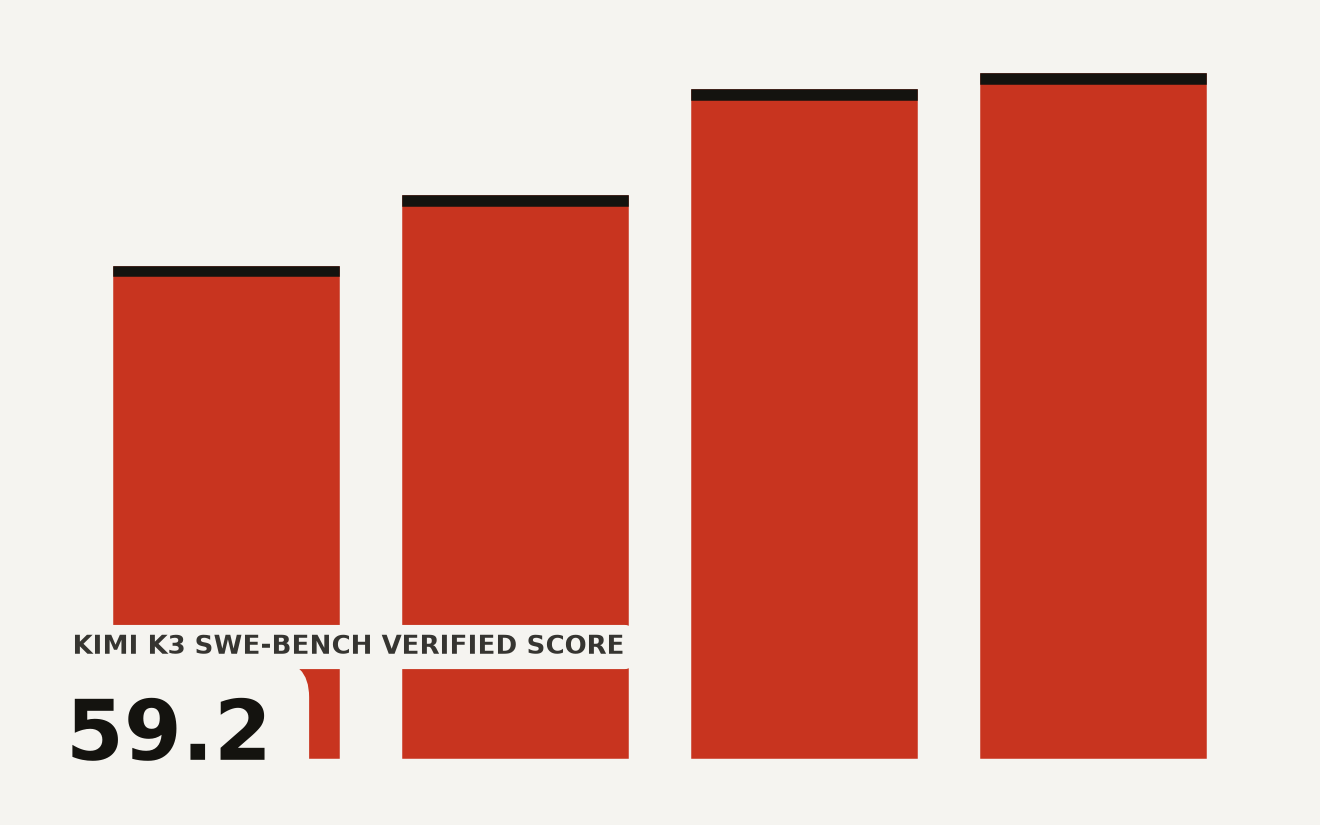
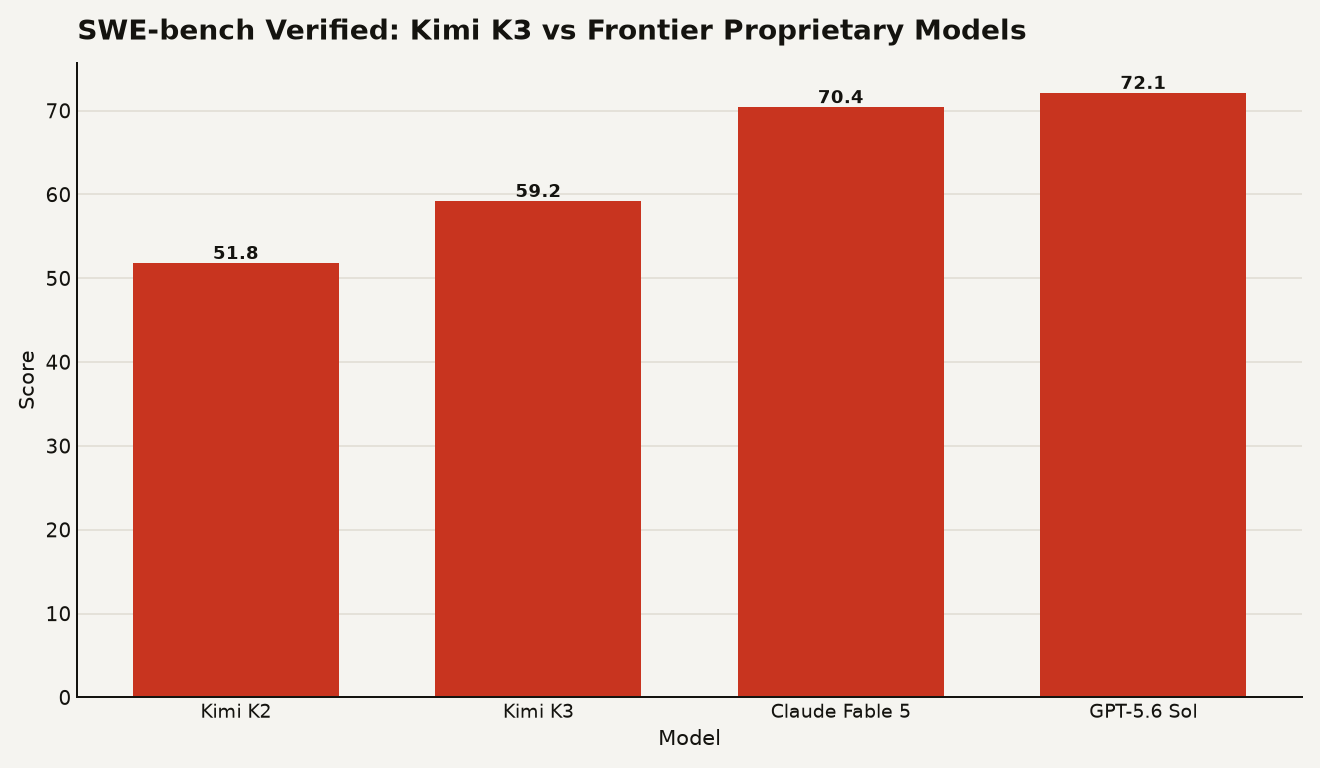
On SWE-bench Verified, Kimi K3 scores 59.2, compared to 51.8 for Kimi K2 and 70.4 for Claude Fable 5. That puts the open model at 83 percent of the top proprietary score on one of the hardest coding benchmarks available. GPT-5.6 Sol leads at 72.1.
The report also reports results on BrowseComp, where Kimi K3 scores 37.1, and Agent Arena, where it earns a 9.1 rating and places fourth of 37 models. Claude Fable 5 leads Agent Arena at 12.7. On Text Arena, Kimi K3 reaches an Elo of 1,029. The gaps are real but narrowing. A year ago, open models were not in the same conversation on agentic tasks. Now one is sitting in fourth place on a ranked leaderboard of nearly 600 models, and the three ahead of it are all closed.
The report is candid about the ceiling. Kimi K3 trails Claude Fable 5 and GPT-5.6 Sol on overall performance, and the authors state that directly. The open frontier has moved, but it has not closed.
How hard is this model to run in production?
This is the section that should temper enthusiasm. Kimi K3 is open-weight, but it is not cheap to serve.
Moonshot recommends deploying on supernode configurations with 64 or more accelerators to get acceptable throughput. The model uses quantization-aware training from the SFT stage onward, with MXFP4 weights and MXFP8 activations, which helps with hardware compatibility and memory footprint. But the routing challenge at 896 experts is a first-order engineering problem. Moonshot introduces a fully balanced expert-parallel training method with static shapes and no host synchronization on the critical path, which solves throughput degradation at large expert-parallel scales during training. Inference faces a related but distinct challenge.
KDA complicates conventional prefix caching because the attention pattern differs from standard transformers. Moonshot contributed a KDA-aware vLLM implementation to handle this, and it is what allows them to serve Kimi K3 at a competitive token price despite the model's scale and 1-million-token context window. Without that contribution, deploying KDA models at this size would require significant custom inference engineering. With it, the path is shorter but still not trivial.
The practical takeaway: if your team is not already operating large MoE inference infrastructure, Kimi K3 is a research target, not a drop-in replacement for an API call. Teams that have invested in vLLM pipelines and multi-GPU serving have a real shot at running it. Everyone else should use the Kimi API or wait for distilled variants.
What does this mean for builders and the open-weight landscape?
Kimi K3 changes the calculus for anyone deciding between open and proprietary model strategies. Here is the concrete breakdown.
- Moat shift: The gap between open and closed at the frontier is now measured in percentage points on some benchmarks, not multiples. Kimi K3 trails the best proprietary model by about 11 points on SWE-bench Verified. If your product depended on a 20-point gap to justify API costs, that gap may not survive the next training run. Revisit your build-versus-buy math.
- Infrastructure barrier: 2.8 trillion parameters with 896 experts is not a model you fine-tune on a single node. Full-parameter fine-tuning is out of reach for most teams. Parameter-efficient methods like LoRA remain the practical path, but they have known failure modes on multi-step procedural tasks, as we have covered in our analysis of LoRA limitations.
- Agentic readiness: Kimi K3 was trained with reinforcement learning across general, agentic, and coding domains, with multiple reasoning-effort levels. The Agent Arena and BrowseComp results suggest the RL pipeline produced real agentic capability, not just benchmark polish. For teams building coding agents or autonomous workflows, this is the first open model that is plausibly competitive with proprietary options on long-horizon tasks.
- Deployment cost: The 1-million-token context window is a genuine capability, but it is also a cost multiplier. Serving a million-token context with KDA and 896 experts requires the supernode setup Moonshot describes. Token pricing through the Kimi API will be the more economical path for most teams until inference tooling catches up.
- Security and governance: For regulated industries evaluating open-weight models, supply chain and provenance questions apply. The model is trained and released by a Chinese company, which carries the regulatory exposure we examined in our coverage of Chinese open-weight models and Washington regulatory risk. That piece looks at the policy landscape and what it means for adoption.
The open frontier is now one model wide
Kimi K3 is a proof point that the open-weight frontier is real, but it is a thin line. One model from one lab is holding the position. If Moonshot stops training or the next regulatory cycle restricts access to frontier compute, the gap could widen again quickly. The architecture innovations in KDA, Attention Residuals, and Stable LatentMoE are genuinely interesting and may propagate into other open efforts, but they are not yet a broad movement.
The bet you can make with some confidence: open models will continue to close ground on specific benchmarks. The bet that remains uncertain: whether open deployment at frontier scale becomes economically practical for teams outside hyperscalers and well-funded labs. Kimi K3 is available today on the Kimi API, and the weights are downloadable. The real test is what the next three months of community deployment and fine-tuning produce.
Sources
- arXiv: Kimi K3 Technical Report
- Moonshot AI: Kimi K3 Open Frontier Intelligence blog post
- GitHub: MoonshotAI/Kimi-K3 model repository
- MoClaw: Kimi K3 Technical Report analysis
- Reddit: How Kimi K3 Engineered Its Way to the Frontier discussion