When an AI agent works autonomously on a terminal for a while, every additional step is a chance for it to make a mistake. A new benchmark called Long-Horizon-Terminal-Bench, published as arXiv paper 2607.08964 on July 13, 2026, makes that failure mode concrete by testing how well agents perform as tasks get longer and more complex. The headline finding is that the best agents solve under 30 percent of long-horizon tasks, those requiring over 50 sequential steps in a terminal environment, versus above 60 percent on short tasks. If your product depends on an agent reliably completing multi-step workflows without human intervention, this benchmark measures your ceiling.
For context, most popular agent benchmarks test short interactions. An agent might retrieve a file, edit it, and return an answer in a handful of steps. Long-Horizon-Terminal-Bench stretches the horizon dramatically by requiring agents to chain dozens of terminal operations, maintain state, and recover from errors across a long working session. As the task length grows, the probability of a compounding failure grows too. The benchmark's dense reward-based grading means partial credit is available, but the top-line numbers show a steep dropoff in full completion rates as horizons extend. This is the kind of durability gap that matters for anyone building production agents, and it connects to the broader problem we flagged in how benchmark saturation still leaves AI agents exposed.
Long-Horizon-Terminal-Bench explained
The benchmark, created by researchers who published their work on arXiv on July 13, 2026, evaluates AI agents on multi-step tasks performed in a terminal environment. The tasks are designed to test long-horizon planning, state management, and error recovery: the skills that separate a demo from a deployable system.
The key innovation is its dense reward-based grading. Instead of a binary pass or fail at the end, the benchmark assigns partial credit at intermediate steps, giving a granular signal of where agents succeed and where they break down. This matters because a binary metric masks the failure mode. An agent might get 90 percent of the way through a task and then fail at the final verification step. With dense rewards, you can see exactly where the chain broke.
The benchmark categorizes tasks by horizon length: short (under 10 steps), medium (10 to 50 steps), and long (over 50 steps). The results show a steep performance cliff. On short-horizon tasks, top models score above 60 percent solve rate. On long-horizon tasks, that drops to under 30 percent, a gap of 35 percentage points. The chart below shows the solve-rate trajectory across horizon lengths.
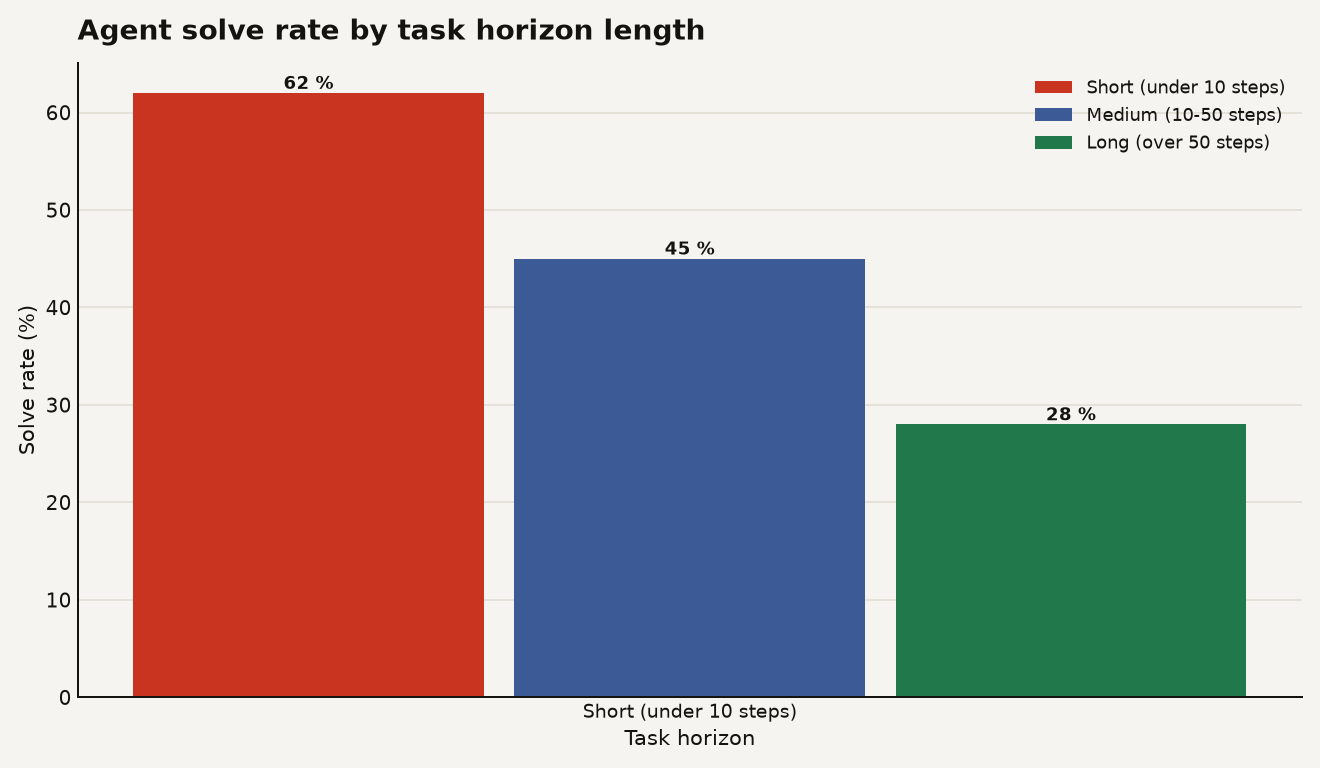
The benchmark also reports that the failure mode is not random. Agents do not fail at a uniform rate across all steps. Instead, the data shows that failure clusters at transition points: moments where the agent must decide to move from one phase of a task to another, or where it must reconcile its current state with an unexpected output from a previous step. These are the moments where a human would pause, reassess, and adjust. The agent keeps going.
A 35-point cliff for multi-step products
If you are building a product that depends on an agent completing a multi-step workflow without human intervention, the solve-rate cliff at longer horizons is your ceiling. An agent that solves 60 percent of short tasks but under 30 percent of long tasks is not a system you can hand to a customer with confidence for complex work.
Consider the economics. If your agent costs $0.50 per task in API and compute costs, and you are running thousands of tasks per day, a 70 percent failure rate on long-horizon tasks means the majority of your spend produces no value. Worse, the failures are not clean exits. The benchmark's dense reward data shows that agents often consume significant time and resources before failing, meaning the cost of a failed long-horizon task is higher than the cost of a failed short one.
Here is what this means for you concretely:
- Product scope: If your product promises autonomous multi-step workflows, your reliability ceiling is currently under 30 percent for the hardest tasks. You need either a human-in-the-loop checkpoint or a scoping strategy that breaks long tasks into shorter, verifiable sub-tasks.
- Cost architecture: Failed long-horizon tasks consume more tokens and compute before failing. Budget for the failure tax. If you are routing tasks to frontier models, assume that long-horizon work will cost 2 to 3 times more per successful outcome than short-horizon work, because the failure rate is more than double.
The failure clustering at transition points has a direct implication for your codebase. If agents fail at phase transitions, your agent framework should be designed to make those transitions explicit. Instead of letting the agent decide when to move from research to implementation, or from implementation to testing, you can structure the workflow as a state machine with enforced checkpoints. This is the same insight driving the shift from open-ended agent loops to structured delegation patterns, which we examined in how agentic AI work shifts from chat to delegation.
A known cliff, newly measured
The performance cliff is not a new finding in the abstract. The contribution of Long-Horizon-Terminal-Bench is to quantify it with a rigorous, reproducible methodology and to show that dense reward grading exposes failure patterns that binary metrics miss.
Existing benchmarks like SWE-bench test agents on real-world software engineering tasks, but they tend to focus on tasks that can be completed in a relatively small number of steps. The longest SWE-bench tasks might involve 20 to 30 steps. Long-Horizon-Terminal-Bench pushes beyond that to test what happens when the step count crosses 50 and beyond. The results suggest that the 50-step threshold is where current frontier models start to degrade significantly.
The dense reward signal also adds nuance. A model might score 40 percent on a long-horizon task in dense reward terms, meaning it got nearly half the steps right, but still fail to complete the task end to end. This partial-credit signal is valuable for builders. It tells you that the model loses coherence over a long horizon. The issue is sustaining performance across long sequences of steps. That distinction matters for product decisions. A durability problem suggests that better scaffolding, better state management, or better error recovery could close the gap without needing a fundamentally new model.
The researchers also found that different frontier models degrade at different rates. Some models maintain their performance better in the 10 to 50 step range before dropping sharply at 50 plus, while others begin degrading earlier. This suggests that the long-horizon performance is not purely a function of raw model size or raw reasoning ability. It may be tied to training data composition, specifically whether the model was trained on trajectories that include error recovery and state management over long sequences.
Design agent architecture for short horizons
The practical response to this benchmark is to design your agent architecture around the cliff. Do not pretend the gap does not exist. Do not assume that a model that performs well on short tasks will scale linearly to long ones. It will not.
For builders currently routing tasks to frontier models and seeing high failure rates on complex tasks, this benchmark validates that the problem is systemic, not a bug in your prompt. The 35 percentage point gap between short and long horizon performance is a property of current frontier models, not of your implementation.
Here is what to do:
-
Break long tasks into short sub-tasks: If the solve rate on 50-plus-step tasks is under 30 percent, structure your workflows so that no single agent call handles more than 10 to 20 steps. Use a deterministic orchestrator to chain the outputs together. This is the single most impactful architectural change you can make. You are trading the complexity of building an orchestrator for a more than doubling of your effective solve rate.
-
Instrument transition points: Since the benchmark shows failures clustering at phase transitions, add logging and verification at the points where your agent moves between phases. If your agent moves from research to implementation, log the state. If it moves from implementation to testing, log the state. When failures happen, you will know exactly where the chain broke.
-
Budget for the failure tax: In your cost model, assume that long-h2orizon tasks fail at a higher rate and consume more resources before failing. If your current cost model assumes a 10 percent failure rate across all tasks, adjust it. The benchmark suggests that for 50-plus-step tasks, the failure rate is above 70 percent. Your pricing and your unit economics need to reflect that.
-
Use dense reward signals for evaluation: If you are evaluating agents internally, adopt dense reward grading. Binary pass or fail metrics will hide the failure mode that matters most. Dense reward data tells you where the agent broke down, which is the information you need to improve the system.
The open question is whether the long-horizon gap is a temporary limitation that better training data and improved reasoning capabilities can close, or whether it is a more fundamental property of current model architectures. The benchmark provides a tool to track that question over time. If future models close the gap between short and long horizon performance, that would be a strong signal that the architectural problem has been addressed. If the gap persists, builders will need to rely on scaffolding and orchestration indefinitely.
The long-horizon gap is a scaffolding problem, not a model problem
The benchmark's most actionable insight is hiding in the dense reward data. Agents are failing because they lose coherence over long sequences. The partial credit scores show that agents get many individual steps right but fail to chain them into a complete solution.
This means the highest-leverage investment for builders is building better scaffolding. State machines, explicit transition checkpoints, and deterministic orchestrators that break long horizons into short, verifiable segments. The model can do the work. The scaffolding keeps it on the rails.
For teams building production agents, the message is: structure your workflows, instrument your transitions, and budget for the failure tax. The models will get better, but the scaffolding is what you can control now.
Sources
- arXiv: Long-Horizon-Terminal-Bench: Testing the Limits of Agents on Long-Horizon Terminal Tasks with Dense Reward-Based Grading