Every time a new AI model lands, the announcement throws around words like "frontier" and "long-horizon" as if everyone knows what those mean. Google DeepMind announced Gemini 4 Argon on September 30, 2026, and the headline is simple: this is Google's most capable AI model yet, and you cannot use it yet. It is rolling out first to a small group of cybersecurity professionals through a program called Fairwind, with wider access coming later. The model sets a new high water mark on several benchmarks for coding, business automation, and security work, and it introduces an output limit of 1 million tokens, which is roughly 15 times larger than what previous Gemini models could produce in a single response. If you are just starting to build with AI, here is what changed, what is real, and what you should do about it.
Gemini 4 Argon is a frontier AI model that can think through long, multi-step problems and produce massive outputs in a single response, but Google is limiting access while safety testing continues.
What exactly is Gemini 4 Argon?
A "frontier model" is an AI system that sits at the very edge of what is technically possible. It is the strongest, most capable model a lab has built at a given time. Google calls Argon its new frontier model, meaning it outperforms everything else Google has shipped, including the Gemini 3.8 family that we covered in our Gemini 3.8 Flash explainer.
The model handles four main categories of work: software engineering (writing and fixing code), enterprise knowledge work (tasks in finance, law, and tax), cybersecurity defense (finding and patching security holes in software), and creative writing. It is also "multimodal," which means it can process text, images, and video, not just words.
"Tokens" are the chunks of text an AI model reads and writes. Think of a token as roughly three-quarters of a word. When you send a prompt to an AI, the model counts your words as "input tokens." When it answers, those words are "output tokens." Models have limits on how many tokens they can produce in a single response, and Argon raises that ceiling dramatically.
Google DeepMind, the research lab behind the model, described Argon in a blog post authored by Koray Kavukcuoglu, the company's SVP and Chief AI Architect. The model launches at an introductory price of $2 per million input tokens and $10 per million output tokens, with cached input tokens (previously processed text the model can reuse) priced at a 95 percent discount.
How much better is it at coding and work tasks?
Google reported several benchmark scores. A "benchmark" is a standardized test that measures how well an AI model performs on a specific type of task, so you can compare models apples to apples. Here are the numbers Google shared:
- DeepSWE v1.1: 77.9 percent. This benchmark measures performance on real-world software engineering tasks that require many steps. Argon set a new state of the art, meaning no other model has scored higher.
- AutomationBench: 51.3 percent. Built by Zapier, this benchmark tests whether a model can execute end-to-end business functions like data entry and workflow automation. Argon ranked first.
- LVBench: 91.7 percent. This measures long video understanding, meaning the model can watch a lengthy video and answer questions about its content. Argon is state of the art here as well.
- CWE-bench v1: 68 percent. This tests whether the model can find and fix security vulnerabilities in code. Argon tied for first place.
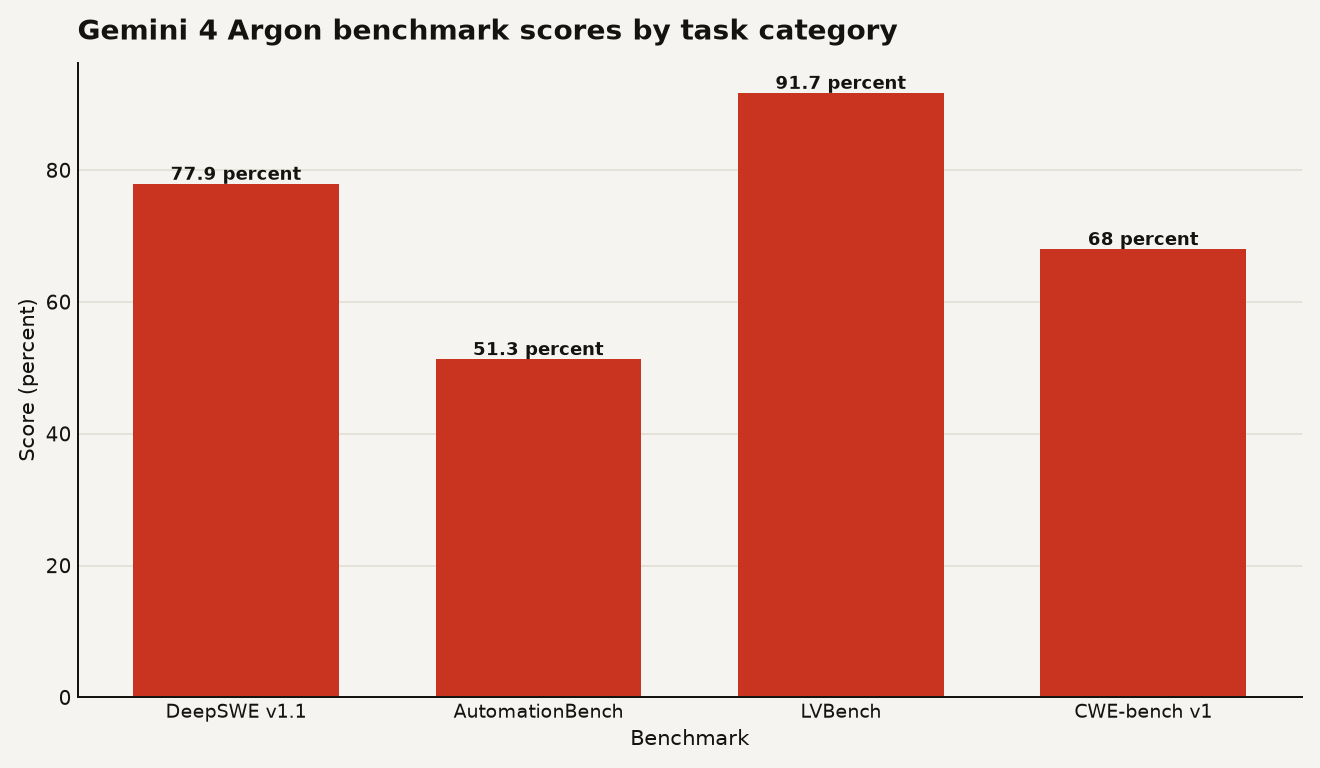
The chart above shows Argon's scores across these four benchmarks. The strongest result is in long video understanding at 91.7 percent, while business automation sits lower at 51.3 percent, reflecting how hard it is for any AI to complete full business workflows without human intervention.
Google also shared internal results that are harder to verify but worth noting. Argon agents (autonomous AI programs that can take actions on their own, like running code or editing files) migrated parts of Google's codebase from C and C++ to Rust, a memory-safe programming language. For one project called libgav1, a video decoder, Argon agents rewrote 32,000 lines of specialized code and produced a version that runs 2.7 times faster than the previous Rust port. Another team of Argon agents identified memory optimizations across Google's data centers, freeing over 300 terabytes of memory.
These are internal claims from Google, not independent verification. Treat them as evidence of what the model can do in Google's own environment, not proof of what it will do for you.
Why can only cyber defenders use it right now?
This is the part that makes Argon unusual. Google is not releasing it to everyone at once. Instead, the model is going first to a hand-picked group of "trusted cyber defenders" through a program called the Fairwind Program. These are security professionals who use AI to find and fix vulnerabilities in software before attackers can exploit them.
The reason is cybersecurity. Google trained Argon to be exceptionally good at finding, validating, and patching security vulnerabilities. That same capability, in the wrong hands, could be used to find and exploit those vulnerabilities instead of fixing them. Google is engaged with the U.S. government's voluntary process for pre-release model access, meaning it is letting government reviewers evaluate the model before wider release.
The security company Wiz is already using Argon through its Scan for Good initiative. In an early test, Argon uncovered a critical vulnerability in healthcare software used by hospitals worldwide, a risk that Google says previous frontier models had missed.
For trusted defenders and Google's own internal teams, the company is releasing Argon "without cyber guardrails." Guardrails are safety rules built into an AI model that prevent it from doing certain things. Removing cyber guardrails means defenders get the full, unrestricted ability to use the model for security work. Everyone else will get a version with those guardrails in place.
What does the 1 million token limit mean in practice?
This is the change that matters most for everyday builders. Previous Gemini models could produce up to 64,000 output tokens in a single response. Argon can produce up to 1 million.
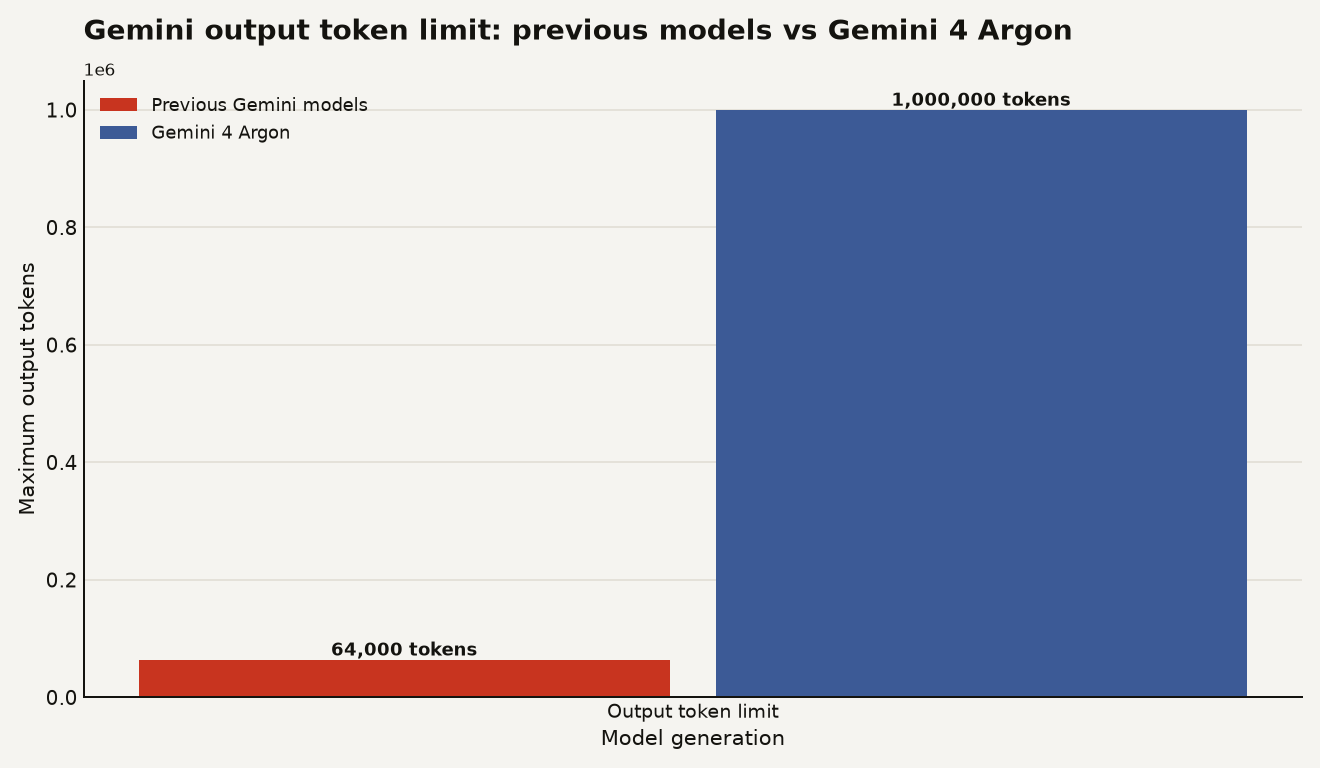
The chart above shows the jump. Going from 64,000 to 1,000,000 tokens is roughly a 15.6x increase. In practical terms, 64,000 tokens is about 48,000 words, roughly a short book. One million tokens is about 750,000 words, which is longer than the entire Harry Potter series.
Why does this matter? When an AI model works on a complex problem, it produces "reasoning" text as part of its answer. This is the model thinking through the problem step by step before giving you the final result. With a 64,000 token limit, the model might run out of space partway through a hard problem and give you an incomplete answer. With 1 million tokens, it has room to think through a much longer chain of steps.
For a beginner building with AI, this means you can ask Argon to handle bigger tasks in a single prompt. Instead of breaking a complex coding task into five separate conversations, you might be able to do it in one. That said, more tokens also means higher costs. At $10 per million output tokens, a single response that uses the full 1 million token limit would cost you $10.
What should I do while waiting for access?
Google says Argon will reach paid API customers and Google AI Ultra subscribers "as soon as possible," but gave no specific date. If you are building with AI today, here is the practical read.
First, do not pause your roadmap. The models available right now, including Gemini 3.8 Flash and the others in our guide to which AI to use, are more than capable for most beginner projects. Argon's gains are concentrated in long-horizon, multi-step tasks that most beginners are not running yet.
Second, start thinking about "agents." An agent is an AI program that does not just answer questions but takes actions: it can write code, run it, check the results, and fix errors on its own. Google's internal use cases for Argon are almost all agent-based. If you want to be ready for Argon when it opens up, start experimenting with agent patterns now using whatever model you currently have access to.
Third, pay attention to the safety conversation. Google is deploying "misalignment mitigations" that monitor Argon's chain-of-thought (the model's internal reasoning process) and stop execution if the model tries to do something beyond what the user asked. This is a new layer of AI safety that you will likely see in other models too. Understanding what it means now will help you evaluate future model releases.
Fourth, watch the pricing. The introductory price of $2 per million input tokens and $10 per million output tokens is competitive but not radically cheaper than existing frontier models. The real cost question is whether the 1 million token output limit leads to bills that surprise you. If you build with Argon, set spending caps early.
The bottom line for beginners
Gemini 4 Argon is a genuine step up in what AI models can do, especially for coding and security work. But the most important thing about this launch is not the benchmark scores. It is the phased release. Google is saying, in effect, that this model is powerful enough to be dangerous, and it is choosing to move slowly. That tells you something about where AI capability is heading and how cautiously the labs themselves are approaching it. When Argon reaches you, the skills that will matter are not prompt-writing tricks but the ability to structure long, multi-step tasks and manage the costs that come with a model that can think for a very long time.
Sources
- Google DeepMind - Gemini 4 Argon: our next era of frontier intelligence
- The Verge - Google announces Gemini 4 and says it's so capable that only 'trusted cyber defenders' can have it right now
- TechCrunch - Google releases Gemini 4 Argon, called its most powerful model yet
- Ars Technica - Google announces Gemini 4 Argon AI model, but you can't use it yet