The moment a coding agent starts looping through a codebase, your token bill stops looking like a software license and starts looking like a cloud compute invoice. That transition is now hitting the dashboards of teams that adopted GitHub Copilot over the past two years, and the numbers are large enough to force budget conversations that engineering leads did not expect to have in 2026. The core issue is Copilot billing shock: per-token costs reaching $0.07 for agentic operations, with invoices that scale with every autonomous decision an agent makes.
GitHub is layering spending limits, expanded credit allowances, and increasingly granular usage reporting onto Copilot, while Microsoft is reworking Visual Studio and VS Code to expose, and reduce, the cost of agentic development. The gap between what teams budgeted for AI assistants and what agents actually consume is the story. A team that paid $19 per user per month for autocomplete is now looking at per-request costs that compound with every file an agent reads, every test it runs, and every error trace it parses.
The sticker shock of agentic Copilot
The term describes the sticker-price moment when a team moves from linear AI costs (per-seat subscriptions) to variable, usage-driven costs (per-token agentic operations). Visual Studio Magazine reports that GitHub has begun implementing spending caps and metering tools specifically to address the budget surprises hitting enterprises that adopted Copilot at scale.
The mechanism is straightforward. Traditional Copilot autocomplete operates on a predictable per-user model. Agentic Copilot, which can autonomously navigate codebases, run commands, and iterate on solutions, operates on a per-token model. The cost per token varies by model and operation type, with the most expensive tier reaching $0.07 per token for complex agentic operations on enterprise tier models. A single agentic task can consume 15x the tokens of a simple autocomplete request, because the agent reads context, attempts solutions, reviews errors, and iterates.
The chart below shows how token consumption scales across different task types. Autocomplete is the baseline. Chat is roughly three times heavier. Automated pull request review consumes significantly more. The agentic loop, where the model works autonomously through multiple steps, is the outlier.
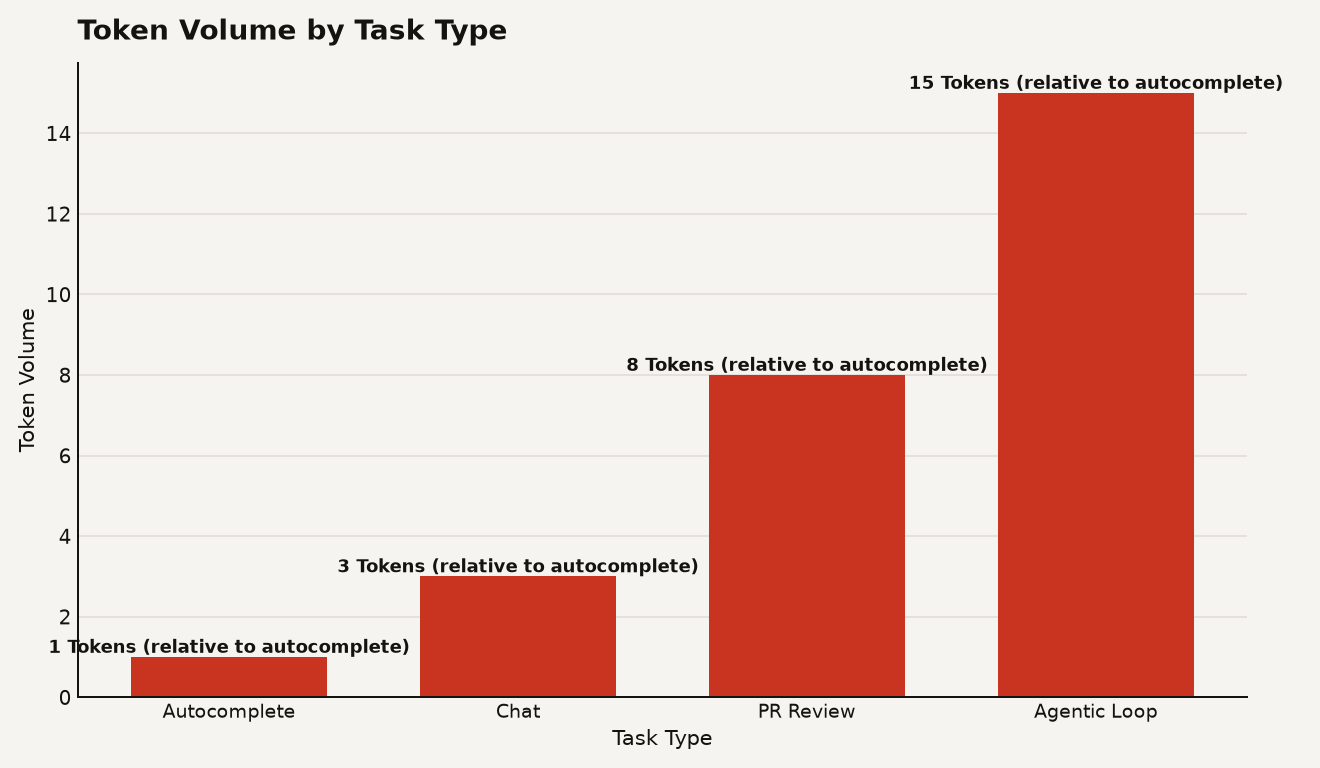
The multiplier matters because it converts a fixed cost into a variable one. A 50-person engineering team on a $19-per-seat plan was paying $950 per month, full stop. That same team running agentic workflows can generate hundreds of dollars in per-token charges in a single afternoon if multiple agents are running parallel tasks across a large monorepo.
GitHub's layered spending controls
GitHub is rolling out a multi-layered spending control system. The first layer is hard spending caps that cut off agentic operations when a defined threshold is reached, preventing runaway costs from a single looping agent. The second layer is expanded credit allowances for enterprise customers, which buffer the transition from subscription pricing to token-based pricing. The third layer is granular per-request reporting, exposed in the VS Code and Visual Studio UI, so developers can see the token cost of each agent action in real time.
Microsoft is also updating the IDE tooling itself. VS Code and Visual Studio are getting built-in features that expose token counts during development, with the goal of making the cost of each agentic decision visible before the invoice arrives. This is a meaningful shift. The AI compute cost gap that leaves 92 percent of enterprises flying blind on spend is exactly the problem these meters are built to close.
The reporting breaks down consumption by model, by operation type, and by user. A team lead can see which developers are running agentic workflows, which repositories are driving the most token consumption, and which models are delivering the most value per token spent. That last metric is the one that matters for procurement decisions. If a cheaper model handles 80 percent of agentic tasks at acceptable quality, routing only the hardest 20 percent to the premium tier changes the unit economics of the entire deployment.
Context windows drive the cost gap
The cost gap between autocomplete and agentic workflows comes down to context window usage and iteration count. Autocomplete predicts the next few lines of code based on the immediate context. It is a single forward pass, one request, one response. Agentic workflows are fundamentally different. An agent reads the repository structure, parses multiple files, plans an approach, writes code, runs tests, reads error output, and iterates. Each of those steps is a separate API call, and each call carries the accumulated context from previous steps.
A practical example: an agent tasked with fixing a flaky test might read the test file, read the implementation file, read the CI configuration, attempt a fix, run the test, see it fail, read the new error, attempt another fix, and run the test again. That is eight to twelve API calls, each carrying growing context. The token count compounds. By the third iteration, the agent is sending the entire conversation history plus the file contents plus the error logs with every call. The cost curve is not linear. It is exponential within a single task.
This is why the spending caps matter. An agent that gets stuck in a loop, retrying the same failed approach, can burn through an entire monthly budget in minutes. The risk is not theoretical. The long-task wall that agents hit on multi-step operations means that the hardest tasks, the ones where you most need agentic help, are also the ones most likely to spiral into token-consuming loops.
Set hard caps before enabling agents
The first move is setting hard spending caps before enabling agentic workflows broadly. The default should be conservative. Start with a cap that covers a week of expected usage, not a month, so you can observe actual consumption patterns before committing to a larger budget. The second move is routing. Not every task needs the most expensive model.
What this means for you, concretely:
- Set per-repository caps: Agentic workflows on large monorepos are the highest-risk spending category. Cap them first and tightest.
- Route by task complexity: Use cheaper models for autocomplete and simple chat, reserve premium tiers for tasks that require deep reasoning or multi-file refactoring.
- Monitor the agentic multiplier: If your team's token usage spikes 10x after enabling agentic features, that is the signal to review whether the agent is looping on failures.
- Build cost into your agent evaluation pipeline: The AgentLens trajectory review approach of scoring agents on quality alone is incomplete. Add token cost as a metric. An agent that produces a correct answer in 15 steps is not equivalent to one that produces the same answer in 5 steps.
- Watch for looping behavior: The most expensive failure mode is an agent that retries the same approach without changing strategy. Build a circuit breaker that kills the agent after N consecutive failed retries on the same error.
The third move is tooling. The VS Code updates that expose token counts during development are useful, but they are reactive. The meters show you what you spent, not what you are about to spend. For proactive cost control, you need a layer that estimates token cost before an agent begins a task, based on repository size and task complexity. That capability does not exist in the current GitHub stack. It is a gap in the market.
Per-seat pricing is on its way out
The trajectory is clear. Per-seat pricing for AI tools is going to disappear for any product that offers agentic capabilities. The usage-based model is the only one that aligns cost with value delivered, and GitHub is moving first because Copilot is the product where the billing shock is most acute. Other vendors will follow.
The open question is whether the tooling to manage these costs will come from the vendors themselves or from a third-party layer. GitHub has an incentive to build meters that keep customers inside their ecosystem, but the meters they build will always be Copilot-specific. A team using multiple AI tools across their stack, Copilot for code, a different agent for testing, another for documentation, needs a unified cost dashboard. That is a product opportunity.
The deeper risk is that cost pressure reshapes agent design. If the most expensive behavior is looping on failures, the most valuable optimization is not making agents smarter. It is making them give up faster. An agent that recognizes a dead end after two attempts and asks for human help is cheaper than one that retries ten times. The question is whether that cost optimization aligns with what users actually want from an AI assistant. The agent evaluation gap that already leaves half of enterprises shipping broken agents could widen if cost-driven design choices trade persistence for thrift.
The meter is the product
The teams that win with agentic coding will not be the ones with the best models or the smartest agents. They will be the ones with the tightest feedback loops between agent behavior and cost. GitHub is building those meters because it has to. The billing shock is real, the invoices are landing, and enterprise customers will not tolerate a tool whose cost is unpredictable. The meters and caps arriving now are the first iteration of what will become a standard layer of AI infrastructure. Every agentic product will need them. The question is whether they come from the vendor or from a third party that can see across the whole stack. The answer to that question is a business decision, not a technical one.