In September 2026, OpenAI announced Sponsored Agents for ChatGPT ads, a format that lets users click an ad and start a conversation with a business-sponsored AI agent. The company also launched a self-serve Ads Manager, CPC bidding, and integrations with Shopify and HubSpot. The ad platform now covers the full funnel: creation via natural-language prompts, delivery via CPC and CPM bidding, and conversion tracking via Conversions API and pixel-based measurement.
The move comes after our earlier reporting found that one third of ChatGPT ads land in the wrong conversation context, raising questions about ad relevance in a conversational interface. Sponsored Agents attempt to solve this by making the ad itself a conversation, rather than a static placement.
What are Sponsored Agents and how do they work?
Sponsored Agents are a new ad format where, after seeing a relevant ad in ChatGPT, a user can choose to start a conversation with a business-sponsored AI agent. The agent can answer questions about the product, provide personalized recommendations, and link to the business's website when the user is ready to take action. The conversation is clearly labeled as sponsored and is separate from ChatGPT's own responses.
For businesses, this means that an ad click can lead to a multi-turn conversation rather than a one-way landing page visit. OpenAI is testing the format with select advertisers in the United States as of September 2026.
The key technical detail is that the Sponsored Agent conversation runs on OpenAI's infrastructure, not the advertiser's. The business provides the agent's knowledge base and configuration, but OpenAI's ads system controls delivery decisions. Advertisers do not have access to individual conversations; they receive only aggregated, non-identifying performance data.
How does the self-serve Ads Manager change who can buy?
OpenAI's beta self-serve Ads Manager lets advertisers sign up, set budgets and bids, upload ads, and view performance without going through a partner. The company says it is gradually opening the tool to more businesses, from SMBs to global brands.
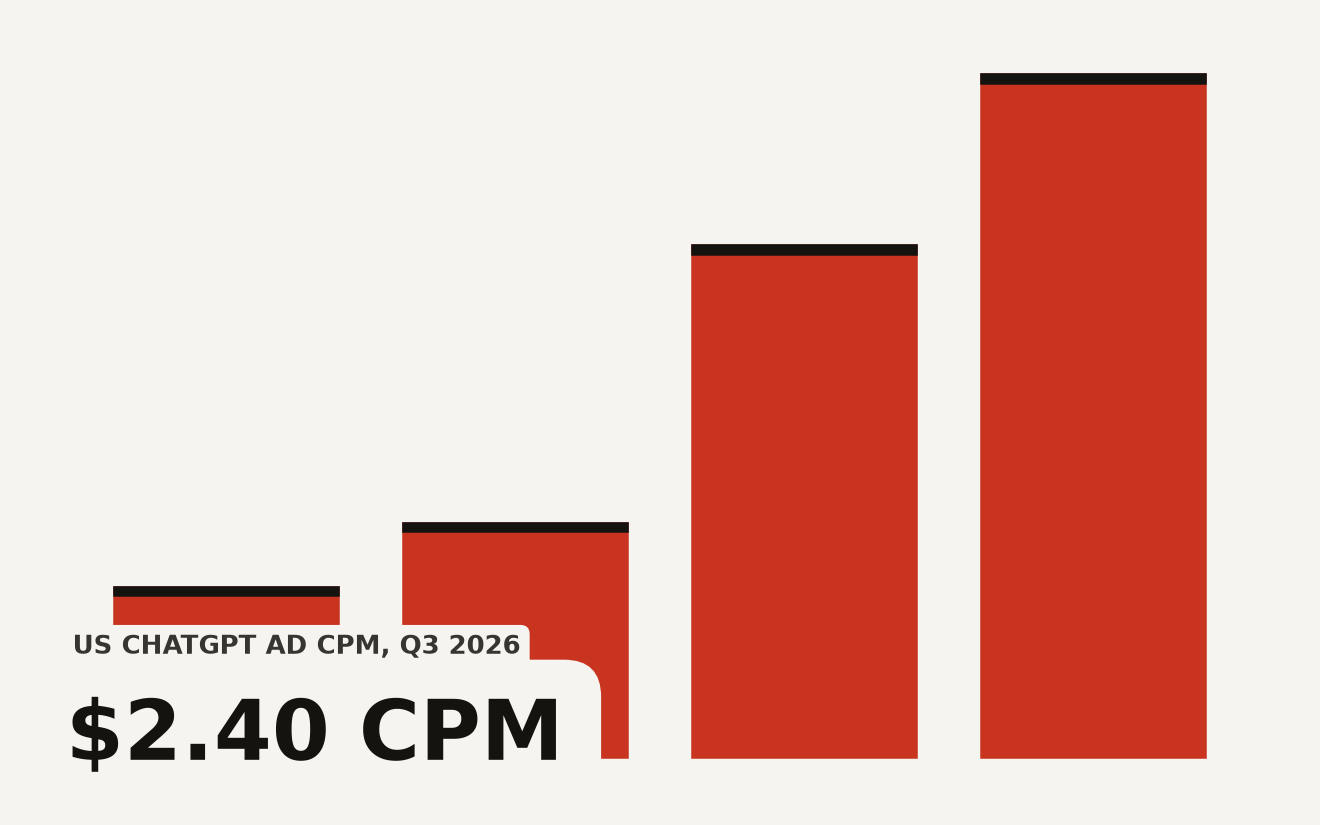
The Ads Manager supports both CPM (cost-per-mille) and CPC (cost-per-click) bidding. CPC bidding is a meaningful addition because, as OpenAI notes, many ChatGPT conversations are active and decision-oriented: people are comparing options or deciding what to do next. A click in that context is a stronger intent signal than an impression.
Advertisers can also use the Ads Manager plugin within ChatGPT to create and manage campaigns using natural-language prompts. According to OpenAI product team member Zoheb Hajiyani, the new campaign onboarding experience can build a campaign in under 60 seconds: an advertiser inputs their website URL, the model analyzes the business objective and product lineup, generates ad creative and copy, and suggests which ChatGPT user journeys the ad should surface in.
What do the Shopify and HubSpot integrations actually do?
The Shopify integration lets US-based merchants create and manage ChatGPT ad campaigns through a ChatGPT Ads app in the Shopify App Store. Products are synced through Shopify Catalog, so merchants can start running ads without manual product feeds. The app will be available internationally in markets where ChatGPT Ads are available starting September 23, 2026.
The HubSpot integration lets businesses connect a ChatGPT Ads account, create ads, track performance, and follow up on leads directly in HubSpot. This is OpenAI's first CRM partner integration.
For developers, OpenAI also offers an Ads API that can programmatically create ad campaigns and retrieve performance data. The API uses a standard structure: campaigns contain ad groups, ad groups contain ads, and ads use a chat_card creative type with title, body, target URL, and optional image asset.
Why does conversational advertising matter for builders?
If you build commerce, marketing, or CRM tools, the Sponsored Agents format changes the unit economics of customer acquisition. Instead of paying for a click that sends a user to a landing page, you are paying for a conversation that can handle qualification, objection handling, and recommendation in a single session. The cost per acquisition could drop if the agent can convert better than a static page, or it could rise if users bounce from sponsored conversations the way they bounce from sponsored search results.
The earlier Data Today analysis found that one third of ChatGPT ads miss the conversation context, which means the ad relevance problem is real. Sponsored Agents could fix this by making the ad itself contextual, but they also introduce a new failure mode: a sponsored agent that gives bad answers could damage brand trust faster than a bad landing page.
Here is what this means for you:
- If you run an ecommerce store on Shopify, you can now buy ChatGPT ads with product catalogs already synced. The friction of setting up a new ad channel drops significantly. Watch your CPC and conversion data closely in the first 30 days.
- If you build CRM workflows, the HubSpot integration means ChatGPT ad leads can flow into your existing pipeline without custom API work. But the leads from a Sponsored Agent conversation will look different from a form fill: they will be conversational intent signals, not structured fields.
- If you build AI agents for businesses, Sponsored Agents create a new deployment target. You will need to design agents that can handle product-specific Q&A, objection handling, and conversion within the constraints of OpenAI's ad delivery system.
- If you manage ad budgets, the shift from CPM to CPC bidding means you can now optimize for clicks rather than impressions. But the real question is whether ChatGPT ad clicks convert better than search or social. There is not enough public data yet to answer that.
What are the risks and open questions?
The biggest risk is ad relevance. If Sponsored Agents surface in the wrong conversation context, the experience will feel intrusive. OpenAI's Help Center documentation says ads consider multiple signals including conversation context, ad landing page, and advertiser-provided targeting selections, but the company has not published relevance or quality metrics.
Privacy is the second risk. OpenAI says it does not share conversations with advertisers and only provides aggregated performance data. But the more personalized the Sponsored Agent experience becomes, the more pressure there will be on the boundary between conversation data and ad targeting data. Users who see ads that feel too relevant may question whether their private conversations are being used for targeting, regardless of what the policy says.
The third risk is brand safety for advertisers. A Sponsored Agent is a business-branded AI conversation. If the agent gives inaccurate product information, makes inappropriate recommendations, or hallucinates pricing, the business is on the hook. OpenAI's ad system controls delivery, but the business controls the agent's knowledge base. The liability split is unclear.
What should builders watch next?
Watch the CPC data. OpenAI has not published benchmark CPCs for ChatGPT ads, and the pricing will vary widely by category and geography. If you are an early advertiser, track your cost per click and cost per conversion against your existing channels. The first 90 days of CPC bidding data will tell you whether ChatGPT ads are a viable performance channel or a brand awareness play.
Watch the Sponsored Agent conversation quality. If you are testing the format, monitor the conversations for hallucinations, irrelevant answers, and user drop-off rates. A Sponsored Agent that cannot answer basic product questions will cost you customers, not acquire them.
Watch the Shopify and HubSpot integration adoption. If merchants and CRM users adopt ChatGPT ads through these integrations at scale, OpenAI's ad platform gains a distribution channel that does not depend on advertisers coming to ads.openai.com directly. That is the path to real ad revenue.
Watch for the Ads API to evolve. The current API supports campaign creation and performance retrieval. If OpenAI adds agent management endpoints, the Sponsored Agents format becomes programmable at scale, and the agent-building ecosystem gets a new platform.
The real test is conversion
OpenAI has built the infrastructure for an AI-native ad platform: self-serve buying, CPC bidding, CRM and ecommerce integrations, and a conversational ad format. The pieces are in place. What is missing is the proof that conversational ads convert better than the alternatives. Until advertisers can see cost-per-acquisition data that beats their existing channels, ChatGPT ads remain an experiment with good infrastructure and an unanswered question.