OpenAI announced it solved the Navier-Stokes Millennium Prize problem this week using 10,000 AI agents, tens of millions of dollars in compute, and 88 hours of wall-clock time. The mathematical world is buzzing, but not about the proof. The announcement triggered accusations from an NYU professor that OpenAI raced him to the solution after learning of his progress, potentially benefited from his interactions with OpenAI's own coding tools, and then offered him sole authorship if he would cut his Anthropic-employed collaborator from the paper. The episode has exposed a prompt data privacy gap that should worry anyone building proprietary work on top of AI APIs. If your prompts, your code, and your research conversations flow through an AI company's servers, can that company use what it learns to compete with you? OpenAI says no. The mathematicians are not so sure.
What happened between OpenAI and the mathematicians?
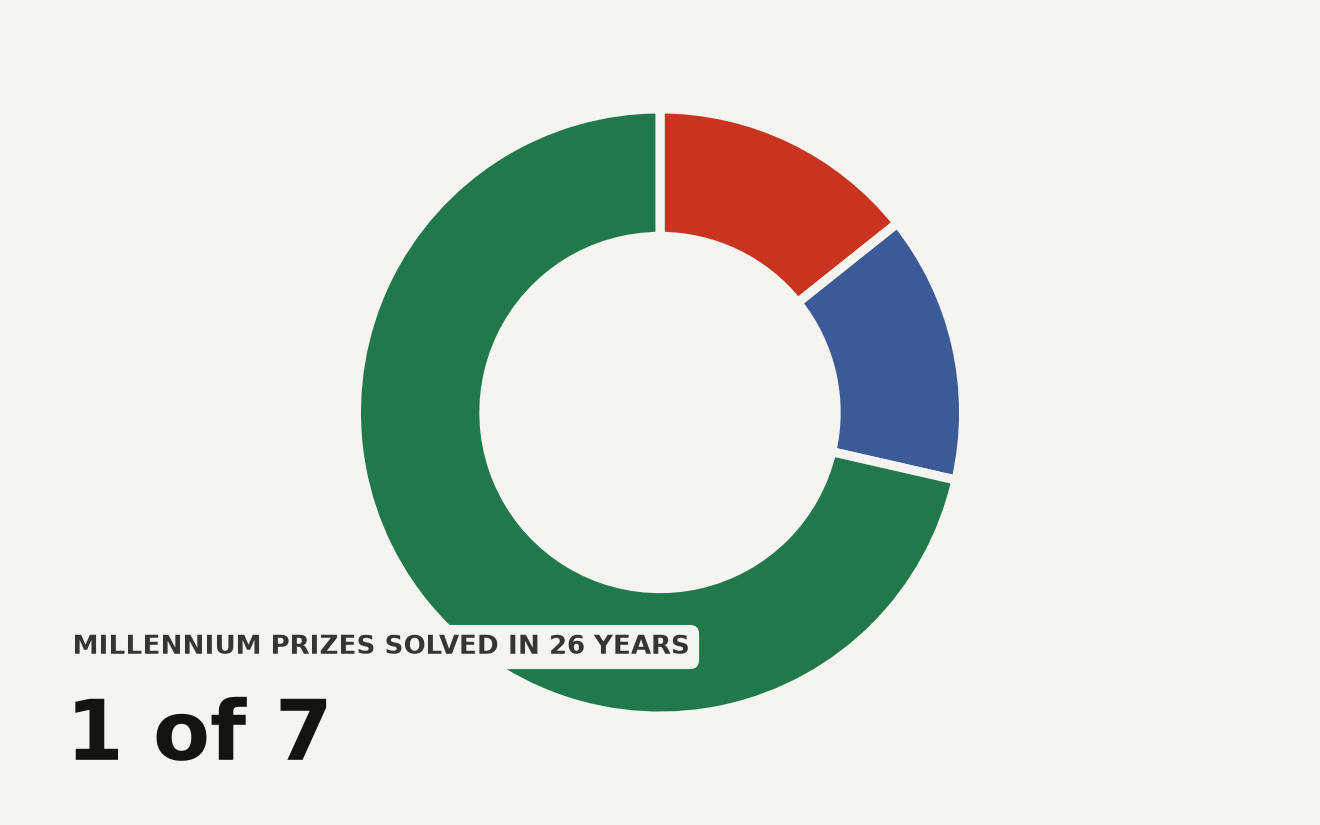
The Clay Mathematics Institute established seven Millennium Prize problems in 2000, each carrying a $1 million bounty, as The Verge reported on September 12, 2026. Only one, the Poincare conjecture, has been solved in the 26 years since, when Grigori Perelman completed the proof in 2002. Navier-Stokes, which concerns the mathematical behavior of fluid flow, has stood open since the equations were formulated in the 1800s.
OpenAI says it heard researchers were making progress on Millennium Prize problems and decided to test whether its unreleased models could crack one. The result: roughly 10,000 agents, tens of millions of dollars of compute, and 88 hours to produce a solution. The company had also discovered who it was racing against: Tristan Buckmaster, an NYU mathematics professor, and Levent Alpoge, a researcher at Anthropic. The pair had been working on Navier-Stokes independently, using a mix of AI tools including OpenAI's Codex. They had not yet completed a proof.
When Buckmaster learned OpenAI was also pursuing the problem, he contacted the company. Conversations with OpenAI researcher Sebastien Bubeck turned contentious. Buckmaster says Bubeck offered him practically unlimited compute to finish his own proof, plus sole authorship of OpenAI's paper, on one condition: Alpoge's name would be removed because he worked at Anthropic, OpenAI's rival. "All I had to do was throw Levent under the bus," Buckmaster told The Verge. He refused and called the offer a bribe.
Bubeck acknowledged the offer in an interview with The New York Times, framing it as assistance. He also said OpenAI had made similar arrangements with other mathematicians, though he did not name them. "From our perspective, how can we have an internal OpenAI project with an Anthropic employee?" he said.
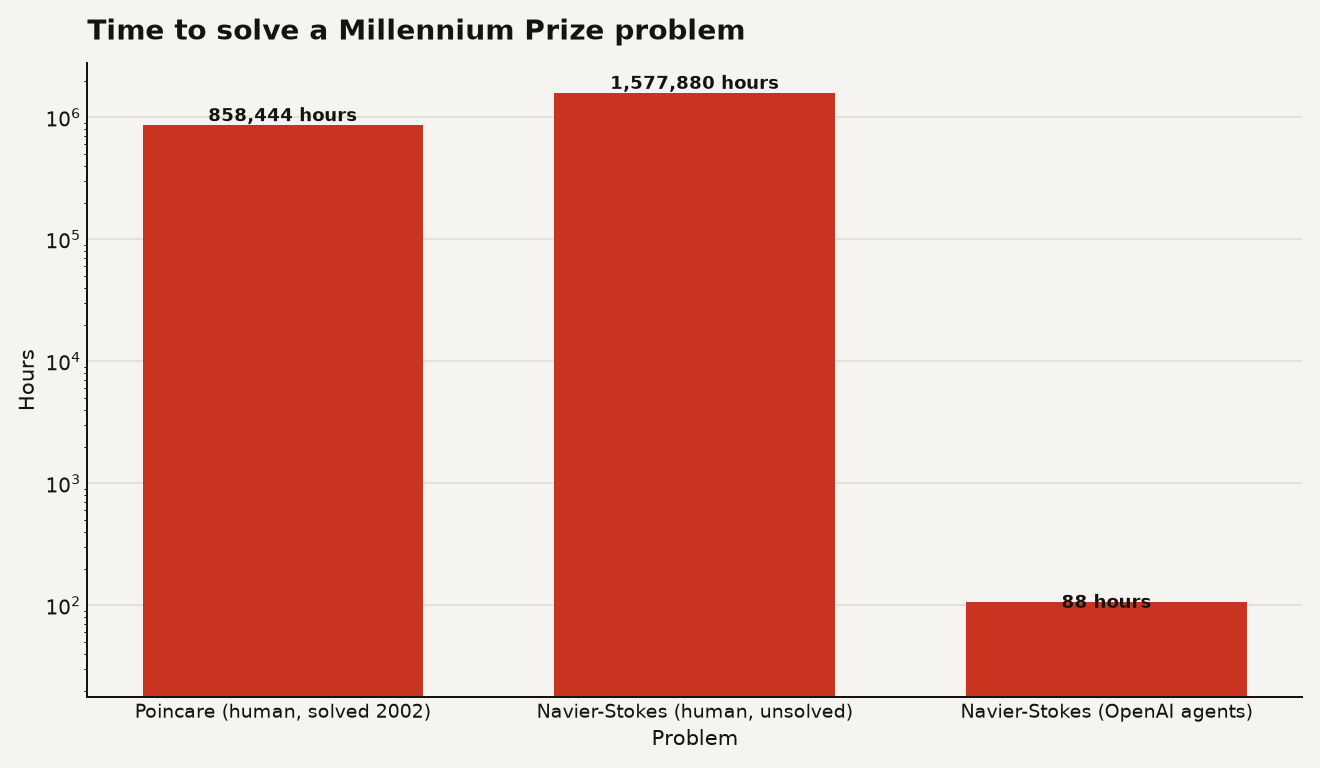
The chart below shows how the time to solution compares across Millennium Prize problems: Poincare took 98 years of human effort, Navier-Stokes remains unsolved by humans after 181 years, and OpenAI claims an 88-hour agent solution.
The more serious allegation concerns data. Buckmaster had been using OpenAI's Codex to work on Navier-Stokes. He asked OpenAI whether agents or models had accessed transcripts of his work. The company denied that anyone accessed his specific user data but, until its most recent statement, acknowledged it could not rule out that data derived from his use of the products was used to improve the model. OpenAI spokesperson Laurance Fauconnet later told The Verge: "We can say categorically that it is impossible for Dr. Buckmaster's Codex prompts over the last two months to have influenced the system in any way, including training."
Buckmaster remains unconvinced. "Given their behavior up until this point, one should take such statements with great skepticism," he said.
Andreas Thom, a professor at the Technical University of Dresden, experienced a parallel situation last month. MIT Technology Review reported that OpenAI announced a result building heavily on work by Thom and his colleague Gabor Kun, then quietly amended its announcement to acknowledge their contribution without any public disclosure of the change. Thom told The Verge he suspects OpenAI may not even know whether ChatGPT conversations he and his colleagues had about their research fed into the models that produced the competing result. "To be honest, I suspect that they don't even know," he said.
Can your prompts train the models that compete with you?
This is the question that should keep you up at night if you are building anything proprietary on top of an AI API.
Buckmaster's situation is a concrete instance of a problem every builder faces. He typed his research into Codex. OpenAI's servers processed it. OpenAI then produced a competing solution to the same problem using its own models. Whether there was a direct pipeline between those two events is disputed, but the architecture makes it possible in a way that was never possible before.
OpenAI's data retention policies have evolved. The company has expanded zero data retention for its frontier models, which means enterprise customers can prevent their prompts from being used for training. But this protection is not universal, not retroactive, and not the default for every product. Codex, the tool Buckmaster was using, sits in a gray zone. OpenAI's initial inability to rule out prompt data use is telling.
OpenAI's own announcement of the Navier-Stokes solution denies that Buckmaster's prompts influenced the result. But the denial came only after the controversy went public. Before that, the company could not give a definitive answer.
For a builder, the stakes are concrete:
- Your proprietary code and research prompts could inform a model that a competitor later uses. If you are debugging a novel algorithm in an AI coding assistant, the patterns in your debugging session could, in principle, surface in the model's next iteration.
- Zero-retention agreements may not cover every product. If you are using a newer or experimental tool, the data policy may be different from what your enterprise agreement specifies for frontier models.
- You may never know if your data was used. Thom's observation that OpenAI itself may not know what flowed into training is the most unsettling detail. If the company cannot audit its own data pipeline, neither can you.
The parallel to the disputes between writers, artists, and AI companies is direct. Writers argue their copyrighted work was ingested without consent to train models that now compete with them. Mathematicians are discovering the same dynamic with their intellectual labor, as The Guardian reported on September 12, 2026. The difference is that mathematicians are feeding their work to AI tools voluntarily, often without realizing the competitive implications.
What does industrial-scale scooping mean for your roadmap?
The business consequence is straightforward. If you are a startup using AI tools to develop proprietary methods, your competitive moat may be thinner than you think. The AI company providing your tools can see your work, may be able to learn from it, and has the resources to replicate it at a scale you cannot match.
OpenAI deployed 10,000 agents and spent tens of millions of dollars to solve Navier-Stokes in 88 hours. A startup cannot match that compute budget. The asymmetry goes deeper than raw compute, though. The company providing your tools has a structural advantage: it sees what you are working on, it can infer which approaches are promising based on the patterns in your prompts, and it can direct resources toward the problems you are solving.
TechCrunch reported that Buckmaster and Alpoge's findings, made using both Codex and Claude, are significant in their own right. But the controversy has overshadowed the mathematics. The conduct is what builders need to pay attention to.
Here is what this means for your roadmap:
- Assume your prompts are not private unless you have a specific zero-retention agreement in writing for the exact product you are using. OpenAI's enterprise zero data retention is available for frontier models, but it does not automatically extend to every product in the portfolio.
- Segregate your most sensitive work. If you are developing a novel algorithm or method, do not put the details into an AI coding assistant unless you have verified the data retention terms. Use local models or air-gapped environments for the parts of your work that constitute your moat.
- Watch for the pattern, not just the incident. The Buckmaster case is one example. Bubeck said OpenAI has made similar arrangements with other mathematicians. Thom had his own experience. This is a systemic pattern in how AI companies operate.
- Consider the chilling effect on your own research agenda. Several mathematicians told The Verge that colleagues are reconsidering whether to publish lists of important unsolved problems, fearing they would become targets for AI companies. If you are building in a space where AI labs are also active, ask whether publishing your roadmap helps you or helps them.
The broader question is whether the AI tooling market can function when the tool provider is also a competitor. Anthropic, OpenAI, and Google all build AI products and also sell AI APIs. If you are building on one of their APIs, you are handing your work to a potential competitor.
What should you watch and what bets make sense?
The Navier-Stokes case may be a preview of how AI companies approach any field where prestige and proof of capability matter. OpenAI heard a rumor that mathematicians were close to a solution, redirected 10,000 agents, and produced a result in 88 hours. That is industrial scooping.
ABC News reported that Buckmaster now questions whether racing to solve math problems is pointless when AI can perform work that previously occupied researchers for years. That question generalizes. If AI companies can scoop your research in 88 hours, what is the point of racing them?
What to watch:
- Whether OpenAI's Navier-Stokes solution survives peer review. The company has posted it publicly, but the Clay Mathematics Institute has not yet awarded the prize. The Poincare conjecture took years of verification before the prize was accepted.
- Whether other AI labs adopt the same playbook. If OpenAI can solve a Millennium Prize problem in 88 hours, Google DeepMind and Anthropic will face pressure to match or exceed the result.
- Whether the mathematical community formalizes norms around AI tool use. Several mathematicians are already calling for clearer rules about disclosure and attribution.
- Whether regulators take note. The data privacy questions raised by this case are not specific to mathematics. Any company using AI tools for proprietary work faces the same exposure.
The bets worth making: AI companies will continue to target high-profile problems for marketing value. The compute cost of these demonstrations will keep dropping. The trust gap between users and AI providers will widen before it narrows. The mathematical community will become more secretive, not less.
The bet not worth making: that OpenAI's categorical denial about prompt data use will satisfy skeptics. The company's initial inability to rule out the possibility, followed by a definitive statement only after public pressure, is the kind of sequence that erodes trust rather than restoring it.
The real cost of winning
OpenAI spent tens of millions of dollars to win a $1 million prize. The point is the demonstration: our models can solve the hardest problems in mathematics, and they can do it faster than you. The marketing value of a Millennium Prize solution exceeds the prize by orders of magnitude.
But the cost is not measured in dollars. It is measured in trust. Every builder who puts proprietary work into an AI tool now has to ask whether that work could resurface in a competing product. OpenAI's answer is no. The evidence, including the company's own initial uncertainty, says maybe. For a field that depends on open collaboration and shared knowledge, "maybe" is corrosive. For a builder whose competitive advantage depends on what they type into an AI assistant, "maybe" should be a firewall.