Open an assistant, ask a question, and the assistant may answer with a recommendation. Now pay to be that recommendation. Except in ChatGPT, your ad might end up next to a conversation about something else entirely. Two studies released in August 2026 find ChatGPT ads appear frequently but miss the mark, with roughly one third of all ads landing in irrelevant conversations. For any brand thinking ChatGPT ads are a shortcut to AI visibility, the data says the opposite: paid placement and organic answer citations are separate systems, and one does not buy you the other.
ChatGPT launched its advertising business in February 2026, and by the summer it was already serving sponsored placements on commercial prompts at a rate approaching Google's own AI search results. Denise Dresser, then OpenAI's chief revenue officer, said in June that the rate at which users dismiss ads inside ChatGPT had fallen by half since launch, and the company treats dismissals as its proxy for relevance. Two independent analyses of ad volume and relevance suggest the real picture is more complicated. SE Ranking tested 50,006 commercial prompts and found ads on 25.94% of them, close to the 29.45% ad rate it previously measured for Google's AI Mode. Searchable, an AI visibility platform, analyzed more than 11,000 ads served inside real ChatGPT conversations between 4 July and 4 August 2026, and graded how closely each advertised product matched what the user was actually asking about.
Three relevance bands for ChatGPT ads
Searchable's analysis assessed every ad according to one of three relevancy bands: direct match, contextual match, or unrelated. The results were rough for advertisers hoping for precision. A direct match, where the ad promoted the specific product the user was asking about, happened only 27% of the time. The largest group, 40%, were contextual matches, connected to something the user had raised earlier in the thread but not to the question in front of them. The remaining 33% were unrelated, with no connection to the conversation at all.
The SE Ranking study, which used semantic similarity scoring against a random baseline, found a lower but still significant mismatch rate of 14.35% across its 50,006-prompt dataset. The discrepancy between 33% and 14.35% comes down to methodology: Searchable graded relevance in conversation context, while SE Ranking measured whether an ad was no more related to its prompt than a random pairing. Searchable's 33% includes ads that were off-topic for the immediate question but might have touched on an earlier thread topic, whereas SE Ranking's stricter test only flagged ads that were as irrelevant as a random match. Taken together, the studies suggest that between one in seven and one in three ChatGPT ads are reaching the wrong conversation.
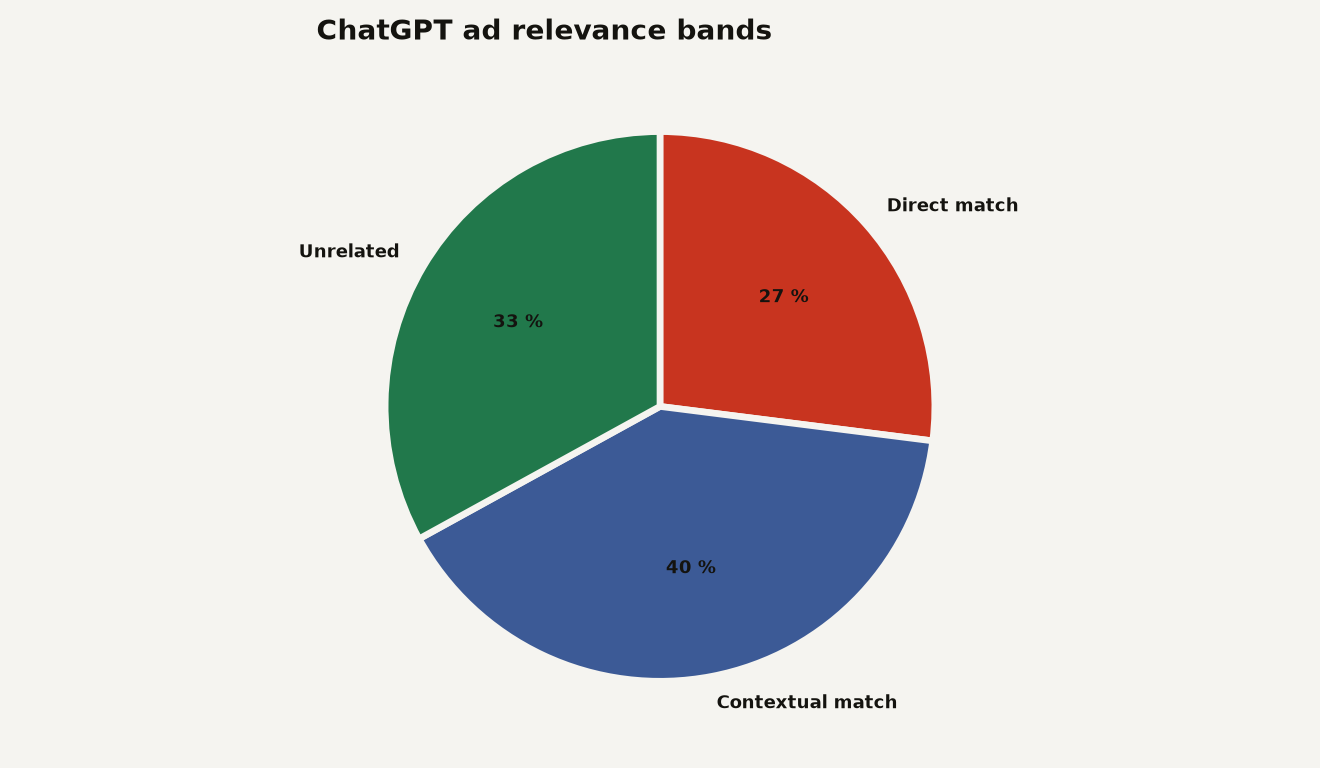
Searchable's data shows the largest single band is contextual match at 40%, meaning the ad connected to something raised earlier in the thread but not to the current question. Direct matches accounted for 27%, and unrelated ads made up the remaining 33%, as shown in the chart above. No single band reached a majority.
The problem varied considerably by category. Searchable found that 47% of marketing and B2B services ads and 45% of software and SaaS ads were unrelated, the two worst rates of any sector measured. SE Ranking found that in niches like Relationships and News and Politics, more than 50% of ads were off-topic. The best-performing sectors in Searchable's data were data brokers and background checks at 50% direct relevance, travel at 43%, and automotive at 42%. No sector managed a direct relevancy match for ads more than half the time.
Conversational targeting misses without keywords
The core issue is that ChatGPT ads do not use conventional keyword targeting. In paid search, the advertiser picks the keywords that signal a buyer. ChatGPT's ad platform works with what OpenAI calls context hints: natural-language descriptions of the conversations, situations, and topics where an advertiser wants to appear, alongside keyword-style phrases. Those signals guide the matching system rather than acting as strict targeting rules.
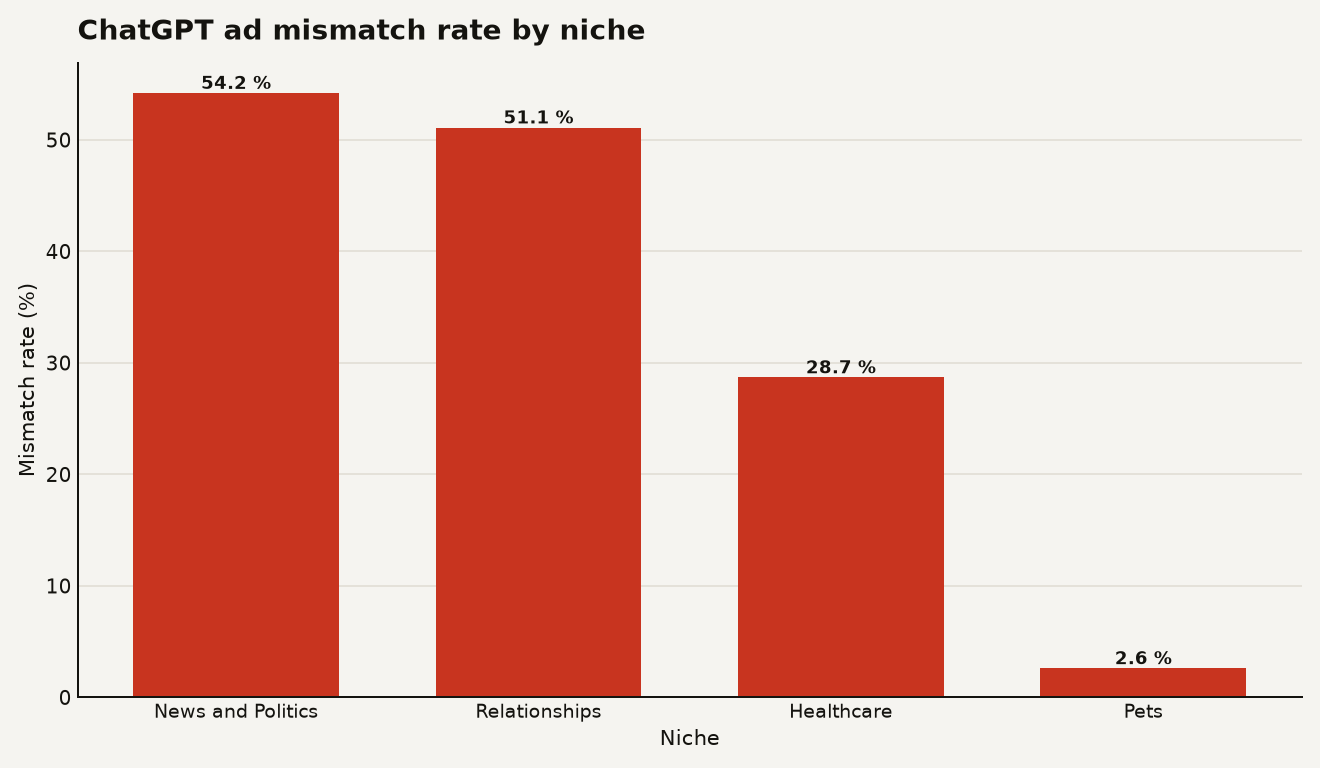
SE Ranking's data on off-topic ad rates by niche is shown in the chart above. Relationships had the highest mismatch rate at 51.1%, followed by News and Politics at 54.2%. Pets had the lowest at 2.6%, and Healthcare sat at 28.69%.
The platform is also opaque. Advertisers cannot see the specific queries or conversations where their ads appeared, making it harder to diagnose irrelevant placements. The system may find a broad semantic connection even when the product is not a strong fit for the user's actual request. A user asking about a relationship argument gets a Hungryroot ad, and the system sees a loose thread about eating habits from three turns ago.
This matters because ChatGPT is an AI engine that people also use to write, study, troubleshoot, and think through problems. Searchable found that 68% of ads appeared in conversations where the user showed no sign of wanting to buy, book, hire, or compare anything, at any point in the thread. Counted by conversation rather than by ad, 40% of ad-carrying chats contained at least one ad unrelated to the discussion, and in 28% every ad served was unrelated.
Paying for an ad does not buy the answer
No. This is the finding that should reframe how every brand thinks about ChatGPT advertising. SE Ranking found that the advertiser's domain appeared among the cited sources in just 3.63% of placements, the exact advertised URL appeared in citations only 0.09% of the time (12 cases out of 12,974), and a simple brand mention showed up in just 4.44% of answers. In 96.37% of placements, the advertiser was not cited among the sources used in the answer above the ad.
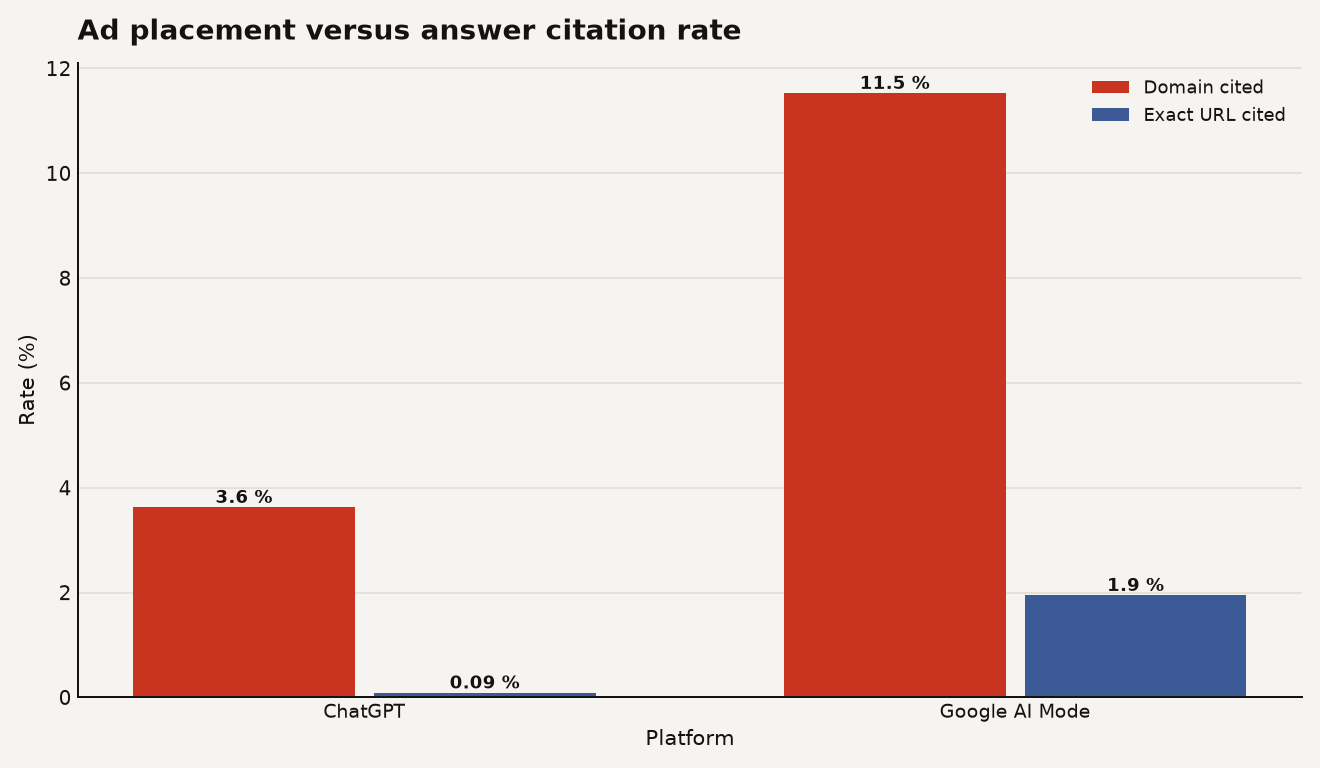
SE Ranking's comparison of ad placement versus answer citation is shown in the chart above. Google's AI Mode cited the advertiser's domain in 11.53% of cases and the exact URL in 1.95%. ChatGPT cited the advertiser's domain in 3.63% of cases and the exact URL in just 0.09%.
The overlap is also lower than in Google's AI Mode, where advertiser domains appeared among cited sources in 11.53% of cases and exact URLs in 1.95%. The conclusion is stark: buying a ChatGPT ad does not appear to make a brand significantly more likely to feature in the AI-generated response. The sponsored card is a paid-media placement, separate from the organic answer generation system. Being cited or mentioned is an AI visibility and content authority challenge, as we explored in our independent data on how people use AI.
There is a structural reason for the separation. OpenAI only shows ads to users on Free and Go plans. Paid plan users see no ads at all. If some of your best prospects fall into that group, organic answer engine optimization (AEO) is the only way to reach them inside ChatGPT by earning mentions and citations in the answer itself. Ad spend cannot reach them.
Treat ChatGPT ads as a separate channel
If you are testing ChatGPT ads, treat them as a separate channel with different rules. The studies point to several concrete adjustments.
-
Separate ad spend from AI visibility work. In 96.37% of placements, the advertiser was not cited among the answer's sources. Do not expect ad spend to improve your visibility inside ChatGPT's organic answer. The sponsored card is a paid-media placement; being cited or mentioned is a content authority challenge.
-
Treat context hints as experiments. You are not targeting exact search queries. You are describing the conversations you want to appear in. Write multiple versions of context hints, test them, and treat the ad platform as a black box you are probing. Advertisers cannot see the specific conversations that triggered their ads, so iteration is the only diagnostic tool.
-
Budget for low commercial intent. Searchable found 68% of ads appeared in conversations with no purchase intent. Your CPA calculations from paid search will not translate. Expect more impressions, fewer sign-ups, and adjust your bidding accordingly. SE Ranking's own ad campaigns generated more than 97,000 impressions and 1,263 clicks with an average CTR of 1.30%, but very few sign-ups.
-
Watch sector mismatch rates. If you are in marketing and B2B services (47% unrelated) or software and SaaS (45% unrelated), expect a large share of wasted impressions. If you are in travel, automotive, or data services, relevance is better but still below 50% direct match.
The gap between placement and answer
The promise of advertising inside an AI assistant is that the assistant already knows what the user wants, so ads can be more relevant than search. The data says that promise is still unmet. A third of ads land in the wrong conversation, and even when they land in the right one, they almost never make it into the answer the user actually reads. For builders and marketers, the takeaway is to treat ChatGPT ads as a distinct, early-stage channel, and to invest in answer engine optimization as the real moat. The ad gets you a card below the answer. The citation gets you into the answer. Those are two different games, and only one of them scales to every user, including the ones who never see an ad.