Apple just made the most consequential AI partnership of the year, and almost nobody outside of Beijing and Cupertino is talking about what it means for the rest of us. The company has trained a custom large language model for the China market with direct support from Alibaba, according to Reuters, citing three people familiar with the matter. This is not a wrapper around someone else's API. Apple built its own model on Chinese infrastructure, with a Chinese partner, to satisfy Chinese regulators, and it is about to ship it to the largest smartphone install base in the world.
China's cyberspace regulator registered Apple Intelligence for on-device use on iPhones in July 2026, clearing the biggest regulatory hurdle for a rollout that sources say will arrive in the coming months alongside an iOS update. Alibaba confirmed to Reuters that its Qwen model will be integrated across iOS, iPadOS, macOS, and visionOS for Chinese users, handling text and image understanding and generation. Baidu is also contributing, a Baidu spokesperson told TechCrunch, though its exact role remains less defined. Apple did not respond to requests for comment.
The headline number: Apple would become the first US company approved to offer a proprietary AI model in China. That is the stakes. Everything else follows from it.
Apple's China model, trained with Alibaba
The core fact, per Reuters, is that Apple trained a China-focused large language model in partnership with Alibaba, using Alibaba's infrastructure and expertise. This is a meaningful shift from Apple's earlier strategy, which leaned on domestic Chinese models as drop-in replacements for the OpenAI ChatGPT integration that powers Apple Intelligence in every other market.
Alibaba's Qwen models will be deeply integrated into Apple Intelligence experiences across Apple's four Chinese operating systems, Alibaba said in a statement to Reuters. The scope includes both text and image understanding and generation. Baidu is also in the mix, with a Baidu spokesperson confirming to TechCrunch that it is working with Apple on Apple Intelligence features for Chinese users, though the specific division of labor between Alibaba and Baidu has not been publicly detailed.
For builders, the architecture matters. Apple is not routing Chinese user queries to a cloud-hosted Qwen endpoint. The registration with the Cyberspace Administration of China covers an on-device generative AI service, which means the model runs locally on Apple silicon inside iPhones, iPads, and Macs sold in China. Alibaba's contribution appears to be in training and regulatory navigation, not inference hosting. That distinction shapes everything from latency to data residency to how Apple handles content filtering requirements under Chinese law.
China's registration rules for LLMs
China requires companies to register large language models and generative AI services with regulators before making them available to the public. The Cyberspace Administration of China, the country's internet content regulator, announced the registration on July 15, 2026, according to Reuters. The regulator's statement did not give a launch date, but approval typically precedes a rollout by only a few months, as MacRumors noted, putting a China Apple Intelligence launch roughly in line with Apple's usual fall software release cycle.
The timing is not accidental. Apple Intelligence debuted in 2024 in other markets, and its absence in China has been a visible gap. Chinese smartphone competitors like Huawei and Xiaomi have been shipping on-device AI features for over a year. Apple's share of the China smartphone market has been under pressure, though the company regained the number two position after a recent shopping festival. The longer Apple waited, the more ground it ceded.
China's regulations also grew stricter. As we have covered in our reporting on EU AI Act transparency rules, governments are moving from principles to enforcement. China's approach is more direct: no registration, no market access. Apple's choice to build a custom model with a domestic partner, rather than try to import its US-trained models, reflects the reality that the model layer is now a regulatory artifact, not just a technical one.
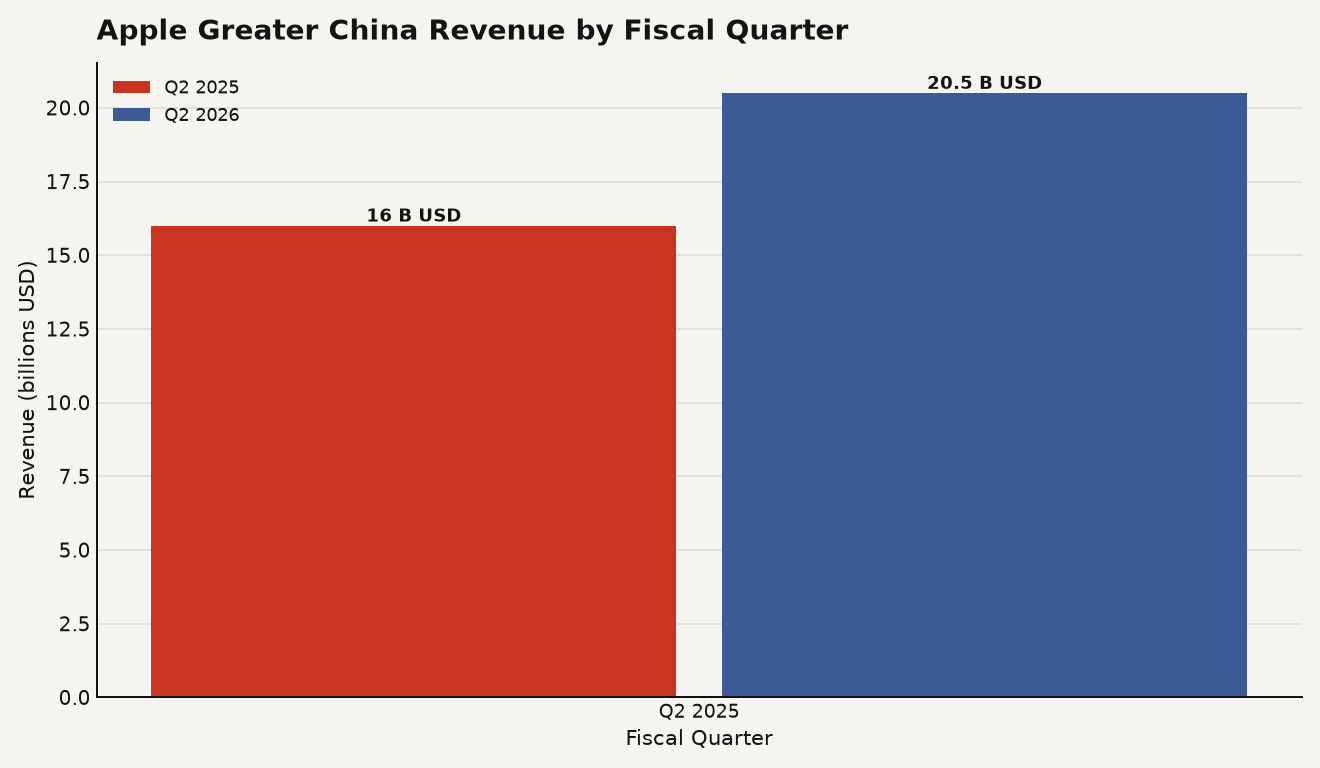
The chart above shows why Apple could not afford to wait. Apple generated $20.5 billion in Greater China sales in the second quarter of its fiscal year, up 28 percent from the same period a year earlier, according to figures reported by TechCrunch. That is roughly a fifth of Apple's total revenue, and it is a market where AI features increasingly drive upgrade cycles. A phone without on-device AI is becoming a phone without a selling point.
Apple just showed the cost of entry into China
If you are building an AI product with any ambition of reaching Chinese users, Apple just wrote the playbook. The lessons are specific enough to act on.
-
Build local, do not export. Apple did not try to get its US-trained foundation model through Chinese review. It built a new model with a Chinese partner on Chinese terms. If your product depends on a model trained primarily on English data in US or EU data centers, your path to China goes through a rebuild, not a port.
-
Pick your partner for politics, not just performance. Alibaba's Qwen is a strong model, but so are alternatives from DeepSeek, Moonshot, and others. Apple chose Alibaba and Baidu because they have the regulatory relationships, the government registrations, and the political standing to make approval happen. Your partner selection in China should weight regulatory track record as heavily as benchmark scores.
-
On-device is the compliance strategy. By registering an on-device service, Apple keeps user data local and sidesteps some of the cloud-era data flow rules that have trapped other foreign AI products. If your architecture sends every prompt to a US-based inference endpoint, you have a compliance problem that no amount of prompt filtering will fix.
-
The model layer is not your moat in China. Apple, a company that builds its own silicon and trains its own models, still needed Alibaba. Whatever proprietary model you have trained, China will require it to be registered, reviewed, and potentially modified before it touches a Chinese device. Plan for that cost in your roadmap, not after the first rejection.
The broader signal: China is not closing its AI market to foreign companies, but it is restructuring the terms of entry. Companies that build with Chinese partners, on Chinese infrastructure, under Chinese regulatory oversight, get in. Companies that try to import a finished product do not.
Alibaba lands the most visible partnership
Alibaba just landed the most visible partnership in Chinese AI. Having Qwen inside Apple Intelligence across four operating systems puts Alibaba's model on hundreds of millions of devices, with Apple's brand and distribution behind it. That is a distribution moat that no amount of benchmark scores can replicate.
Baidu's role is less clear but still significant. A Baidu spokesperson confirmed participation to TechCrunch, and Reuters reported that Apple is working with Baidu on Apple Intelligence features for Chinese iPhone users. Whether Baidu handles search-style queries, visual understanding, or a separate function category is not yet public. The dual-partner structure suggests Apple is hedging, or that no single Chinese lab could cover the full scope of what Apple Intelligence needs.
For the open-weight community, the stakes are different. Alibaba's Qwen models are already among the most capable open-weight options available, as we noted in our coverage of Qwen3.8-Max narrowing the open-weight frontier gap. The Apple partnership gives Alibaba revenue, scale, and training data feedback loops that will likely flow back into Qwen's open-weight releases. Builders using Qwen outside China should expect the model family to keep improving, partly because Apple is now one of its largest customers.
The competitive risk for Chinese labs not in the Apple deal is real. DeepSeek, Moonshot, Zhipu, and others now face a market where the default on-device AI for iPhone users in China is Qwen, backed by Apple's UX and marketing. That is a distribution advantage that is hard to out-benchmark.
A market fragmenting along regulatory lines
The Apple-Alibaba deal is a case study in how the global AI market is fragmenting along regulatory lines. Here is what to take seriously and what to watch.
Take seriously:
-
China is a separate AI market with its own model layer, its own compliance regime, and its own distribution dynamics. If your roadmap treats it as a variant of your US product, revise the roadmap.
-
The cost of China entry is a domestic partner plus a custom model plus a registration process. Budget for all three. Apple, with its resources, spent months on this. A smaller company will spend longer.
-
On-device AI is becoming a regulatory advantage, not just a performance one. Local inference sidesteps cross-border data rules and gives regulators a cleaner review target.
Watch closely:
-
The actual iOS rollout date. Registration happened in July 2026, but no public launch date has been announced. Watch the fall iOS release cycle for the feature flag.
-
What Baidu actually does. If Baidu handles a distinct capability set from Alibaba, that reveals a model-layer segmentation in the Chinese market that other builders should understand.
-
Whether other US tech companies follow Apple's template. If Microsoft, Google, or Meta pursue similar custom-model-plus-domestic-partner structures for China, the pattern hardens into a standard. If they do not, Apple's deal looks more like a one-off driven by smartphone-specific pressures.
-
How Alibaba uses the partnership to advance Qwen's open-weight releases. If Qwen's next major release lands with notable capability jumps, the Apple feedback loop is a plausible driver.
Do not assume:
-
That this deal signals warming US-China tech relations. It signals that Apple needs China revenue and is willing to pay the regulatory price. The broader geopolitical trajectory is unchanged.
-
That a custom model means Apple controls the content filtering. Chinese law still applies. The model may be Apple's, but the compliance obligations are China's, and Beijing defines those.
-
That on-device means no cloud. Apple Intelligence in other markets uses a mix of on-device and Private Cloud Compute. China may get a different cloud story, or none at all. Watch for that detail in the launch.
The price of the largest smartphone market
Apple just showed what it costs to play in the world's largest smartphone market when AI is the product: you build local, you partner local, and you let the regulator sit at the design table. The model is yours, but the terms are theirs. Every builder with global AI ambitions should read that trade and ask whether their own roadmap accounts for it, because the companies that treat China as a distribution problem rather than a build problem are about to learn what Apple already paid to find out.
Sources
- Reuters via Yahoo Finance: Apple Intelligence AI service registered with Chinese cyberspace regulator
- TechCrunch: Apple Intelligence approved for launch in China with Alibaba and Baidu
- The Verge: Apple Intelligence approved in China
- MacRumors: Apple Intelligence Finally Cleared to Launch in China
- Livemint: Apple trains its own AI model for China market with Alibaba's support