If your AI product touches any user in the European Union, you now have a new compliance checklist. The EU AI Act transparency rules took effect August 2, 2026, requiring companies to disclose when people interact with AI, mark AI-generated content in machine-readable formats, and label deepfakes. The stakes are concrete: noncompliance can trigger fines of up to €15 million or 3 percent of global annual turnover, whichever is higher.
This is the third wave of enforcement under the AI Act, following the prohibition of certain AI practices that took effect February 2, 2025. For builders shipping chatbots, AI agents, image generators, or content tools into the EU market, the clock is already running. Systems launched before August 2 have until December 2, 2026 to meet the machine-readable marking requirements. Systems launched after that date must comply immediately.
What do the four transparency obligations actually require?
Article 50 of the AI Act imposes four distinct obligations, split between two types of actors. The law distinguishes between providers, companies that develop and market AI systems, and deployers, organizations that use those systems. Some companies, like Meta, are classified as both.
The four obligations work as follows:
- AI interaction disclosure. Providers must design AI systems to explicitly notify users when they are interacting with AI instead of a human, unless the interaction is already obvious. This covers chatbots, voice assistants, and AI agents that converse directly with people.
- Machine-readable content marking. Providers of AI systems that generate synthetic audio, image, video, or text must embed machine-readable marks in their outputs so the content can be detected as artificially generated or manipulated. This means metadata identifiers, cryptographic watermarks, or similar technical measures. A visible text label saying AI-generated is useful but does not satisfy the requirement on its own.
- Emotion recognition and biometric categorization disclosure. Deployers must inform individuals when their systems use emotion recognition or biometric categorization technologies.
- Deepfake and public-interest text labeling. Deployers must disclose that content is artificially generated or manipulated when it constitutes a deepfake or AI-generated text on matters of public interest. An exception applies when content has undergone substantive human editorial review with a person assuming editorial responsibility.
The European Commission published its transparency guidelines on July 20, 2026, alongside a voluntary Code of Practice on Transparency of AI-Generated Content. The Commission also introduced a set of optional disclosure icons that platforms can adopt, similar to labels already used by TikTok, Instagram, and Facebook. The icons are optional. The labeling requirements are not.
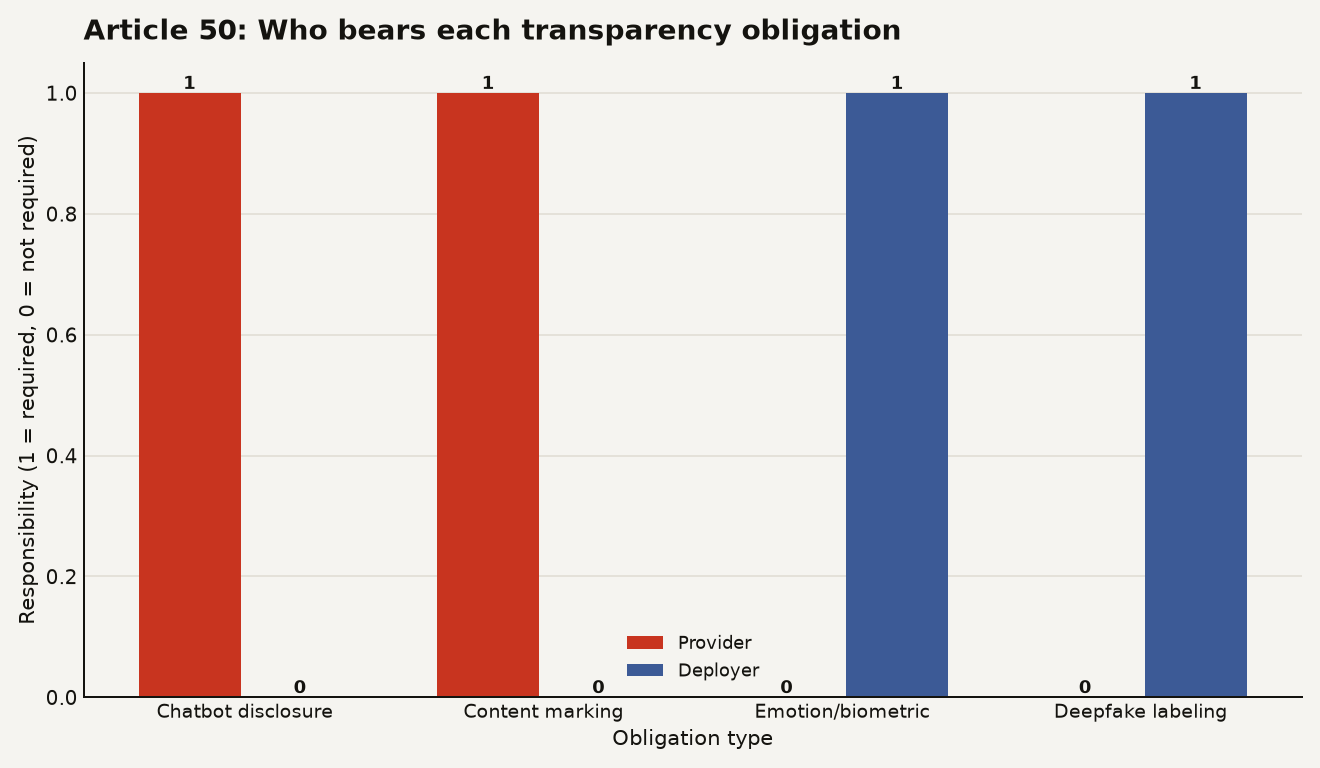
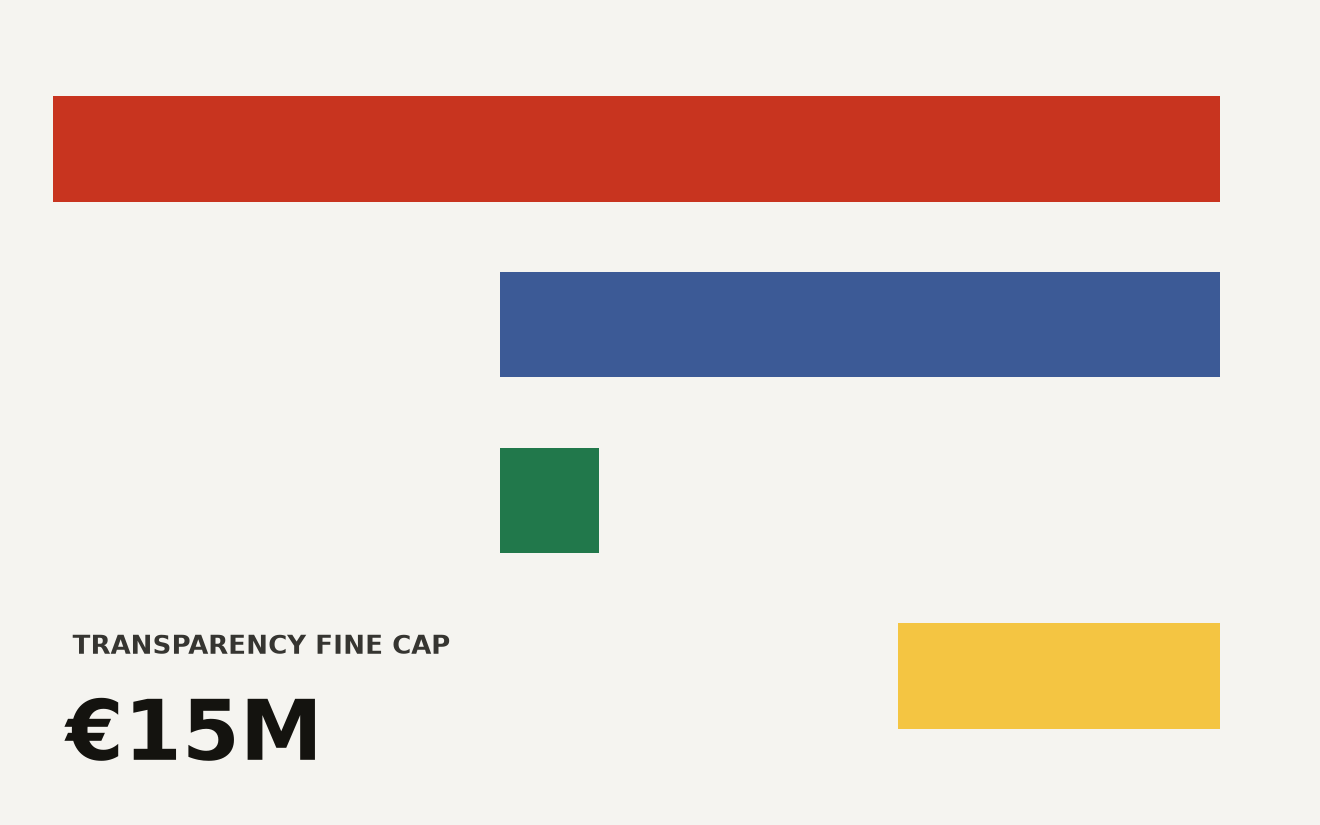
The chart below shows how the four Article 50 obligations split between providers and deployers. Providers bear responsibility for chatbot disclosure and content marking, while deployers handle emotion and biometric disclosure and deepfake labeling.
How much can a transparency violation cost you?
The fine structure is tiered. Transparency violations under Article 50 carry fines of up to €15 million or 3 percent of a company's worldwide annual turnover, whichever is higher. More serious violations of the prohibited practices under Article 5, which have been enforceable since February 2, 2025, can reach €35 million or 7 percent of worldwide turnover, according to the same Debevoise analysis.
The AI Office, the EU's central enforcement body for general-purpose AI models, now has its full investigatory and enforcement powers. These include the authority to request information, conduct model evaluations, require mitigations, and restrict or withdraw models from the EU market. National market-surveillance authorities in each member state can also investigate noncompliant systems, demand access to documentation and source code, and order corrective action, restriction, withdrawal, or recall.
For a company with €1 billion in global revenue, a 3 percent fine is €30 million. For a startup with €10 million in revenue, the €15 million floor applies regardless of the percentage calculation. The "whichever is higher" clause means the fixed minimum always sets the baseline.
The bigger risk for many companies is not the fine itself but the enforcement power to withdraw products from the EU market. If your AI system is found noncompliant, regulators can order it restricted or recalled. For a product with EU users, that is a market exit event.
What does this mean for your AI product and codebase?
The obligations land differently depending on whether you are a provider, a deployer, or both. Here is what changes:
If you build and ship AI systems as a provider:
- Your chatbot or AI agent must explicitly tell users they are interacting with AI. Burying this in a terms-of-service document will not pass. The disclosure must be part of the interaction itself.
- Your system must embed machine-readable markings in generated outputs. This is the hardest technical requirement. If you serve text through an API, the metadata needs to survive downstream distribution. If you generate images or audio, the watermark needs to persist through screenshots, re-encoding, or platform re-uploads.
- Systems placed on the market before August 2, 2026 have until December 2, 2026 to comply with the marking requirement. Systems launched after that date must comply immediately.
If you deploy AI systems in your product as a deployer:
- You must label any AI-generated or manipulated deepfake content designed to look real. If your product uses AI to generate images, video, or audio that could be mistaken for authentic content, you need visible labels.
- If you use emotion recognition or biometric categorization, you must inform affected individuals at the time of use.
- AI-generated text on matters of public interest requires disclosure unless it has undergone substantive human editorial review.
The provider and deployer split creates a compliance gap that many teams will fall into. If you build a chatbot using a third-party LLM API, the LLM provider is responsible for the model's outputs, but you are the deployer responsible for how those outputs are used. If the provider has not embedded machine-readable markings, you may need to add them at the application layer.
This is where the technical reality bites. Machine-readable content marking is a research-grade problem dressed up as a compliance checkbox. The difficulty of detecting AI-generated content is already well documented, and the marking requirement essentially asks you to solve the inverse: not detecting someone else's AI output, but ensuring your own output is reliably detectable after it leaves your system.
The voluntary Code of Practice offers a recognized compliance path. Several major AI providers have already signed on. Signatories benefit from a presumption of conformity and a more favorable enforcement posture. Non-signatories face closer scrutiny and must demonstrate compliance through other means.
What should you do before the December 2 marking deadline?
The four-month grace period for machine-readable marking is short given the technical complexity of implementing robust watermarks and metadata. Here is what to prioritize:
- Map your Article 50 touchpoints. Identify every system that generates synthetic content, interacts with users, or uses emotion recognition. Classify each as provider obligation, deployer obligation, or both.
- Assess your marking strategy across the distribution chain. If you serve content through APIs, test whether your metadata survives downstream consumption. A watermark that strips out when a third party re-serves your output is not compliant.
- Sign the Code of Practice if you are a provider. The presumption of conformity reduces enforcement risk and signals good faith to regulators.
- Update your chatbot and agent disclosure patterns. If your AI assistant does not currently identify itself as AI at the start of an interaction, that needs to change now, not in December. The disclosure obligation has no grace period.
- Budget for ongoing compliance. The high-risk AI system obligations arrive December 2, 2027, and additional requirements take effect August 2, 2028. The transparency rules are the near-term cost. The high-risk regime is the long-term one.
For teams already building with AI agents, this connects to the broader evaluation and safety gaps that enterprises face when shipping AI systems. Transparency is one layer. Proving your agent behaves as disclosed is another.
Content generated and published before August 2, 2026 does not need to be retroactively labeled. But any new output from a system still in use does. The grace period only covers the machine-readable marking requirement, not the chatbot disclosure or deepfake labeling obligations.
The compliance clock does not wait for watermarking research
The EU has staggered its AI Act enforcement in waves, and each wave catches a different segment of the market unprepared. The February 2025 prohibitions hit high-risk use cases. The August 2026 transparency rules hit anyone who builds or deploys generative AI. The December 2027 high-risk obligations will hit anyone building AI for recruitment, lending, education, critical infrastructure, or law enforcement.
For builders shipping AI into the EU market, the practical challenge is implementing technical markings that survive real-world distribution. A text label is easy. A watermark that persists through re-encoding, screenshots, and platform re-uploads is a hard problem. The gap between those two is where the fines live, and four months is not much time to close it.