The AI model price war has arrived, and it is hitting the tier where most production workloads live: the middle. OpenAI and Anthropic are slashing mid-tier prices by as much as 80 percent as Chinese open-weight models become good enough to steal real workloads. Since mid-July, the prices that customers pay for models from leading US labs have fallen by almost 25 percent, according to Silicon Data's token price index, cited by the Financial Times and reported by Ars Technica. The AI model price war marks the first time the US frontier labs have competed on cost rather than pure capability, and it changes how every team should think about model selection, routing, and budgeting.
OpenAI cut GPT-5.6 Luna prices by 80 percent
OpenAI slashed prices for GPT-5.6 Luna by 80 percent, dropping input tokens from $1.00 to $0.20 per million and output tokens from $6.00 to $1.20 per million. Luna is positioned as OpenAI's fastest and most affordable model, and the cut brings it into the same price range as the cheapest Chinese offerings.
Anthropic took a different angle. It launched Claude Opus 5 at $5 per million input tokens and $25 per million output tokens, which the company describes as half the price of Fable 5, its flagship model. Anthropic also quietly withdrew a planned 50 percent price increase for Sonnet 5 that was scheduled to take effect in September, according to the Asia Business Daily. That reversal is telling: a lab does not cancel a price hike unless it fears losing customers.
The pattern is consistent across both companies. Every reduction targets mid-tier models that compete directly with Chinese alternatives. Flagship prices have not moved.
Chinese alternatives are far cheaper
The Chinese models driving this pressure are not marginal. DeepSeek's V4 Flash, released in late July, charges just $0.14 per million input tokens and $0.28 per million output tokens, according to vendor documentation reported by The Register. At 284 billion parameters, it is small enough to run on enterprise servers, and it tops the usage leaderboard on OpenRouter, the popular model routing platform, as France24 reported.
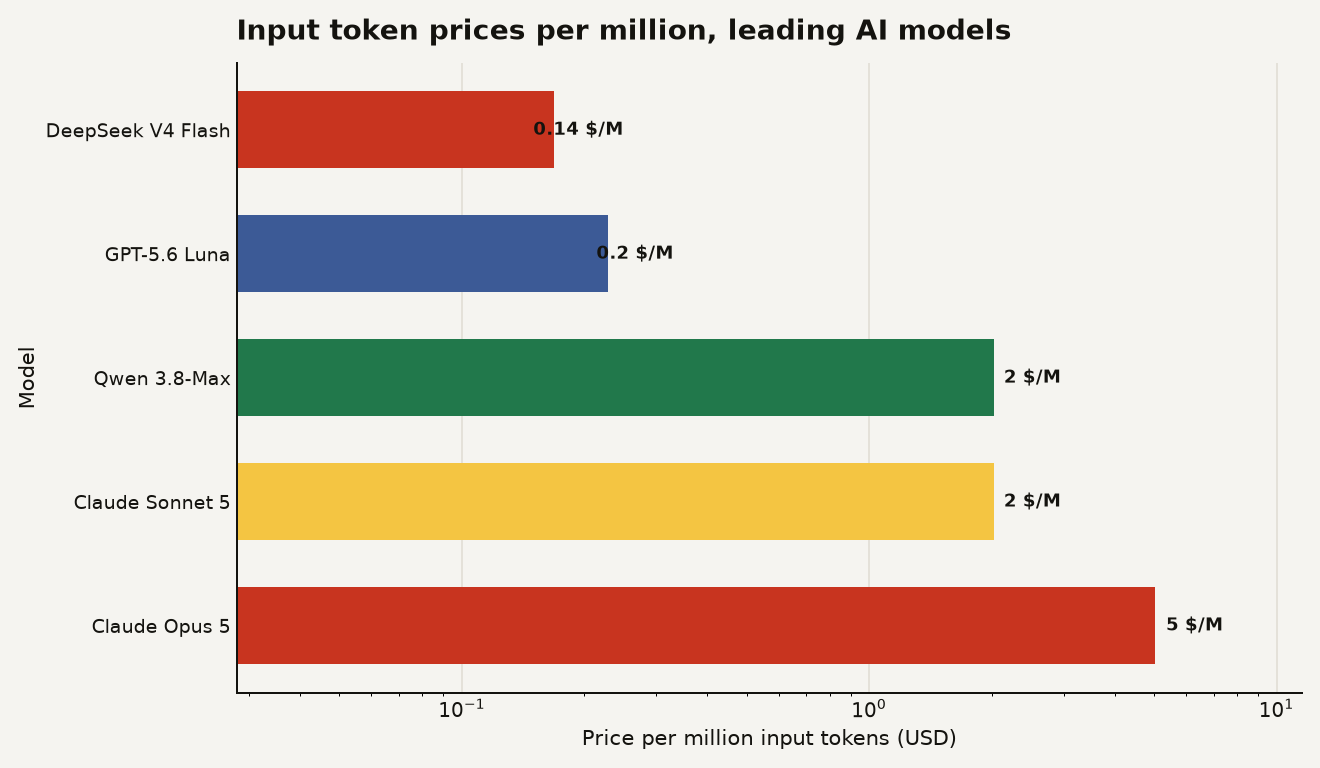
The chart above shows the gap in input token prices across five leading models. DeepSeek V4 Flash at $0.14 and GPT-5.6 Luna at $0.20 sit far below Qwen 3.8-Max and Claude Sonnet 5 at $2.00 each, with Opus 5 at $5.00.
Alibaba's Qwen 3.8-Max, which narrowed the open-weight frontier gap in benchmarks earlier this year, costs $2 per million input and $6 per million output on Alibaba's QwenCloud API. Moonshot AI's Kimi K3, a 2.8-trillion-parameter mixture-of-experts model we examined when it launched, has topped frontend coding benchmarks and performs strongly across multiple evaluation suites.
But raw token prices are only half the story. Artificial Analysis, which benchmarks models on math, science, coding, and reasoning, found that DeepSeek's V4 Flash has a cost to solve of just $0.03 per task, compared to $0.05 for GPT-5.6 Luna. That makes DeepSeek 40 percent less expensive per completed task, not just per token, even though Luna is among the cheapest US models on the market.
Companies are noticing. DoorDash, Airbnb, and Coinbase have all confirmed using Chinese AI models to cut costs, according to TechRepublic. These are not experimental side projects. They are production workloads moving to cheaper providers, and the list is growing.
Token price misleads on real cost
Here is the trap that catches teams who optimize purely on token price: a model that costs less per token can actually cost more per task if it requires more tokens to reach the same result.
Artificial Analysis found that Anthropic's Opus 5 at medium effort delivered similar performance and cost per task to Moonshot's Kimi K3 at max effort. OpenAI's GPT-5.6 Luna at max effort performed similarly to DeepSeek's V4 Flash at max effort, but cost just under twice as much per task. The effort setting, which controls how much compute a model uses to reason through a problem, can swing both quality and total cost dramatically.
This means the pricing tables that circulate on social media are a starting point, not a procurement decision. The real comparison requires benchmarking each model on your actual workload, at the effort level that meets your quality bar, and measuring total tokens consumed per completed task.
Consider a practical example. If your application calls a model 10,000 times per day to classify support tickets, a model that charges $0.14 per million input tokens but needs 500 tokens per call costs $0.70 per day. A model at $0.20 per million that needs only 300 tokens per call costs $0.60 per day. The cheaper model lost.
| Model | Input $/M | Output $/M | Cost to solve | Source |
|---|---|---|---|---|
| DeepSeek V4 Flash | $0.14 | $0.28 | $0.03 | The Register |
| GPT-5.6 Luna | $0.20 | $1.20 | $0.05 | The Register |
| Qwen 3.8-Max | $2.00 | $6.00 | not reported | The Register |
| Claude Sonnet 5 | $2.00 | $10.00 | not reported | The Register |
| Claude Opus 5 | $5.00 | $25.00 | similar to Kimi K3 at max | Artificial Analysis |
Single-provider lock-in becomes a financial risk
The immediate consequence for builders is that single-provider lock-in is now a financial liability, not just a technical risk. If you are routing every request through one lab's API, you are almost certainly overpaying for at least some portion of your workloads.
The specific moves worth making now:
- Audit your workload mix. Pull the last 30 days of API logs and bucket calls by complexity. Simple classification, summarization, and formatting tasks can move to the cheapest tier. Reserve mid-tier models for multi-step reasoning and code generation. Save flagship models for the tasks where quality is non-negotiable and the cost per task justifies it.
- Build a routing layer. OpenRouter already supports most of these models, or you can build a thin router that directs traffic by task type. The cost savings from routing alone can fund the engineering work within weeks at moderate volume.
- Benchmark on your own data, not marketing leaderboards. Run your top five task types through three or four models at different effort settings. Measure total tokens consumed, latency, and quality against a held-out evaluation set. The model that wins on your data may not be the one that tops public benchmarks.
- Watch the billing model shift. OpenAI and Anthropic are moving some enterprise customers from flat-rate subscriptions to usage-based billing, as the Asia Business Daily reported. If you are on a flat plan, model your actual usage and compare. Teams with spiky workloads may find usage-based billing cheaper. Teams with steady high-volume traffic may get squeezed.
- Consider self-hosting for the cheapest models. DeepSeek V4 Flash at 284 billion parameters is within reach of enterprise GPU clusters. If your volume is high enough, the math on self-hosting may flip in your favor, given the zero per-token cost after hardware amortization.
US labs and their premium tier
The question every builder and investor should ask is whether the price cuts stop at mid-tier or eventually climb to the flagship models. Mantas Lukauskas, AI tech lead at Hostinger, a website hosting provider that has used large language models since 2020, calls the current moment the first real test of whether OpenAI and Anthropic can protect prices on their most advanced offerings. His read, reported by Ars Technica: the US labs have cut the middle and are defending the top.
So far, that defense is holding. Prices for top-tier models are flat to rising. But the pressure is structural, not cyclical. Chinese labs are releasing capable open-weight models every few weeks, and each release narrows the gap. DeepSeek, ironically, is also planning a significant increase in prices for developers, as France24 reported, which suggests the Chinese labs believe their models have earned pricing power too.
Meanwhile, OpenAI and Anthropic are reportedly plotting IPOs at trillion-dollar valuations. Those valuations depend on margin growth, and margin growth depends on maintaining premium pricing on flagship models. If the open-weight ecosystem keeps closing the performance gap, the premium tier becomes the next domino, and the IPO narrative gets harder to sustain.
The deeper risk for US labs is that the open-weight model ecosystem is building a flywheel that closed models cannot match. Every developer who downloads DeepSeek or Qwen, fine-tunes it, and deploys it on their own infrastructure becomes a permanent non-customer. The battle over open-weight AI models that Geoffrey Hinton called lost is now showing up in API revenue, not just in philosophical debates.
The fight is for the middle tier
The AI model price war is a squeeze on the middle tier, where most production workloads live. The cheapest models from China and the most expensive flagships from the US are both holding their ground. The casualties are the models in between, the ones that used to win on the proposition of good enough and from a trusted vendor. That proposition is no longer competitive when good enough is available for $0.14 per million tokens, downloadable, and modifiable.
For builders, the actionable insight is direct: stop paying mid-tier prices for mid-tier work. The tools to route around them exist today, the cost gap is wide enough that the engineering effort pays for itself in weeks, and the 25 percent drop since mid-July is likely a floor, not a ceiling. The era of choosing one model and accepting its price is over.
Sources
- Ars Technica - OpenAI and Anthropic in price war as Chinese AI rivals gain ground
- TechRepublic - OpenAI, Anthropic Cut AI Costs as Rivals Gain Ground
- The Asia Business Daily - OpenAI and Anthropic Join 25% Price Cut Race Amid Chinese Low-Cost Offensive
- France24 - Chinese AI drives price competition among US labs
- The Register - China turns up the heat with open model blitz as US model makers panic