If you build with LLMs, you already know the routine. Pick a model, wire up an API, watch your token bill explode, then wonder whether a cheaper provider would have done the same job. OpenRouter built a business around solving that problem, and Stripe just decided the solution was worth more than $7 billion.
Stripe has agreed to acquire OpenRouter, the largest independent AI model routing platform, which gives developers a single API to access over 400 models from more than 80 providers. The deal merges two halves of the same problem: OpenRouter routes requests to the optimal model based on cost, speed, and reliability, while Stripe meters, prices, and bills the resulting token consumption. OpenRouter now processes more than 10 trillion tokens per day for a community of over 10 million developers. The transaction is valued at more than $7 billion. A separate Reuters report cited a figure slightly above $8 billion.
Stripe bought a routing layer and model marketplace
OpenRouter is a routing layer and model marketplace. Instead of integrating separately with Anthropic, OpenAI, Google, and dozens of other providers, you send one API call to OpenRouter. It decides which model and which provider endpoint should handle the request, based on criteria you define: task complexity, price, speed, latency, throughput, and reliability.
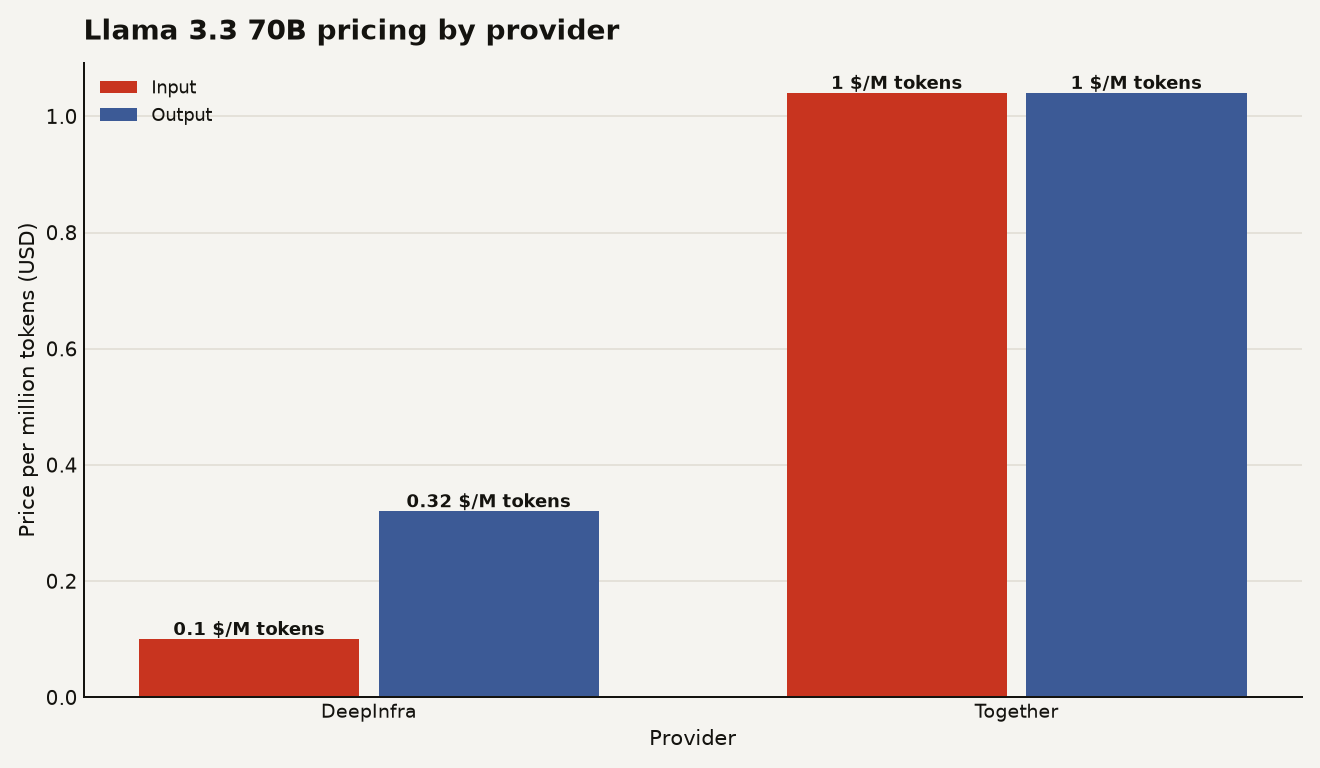
The routing happens at two levels. First, OpenRouter picks a model for the task. Second, for that model, it picks a provider endpoint serving it. That second layer matters because the same model can cost dramatically different amounts depending on who serves it. In a June 2026 example from OpenRouter pricing data, Llama 3.3 70B input pricing ran $0.10 per million tokens through DeepInfra and $1.04 through Together, a 10x gap for identical model weights. Output pricing ranged from $0.32 to $1.04 per million tokens across the providers shown.
The chart below shows that gap at a glance.
OpenRouter also handles failover. If a provider endpoint goes down, hits a rate limit, returns a context-length error, or refuses a request on moderation grounds, the system moves to an alternative provider or model. That resilience is the part most teams underestimate until production traffic hits an outage at 2 a.m.
The company was founded in early 2023 by Alex Atallah. Its Series B round raised $113 million in May at a reported $1.3 billion valuation, led by CapitalG with participation from Menlo Ventures, Andreessen Horowitz, and corporate venture arms from ServiceNow, MongoDB, Snowflake, and Databricks. Three months later, Stripe is paying roughly five to six times that valuation.
Routing savings on inference
The pricing gap OpenRouter exposes is not a rounding error. A team running Llama 3.3 70B at scale through Together instead of DeepInfra pays ten times more for input tokens and three times more for output tokens, for identical model weights. Multiply that across billions of tokens and the savings from routing become a board level number.
The volume at stake is enormous. OpenRouter's traffic tells the story: weekly volume grew from 5 trillion tokens to 25 trillion tokens over the six months ending in May 2026, then jumped to more than 10 trillion tokens per day by August. That works out to roughly 70 trillion tokens per week, a 14x increase in nine months.
Enterprise consumption patterns confirm the trajectory. According to reporting on the deal, Deloitte surveyed 515 decision-makers at companies generating at least $500 million in annual revenue and found that 37% were consuming between 1 billion and 10 billion AI tokens per month, while another 30% consumed more than 10 billion. By 2028, 61% expect monthly consumption to exceed 10 billion tokens. Deloitte cautioned that much of this consumption is wasteful, driven by oversized prompts, weak context management, and limited reuse, which means the savings opportunity from smart routing is larger than the raw volume suggests.
Multi-model environments are already standard. The same reporting noted that F5's 2026 State of Application Strategy report, based on responses from more than 1,100 IT decision-makers, found that 52% of organizations were chaining or orchestrating multiple AI models, with respondents using an average of seven each. But Menlo Ventures' mid-year survey found that 66% of builders upgraded models while staying with their existing provider, while only 11% switched vendors. The routing opportunity is optimization within a portfolio builders already hold.
Neutrality under Stripe
This is the question every OpenRouter customer is asking, and the answer depends on how much you trust Stripe's incentives.
OpenRouter's announcement blog post was emphatic. "OpenRouter will continue to operate as it is: same mission, same name, same product, same roadmap. If you build on OpenRouter today, nothing about your integration changes." CEO Alex Atallah wrote that routing decisions will remain driven by one thing: what is best for the user. The company built its brand on neutrality, presenting every model on equal footing and refusing to favor any single provider.
Stripe has its own incentive structure. The company makes money on transaction volume. If Stripe controls the routing layer that decides which model provider gets each request, it controls where inference spend flows. A routing default that quietly favors providers with better Stripe economics, or that bundles routing discounts with billing commitments, would undermine the neutrality promise.
Competing products offer a reality check. As one former Stripe executive told Payments Dive, "it's not technically hard to create" an AI orchestration product. The hard part is getting customer usage, which OpenRouter has and competitors want. Snowflake announced dynamic model routing for Cortex AI Gateway on August 18. Cloudflare offers Dynamic Routing in beta through AI Gateway. AWS provides Intelligent Prompt Routing through Bedrock. Microsoft Foundry offers routing profiles that balance quality and price. If OpenRouter's neutrality erodes, customers have alternatives, and the switching cost for a routing API is low compared to migrating a database or a payments processor.
Keep building on OpenRouter for now
If you are already using OpenRouter, the immediate answer is keep building. The API does not change, your integrations do not change, and the routing logic you depend on should continue to operate as before. But start watching for signs of drift.
Here is what this means for you, depending on what you are building:
- If you route through OpenRouter today: nothing breaks. But add monitoring for routing defaults. If you see traffic shifting toward a provider that happens to offer Stripe better billing terms, that is the signal to evaluate alternatives.
- If you are building your own routing layer: the independent window is narrowing. OpenRouter's scale, now backed by Stripe's distribution, makes standalone routing products harder to justify. Compete on a dimension OpenRouter does not own, like domain-specific routing for healthcare, legal, or financial workloads where compliance constraints matter more than cost optimization.
- If you manage AI spend for an enterprise: the integration of routing and billing is the real product. Stripe's Token Billing service, currently in private preview, can meter consumption by model and token type, including input, output, and cached tokens. If you are separately tracking token costs and routing decisions, this deal promises to collapse them into one workflow.
- If you are a competing gateway: the clock is ticking. OpenRouter's 10 million developers and 10 trillion daily tokens are now backed by Stripe's sales force and billing infrastructure. The story shifts from who has the best routing algorithm to who can bundle routing with payments.
The deeper shift is structural. As the AI model price war has shown, model pricing is compressing fast, and the margin is moving from the model layer to the infrastructure layer. Routing and billing infrastructure are where the durable economics live. Stripe just bought that position.
Three signals in the next year
Watch for three signals in the next six to twelve months.
First, whether Stripe bundles routing with billing at a discount. If Stripe offers lower token costs or lower billing fees to customers who route through OpenRouter, that confirms the strategy is about owning the spend flow, not just selling a tool.
Second, whether model providers push back. OpenRouter's neutrality was a selling point for labs that wanted distribution without favoritism. If providers like Anthropic or Google start building tighter direct relationships with enterprise customers to bypass a Stripe-owned gateway, that signals concern about gatekeeping power.
Third, whether the deal closes at the reported price. The Wall Street Journal previously reported a potential $10 billion price tag, while Bloomberg's final figure is above $7 billion and Reuters cites slightly more than $8 billion. A gap that wide between early reports and final terms suggests the valuation conversation was contested, which means Stripe's diligence may have surfaced concerns about revenue, retention, or competitive risk.
The broader market signal is clear. Stripe CEO Patrick Collison [called tokens "the central currency for companies building with AI"]](https://stripe.com/newsroom/news/stripe-agrees-to-acquire-openrouter) and tied their economic use to how companies manage scarce compute resources. When the CEO of the world's largest payments company frames tokens as a currency, the infrastructure play is explicit.
A toll booth on the token highway
Every internet platform eventually gets its payments moment. Search got ad auctions. Commerce got Stripe checkout. AI inference just got its toll booth, and Stripe is the one collecting.
The bet is simple: tokens are the new transactions, and the company that routes them, meters them, and bills them will sit at the center of the AI economy. Whether OpenRouter's neutrality survives that position is the question every builder should be watching.
Sources
- Stripe Newsroom - Stripe agrees to acquire OpenRouter
- OpenRouter Blog - OpenRouter is Joining Stripe
- TechCrunch - Stripe will reportedly acquire AI gateway startup OpenRouter for $7B+
- Fortune - Stripe clinches over $7 billion deal to buy AI firm OpenRouter
- Payments Dive - Stripe acquisition may bolster its AI strategy
- AI News - Stripe agrees to buy OpenRouter as AI model routing expands