Build on Trainium is Amazon's $110 million compute-credit program that hands academic researchers access to AWS Trainium chips, Amazon's custom silicon for machine learning training and inference. Amazon just announced 34 recipients at 30 universities for its Fall 2025 cycle, which focused on Responsible AI across five priority topics: AI safety and alignment, multilingual language models, representation engineering, sustainability and small language models, and synthetic data generation. Every project runs on Trainium, and the biggest allocation gives a single team access to 1,024 Trainium chips to train mixture-of-experts models at up to one trillion parameters.
The program matters because it locks a cohort of academic researchers into Amazon's silicon ecosystem at a moment when the gap between NVIDIA's CUDA monopoly and challenger platforms is narrowing fast. If you are building AI infrastructure, deploying models at scale, or deciding which cloud to standardize on, where these 34 researchers publish their code and what they optimize for will shape the open-source tooling you inherit over the next two to three years.
A $110 million Trainium credit program
Amazon's Build on Trainium program is a multi-year, $110 million credit initiative that funds novel AI research on Amazon's purpose-built training chips. The latest announcement covers the Fall 2025 cycle, which was organized around Responsible AI. A panel reviewed proposals for scientific quality and societal impact, then selected 34 projects spanning 30 universities including UIUC, UCLA, CMU, MIT, Georgia Tech, Imperial College London, and the National University of Singapore.
Each recipient gets AWS Promotional Credits for compute, access to more than 700 Amazon public datasets, a dedicated Amazon research contact for consultation, and hands-on Trainium resources such as tutorials and sessions. The program also supports work on the Neuron software development kit and the Neuron Kernel Interface, Amazon's lower-level programming model for custom Trainium operations.
Two flagship projects give a sense of scale. Yida Wang, AWS AI Principal Applied Scientist, said that University of Illinois Urbana-Champaign researchers are studying topology-aware parallelization strategies for large-scale mixture-of-experts models with as many as one trillion parameters on up to 1,024 Trainium chips. At the University of Washington, a separate team is building an inference-optimization framework designed to raise token efficiency for everyone building on Trainium, with the goal of delivering portable, high-performance LLM inference.
The full recipient list reads like a map of where Amazon wants Responsible AI research to go. The projects break down across the five priority topics as follows: about 11 of 34 awards target AI safety and alignment, covering everything from hallucination detection at Northwestern to agent tool-use safety benchmarking at MIT. Roughly 8 awards focus on synthetic data generation, including differentially private synthesis of hierarchical relational data at NUS. Another 7 address multilingual language models, including work on low-resource language pretraining at UCL and Indic-language healthcare dialogues at the University of Pittsburgh. The remaining awards split between sustainability and small language models (5) and representation engineering (3).
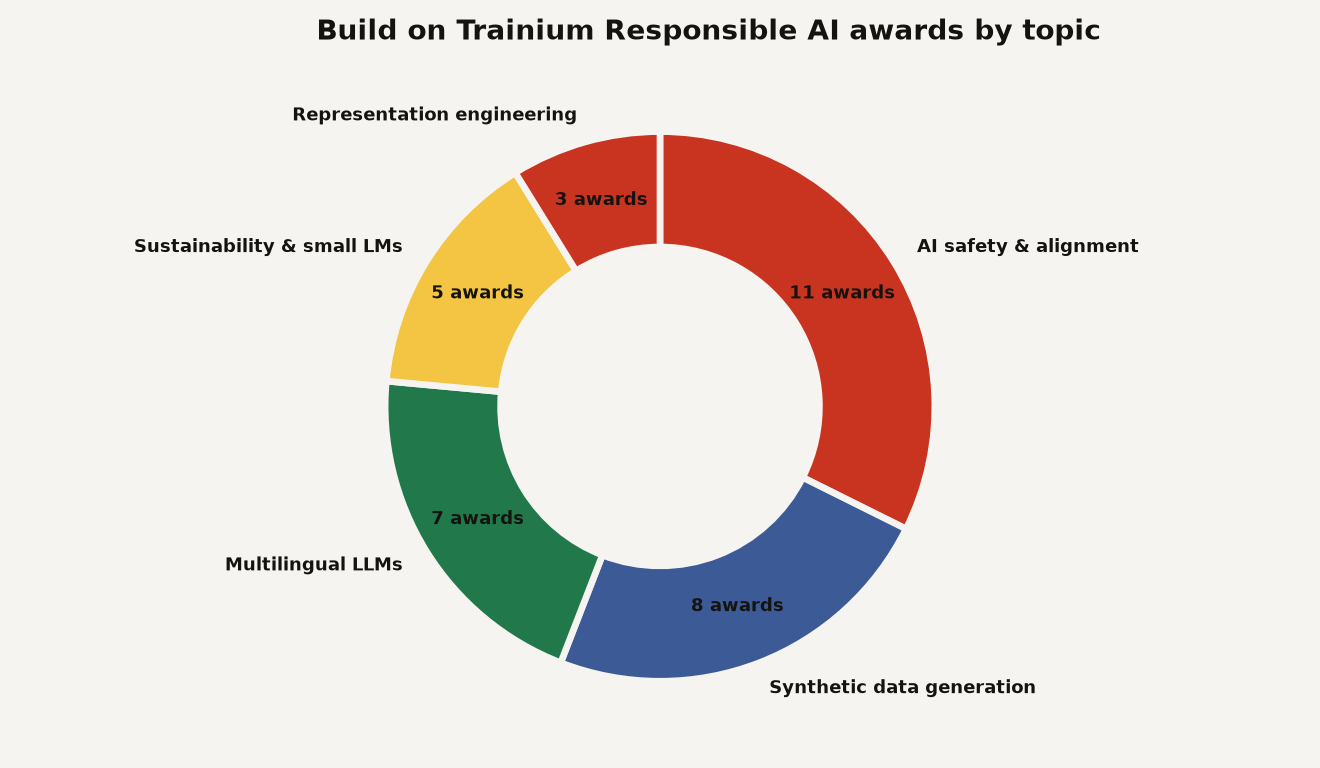
The chart above shows the distribution of the 34 awards across the five priority topics, with AI safety and alignment drawing the largest share at 11 projects.
Credits to win researchers away from NVIDIA
The strategy is straightforward. NVIDIA owns roughly 80 percent of the AI chip market, and CUDA has a 15-year software moat that makes switching costly. Amazon cannot outspend NVIDIA on hardware alone, so it is buying the software ecosystem the way a platform company always does: by funding the people who write the libraries, the kernels, and the benchmarks that everyone else will use.
This is the same playbook that Google ran with TensorFlow and TPU research grants, and that Microsoft has run with Azure OpenAI Service academic access. The difference is that Trainium is a younger platform with a thinner software stack. Every researcher who writes a Neuron kernel, debugs a distributed training recipe, or publishes a Trainium-optimized inference engine is contributing code that Amazon's customers can eventually use for free.
The Responsible AI framing is also deliberate. Regulators in the EU and elsewhere are tightening requirements around AI safety, transparency, and robustness, as we have covered in our reporting on the EU AI Act transparency rules. By funding safety and alignment research that runs on its own chips, Amazon gets to say that the next generation of safety tooling was built on Trainium. That is a credible argument to enterprise buyers who need to demonstrate due diligence on model safety.
The $110 million figure is significant but modest next to the overall AI infrastructure market. For comparison, AMD committed $5 billion to Anthropic in a broader infrastructure partnership that bundles chips, software, and cloud capacity. Amazon's program is smaller and more targeted: it buys influence over academic research directions rather than locking in a single anchor customer.
Three consequences for builders
If you are a developer, founder, or platform lead, this announcement has three concrete implications.
- Your open-source training and inference tooling will increasingly have Trainium code paths. When a UIUC team publishes its MoE parallelization library or a Johns Hopkins team releases its linear-attention pruning framework, that code will be optimized for Trainium first. If your infrastructure team has been assuming CUDA is the only target that matters, expect that assumption to be tested within 18 months.
- Responsible AI tooling is becoming a silicon-level feature. Several of these projects, from representation immunization at Dalhousie to certified robustness for quantization at UIUC, bake safety and robustness into the training and inference pipeline at the hardware level. If you are building guardrails, you should be watching whether these techniques become part of the default stack rather than bolt-on APIs. The gap between bolt-on safety and baked-in safety is where a lot of agent security failures currently live.
- Synthetic data generation is getting a subsidized research push. Eight of 34 awards target synthetic data, including differentially private generation at Georgia Tech and UCSB, and LLM-guided synthesis of relational data at NUS. If you are building data pipelines for fine-tuning or evaluation, expect open-source synthetic data tools optimized for Trainium to appear over the next 12 to 24 months. That could lower the cost of generating compliant training data, especially in regulated domains where differential privacy matters.
The inference-optimization work at the University of Washington is worth particular attention. If that team delivers a portable, high-performance inference engine for Trainium, it directly addresses the biggest complaint from teams evaluating non-NVIDIA silicon: the software stack is immature and performance is hard to tune. A credible open-source inference optimizer would make Trainium a viable option for production deployments, not just research experiments.
Plan for Trainium without betting on it yet
Not yet, but you should start planning for it. Here is the honest read.
If you are a small team shipping a product on CUDA today, do not rip up your stack. The Trainium software ecosystem is still behind NVIDIA's in depth and community size, and migrating production inference workloads requires engineering time you probably do not have. The credits in this program go to academic researchers, not to your startup.
But if you are an infrastructure lead at a company already on AWS, the calculus is different. Trainium instances are available through AWS and priced competitively against NVIDIA GPU instances. The question is whether the software stack can support your workload. The projects announced this week target exactly the gaps that have held Trainium back: distributed training for large MoE models, inference optimization, quantization-aware training, and multilingual model efficiency.
The timeline to watch is 12 to 24 months. That is when the first papers, libraries, and open-source releases from this cohort should start landing. If the UIUC team publishes a working trillion-parameter MoE training recipe on Trainium, and the UW team ships a performant inference engine, the platform becomes a credible alternative for specific workloads: large-scale training runs, multilingual models, and safety-optimized inference where the Responsible AI research is concentrated.
One caveat: academic research timelines slip. The 1,024-chip MoE experiment is ambitious, and training at that scale on a new platform will surface infrastructure bugs that do not exist on CUDA. Expect delays, expect some projects to publish negative results, and expect the most useful output to be the tooling and infrastructure code rather than the headline model sizes.
A software problem more than a hardware one
Amazon is spending $110 million to solve a software problem, not a hardware problem. The Trainium chips exist and are competitive on raw specifications. What has been missing is the ecosystem of optimized kernels, distributed training recipes, inference engines, and safety tooling that makes a platform usable without a PhD in compiler internals. By funding 34 researchers to build exactly that, Amazon is paying to close the gap that has kept most teams on NVIDIA. Whether it works depends on whether the code these researchers publish is good enough that you would run it in production.