Self-driving crashes and disengagements increasingly come from rare, multi-agent scenarios where the car needs to reason about cause and effect, weigh options, and produce an explainable decision in real time. Perception solved most of the easy cases. The remaining long-tail events demand something closer to deliberation.
NVIDIA's Alpamayo 2 Super, released August 4, 2026, targets exactly that gap. It is a 34-billion-parameter vision-language-action model that fuses a 32-billion-parameter reasoner with a 2-billion-parameter diffusion-based action expert, post-trained with reinforcement learning for driving-specific tasks. The weights are on Hugging Face under OpenMDW-1.1, a permissive Linux Foundation license that covers commercial deployment, fine-tuning, and derivative models without additional permissions. The Alpamayo family has already surpassed 500,000 downloads on Hugging Face, making it the most-adopted open reasoning model family for autonomous driving on the platform.
What does Alpamayo 2 Super actually score on AV benchmarks?
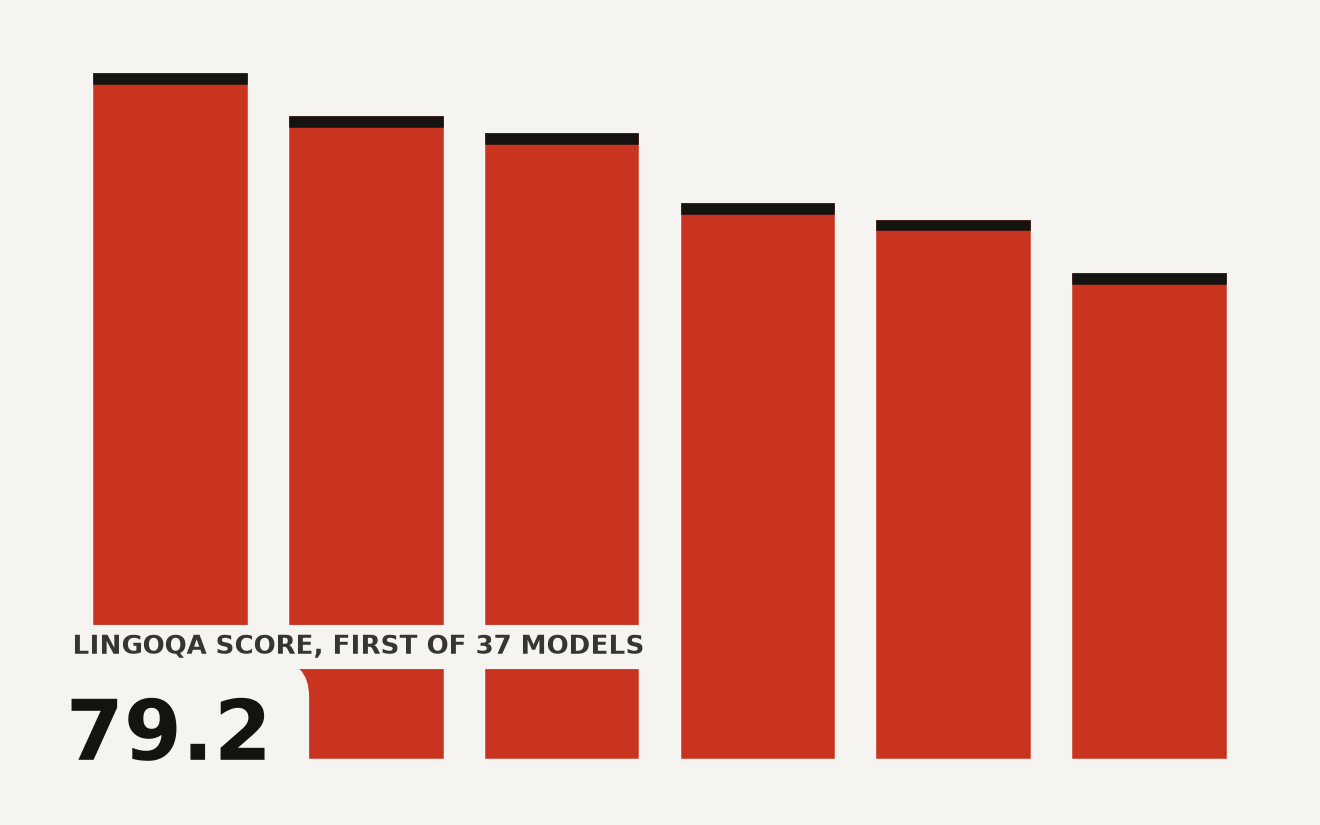
The headline number is a LingoQA score of 79.2, ranking first among 37 evaluated models on the autonomous driving reasoning benchmark. In NVIDIA's own testing using the Lingo-Judge metric, it outperformed Qwen2.5-VL 72B by 17.0 points, Gemini 2.5 Pro by 15.1 points, and GPT-4o by 23.2 points. It also beat Qwen3-VL 32B by 7.0 points, a model with nearly identical parameter count.
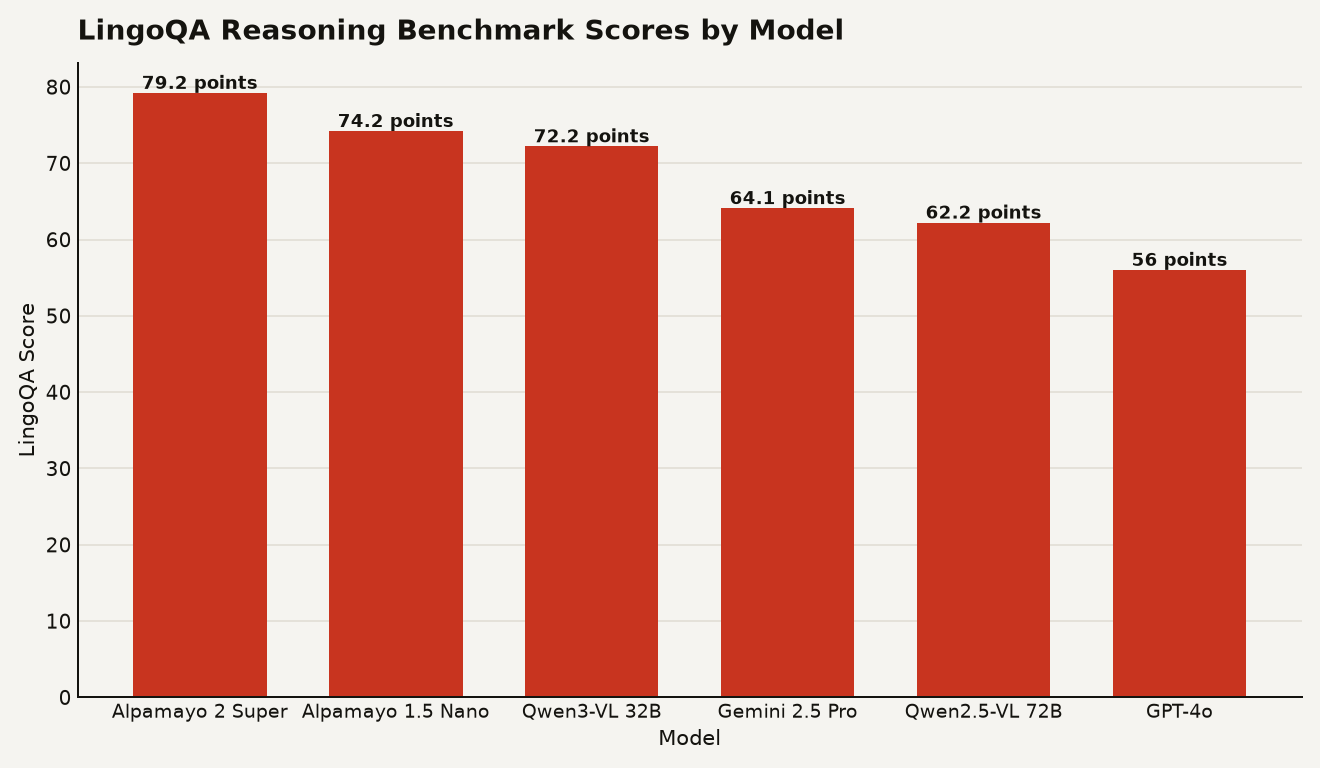
The chart above shows the full LingoQA comparison. Alpamayo 2 Super's nearest open-weight competitor is its own predecessor, Alpamayo 1.5 Nano, at 74.2. The gap to general-purpose frontier models is substantial: Gemini 2.5 Pro scores 64.1 and GPT-4o manages 56.0. This is a domain-specialized model beating larger generalists on their own turf, which is exactly the pattern you would expect when a model has been post-trained with reinforcement learning on driving-specific reasoning traces.
But the LingoQA result is only one axis. On the Physical AI AV Dataset, covering 1,434 challenging driving samples, Alpamayo 2 Super records a minADE_6 of 0.911 meters at 6.4 seconds of prediction horizon, according to NVIDIA's developer blog. Lower is better for trajectory error, and it edges out Alpamayo 1.5 Nano's 0.916 meters by a thin margin. On the Physical AI AV Reasoning Benchmark, the model scores 0.433, ahead of Alpamayo 1.5 Nano at 0.414 but behind GPT-5.5 at 0.502. That gap is worth noting: the open model wins on driving-specific reasoning, but a closed frontier model still leads on the general reasoning benchmark.
On closed-loop simulation, which is where most AV teams spend their real engineering effort, Alpamayo 2 Super scores 1.50 plus or minus 0.13 on the AlpaSim Score across 913 reconstructed scenes from the Physical AI AV NuRec dataset. That beats Alpamayo 1.5 Nano's 1.37 plus or minus 0.10. Closed-loop simulation matters because it reveals collisions, road departures, and close encounters that only emerge when the policy's actions influence future observations. Open-loop metrics tell you whether the trajectory was accurate in a frozen scene. Closed-loop metrics tell you whether the car would have survived.
Why would an AV team pick this over a proprietary stack?
The licensing story is the real differentiator. OpenMDW-1.1, maintained by the Linux Foundation, covers fine-tuning, derivative models, and commercial redistribution. Distilled models can be deployed commercially without further permission from NVIDIA, and model outputs carry no license conditions. For AV developers, this means three things that proprietary APIs cannot match.
First, you keep your data. AV programs involve proprietary fleet data, driving logs, and safety-critical edge cases. Sending that data to a third-party API for labeling or distillation creates a liability most safety teams will not accept. With an open-weight model running on your own infrastructure, the data never leaves.
Second, you own the derivatives. If you fine-tune Alpamayo 2 Super on your fleet's driving data and distill it into a compact policy that runs on NVIDIA DRIVE AGX Thor in the vehicle, that distilled model is yours. No per-mile inference fee, no API dependency, no risk of a provider deprecating the model you built your safety case around.
Third, you control the cost curve. The Alpamayo family includes Alpamayo 1.5 and Alpamayo 1 at 10 billion parameters, roughly one-third the scale of the 34-billion-parameter Super variant. A team could use Alpamayo 2 Super as a cloud-based teacher model to generate reasoning traces and synthetic training data, then distill into a smaller, faster model for in-car inference. That is a fundamentally different cost structure from paying per-token API rates for every inference on every car in your fleet.
The parallel to other open-weight frontier releases is direct. When Kimi K3 hit the open frontier with a 2.8T mixture of experts, the argument was the same: open weights let builders control their inference costs, own their derivatives, and keep their training data private. NVIDIA is making that case for autonomous driving specifically, with a model family that has already crossed half a million downloads.
How does the cloud-to-car distillation workflow actually work?
Alpamayo 2 Super is built to be a teacher, not a deployed policy. At 34 billion parameters, it is too large to run inside a vehicle at the latency self-driving demands. The intended workflow is cloud-to-car.
In the cloud, you run Alpamayo 2 Super to generate five types of output for each driving scenario: a planned trajectory, a chain-of-causation reasoning trace, a high-level meta-action such as yield or change lanes, reasoning auto-labels with 2D grounding, and visual question answering responses tied to specific regions in camera images. The model processes 360-degree coverage from up to seven cameras, which gives it full surround context for lane changes, merges, and complex intersections.
These outputs serve multiple stages of the development cycle. As an offline auto-labeler, Alpamayo 2 Super can generate chain-of-causation annotations and perform visual question answering with 2D grounding on proprietary fleet data. NVIDIA claims this can compress annotation cycles from months to days. The same developer blog reports that the model's VQA answer similarity reaches 0.652 on an internal set of 8,000 question-answer pairs, compared with 0.450 for Qwen3-VL 32B. For 2D grounding, measured by intersection-over-union, it scores 0.71 versus 0.17 for Qwen3-VL 32B. That grounding score is a 4x gap, and it matters because an auto-labeler that cannot link its reasoning to the correct visual evidence produces labels that degrade downstream training rather than improve it.
As a teacher, the model distills into compact policies that run on NVIDIA DRIVE AGX Thor inside production vehicles. As a critic, it evaluates the outputs of a deployed policy and flags discrepancies. As a data engine, it curates difficult cases from fleet logs by generating reasoning traces that reveal why a scenario was hard.
The chain-of-causation traces also feed into NVIDIA Halos safety-validation workflows, which align with ISO/PAS 8800 requirements for AI safety in road vehicles. For a safety case, having an explainable reasoning trace tied to camera evidence is more valuable than a black-box trajectory output, because it lets engineers diagnose whether a failure originated in perception, reasoning, or action generation.
What should builders watch as the Alpamayo family matures?
Several caveats deserve attention before betting a roadmap on this model.
The benchmarks are NVIDIA's own. LingoQA, the Physical AI AV Dataset, the Physical AI AV Reasoning Benchmark, and AlpaSim are all NVIDIA-built evaluation tools. The comparisons are honest in method, but a model maker evaluating its own model on its own benchmarks is a structural conflict that every builder should discount. Independent third-party evaluation on these benchmarks has not yet appeared at scale.
The reasoning benchmark gap to GPT-5.5 is real. Alpamayo 2 Super scores 0.433 on the Physical AI AV Reasoning Benchmark versus GPT-5.5 at 0.502. If your development workflow leans on general reasoning rather than driving-specific reasoning, the open model may not be your best teacher yet. The driving-specific benchmarks favor Alpamayo because of RL post-training on driving traces, but raw reasoning ability still tilts toward the closed frontier.
The 360-degree perception is camera-only. The model processes up to seven camera inputs but does not mention radar, lidar, or ultrasonic sensor fusion. For teams running sensor suites that include non-camera modalities, Alpamayo 2 Super is a partial solution, not a complete perception stack. You would still need a separate sensor-fusion pipeline before or alongside this model.
The ecosystem lock-in is soft but present. The cloud-to-car workflow assumes NVIDIA DRIVE AGX Thor for in-car inference, AlpaSim for closed-loop simulation, AlpaGym for reinforcement learning, and Physical AI Open Datasets for training data. Each component is open or available, but the integrated workflow is optimized for NVIDIA silicon. A team running non-NVIDIA inference hardware would need to port the distilled model and may lose the safety-validation integration with Halos.
The open-weight endgame for autonomous driving
NVIDIA is doing something strategically interesting here. The company makes most of its AI revenue from selling compute, not from selling models. By open-sourcing a frontier-scale AV reasoning model under a permissive commercial license, NVIDIA is commoditizing the model layer to make the compute layer more valuable. Every team that downloads Alpamayo 2 Super from Hugging Face, fine-tunes it, generates synthetic data with it, and distills it into deployable policies is buying NVIDIA GPU hours in the cloud and NVIDIA DRIVE AGX Thor chips in the car.
This is the same playbook NVIDIA runs across its AI business, from NIM microservices to NeMo frameworks. The model is free. The compute is not. And the more open the model, the more teams build on it, and the more compute they need. For AV developers, that is still a good deal. The alternative is paying per-mile API fees to a closed model provider, surrendering fleet data to a third party, and building a safety case on a model you cannot inspect or modify.
Alpamayo 2 Super is available now on Hugging Face, with inference notebooks on GitHub. The weights, the license, and the tooling are real. The question is whether the AV ecosystem outside NVIDIA's orbit will adopt it fast enough to make it a genuine standard, or whether it remains the best model that most teams never quite get around to trying.