Mythos 5 access is back, but the important number is the size of the gate: at least 100 approved U.S. agencies and companies can use Anthropic's strongest cybersecurity model again, according to TechCrunch's report on the June 26 Commerce Department shift. That is a recovery, but it is also a template.
If you build on frontier models, this is the week model availability stopped looking like a pure product decision. Anthropic launched Claude Fable 5 and Claude Mythos 5 on June 9, suspended both on June 12 after a U.S. export control directive, and then got a narrow Mythos 5 exception on June 26. The practical finding is simple: Mythos 5 access now depends on whitelist status, and Fable 5 remains outside general use.
That should change how you plan.
A model endpoint used to be something you monitored for latency, cost, and eval drift. Now the access policy itself can drift. For a team that has wired a security product, code migration workflow, or internal red-team assistant to the newest model, the scary part is the gap between June 9 and June 12: three days of launch energy, then a compliance cliff.
Mythos 5 returned for a selected group
The June 26 move restored Claude Mythos 5 for a selected group, but it did not reopen the full Anthropic launch. TechCrunch reported that the Trump administration was allowing Mythos 5 to be used by more than 100 specific U.S. government agencies and companies, including non-American employees at those approved organizations. The Verge, which said it viewed the Commerce Department letter, reported that the revision applied to Mythos 5 while Fable 5 still had no apparent rollout agreement.
Anthropic's own public statement on June 12 said the U.S. government directive required it to suspend access to Fable 5 and Mythos 5 by any foreign national, including foreign national Anthropic employees, and that the company had to disable both models for all customers to ensure compliance. The same statement said Anthropic received the directive at 5:21pm ET and understood the government's concern to involve a method of bypassing Fable 5.
That last detail matters because the product split was supposed to solve the release problem. Anthropic said on June 9 that Fable 5 was the same underlying model as Mythos 5 with safeguards, while Mythos 5 was aimed at a small group of cyber defenders and infrastructure providers through Project Glasswing. In other words, the lab had already separated general knowledge work from high-risk cyber capability.
The government still treated both names as controlled enough to halt.
Here is the cleanest view of the new access map. Fable 5 public access is still effectively 0, OpenAI's GPT-5.6 started around 20 approved preview companies, and Mythos 5 is back for at least 100 approved organizations.
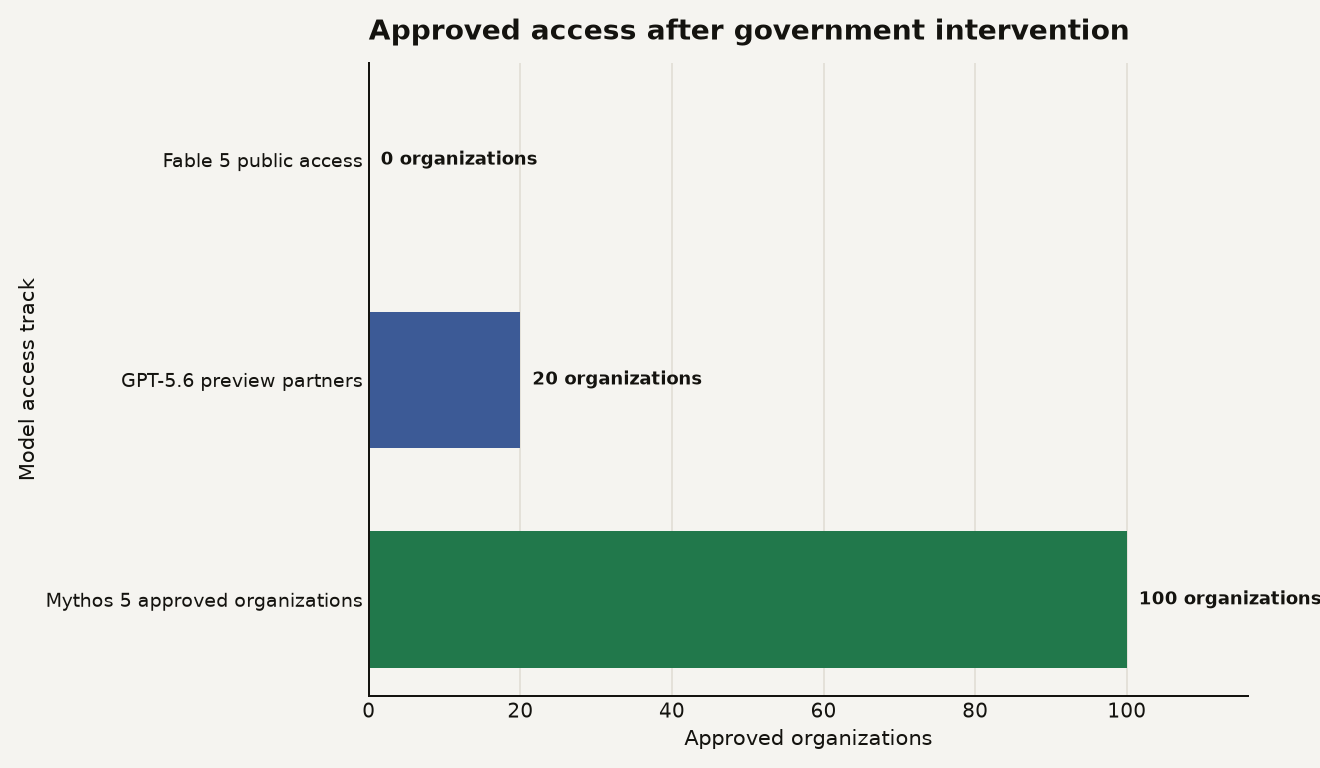
The chart above measures how many organizations can reach each model. The strongest model does little for your roadmap if you cannot get onto the list.
| Model or family | Access after intervention | What builders should assume |
|---|---|---|
| Claude Fable 5 | No general-use return announced | Treat as unavailable until Anthropic posts a new access policy |
| Claude Mythos 5 | At least 100 approved U.S. agencies and companies | Useful for approved cyber and infrastructure buyers, risky for broad product dependencies |
| GPT-5.6 | Around 20 trusted preview partners at launch | Another sign that top-tier releases are becoming staged |
OpenAI's comparison is useful because it shows Anthropic was no longer alone by June 26. OpenAI said it began a limited preview of GPT-5.6 Sol, Terra, and Luna for a small group of trusted partners whose participation had been shared with the U.S. government, and Axios reported that the initial group was around 20 companies.
A technical dependency becomes a legal one
The whitelist turns a technical dependency into a sales and legal dependency. If your product promise says the agent uses the best available model for cyber triage, code repair, or vulnerability research, you now need a second sentence: available to whom?
Anthropic priced Fable 5 and Mythos 5 at $10 per million input tokens and $50 per million output tokens in the June 9 launch post, but price is suddenly the easy part. A $50 output rate is predictable. A government access list is not.
For builders, the consequences are concrete:
- Your fallback path is part of the product. If your agent depends on Mythos-class reasoning, define what happens when it falls back to Opus 4.8, GPT-5.5, an open model, or a human queue.
- Your customer segmentation now has a policy layer. A critical infrastructure buyer may get access to a model that a commercial SaaS customer cannot use, even inside the same workflow.
- Your procurement story gets longer. Security review, nationality controls, data retention, and model access evidence become part of the enterprise close.
- Your eval suite needs an availability dimension. Benchmark saturation already hides agent fragility, as we argued in our piece on why saturated benchmarks still leave agents exposed, and this episode adds another failure mode: the benchmark winner can vanish.
The cost problem is subtle. If you overbuild for the newest model, you pay twice. First, you pay integration time while access exists. Then you pay migration time when access narrows. That is not a theoretical platform risk. Anthropic's sequence compressed it into 17 calendar days from launch to limited redeployment.
The business risk is also sharper than a typical API outage. An outage affects everyone and usually has a status page. A whitelist affects classes of users differently. Your U.S. government customer may regain access while your multinational enterprise account cannot. Your U.S. citizen engineer may be allowed to test something your foreign national teammate cannot touch. That is product management by passport, and it is miserable to explain after the contract is signed.
Make model availability explicit
Start by making model availability explicit in your architecture. Do not bury the model choice inside a prompt wrapper and call it a day. Treat it like a region, permission, or data residency constraint.
A good internal policy for June 2026 has at least four states: generally available, trusted preview, customer-specific approved, and unavailable. Those states should sit beside your latency, price, and quality metrics. If your router cannot represent those states, your product will lie to the user sooner or later.
Anthropic's June 9 launch post said Fable 5 would route some safeguard-triggering sessions to Claude Opus 4.8, with safeguards triggering on average in less than 5 percent of sessions. That routing design is the right shape for builders: graceful degradation beats a hard wall.
But do not copy the public description blindly. A fallback for risky cyber content is different from a fallback for all product access. Your own system needs to answer three questions before the next frontier release lands:
- Which workflows truly require the frontier model?
- Which workflows can degrade to a safer or cheaper model without breaking the user promise?
- Which workflows should stop and ask for human approval when the approved model disappears?
The third bucket is where many teams will underinvest. When a model can write exploit chains, migrate a 50-million-line Ruby codebase, or automate long-horizon security work, a weaker fallback can create a false sense of safety. Anthropic said Stripe reported a codebase-wide migration in a 50-million-line Ruby codebase in one day during early testing, but that claim belongs in your due diligence file, not your default product promise.
There is also a data retention wrinkle. Anthropic's Mythos product page says using Mythos 5 requires accepting a 30-day data retention policy for safety monitoring. That may be acceptable for vetted cyber defense work, but it will collide with some enterprise data handling policies. If your moat depends on being the first app to wrap Mythos 5, your moat may collapse at the legal review stage.
Watch the formal process
Watch the formal process, not the press cycle. The White House executive order signed on June 2 directs agencies to develop and maintain a classified benchmarking process for advanced cyber capabilities and asks developers to provide the federal government access to covered frontier models for up to 30 days before release to other trusted partners.
That order is framed as a security and innovation measure, but the market is already living inside the unfinished version. OpenAI said it does not believe the current government access process should become the long-term default, while also saying it accepted a limited GPT-5.6 preview as the strongest path to broader availability in the coming weeks.
That is the line to watch. If the government produces a repeatable process, builders can plan around it. If every release becomes a bespoke negotiation, the frontier model market turns into airport security for APIs. Shoes off, laptop out, roadmap delayed.
For Fable 5 specifically, there are three signals worth tracking:
- A new Anthropic access post. The June 12 statement says all other Anthropic models were unaffected, but Fable 5 and Mythos 5 were treated separately from the rest of the Claude lineup.
- A public safeguard update. Anthropic's June 9 launch said Fable 5 used conservative safeguards and routed some risky topics to Opus 4.8, so a return likely needs a stronger story about bypass resistance.
- A government benchmark milestone. The June 2 order makes cyber capability assessment the center of the process, so Fable's general release probably depends on how its safeguards perform under that framework.
Builders should also resist the easy conclusion that restricted access automatically means the model is uniquely dangerous. Anthropic argued on June 12 that the demonstrated bypass identified a small number of previously known, minor vulnerabilities, and that other publicly available models could find them without the bypass. That could be true and still leave the government worried about scale, automation, and multi-step cyber workflows.
The useful stance is operational: assume the frontier will keep moving, and assume access will become conditional at the top end.
The new moat is launch resilience
The old frontier AI launch question was, "How good is the model?" The June 2026 answer has another column: "Can your product survive the access rule?"
Mythos 5 access returning for at least 100 approved organizations is good news for defenders who can get through the gate. For everyone else, it is a warning label on dependency design. The teams that win will still use the best models. They will also make sure a June 12 letter cannot take their whole product with it.
Sources
- TechCrunch: Trump Admin releases Anthropic Mythos to be used by more than 100 US companies, agencies
- The Verge: Anthropic's Mythos 5 is back
- Anthropic: Statement on the US government directive to suspend access to Fable 5 and Mythos 5
- Anthropic: Claude Fable 5 and Claude Mythos 5
- Anthropic: Claude Mythos
- OpenAI: Previewing GPT-5.6 Sol, a next-generation model
- Axios: OpenAI releases powerful new GPT-5.6 model under restrictions
- The White House: Promoting Advanced Artificial Intelligence Innovation and Security