Three weeks. That is how long Google kept Gemini 3.6 Flash around before shipping its replacement. On August 13, 2026, Google DeepMind introduced Gemini 3.7 Flash, calling it their most intelligent workhorse model yet for coding and agents. For a beginner watching the AI space, the breakneck release pace can feel like noise. But the numbers say this one matters: a real jump in coding ability at half the launch price of the model it replaces.
Gemini 3.7 Flash is Google's latest fast and affordable AI model, tuned for writing code and running automated multi-step tasks, and it costs $0.75 per million input tokens and $3.75 per million output tokens.
Tokens are the small chunks of text that AI models process. Input tokens are what you send to the model (your prompt), and output tokens are what the model generates back (its answer). A million tokens is roughly 750,000 words, so $0.75 per million input tokens means you can send about 750,000 words of text for under a dollar. The previous model, Gemini 3.6 Flash, launched at roughly double that price. The 3.7 Flash introductory price runs through the end of 2026.
If you are new to all this, our guide to which AI to use for tasks in 2026 covers the full range of AI options available. Here we focus on what 3.7 Flash changes.
Better reasoning than 3.6 Flash
The short version: Google improved the model's reasoning, meaning its ability to think through problems step by step before answering. The result shows up most clearly in coding benchmarks. Benchmarks are standardized tests that let you compare AI models on the same tasks, like a standardized exam for software.
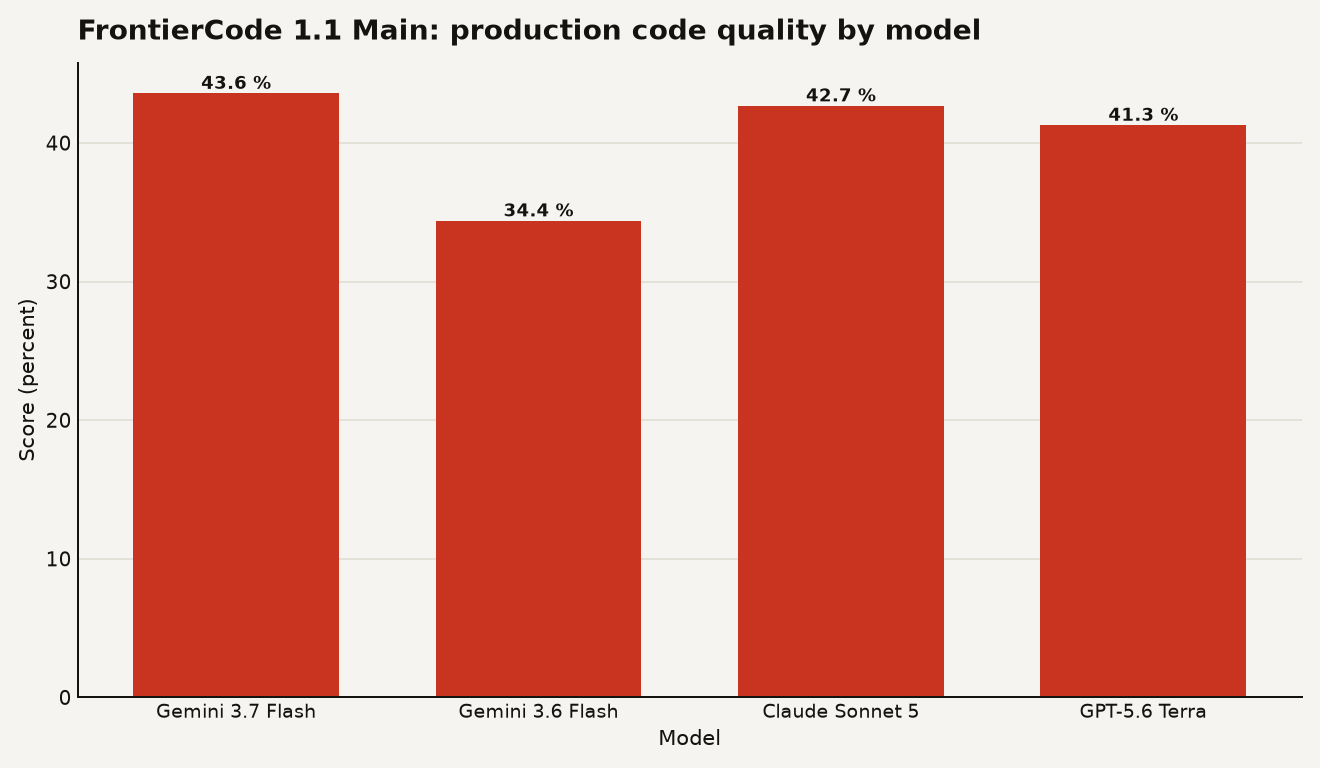
On FrontierCode 1.1 Main, a benchmark that tests whether a model can write production-quality code, Gemini 3.7 Flash scored 43.6 percent, up from 34.4 percent on Gemini 3.6 Flash. That is a 9.2 percentage point jump in a single generation. For comparison, Claude Sonnet 5 scored 42.7 percent and GPT-5.6 Terra scored 41.3 percent on the same test, according to the benchmark tables Google published, putting 3.7 Flash narrowly ahead of both.
On DeepSWE v1.1, a benchmark for long-horizon software engineering tasks (meaning multi-step coding projects that require sustained planning), the gap is even wider. Gemini 3.7 Flash scored 65.3 percent compared to 49.0 percent on 3.6 Flash. Claude Sonnet 5 scored 53.8 percent. GPT-5.6 Terra led the field at 69.6 percent, and Muse Spark 1.2 scored 54.9 percent.
The model also improved on Terminal-bench 2.1, which tests agentic terminal coding, meaning the model's ability to use a command-line interface to write, test, and fix code on its own. 3.7 Flash scored 85.8 percent, up from 78.0 percent on 3.6 Flash. That puts it close to GPT-5.6 Terra at 87.4 percent.
Not every benchmark moved. On CharXiv, a test of how well a model can read and reason about complex charts, 3.7 Flash scored 84.5 percent, basically flat with 3.6 Flash's 85.2 percent. The gains concentrate in coding and agent tasks.
Google also highlights gains in web development. On Arena.ai's WebDev Arena, a crowdsourced competition where human judges compare web apps generated by different models, 3.7 Flash achieved an Elo score of 1588 versus 1538 for 3.6 Flash. An Elo score is a rating system originally designed for chess that ranks competitors based on head-to-head wins and losses. A 50-point gap in Elo is noticeable in practice: it means 3.7 Flash wins roughly 57 percent of head-to-head comparisons against a model rated 1538.
Price against Claude Sonnet 5 and GPT-5.6 Terra
Google published a full comparison table against Claude Sonnet 5, GPT-5.6 Terra, and Muse Spark 1.2. The Artificial Analysis Intelligence Index is a composite score that combines many benchmarks into a single number. Gemini 3.7 Flash scored 56 on this index, up from 52 for 3.6 Flash. Claude Sonnet 5 scored 55, GPT-5.6 Terra scored 57, and Muse Spark 1.2 scored 57. So on raw intelligence, 3.7 Flash now sits in the same tier as the top competing models.
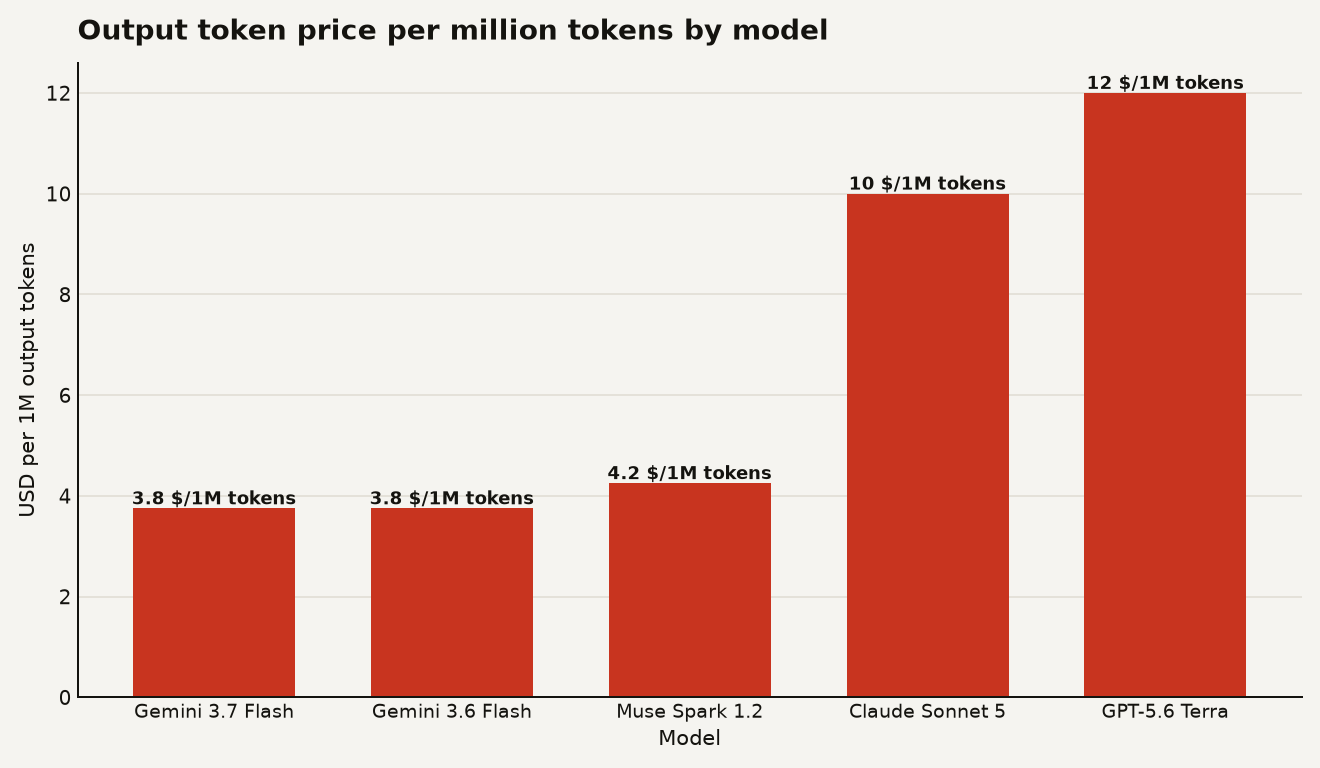
Where 3.7 Flash stands apart is price. At $0.75 per million input tokens and $3.75 per million output tokens, it costs less than half of Claude Sonnet 5, which charges $2.00 for input and $10.00 for output. GPT-5.6 Terra costs $2.00 input and $12.00 output. Muse Spark 1.2 sits in between at $1.25 input and $4.25 output.
For a hobbyist building a small app, the price difference means you can run roughly 2.6 times more prompts with 3.7 Flash than with Claude Sonnet 5 for the same budget. If you are experimenting with agents that make dozens of API calls per task, that ratio compounds quickly.
A strong choice for coding right now
If you are writing code with an AI assistant, 3.7 Flash is a strong choice right now. The model does better at debugging (finding and fixing errors in code) and issue resolution (diagnosing why a program fails). Google says it thinks more diligently, meaning it spends more effort on multi-step planning before generating code, which translates to fewer retries on your end.
The context window is 1,048,576 tokens, which means the model can see about one million tokens of text at once. In practice, that is roughly 750,000 words, or a large codebase with documentation. You can paste in multiple files and ask the model to reason across them without losing track.
One caveat: the knowledge cutoff. The model card from Google DeepMind says the training data goes up to March 2026 for some topics, but for others it is limited to January 2025. If you ask about a library or framework that released after January 2025, the model may not know about it or may hallucinate details. A hallucination is when a model confidently states something that is false. Always verify code suggestions against current documentation.
The model also has a 64K token output limit, meaning it can generate at most about 48,000 words in a single response. For most coding tasks that is plenty, but if you are generating very long files, you may need to work in chunks.
Gemini Spark, Google's personal agent
Gemini Spark is Google's personal AI agent, available to Google AI Pro and Ultra subscribers in over 160 countries. Think of it as an assistant that runs 24/7 and can take actions on your behalf inside Google Workspace apps like Gmail, Docs, and Sheets. As of August 13, 2026, Spark switched to using Gemini 3.7 Flash under the hood.
If you already pay for Google AI Pro or Ultra, you do not need to do anything. Your Spark experience should improve automatically, with better accuracy on multi-step workflows like consolidating files, drafting emails, and updating status documents. If you are a developer building with the Gemini API, Spark is separate from your API access and does not affect your pricing or quotas.
What to do with 3.7 Flash today
Here is the practical breakdown:
- If you are a hobbyist or beginner coder: Try 3.7 Flash in Google AI Studio, Google's free playground for testing models. You can type prompts, paste code, and see results without setting up billing.
- If you are building an app with an API: 3.7 Flash is available through the Gemini API at the introductory price through the end of 2026. The low price makes it a good default for agent workflows that need many API calls.
- If you are choosing between models: 3.7 Flash is competitive on coding quality with Claude Sonnet 5 and GPT-5.6 Terra at less than half the cost. For pure reasoning or knowledge work tasks like legal analysis, Claude Sonnet 5 still leads on some benchmarks like GDPVal-AA v2 with a score of 1598 versus 3.7 Flash's 1525.
- If you care about open-weights models (models you can download and run on your own hardware): 3.7 Flash is proprietary, meaning you can only access it through Google's servers. For a local alternative, consider Muse Glimmer 30B for local agents.
One thing to watch: the introductory price. Google says $0.75 and $3.75 per million tokens runs through the end of the year. Whether that price sticks or rises in 2027 is unknown. If you are building a product on this model, budget for the possibility that costs change.
Another open question is how 3.7 Flash holds up in real-world use versus benchmarks. Benchmark scores measure performance on standardized tests, but your actual codebase and workflow may surface different strengths and weaknesses. The model card notes that the model can still hallucinate and may occasionally have slowness or timeout issues.
Google also shipped updated safety safeguards against misuse in chemical, biological, radiological, and nuclear domains, plus cyber offense. For a beginner building a coding assistant, these protections are background noise. They matter if you are building tools in sensitive research areas.
Production-grade coding agents at beginner prices
Gemini 3.7 Flash is the first model that lets a beginner or small team build production-grade coding agents at a price that does not sting. It matches or beats models costing twice as much on the benchmarks that matter for software engineering. The model's quality is strong. The bigger risk is Google's release pace: two Flash generations in three weeks, with no sign of slowing. Build around the API and treat model names as interchangeable.
Sources
- blog.google , Introducing Gemini 3.7 Flash
- deepmind.google , Gemini Flash model page with benchmark tables
- deepmind.google , Gemini 3.7 Flash Model Card
- arstechnica.com , Google announces Gemini 3.7 Flash just three weeks after previous release
- docs.cloud.google.com , Gemini 3.7 Flash on Google Cloud