There is a specific frustration every builder knows: you want to automate a workflow that touches five SaaS tools, three of which have no API, and the other two rate-limit you into uselessness. SpaceXAI's Grok Bot, launched in beta on August 11, proposes to solve this by logging into those tools the way a human would and operating their interfaces directly.
The product comes from the SpaceX division formerly known as xAI, a company that has been expanding its AI compute business aggressively over the past year. It enters a crowded field. The Verge reports that the "AI teammate" category already includes OpenAI's ChatGPT Work, Anthropic's Claude Cowork, and Microsoft's Copilot Tasks. Grok Bot's distinguishing claim is that it does not require applications to expose APIs or Model Context Protocol support. VentureBeat reports that the company explicitly says this includes applications with "no clean API or MCP." Each Bot operates from its own cloud-based computer, works while your laptop is closed, and returns only when it needs approval or has finished the assignment. According to the same report, beta pricing starts at $120 per seat per month for Cursor Premium Teams, $200 per month for individuals on Cursor Ultra, and $300 per month for SuperGrok Heavy subscribers.
Grok Bot uses apps like a person
The core technical differentiator is the approach to tool access. Most agent frameworks, from LangChain to the Model Context Protocol ecosystem, require explicit integration: an API endpoint, a tool definition, a function call. Grok Bot sidesteps that entirely. The Bot signs into tools using credentials you provide, interacts with their interfaces as a human would, and maintains its own cloud computer environment that stays running 24/7.
This is architecturally distinct from API-based agents, and the distinction matters for what you can actually automate. A sales Bot, to use the company's own example, can research accounts, score prospective contacts, prepare email and LinkedIn outreach in the user's voice, and assemble results for human approval. That workflow touches LinkedIn, a CRM, and an email client. Building that pipeline with traditional agents would require working around LinkedIn's scraping restrictions, integrating with a CRM API, and configuring an email provider. Grok Bot just logs in and does it.
The multi-agent coordination layer is the second notable feature. Users can place multiple Bots in a group conversation where they assign ownership, transfer work, and coordinate among themselves. SpaceXAI says employees internally placed a Chief of Staff Bot above specialist Bots responsible for functions like inbox management, recruiting, expenses, and bug fixes. This is a hierarchical orchestration pattern that mirrors how human teams operate, and it is more ambitious than the single-agent-assistant model most products ship with.
The system also learns by watching. A user can demonstrate a workflow while a Bot follows along, and the Bot saves that sequence as a reusable routine that runs automatically on subsequent requests. CompsMag's coverage notes that the agents retain context from previous interactions and persist across devices. SpaceXAI says Bots become proactive over time, "picking up work before you need to ask." That last claim is the one to watch carefully. Proactive agent behavior in production systems is where permission boundaries get tested.
The distribution channel is worth noting separately. SpaceX acquired Cursor for $60 billion in June, according to the VentureBeat report, and Grok Bot ships through Cursor's subscription tiers. That gives SpaceXAI a built-in audience of developers already paying for AI-assisted coding. The question is whether those developers want their coding tool to also run their sales outreach.
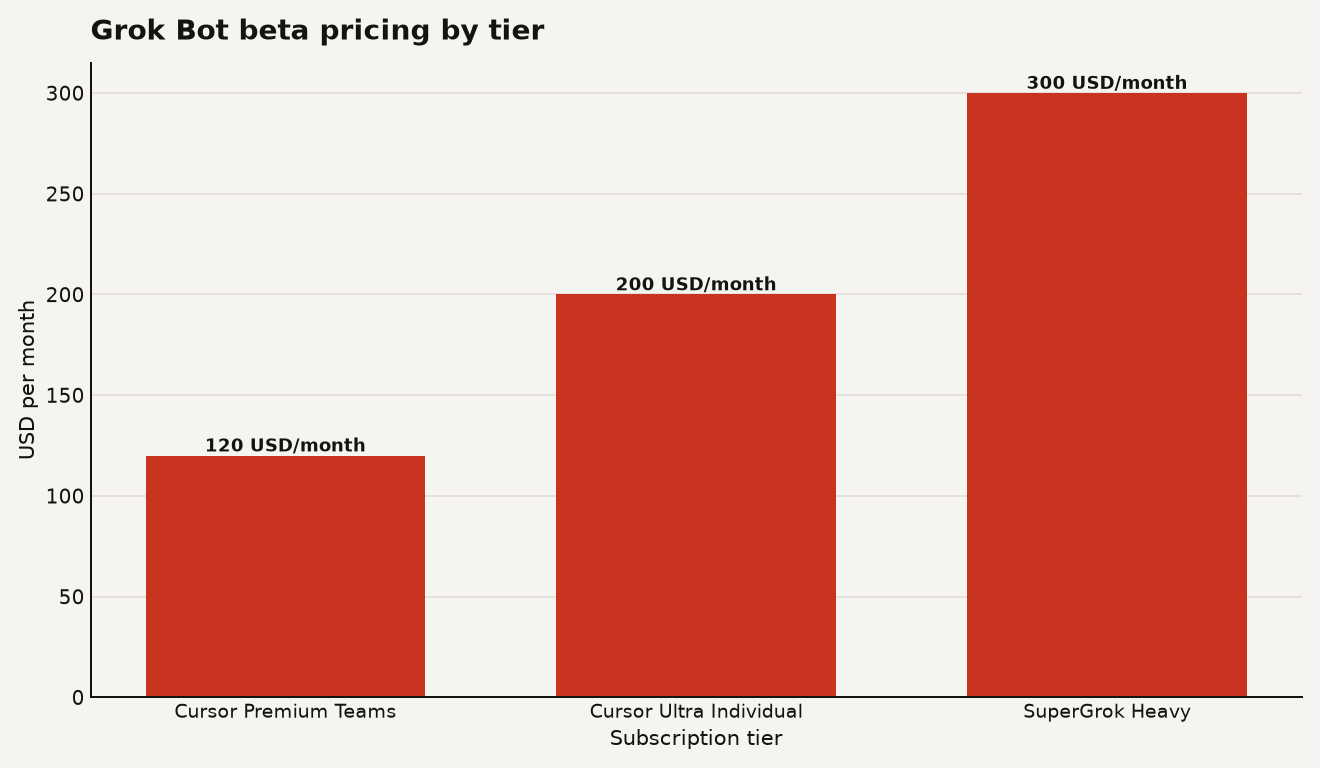
The chart above shows the three beta pricing tiers: $120 per seat per month for Cursor Premium Teams, $200 per month for individuals on Cursor Ultra, and $300 per month for SuperGrok Heavy. The teams tier adds centralized billing, a team marketplace for skills and plugins, shared usage analytics, and SAML/OIDC single sign-on.
Your credentials widen the security surface
Every security concern you have about API-based agents gets worse when the agent is logging into a production tool through its UI. API integrations give you audit logs, rate limits, and scoped permissions. A Bot that signs into your CRM with your username and password, or your session token, operates with your full access level. There is no principle of least privilege when the agent is impersonating you.
This is not a theoretical concern. The credential-sharing security gap that already affects 54% of enterprises becomes substantially harder to close when agents need persistent, full-access logins to do their jobs. Grok Bot's model requires you to hand credentials to a cloud-based computer you do not control, running software you cannot inspect, and trust it to operate within boundaries you cannot easily verify.
The proactive behavior claim compounds the risk. GlitchWire reports that people are already using Grok Bot to negotiate with vendors in their own voice, manage support tickets for online stores, and maintain CRM databases. A Bot that takes initiative in a production CRM, support ticketing system, or financial tool can make mistakes at scale and at speed. The launch announcement acknowledges this tension but does not detail the permission controls, escalation rules, or audit mechanisms that would make proactive behavior safe in a production environment.
The behavioral memory feature raises a separate concern. Bots that "learn preferences" and "learn when to interrupt for approval versus continue independently" are building a model of your workflows that lives in SpaceXAI's infrastructure. If you move to a different agent platform, that accumulated context does not transfer. It is a switching cost dressed up as a feature.
For builders, the security checklist before deploying Grok Bot should include:
- Which credentials are you handing over, and can you scope them? Probably not, if the Bot needs to log in as you.
- What audit trail does the Bot produce? Can you reconstruct what it did after the fact?
- What happens when the Bot makes an error in a production system? Is there a rollback path?
- Who at your organization can review the Bot's accumulated behavioral memory?
- What is your offboarding plan if you stop using Grok Bot?
None of these questions are unique to Grok Bot, but the UI-based access model makes each one harder to answer than it would be with an API-scoped integration.
$120 per seat targets buyers
The pricing reveals who SpaceXAI thinks the customer is. At $120 per seat per month for teams, Grok Bot costs more than most SaaS tools and less than most employees. The positioning is explicit: this is a digital worker. The company says "Bots are AI teammates that do real work for you," and the pricing matches that framing.
For an individual builder on Cursor Ultra at $200 per month, the value proposition is different. You are already paying for an AI coding assistant, and Grok Bot comes bundled. The question is whether you trust an agent with your credentials for non-coding tasks like expense management, vendor negotiation, or CRM maintenance. The use cases SpaceXAI lists span far beyond the developer workflow that Cursor was built for: Sales Outbound, Talent Scout, Paid Media, Expense Manager, Product Performance, Bug Reproduction, Account Health, and Chief of Staff.
The agent cost problem that has hit Copilot users is relevant here. Agent workloads are unpredictable in consumption. A Bot that runs 24/7 and takes proactive action could rack up token costs that dwarf the subscription price. SpaceXAI mentions "extended AI-token limits" for the Cursor Ultra tier but does not publish what those limits are, how they scale with multiple Bots, or what happens when you exceed them. If you are evaluating Grok Bot for a team, the subscription price is the floor, not the ceiling.
Beta caveats before production
Grok Bot is in beta, and the caveats that apply to any beta apply here with extra weight because the product operates in your production tools.
Start with read-only tasks. Have a Bot research accounts or compile reports from tools where a mistake is reversible. Do not hand a Bot write access to your CRM, financial system, or support queue on day one. The learning-by-watching feature is a good entry point: demonstrate a workflow, let the Bot save it, and review what it captured before letting it execute independently.
Test the multi-agent coordination in a controlled setting before deploying it against real work. The Chief of Staff pattern, where one Bot manages specialist Bots, is powerful but adds failure modes. If the Chief of Staff Bot misroutes work or misinterprets a handoff, the error propagates across all the specialist Bots it manages. SpaceXAI's internal use is encouraging but not conclusive. The company says adoption "spread quickly" internally but has not published failure rates, accuracy metrics, or incident reports.
Watch the security tools from the Open Secure AI Alliance for guardrails that might apply. The current agent security ecosystem is built largely around API-based access patterns, and UI-based agents may require new approaches to monitoring and control.
The Android gap is minor for most builders but worth noting if your team is mobile-first. iOS is available at launch. Android is listed as "coming soon" with no date. The beta is also limited to three subscription tiers: SuperGrok Heavy, Cursor Ultra, and Cursor Premium Teams. Enterprise and team users outside those tiers can join a waitlist, but SpaceXAI has not specified when general availability will arrive or what pricing will apply.
Finally, watch what happens with the proactive behavior claims. The beta likely ships with Bots that respond to explicit instructions. The proactive features, where Bots identify work before being asked, are the features most likely to be delayed, scaled back, or gated behind higher tiers. They are also the features that would make Grok Bot genuinely different from a well-constructed Zapier workflow with API integrations.
Production will decide whether Bots survive
SpaceXAI has built something architecturally interesting: an agent that does not wait for the world to build APIs for it. The UI-first approach solves a real problem, and the multi-agent coordination model is more sophisticated than what most competitors ship. But the product launches into a market where agent security failures are already common, where agent costs are already unpredictable, and where the gap between demo and production is measured in the number of edge cases an agent has not seen. Grok Bot's beta will tell us whether the UI-first model works at scale. The security model will tell us whether it should.