SpaceX just filed its first quarterly earnings report as a public company, and the number that should stop you is not the $7.8 billion in total revenue or the 92% year-over-year jump. It is this: the AI division brought in $2.6 billion, while the space division, the one with the rockets and the name on the building, brought in $962 million. SpaceX is now an AI compute company that also flies rockets.
The company went public in June 2026 with the largest IPO on record, and told investors in its filing that most of its value would come from AI, not space. This earnings report is the first hard evidence of what that looks like in practice. SpaceX spent $18.4 billion in capital expenditures in a single quarter, with well over 80% going to AI infrastructure. It signed compute deals with Anthropic worth up to $1.25 billion per month and with Google worth up to $920 million per month. It is now competing head to head with CoreWeave and the hyperscalers to sell GPU capacity to the same AI labs racing to build frontier models.
If you build or buy AI infrastructure, a new deep-pocketed entrant just changed the supply side of the market.
How much of SpaceX is actually an AI company now?
The Q2 2026 numbers tell the story plainly. SpaceX reports three segments: space, AI, and connectivity, which is the Starlink satellite internet service.
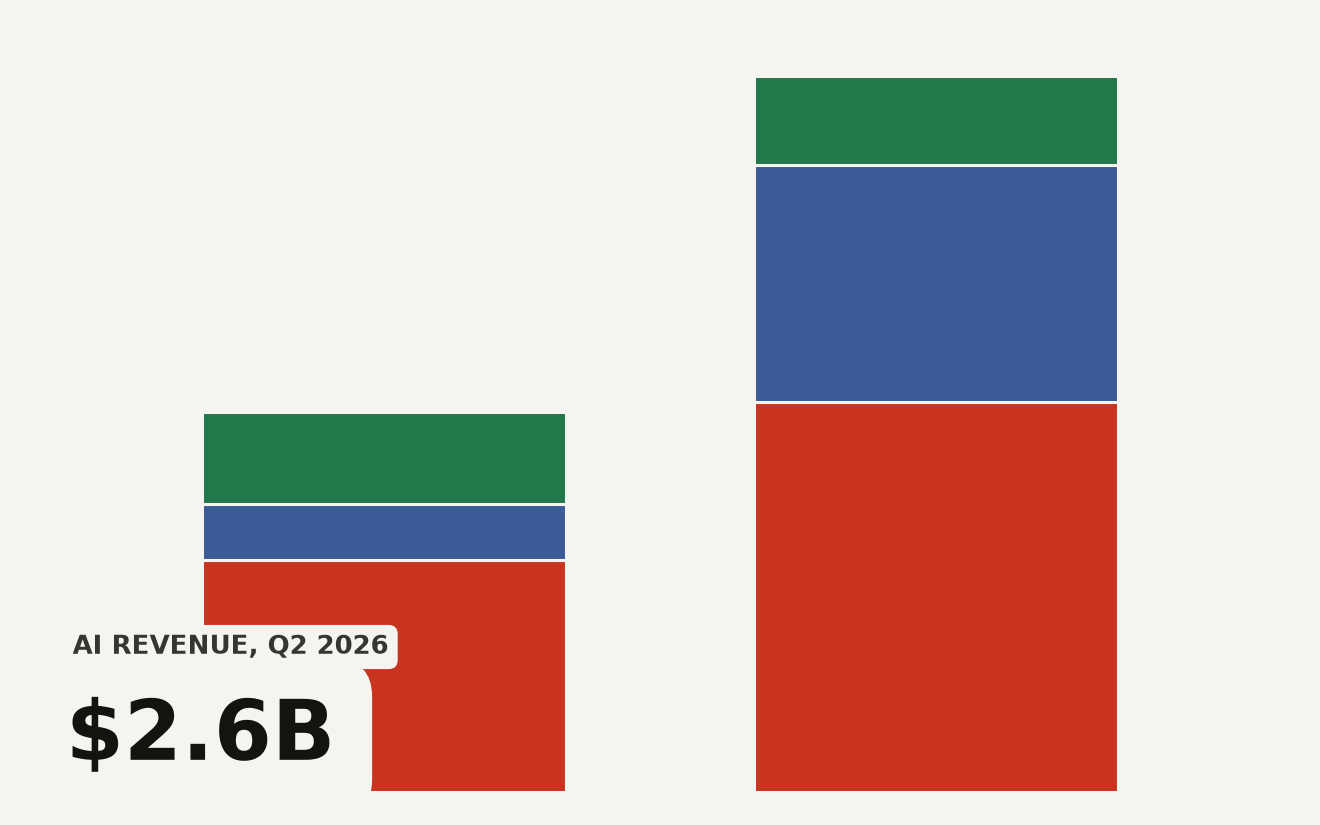
Starlink remains the single biggest revenue source at $4.2 billion, up 66% from the same quarter last year, and it is the only profitable part of the company. The AI division, which includes xAI, Grok, the social platform X, and the data center operation, generated $2.56 billion in revenue, surging roughly 250% year over year. Space, the original business, contributed $962 million.
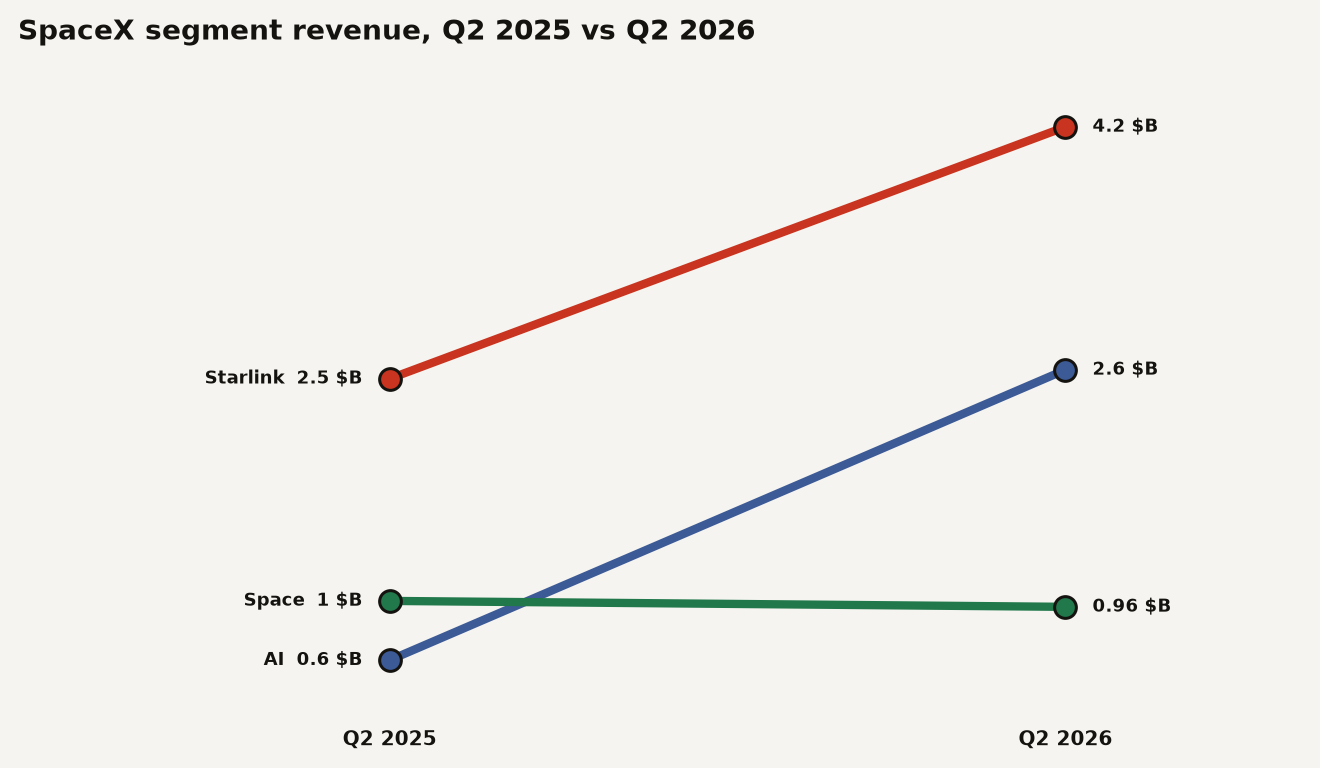
The chart above shows the shift in one image. A year ago, AI was the smallest of the three segments at roughly $600 million. Now it is the second largest at $2.56 billion and growing the fastest. Space revenue, by contrast, was roughly flat year over year, while the cost of developing space technology rose by $389 million, with Starship as the primary driver. SpaceX's CFO Bret Johnsen told investors the company has an additional $6.7 billion in cloud services revenue under contract, ramping over a six-month period starting in October 2026.
The AI division is still losing money. It posted a $1.26 billion operating loss in Q2, following a $2.47 billion loss in Q1. But the total company operating loss narrowed to $143 million from $970 million a year earlier, kept afloat by Starlink's swelling operating income, which grew 79%.
Who is buying SpaceX's compute, and at what price?
The deals that turned SpaceX into a neocloud are remarkably large and remarkably public.
Before its IPO, SpaceX had built data center capacity for its own AI model, Grok, which had fallen behind competitors like OpenAI and Anthropic in the frontier model race. Rather than let that capacity sit idle, SpaceX started renting it out. The strategy has produced three contracts that form the backbone of its AI revenue:
- Anthropic: up to $1.25 billion per month for three years, for compute capacity at SpaceX's Colossus data center in Memphis, Tennessee.
- Google: up to $920 million per month, signed in June 2026 just days before the IPO.
- Reflection AI: up to $150 million per month.
These are maximum amounts, not guaranteed revenue. But even at a fraction of the ceiling, the Anthropic deal alone could generate more in a single month than the entire space division earns in a quarter. And SpaceX is building more capacity, not less. Capital expenditures in the AI segment hit $15.83 billion in Q2 2026, up from $749 million a year earlier, a twentyfold increase. Through the first half of 2026, total capex reached $28 billion, compared with $7 billion in the first half of 2025.
The competitive landscape is now SpaceX, CoreWeave, and the three hyperscalers all chasing the same finite set of frontier AI labs as compute customers. If you have been tracking the compute cost transparency problem that leaves most enterprises flying blind on spend, this adds a new wrinkle: the supply side is getting more concentrated, not less, even as total capacity grows. The same pattern that drove AMD's $5 billion Anthropic infrastructure bet is now playing out at twenty times the scale, with SpaceX as the newest and most aggressive entrant.
Does the math work on $18 billion in quarterly capex?
This is the question Wall Street asked after the report, and the answer is why shares declined despite a revenue beat.
SpaceX's capex of $18.4 billion in one quarter is more than double its total revenue for the same quarter. Through the first half of 2026, capex of $28 billion exceeds the company's full-year 2025 revenue of $18.67 billion. The company is spending money faster than it earns it, funded by a $100 billion war chest raised in its IPO and a subsequent bond sale.
Musk and Johnsen framed the spending as self-liquidating. Johnsen said on the call that SpaceX can deploy capital in its compute business in a way that delivers less than a one-year payback. Musk went further, calling the $100 billion annualized revenue run-rate target by December 2026 a certainty, saying it is what the company would achieve if it did nothing.
Those are aggressive claims. The AI division lost $1.26 billion in the quarter on $2.56 billion in revenue, meaning the cost of delivering compute is still higher than the revenue it generates. The payback assertion depends on utilization rates, contract ramp timing, and whether customers actually draw down their maximum monthly commitments. The Anthropic and Google deals are structured as ceiling amounts, meaning actual revenue could be materially lower.
There is also the pending $60 billion acquisition of Cursor, the AI coding tool company, which has not yet closed. Musk said on the call they are close but did not want to jump the gun on regulatory approval. Johnsen's $100 billion ARR projection assumes that deal closes. Without it, the target gets harder to defend.
What does this mean if you are shopping for AI compute?
If you are a builder deciding where to run inference or training, the implications are practical:
- More supply is coming. SpaceX is building Colossus and other data centers at a pace that could meaningfully increase available GPU hours. More supply, in theory, puts downward pressure on compute pricing.
- But the market is concentrating. The big compute buyers are Anthropic, Google, and a handful of others signing nine-figure monthly contracts. If you are a smaller customer, your priority in the queue matters more than the theoretical market price.
- Watch the Cursor acquisition. If SpaceX integrates an AI coding tool with its compute business, it could offer bundled compute-plus-tooling deals that undercut standalone neoclouds on total cost. That would change the calculus for teams currently stitching together Cursor or Copilot with AWS or CoreWeave.
- The payback claim is unproven. If SpaceX's compute margins are negative today and depend on utilization ramping to break even, a slowdown in AI lab spending could leave SpaceX with stranded capacity. That is the CoreWeave risk, now at SpaceX scale.
For enterprises already struggling with compute cost transparency, the SpaceX earnings confirm that the infrastructure layer of AI is in a land-grab phase. The players spending the most are not necessarily the ones with the best margins. They are the ones with the deepest war chests and the highest tolerance for near-term losses.
The rocket company that sells GPUs
SpaceX's IPO filing said AI would be the source of most of its value. One quarter in, the numbers are starting to prove it. The space division, the rockets, the Starship program: all of it is now a minority of the revenue and a rounding error in the capex. The company that put space in its name is now spending $15.83 billion a quarter on AI infrastructure and under $1 billion a quarter on space technology.
Musk's pitch is that SpaceX can build data centers faster than anyone, including eventually in orbit. Whether that pays off depends on whether the Anthropic and Google contracts ramp to their maximums and whether a $60 billion coding tool acquisition makes strategic sense alongside a GPU rental business. The market's initial verdict, sending shares down after the earnings pop, suggests investors are not yet convinced.
But for anyone building on AI infrastructure, the signal is clear: the supply side of GPU compute is being reshaped by a company that treats $18 billion in quarterly capex as a down payment, not a final bill. Plan accordingly.