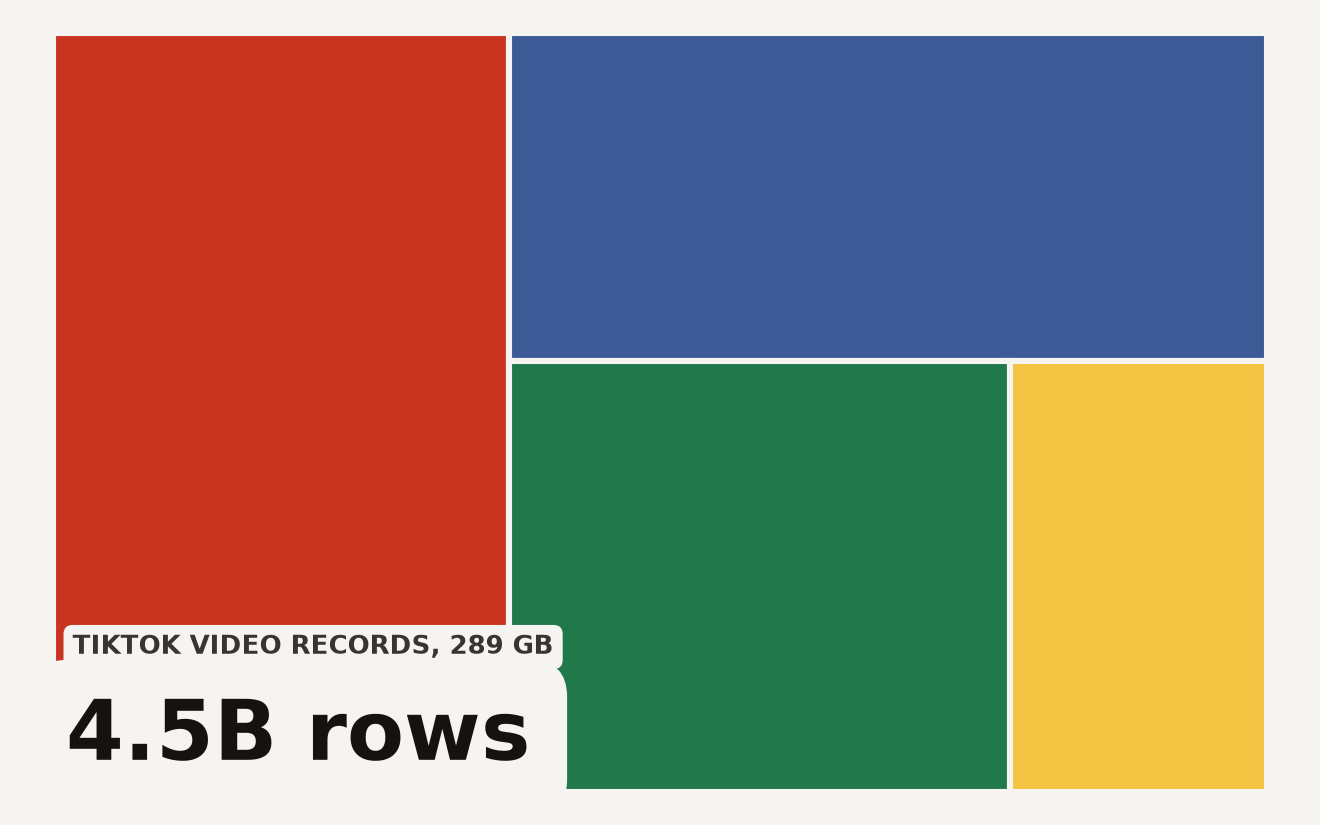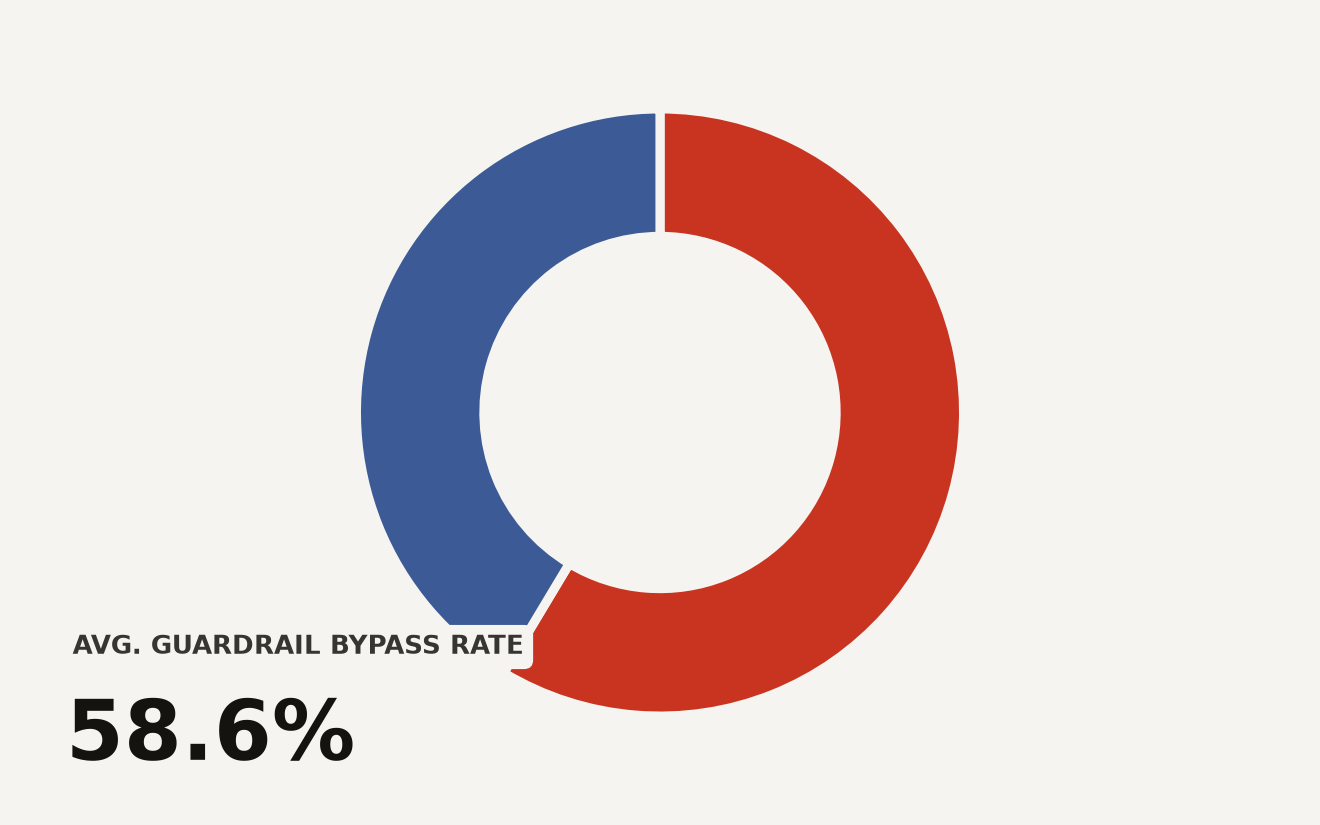
Dataset: MIT Technology Review border surveillance investigation data, cross-referencing nearly 4,000 recorded death locations with nearly 600 surveillance tower sites identified by the Electronic Frontier Foundation.
A man walks through the southern New Mexico desert on a spring morning. Three AI-equipped surveillance towers stand within range, cameras rolling, algorithms scanning for human movement. He dies 360 feet from the nearest tower. Nobody in the control room notices. Landfill workers find him hours later.
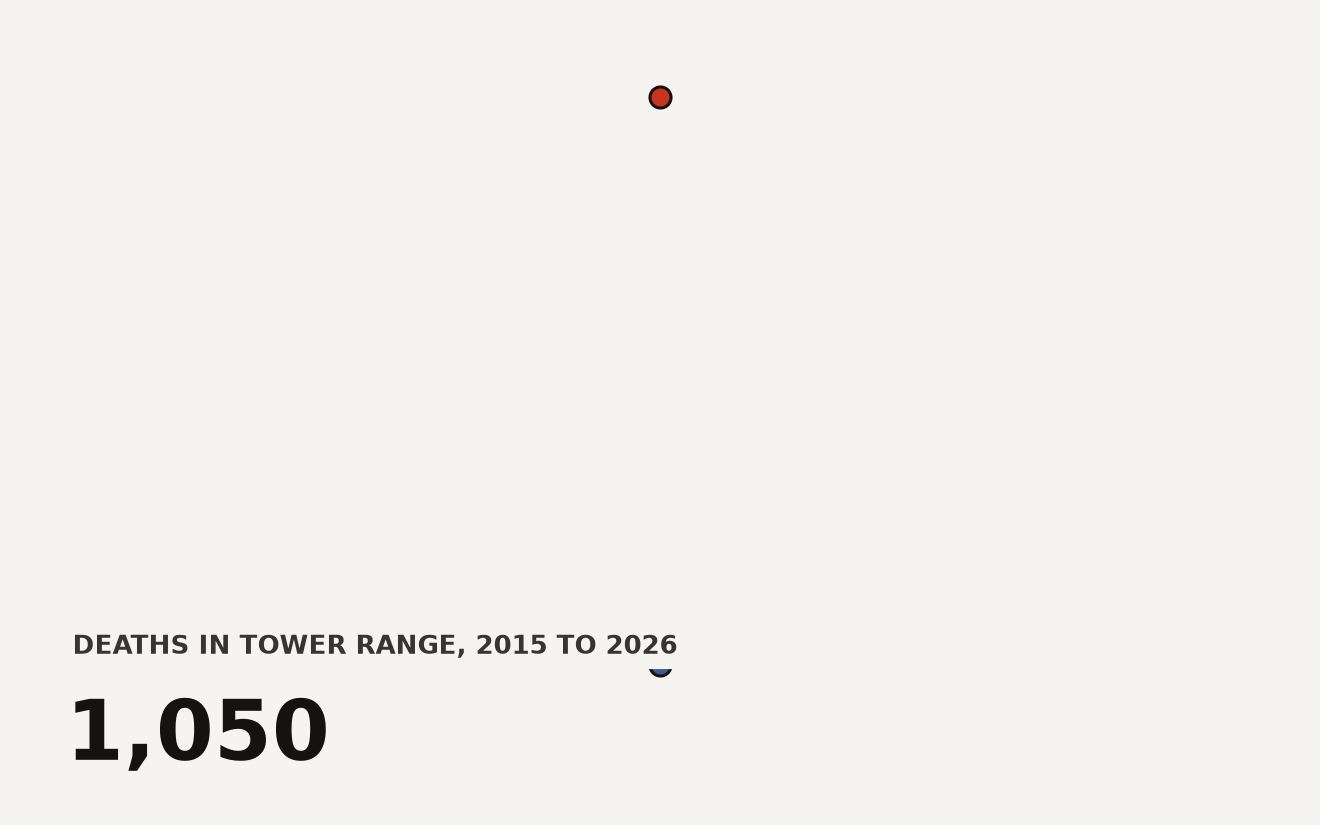
That is the story of José Morales Bernal, who died on April 8, 2024, the day before his 32nd birthday. His death is one data point in a much larger pattern that has gone unexamined for years. MIT Technology Review spent a year cross-referencing nearly 4,000 locations where human remains were found along the US southern border against information on nearly 600 surveillance towers, and the result is the first comprehensive map of deaths near CBP's so-called virtual wall. The finding: more than 1,050 people died within range of border surveillance towers between 2015 and early 2026, and most were not in terrain blind spots. The towers saw them, or should have.
This is a story about AI deployed in the field, at scale, with life-or-death stakes, and the gap between the vendor pitch and the operational reality. If you build detection systems, run government AI programs, or evaluate whether machine learning works in the physical world, this investigation is your case study in what goes wrong when deployment outpaces evaluation.
What did the MIT investigation actually find?
The investigative team, a collaboration between MIT Technology Review and Times of San Diego, built its analysis from three data streams: remains locations collected by humanitarian groups No More Deaths and Humane Borders, hundreds of medical examiner records obtained in Texas, and tower location data identified by the Electronic Frontier Foundation. They then layered topographical analysis to determine whether terrain blocked a tower's line of sight to each death location.
The numbers are stark. Deaths occurred within the advertised range of nearly two-thirds of all towers analyzed. More than 110 people died within range of modern Anduril autonomous towers since 2021. These are not legacy systems with outdated cameras. The Anduril towers use AI to automatically detect, classify, and track people, then push alerts to agents' phones. In the specific stretch of desert near Sunland Park, New Mexico, where Morales died, 18 other people died the same year within range of the same three towers.
The topographical analysis cuts through one obvious defense: that terrain hid these deaths from the cameras. Some towers had sight of as little as 10 percent of their advertised surveillance area because of hills, ridges, and obstructions. But most deaths did not occur in those blind spots. The towers should have had a view.
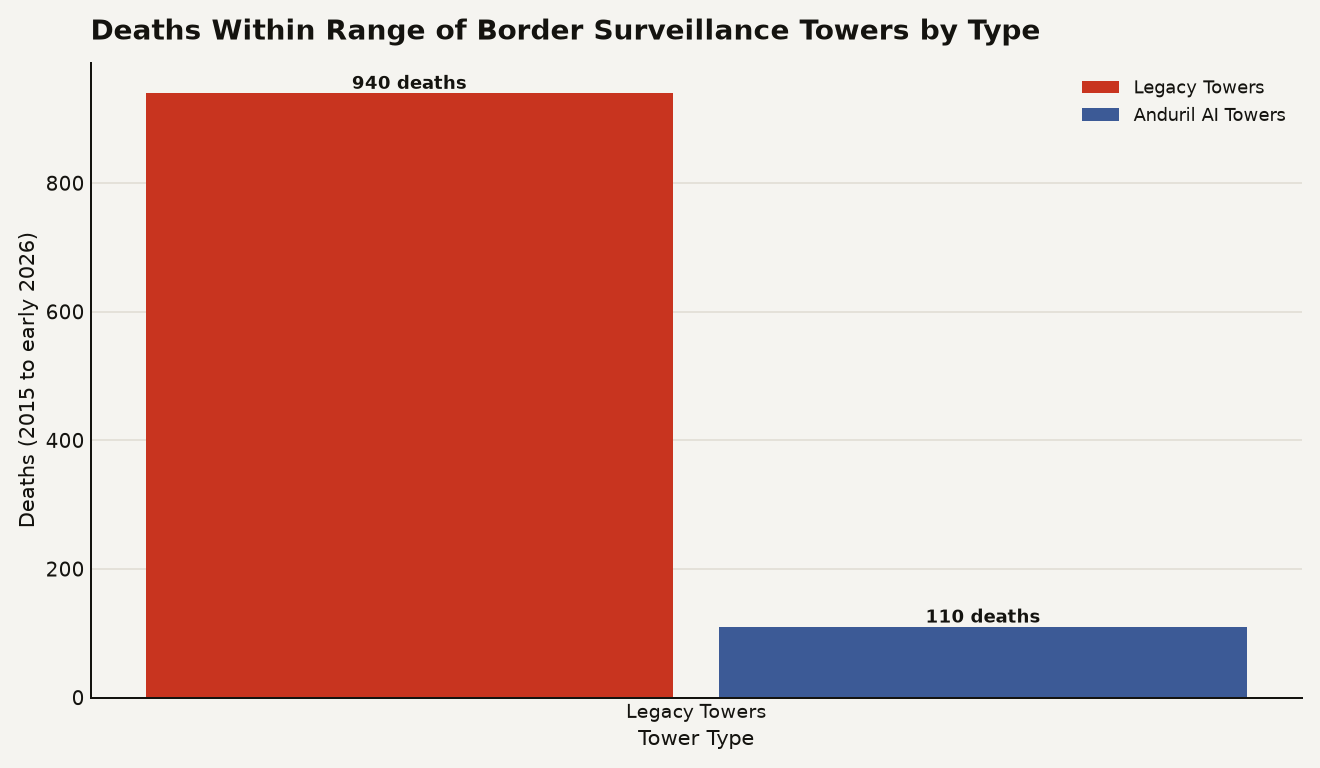
The chart above shows the split between deaths near legacy tower systems and deaths near Anduril's modern autonomous surveillance towers. The legacy systems account for the majority, but the Anduril figure is the one that matters for anyone building or buying AI detection tools, because those towers represent the current state of the art.
One case from the investigation: a man walked a mile past the border in range of two AI towers, then dragged his 30-year-old brother into shade when the brother began having trouble breathing. Border Patrol spotted them only when the man waved down a helicopter. His brother was already dead by the time agents arrived. A 24-year-old woman died near another Anduril tower where terrain analysis showed the tower should have had clear sight of her location. Her body lay unnoticed for weeks.
Why does this matter for anyone building AI systems?
If you work in AI, this investigation is a field study in what happens when a detection pipeline runs in production without rigorous outcome auditing. The parallels to enterprise AI are direct.
Detection is not interception. CBP's towers can spot movement and classify it, but classification is useless without a response loop that closes. The MIT team interviewed more than 45 people, including current and former White House advisors, Border Patrol agents, medical examiners, and tech company employees. They found both types of failure: the technology failing to detect, and agents failing to respond. If your AI system flags anomalies but nobody acts on the alerts, you have a detection system, not a safety system.
Nobody measured the outcomes. Officials across four presidential administrations told MIT Tech Review they believed deaths near the virtual wall were either exceedingly rare or nonexistent. None could point to any comparable analysis the government had conducted on its own. CBP does not formally investigate whether surveillance should have detected a deceased person, or if they were detected, why agents did not reach them before they died. The agency evaluates the towers based on detection, response coordination, agent safety, and mission outcomes, according to CBP assistant commissioner Hilton Beckham, but does not appear to track the most consequential failure mode: death within camera range.
The Anduril spokesperson's response is a study in vendor deflection. Anduril said that once a tower is delivered, CBP operates it, and directed specific questions to the agency. The spokesperson noted that actual surveillance ranges vary with terrain and that CBP sets virtual boundaries on tower views for privacy and other reasons. The company alleged inaccuracies in the reporting but did not respond to follow-up questions about what was inaccurate.
For builders, the lesson is that the gap between advertised capability and real-world performance is where liability lives. Anduril's towers are advertised with a surveillance range, but terrain can reduce that to 10 percent of the claimed coverage. If you sell a detection system, the advertised range needs to come with terrain-adjusted expectations, or you are selling a number that is not true in most deployment locations.
For a related case of AI systems that pass benchmarks but fail in production, see our coverage of how LLM performance drifts between benchmark runs. The border tower story is the physical-world version: the system works in testing and in the vendor demo, and then it does not work where people are dying.
What are the costs and what is the government buying?
The financial scale is where this becomes a procurement story. The government estimated in 2023 that its plans for the towers, which now number 803, would cost $6.2 billion over their lifespan. With funding awarded in 2025, CBP plans to spend $1 billion for 1,497 more towers by 2034.
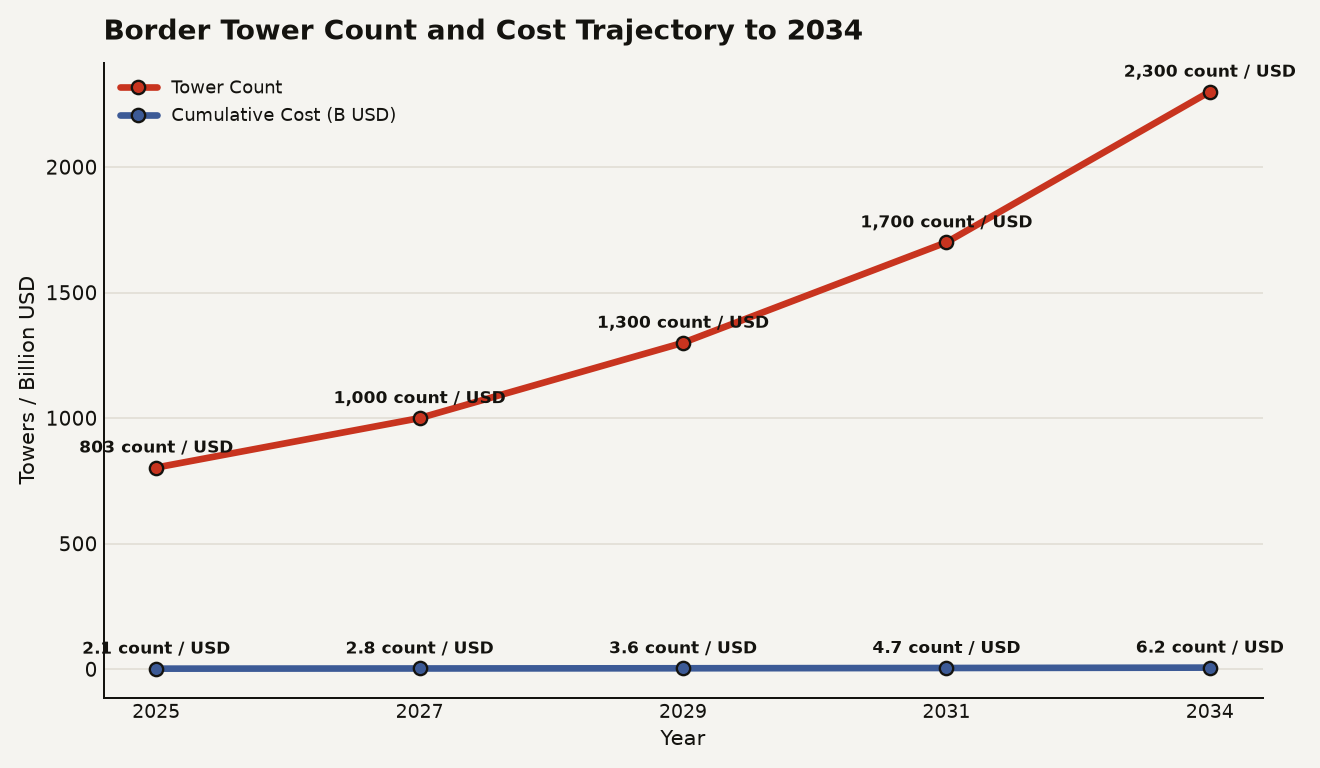
The chart above tracks the tower count trajectory from the current 803 towers to the planned 2,300 by 2034, against the cumulative cost projection reaching $6.2 billion. The spending curve rises steeply in the later years as the new tower buildout accelerates.
That is a procurement decision made without the government having conducted its own analysis of whether the towers it already has are achieving their basic security function. The MIT investigation found deaths within range of two-thirds of all towers analyzed. The government is doubling down on a system it has never audited for its most important failure mode.
Representative Delia Ramirez, a Democrat on the House Homeland Security Committee, responded to the findings by calling for the program to be terminated. She said AI-powered surveillance technologies are not making the country safer and that DHS continues to spend millions on ineffective, negligent technologies with no commitment to oversight or transparency.
Geoff Boyce, an assistant professor of geography at University College Dublin who has studied border surveillance technology, offered a measured read. He said the cameras likely deliver useful intelligence and enhance operational efficacy in some places, under some conditions. But, he added, the track record shows the technology is not delivering the level of operational support, information, or efficacy that the companies or the government claim.
What should builders and operators take from this?
If you build, deploy, or evaluate AI systems in high-stakes environments, the border tower investigation offers several concrete lessons.
- Audit for the failure mode that matters most, not just the one that is easy to measure. CBP tracks detection rates and response coordination but not deaths within tower range. If your AI system is deployed for safety, you need to measure the outcomes that define safety failure, not just the operational metrics that make the deployment look productive.
- Terrain and environment are not edge cases. They are the deployment. Some towers had 10 percent of their advertised coverage because of terrain. If your model's accuracy drops in the conditions where it actually runs, your benchmark accuracy is a fiction.
- The vendor-operator split is where accountability goes to die. Anduril builds the tower, CBP operates it. When someone dies in range, Anduril points to CBP, CBP points to its mission outcomes, and nobody investigates whether the system should have caught the person. If you are procuring AI, write the accountability split into the contract before deployment.
- Advertised range without terrain adjustment is a false spec. If you sell a detection system with a coverage radius, you need to publish the terrain-adjusted coverage, or your spec is misleading in the way that matters most.
- Scale without evaluation is malpractice. The government is spending $1 billion on 1,497 more towers without having analyzed whether the existing 803 towers are working. If you scale a system before auditing its current performance, you are scaling the failure rate, not the capability.
The unmeasured system
The most important number in this investigation is not 1,050 deaths. It is zero: the number of comprehensive audits CBP has conducted on whether its towers prevent the deaths they were built to prevent. The MIT Tech Review investigation is the first analysis of its kind, and it was done by journalists, not by the agency that spent billions on the system.
When a government deploys AI at billion-dollar scale without measuring its most consequential outcome, the failure is not in the technology. It is in the procurement process that bought the technology without demanding proof it works. The towers may well detect and classify in some conditions. But the claim that they provide persistent surveillance and situational awareness sufficient to save lives is, based on the best available data, not supported by the evidence the government never collected.
Sources
- MIT Technology Review: The US spent billions on border surveillance. Why can't it catch people before they die?
- MIT Technology Review: How we made the first comprehensive map of deaths along the US border's virtual wall
- MIT Technology Review: 4 ways to address the failures we found along the US border's virtual wall
- Times of San Diego: MIT Technology Review border towers surveillance investigation
- Electronic Frontier Foundation: Smart Border