Dataset: the figures here come from USAspending.gov, the US Treasury's public record of federal contract awards, which anyone can search and download. PriceProof republishes the award rows behind each product page as CSV and JSON.
Tableau's smallest recorded award to a US federal agency is $397. Its largest is $13,047,775.55. Both are contract totals for enterprise software, both are public, and neither one tells you what a Tableau licence costs.
PriceProof, a new public-records tracker for enterprise software, publishes both numbers side by side and refuses to collapse them into an average. Its first build covers 33 products and 2,368 awards, every figure traced to an award ID that resolves on USAspending.gov. If you buy software for a living, you know the alternative: list prices nobody pays, and case studies that name no figure at all. PriceProof publishes the paperwork instead.
The scope is narrow on purpose. The only category so far is data and analytics platforms, and the only buyer is the US federal government, with a search window running 1 October 2021 to 5 October 2026. What makes the site worth your time is the part most price trackers skip: it tells you what kind of number you are looking at.
A contract total is not a price
Every figure on the site carries one of four labels: a contract total, a unit price stated in the award text, a unit price derived from an amount and a quantity in the same award, or the vendor's own published list price. The site does not compare across those types, and it prints the type next to every number.
The harder filtering happens underneath. An award that names a product might be a licence purchase, a renewal, three years of implementation labour, a support contract, or a funding modification to a contract signed years earlier that adds money without buying anything new. PriceProof sorts every award by what its own description says it bought, then computes the headline band, the median and the range from the licence and renewal awards alone, leaving the rest in the evidence table, labelled and counted, where they cannot move the arithmetic.
Snowflake is a clean example. Seventeen federal awards name it, from August 2021 to September 2026. Ten are licences or renewals, and those ten run from $44,764.55 to $314,963.10, with a median of $99,500. The same product, bought by nine agencies through the same handful of resellers, produces a sevenfold spread between the cheapest and dearest contract. That spread is scope: capacity, term, seats, and how much of the award is labour rather than software.
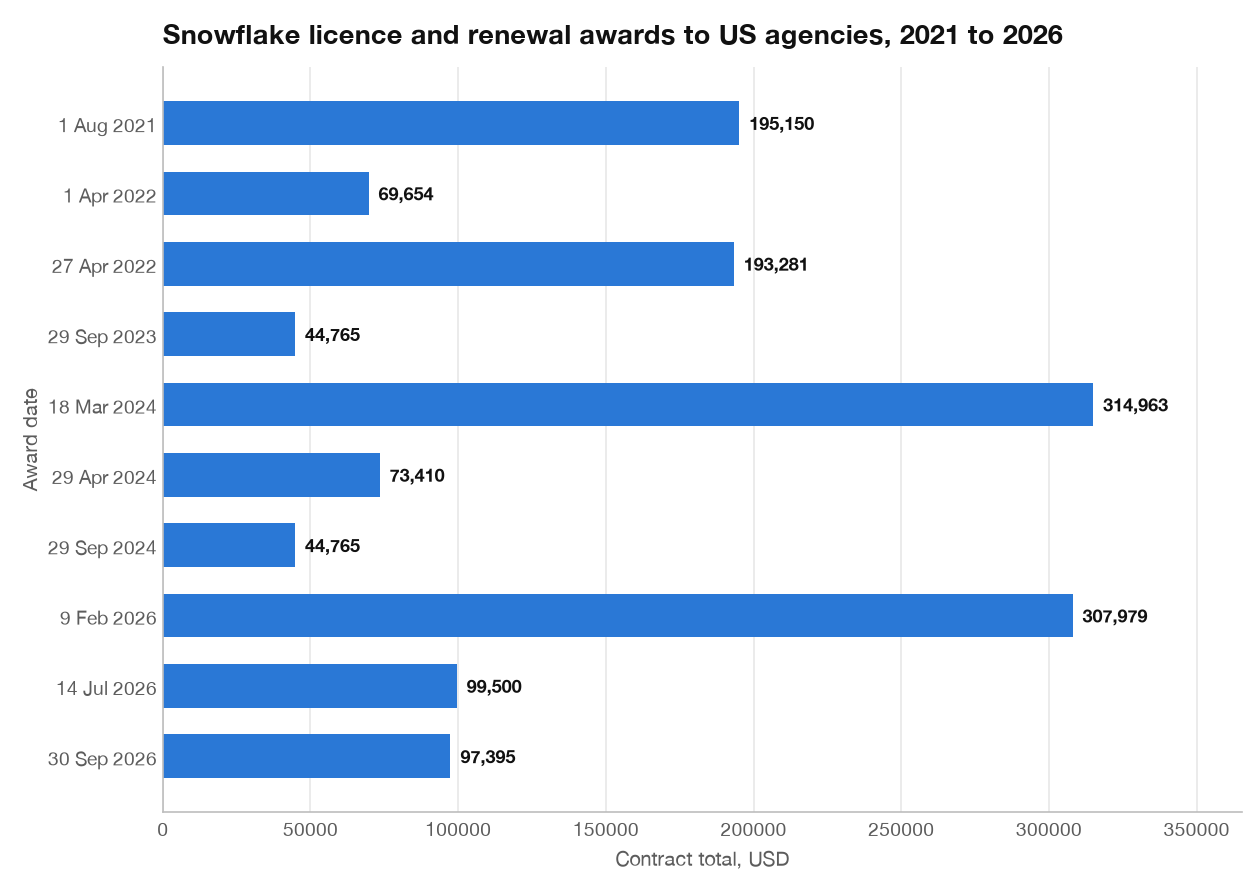
Two of those bars are identical, at $44,764.55, and they are a year apart, both from the Commerce Department through the same reseller. Nothing in the record explains the repeat, and both line items read simply "SNOWFLAKE SUBSCRIPTION".
Next to the band sits the vendor's list price for the same product: $2 per credit. The page says outright that the three are not comparable. The same trap catches anyone pricing an AI API from a list price, which is why the per-token arithmetic only becomes a bill once you know your own volume.
If you use a median contract total as your negotiation anchor, you are anchoring on somebody else's scope. Do it anyway, and know what you are holding.
The bar it will not lower
A product earns a page only when the evidence clears a fixed threshold: at least three distinct awards that name it, or one award plus a verified vendor list price. Fifteen configured products failed that bar and got no page. Looker and Fivetran each had two matching awards. Snowplow, dbt, Matillion, Microsoft Fabric, Sigma Computing and eight others matched nothing at all.
They are still listed, with the reason each one failed, at the bottom of the category page. A tracker that quietly dropped its misses would look more complete and be less useful. This is the fail-closed design, and it is the whole argument for the site.
It is also a response to a real bug. An earlier run built pages for Snowplow on awards for snow-clearing equipment and for dbt on a psychotherapy contract, both from coincidental string matches. The fix, described in the newsroom, was whole-token matching, negative guards on product names that collide with unrelated contracting terms, and a confidence floor below which a match is dropped and counted rather than promoted by hand.
What it cannot tell you
The limits are on the methodology page, written out by the publisher instead of extracted by a critic. Coverage is a floor, because an award that buys Snowflake under the line "data warehouse licences" never reaches the search. Text matching errs in both directions. Agencies key names and amounts inconsistently, and awards get modified after the fact, so the site republishes the source's errors until the source corrects them. Refreshes are periodic, not live.
The obvious objection is that none of this helps you buy anything. If you run a private company buying Databricks, a US federal contract total is not your price, and treating it as one would be a mistake. The objection is right about the number and wrong about the method. What travels is the discipline: knowing which awards are renewals before you compute anything, and refusing to blend a licence purchase with an implementation project. Most internal spend dashboards do not survive that test.
The counts are current as of October 2026, and the change history is empty: no published figure has moved since the first build. The open question is whether the method travels. One category, one buyer and five fiscal years is a small proof of concept. Apply the same rules to state and local contracts, or to the UK's Find a Tender service, and the record is thinner and the naming sloppier. The next category is the test. So is the day a published figure moves for the first time.
Sources
- USAspending.gov, US Treasury, award search.
- PriceProof methodology
- PriceProof data and analytics platforms
- PriceProof Snowflake page
- PriceProof newsroom