Marketing teams and product builders increasingly use LLM-powered synthetic personas to predict how audiences will react to copy before it ships. Build a panel of simulated readers, each with a demographic profile, feed them your headlines, and let the model tell you which one wins. It sounds smart. A new study says it makes your predictions worse.
A zero-shot no-persona baseline outperforms a ten-persona panel at ranking real A/B test winners, and the confidence intervals do not overlap.
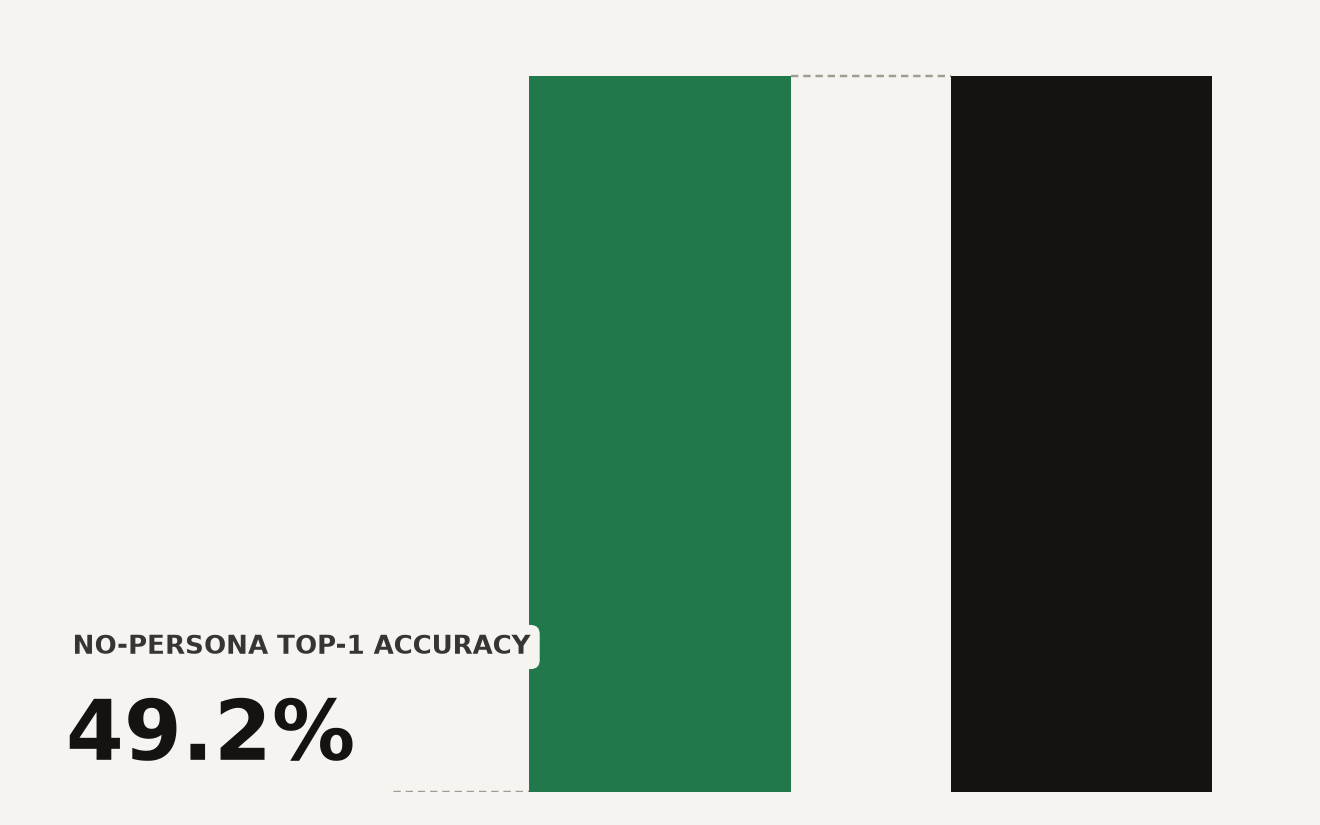
The paper, posted to arXiv in September 2026, tests persona-based copy simulation against held-out ground truth from the Upworthy Research Archive, a collection of thousands of real headline A/B tests with measured click-through rates. The authors, led by Alexandre Cristovão Maiorano of Lumytics, compare a demographically grounded ten-persona panel against a no-persona zero-shot baseline that simply asks the model how likely a typical reader is to click. On the reliable subset of A/B tests where a real winner is statistically distinguishable from the runner-up, the no-persona baseline achieves 49.2% top-1 accuracy and Kendall τ of 0.361, a medium effect. The persona panel manages only 34.6% top-1 accuracy and τ of 0.084, a small and barely significant effect. The gap between the two methods is the story: synthetic personas actively degrade a usable signal the base model already holds.
What did the study actually measure?
The Upworthy Research Archive is a rare asset for this kind of work. It contains thousands of headline A/B tests where the same story was shown to real readers on shared traffic, with different headlines, and click-through was measured. The archive gives you held-out ground truth: actual human behavior, not a synthetic benchmark the authors constructed.
The authors set up two prediction approaches. The ten-persona panel creates ten simulated readers, each grounded in the real audience's demographics. For each headline variant, each persona is queried in its own voice: how likely are you to click this? The model returns a structured click_intent value between 0 and 1. The panel's aggregate prediction is the average across all ten personas. The no-persona baseline asks a single question: how likely is a typical reader to click this headline? One prompt per variant, no role-play, no demographic conditioning.
The model used was gemini-3.1-flash-lite, selected through a model comparison the authors describe in the paper. They also tested robustness across three Gemini tiers and OpenAI's gpt-4.1, and the direction held across all of them with a significant paired gap.
Here is the first obstacle the authors hit. Most A/B tests in the archive have no statistically distinguishable winner. The top headline does not beat the runner-up by a significant margin when tested with a one-sided two-proportion z-test at p<0.05. Out of the full archive, only 399 packages have a reliable winner. Validating any predictor against noisy labels is ill-posed, so the analysis focuses on this reliable subset.
| Method | Top-1 accuracy [95% CI] | Kendall τ [95% CI] |
|---|---|---|
| No-persona baseline | 49.2% [44.2, 54.3] | 0.361 [0.289, 0.430] |
| Persona panel | 34.6% [29.8, 39.1] | 0.084 [0.020, 0.147] |
| Random | 30.4% | , |
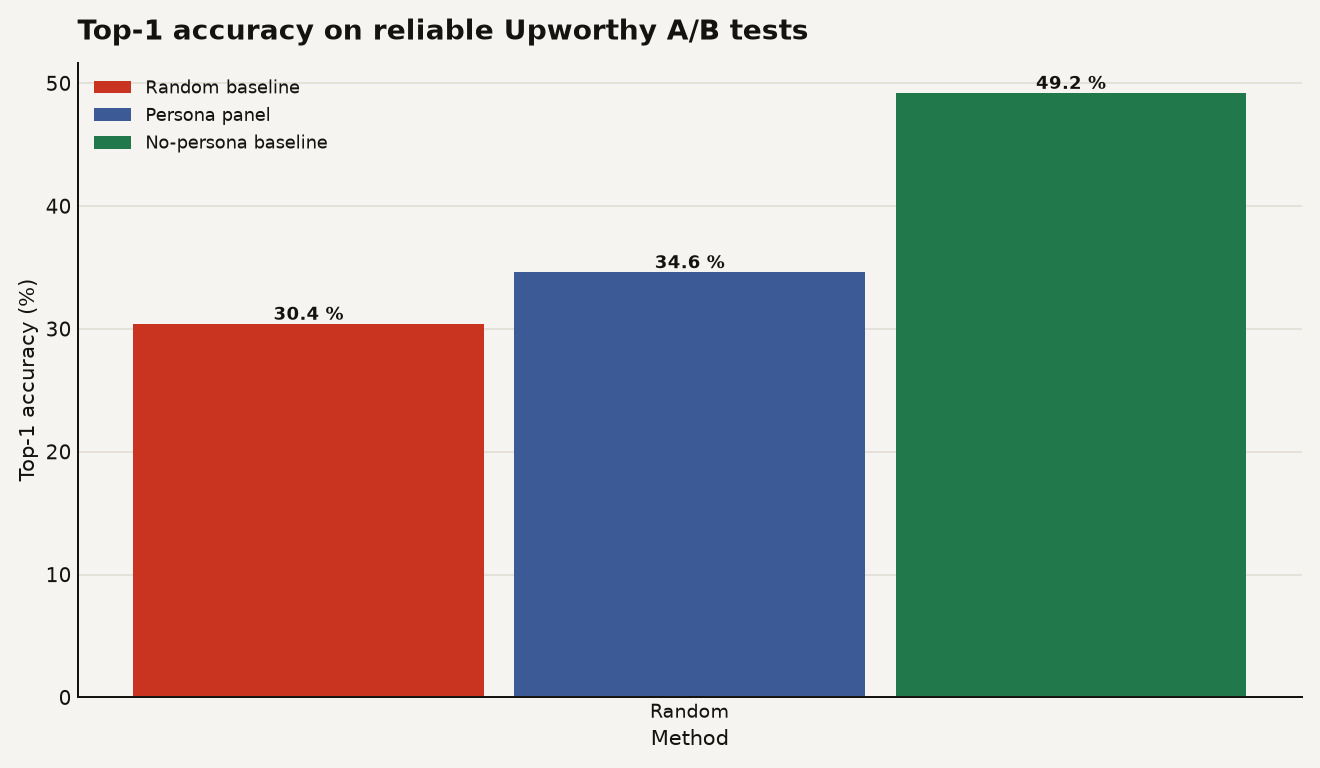
On that subset, the no-persona baseline ranks variants well. Its Kendall τ of 0.361 counts as a medium effect by Cohen's conventions, and its top-1 accuracy of 49.2% sits well above the random baseline of 30.4%. The ten-persona panel is far weaker: τ of 0.084 and top-1 accuracy of 34.6%, with confidence intervals that do not overlap the baseline's on any metric. The chart above shows the gap in top-1 accuracy across all three approaches.
Why does persona conditioning hurt prediction quality?
The authors offer a clear explanation. The base model holds an accurate population-level prior on what makes a headline clickable. When you ask it directly how likely a typical reader is to click, it taps that prior. When you force it to role-play a specific persona, you pull it away from the prior and inject bias and noise.
Think about what a persona actually does to the model's output. You give it a demographic profile and ask it to answer in that persona's voice. The model generates a character, complete with preferences, biases, and a worldview that may or may not match any real person in the target audience. Each persona introduces its own error. Averaging across ten personas does not cancel those errors out. It compounds them, because the errors are systematic: the model's persona simulation inherits its own stereotypes and assumptions, not the ones real readers hold.
The finding replicates. Across three independent Upworthy splits, the Kendall τ gap between the no-persona baseline and the persona panel stays between 0.28 and 0.32. The powered confirmatory split with n=1866 gives the cleanest contrast: τ of 0.393 for the baseline versus 0.070 for the persona panel. On a different-domain dataset, MIND news from 2019, the direction holds but the gap is small at 0.038, as expected when persona-relevant variance is lower. On Reddit title reposts, where upvotes are dominated by posting time and visibility rather than the title itself, neither method predicts the outcome, both scoring τ near zero, and the gap vanishes. The baseline's advantage appears only where the outcome is actually predictable from the copy.
This connects to a pattern Data Today has tracked before: when a model already holds a useful prior, elaborate scaffolding around it can degrade results rather than improve them. Open-source LLM routers failed to beat a simple fixed-tier baseline. Persona panels fail to beat a simple zero-shot prompt. The lesson repeats: test your complexity against a dumb baseline before shipping it.
What does this mean for your LLM evaluation pipeline?
If you are building or running a system that uses LLM personas to predict engagement, the stakes are concrete.
Cost. A no-persona ranker is one API call per variant. A ten-persona panel is ten calls per variant, plus the overhead of constructing and maintaining persona profiles. You are paying 10x for worse predictions. At scale, that is a direct and avoidable line item on your inference bill.
Codebase complexity. The persona approach requires persona construction, per-persona prompting, aggregation logic, and calibration. The no-persona approach requires a single prompt template. Fewer moving parts means fewer failure modes and less code to maintain.
Prediction quality. The no-persona baseline captures a medium effect, τ of 0.361, on reliable ground truth. The persona panel captures a small, barely significant effect, τ of 0.084. If your product decision depends on ranking copy variants, the no-persona approach gives you meaningfully better signal.
Ground truth reliability. The study's most underappreciated finding may be that most A/B tests have no clear winner. If your real-world labels are noisy, no predictor can save you. Before building any prediction system, check whether your ground truth is reliable enough to validate against.
The practical breakdown for your team:
- Stop building persona panels for copy ranking. The evidence says they hurt. Replace them with a single zero-shot prompt per variant.
- Apply reliability filtering to your ground truth. Only evaluate predictors on cases where the real winner is statistically distinguishable. The paper uses a one-sided two-proportion z-test at p<0.05.
- Keep personas for segmentation and qualitative work. The finding is scoped to aggregate engagement prediction. Personas may still help you understand which segments react differently, or surface qualitative objections.
- Always test against a simple baseline. If you are adding complexity to an LLM pipeline, compare it against the simplest possible alternative. The simple alternative won here.
Does the finding generalize beyond Upworthy headlines?
The authors are careful about scope, and you should be too. The study tests aggregate engagement prediction: which headline gets more clicks overall. It does not test segmentation, where the question is which headline works for which audience segment. It does not test qualitative objection-finding, where the question is what concerns different user types would raise.
The model was gemini-3.1-flash-lite. The authors tested three Gemini tiers and OpenAI gpt-4.1, and the direction held with a significant paired gap. But they did not test every model. The finding might not generalize to all future models, though the robustness across two model families is reassuring.
The MIND dataset result is a boundary case worth noting. On MIND, the packages compare different articles within a topic rather than headline variants of one story. The direction holds but the gap shrinks to 0.038. When the outcome is less predictable from the copy itself, the baseline's advantage narrows. On Reddit, where timing and visibility dominate upvotes, neither method works at all. The baseline's advantage appears only where the copy itself drives the outcome.
A separate system called SimAB, published on arXiv earlier in 2026, uses persona-conditioned AI agents to simulate A/B tests for webpage design and reports 67% overall accuracy, rising to 83% for high-confidence cases. That work targets layout and content decisions, not headline copy, and its evaluation differs from the Upworthy held-out protocol. The research community is still actively debating where personas help and where they do not. Another persona-based hypothesis testing paper appeared on arXiv the same week as this study, further evidence that the question is live. The honest read is that personas have a narrower useful scope than their current marketing suggests.
What should you do about it?
Concrete next steps for a builder:
- If you have a persona-based copy ranking system, run the comparison. The paper's replication package is public and artifact-first. Regenerate the numbers on your own data. If your persona panel beats a no-persona baseline on your ground truth, keep it. If it does not, switch.
- Filter your ground truth for reliability. Before trusting any predictor, check whether your labels are statistically distinguishable. Most A/B tests are not. That constraint is the binding one, not the model choice.
- Use the protocol from this paper. Reliability filtering, construct-matched elicitation, and a no-persona baseline. The authors argue this protocol transfers to other copy domains and stronger ground truth.
- Reallocate persona effort. Move persona engineering from copy ranking to segmentation, qualitative research, and objection-finding, where heterogeneity actually matters.
- Watch for the broader pattern. The same dynamic that hurts personas here, complexity degrading a useful prior, shows up in LLM routing, benchmark drift, and evaluation methodology. If you are adding scaffolding to an LLM pipeline, test it against the simplest alternative before shipping.
The simpler prompt was already winning
The persona panel was supposed to be the sophisticated approach. Ten simulated readers, each with a demographic profile, each queried in their own voice, aggregated into a prediction. It cost 10x the API calls, required 10x the engineering, and produced worse rankings than asking the model one question. The model already knew what makes a headline clickable. The personas were the thing standing between it and that knowledge.