Dataset: AMD and Anthropic infrastructure agreement announcement
The biggest AI infrastructure deal of July 2026 is a chipmaker writing a check to a model builder. AMD has agreed to invest up to $5 billion in Anthropic under an infrastructure agreement covering tens of billions of dollars in AI systems, with Anthropic deploying up to two gigawatts of capacity on AMD Instinct MI450-series accelerators. The first gigawatt begins rollout in the first half of 2027.
AMD is putting equity into its own customer, and the investment is tied to deployment milestones the companies have not disclosed. The structure mirrors deals AMD already struck with OpenAI and Meta, and it signals that the AI hardware market has moved from procurement into something closer to vertical integration by financial engineering.
AMD's equity stake and Anthropic's compute deal
The deal has two interlocking parts. AMD committed to make a strategic equity investment in Anthropic of up to $5 billion, tied to Anthropic meeting certain deployment milestones. Separately, Anthropic agreed to deploy up to two gigawatts of capacity using AMD Helios systems built around the Instinct MI455X GPU from the MI450 series, paired with EPYC Venice processors, Pensando networking, and ROCm software. The first gigawatt of deployment starts in the first half of 2027.
AMD said the investment is committed for the future, meaning the full $5 billion has not yet been transferred. The companies have not disclosed the valuation attached to the investment, the specific milestone conditions, Anthropic's purchase obligations, cancellation rights, or what happens if deployments are delayed. That is a lot of undisclosed detail for a deal this size.
The hardware side is a rack-scale platform, not a standalone GPU purchase. Anthropic will run AMD Helios systems featuring MI455X accelerators, EPYC Venice CPUs, Pensando networking, and ROCm software. The deployment builds on Anthropic's existing use of AMD's earlier MI355X accelerators, so this is a deepening of an existing relationship, not a cold start.
Lisa Su, AMD's chair and CEO, framed the deal as platform building. "We are thrilled to deepen our partnership with Anthropic and deploy AMD Helios at gigawatt scale," she said. Her comments reflect AMD's effort to establish Helios as a standard platform for frontier AI infrastructure, not just a one-off sale.
Part of a pattern of chipmaker deals
It is part of a clear pattern, and the pattern matters more than any single deal. AMD has now struck three large agreements that combine infrastructure orders with financial arrangements tying the chipmaker's upside to the customer's deployment success.
In October 2025, AMD agreed to supply OpenAI with systems supporting up to six gigawatts of capacity and issued warrants that could allow OpenAI to acquire about 10% of AMD. Those warrants vest in stages as deployment, commercial, and share-price conditions are met. AMD said that agreement could generate tens of billions of dollars in revenue.
In February 2026, AMD reached an agreement with Meta covering up to six gigawatts of GPU capacity, also including performance-based warrants tied to shipment and purchase targets.
The structures differ. With Anthropic, AMD is making a direct equity investment. With OpenAI and Meta, AMD gave those companies rights to acquire AMD shares when conditions are met. But the logic is the same: the chipmaker's financial upside is tied to the customer actually deploying and buying hardware.
Nvidia has also been moving in this direction. Reuters reported that Nvidia has held talks about investing up to $30 billion in OpenAI. Chip suppliers are increasingly pairing investments or equity incentives with commercial agreements involving major AI developers.
Here is how the three AMD deals compare:
| Deal | Capacity | Financial structure | Key terms |
|---|---|---|---|
| Anthropic | Up to 2 GW | Direct equity investment up to $5B | Tied to deployment milestones, first GW in H1 2027 |
| OpenAI | Up to 6 GW | Warrants for ~10% of AMD | Vest on deployment, commercial, and share-price conditions |
| Meta | Up to 6 GW | Performance-based warrants | Tied to shipment and purchase targets |
Chipmakers now finance their customers
Because the old procurement model is breaking down. When a frontier model lab needs tens of gigawatts of compute, the cost runs into the tens of billions of dollars. AMD executives have said that building one gigawatt of AI computing infrastructure can cost tens of billions of dollars depending on equipment and facilities. No model lab can or wants to sign a traditional purchase order for that much hardware without some form of financial alignment.
The equity-investment structure solves several problems at once. It gives the model lab capital to fund the infrastructure buildout. It gives the chipmaker a direct stake in the lab's success, aligning incentives around deployment rather than just shipment. And it locks in a customer for a multi-year hardware roadmap in a market where Nvidia still dominates.
For AMD specifically, the stakes are existential. Nvidia controls the vast majority of the AI accelerator market, and AMD's path to relevance requires not just competitive silicon but a credible installed base at scale. By investing in Anthropic, AMD is buying a reference customer that will deploy and optimize on its platform, generate performance data, and help mature the ROCm software stack in production workloads.
The deal also includes a multi-year engineering program where Anthropic will use Claude to optimize workloads for Instinct accelerators and support ROCm development. AMD plans to deploy Claude across its own engineering and product teams. That makes Anthropic both a customer and a contributor to AMD's software ecosystem, which is the part of the stack where AMD has historically lagged Nvidia most.
Anthropic's multi-supplier compute network
Anthropic is building a multi-supplier compute network rather than betting on a single platform. The AMD systems will run alongside infrastructure based on Nvidia GPUs, Amazon Trainium processors, and Google TPUs.
The numbers tell the story. Anthropic has secured up to five gigawatts of capacity from Amazon and said it uses more than one million Trainium2 processors, with Trainium3 deployments planned during 2026. Anthropic has also secured multiple gigawatts of next-generation TPU capacity from Google and Broadcom, with deployments expected to begin in 2027. Anthropic has separately secured more than 300 megawatts through SpaceX's Colossus 1 facility in Memphis, which contains more than 220,000 Nvidia GPUs.
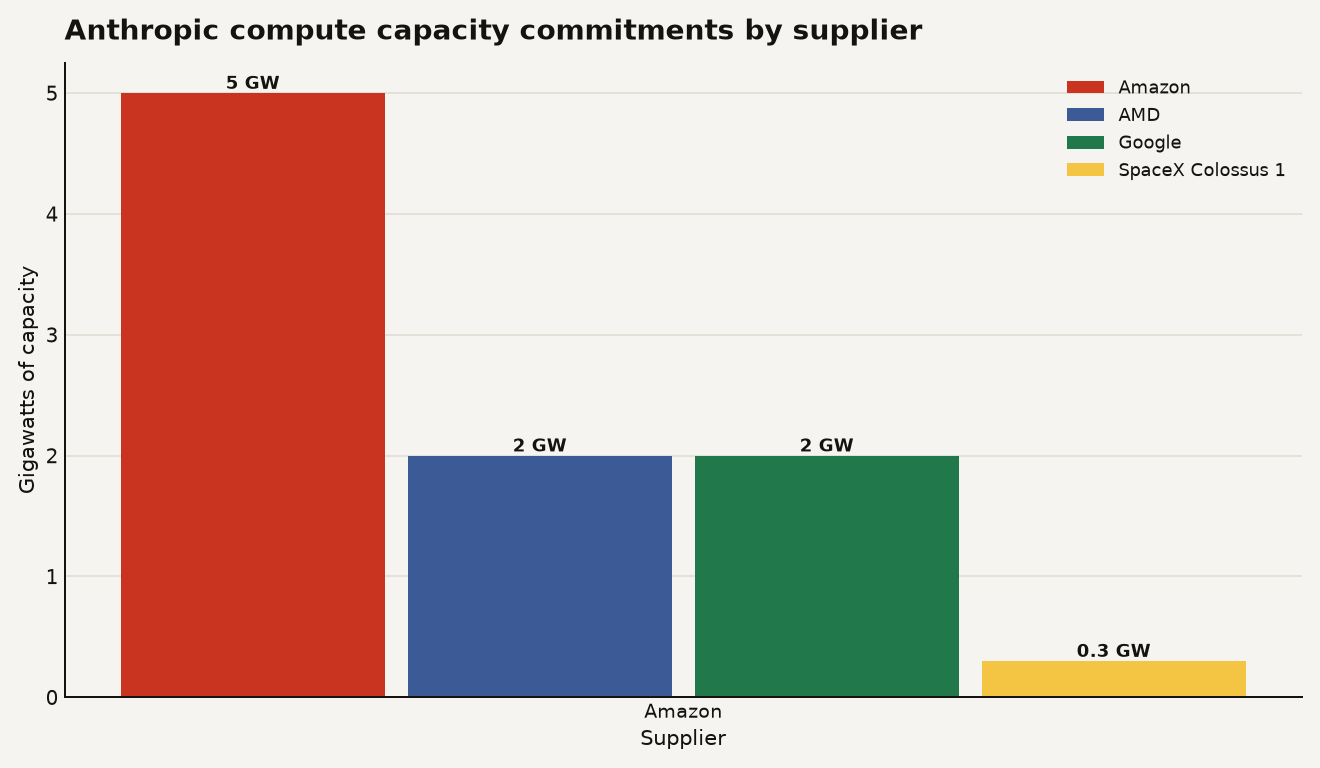
The chart above shows the scale of Anthropic's compute commitments by supplier. Amazon leads at up to 5 GW, followed by AMD and Google each at up to 2 GW, with SpaceX Colossus 1 at over 300 MW. The AMD commitment, if fully deployed, would represent more than six times the power capacity Anthropic obtained through Colossus 1, though the figures are not directly comparable because the facilities use different hardware and deployment models.
Anthropic co-founder and chief compute officer Tom Brown framed the strategy as diversification. "Running across a diversified range of hardware lets us map the right workloads to the right hardware," he said. The company has also discussed leasing infrastructure from Meta, with Reuters reporting a potential agreement worth up to $10 billion over two years.
For builders, no single hardware platform will define the next generation of AI infrastructure. If you are building tools, inference serving, or agentic systems that assume a single GPU vendor, that assumption is increasingly fragile.
Consequences for infrastructure buyers
If you are an AI infrastructure buyer, a platform engineer, or a founder planning around compute costs, this deal changes three things.
- Hardware diversification is now table stakes for frontier labs. Anthropic's strategy of running across AMD, Nvidia, Amazon, and Google silicon is becoming the template, not the exception. If you are building inference or training pipelines, expect to support multiple accelerator targets. Portability layers like OpenAI Triton, Intel SYCL, or vendor-agnostic compiler stacks are becoming more valuable.
- AMD ROCm is getting a serious production workload. Anthropic deploying Claude optimization work on Instinct accelerators means ROCm will get real-world stress testing at scale. If you have been waiting for a signal that AMD's software stack is mature enough to bet on, this is closer to one than anything before it. But it is not a guarantee. The gap between Nvidia's CUDA ecosystem and ROCm is still real, and one customer relationship does not close it overnight.
- Compute costs may not drop, but supply security improves. The deal means more supply. AMD's $5 billion investment and the 2 GW commitment add capacity to a market where access, not price, is the binding constraint. If you have been unable to secure capacity, more suppliers with more deployed silicon helps. If you are already paying premium rates for Nvidia capacity, this does not directly lower your bill.
The deal also raises a competitive question for cloud providers. Amazon remains Anthropic's primary cloud and training partner, but Anthropic is now directly contracting with AMD for infrastructure that could be hosted by specialist AI infrastructure companies or in its own data centers. The Wall Street Journal reported that Anthropic plans to install some AMD systems in its own facilities, with others hosted by cloud providers and specialist AI infrastructure companies. If you are an AWS customer betting on Trainium as your path to Anthropic models, that bet is still safe, but it is no longer the only path.
The deal still has to close
The deal is announced but not closed. AMD said the transaction is subject to customary closing conditions and regulatory approvals, with an expected close by the end of the third quarter of 2026. Watch for three things.
First, the milestone disclosures. The companies have not said what deployment targets Anthropic must hit to receive the full $5 billion. If those milestones are aggressive, the deal could underdeliver. If they are modest, AMD is essentially pre-paying for a customer relationship.
Second, the OpenAI warrant progression. AMD's OpenAI deal includes warrants vesting on deployment, commercial, and share-price conditions. If those warrants start vesting, it validates the equity-for-deployment model and signals that the pattern will spread.
Third, Nvidia's response. If Nvidia closes its own investment in OpenAI, the competitive dynamic shifts from "AMD buys customers" to "both chipmakers buy customers." That would accelerate the vertical integration trend and potentially reshape how AI infrastructure is financed across the industry.
For now, the signal is clear. The companies that build models and the companies that build chips are becoming financially entangled in ways that have no precedent in the semiconductor industry. If you are building on top of these platforms, your infrastructure decisions are now downstream of deals you do not control.
The financing model matters more than the size
A $5 billion investment in a model lab is eye-catching. But the number that matters more is the pattern: three deals in ten months, each pairing chip supply with equity, each tying the chipmaker's financial upside to the customer's deployment success. AMD is buying distribution. And if Nvidia follows, every AI infrastructure decision you make will be shaped by which chipmaker invested in which lab.