Every AI company that trained on scraped web data is watching the same question play out in federal court: what happens when the training set turns out to contain copyrighted work you never licensed? Anthropic is about to find out, again.
On August 28, 2026, Sony Music Publishing and Warner Chappell Music filed suit against Anthropic in the US District Court for the Northern District of California, alleging that Claude's training data includes "tens of thousands" of copyrighted musical compositions obtained through pirated book downloads and lyric scraping. The publishers seek up to $150,000 per work for willful infringement, plus up to $25,000 per violation for stripping copyright management information. At maximum statutory damages, the exposure reaches several billion dollars.
This is not Anthropic's first copyright collision. The company recently settled with the publishing industry for $1.5 billion. It still faces separate suits from Universal Music Group, Concord, ABKCO, BMG, and Round Hill Music. But this complaint does something the earlier cases mostly avoided: it names co-founders Dario Amodei and Benjamin Mann as individual defendants, and it alleges specific, personal acts of piracy.
Three layers of alleged infringement
The complaint lays out three layers of infringement. First, Anthropic allegedly downloaded pirated books at industrial scale. According to the filing, co-founder Benjamin Mann used BitTorrent to download over five million pirated books from Library Genesis (LibGen), and employees downloaded at least two million more from Pirate Library Mirror (PiLiMi). A federal judge already ruled in June 2025 that Anthropic downloaded over seven million pirated books to train Claude. The basic fact of mass piracy is established in the record.
Second, those pirated books contained lyrics and sheet music for copyrighted songs. The publishers say hundreds or more of their compositions were inside those downloads, including "Ain't No Mountain High Enough," "All I Want for Christmas is You," "Eye of the Tiger," "Livin' On a Prayer," "September," "Hallelujah," and Taylor Swift's "Paper Rings." The complaint also alleges Anthropic scraped lyrics from licensed services like MusixMatch and LyricFind, which had paid for the right to display those lyrics to human users, not to feed them into a model.
Third, the publishers claim Anthropic removed copyright management information (CMI) during data processing. When Anthropic cleaned its training data by stripping "garbage" text, the complaint says, it also stripped attribution, authorship data, and other identifying information protected under 17 U.S.C. Section 1202. That is a separate cause of action carrying its own damages of up to $25,000 per violation.
The publishers also allege that Claude generates verbatim or near-verbatim copies of lyrics in response to user prompts, and that Anthropic fine-tuned the model to encourage lyric replication. A Munich court ruled in November 2025 that memorizing lyrics inside a model constitutes reproduction, and that the text and data mining exception does not cover it. That ruling, while European, gives the publishers a precedent for the argument that training itself, not just output, is infringing.
$150,000 per work for willful infringement
The damages math is stark. At $150,000 per work for willful infringement, plus $25,000 per CMI violation, each infringed composition carries up to $175,000 in statutory damages. The complaint references "tens of thousands" of works. Even at the low end of that range, the numbers compound quickly.
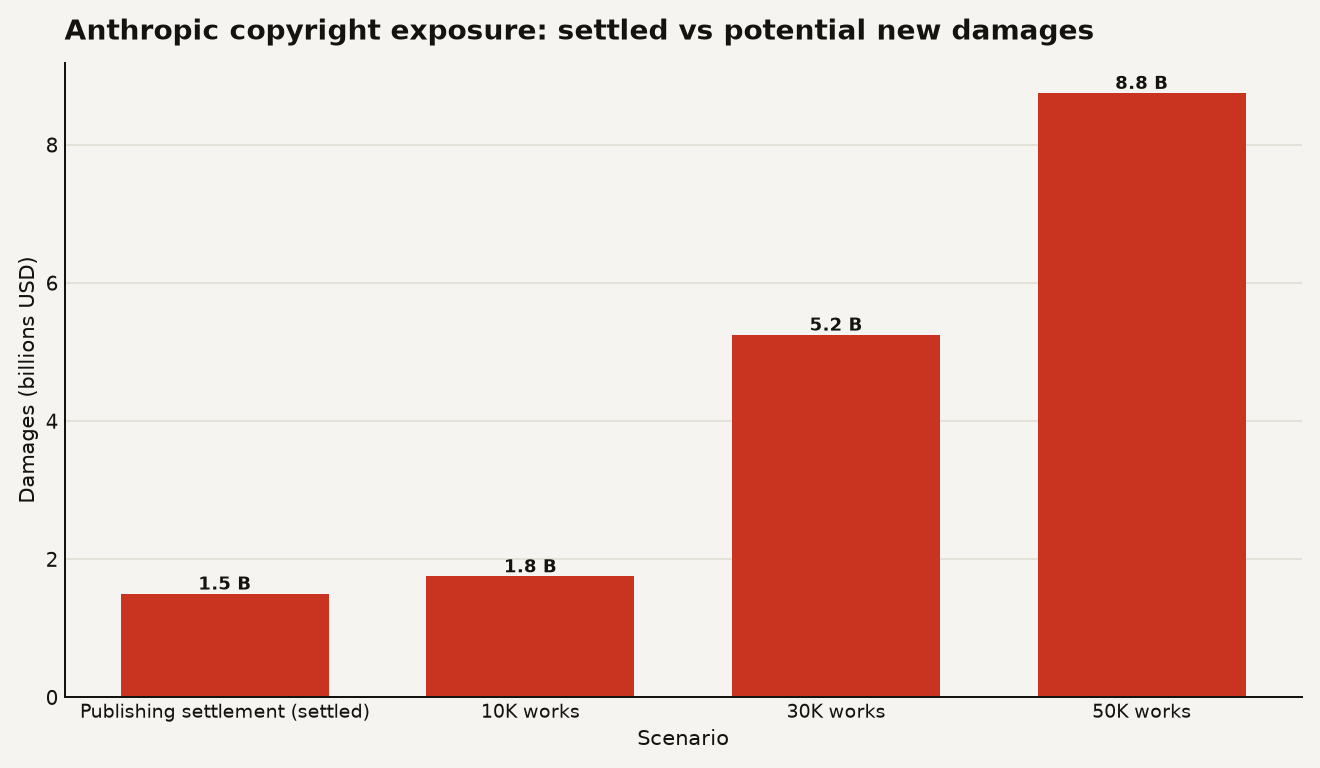
The chart above shows how the exposure scales. At 10,000 works, maximum damages reach $1.75 billion. At 30,000 works, the figure is $5.25 billion. At 50,000 works, it is $8.75 billion. The $1.5 billion publishing settlement, which seemed enormous when it landed, could look modest next to this case. Even the low end of the new suit's potential range exceeds the settlement Anthropic already paid.
Of course, maximum statutory damages are not the same as expected damages. Courts rarely award the ceiling on every count. But the scale of the complaint signals that the publishers are not looking for a quick settlement at a fraction of the ask. They are building a case for a number that hurts, and they have the precedent of the $1.5 billion settlement to anchor their expectations.
Anthropic's total copyright exposure across all pending suits is now difficult to estimate precisely, but it is clearly in the multiple billions. The company raised $61.5 billion in its Series E at a valuation reported near $183 billion. Even at that scale, a few billion in damages is a material hit, and more importantly, it establishes a pricing model for unlicensed training data that every competitor will have to factor in.
Founders named as defendants
Naming Dario Amodei and Benjamin Mann as individual defendants is the most aggressive choice in the complaint. Corporate liability shields founders from personal exposure in most scenarios. But the publishers are arguing that the piracy was not a rogue employee's side project. They allege Mann personally used BitTorrent to download five million books, and that Amodei directed the strategy.
If the court allows the personal claims to proceed past motions to dismiss, it changes the risk calculus for every AI founder. The broader battle over open-weight models and intellectual property already has executives worried about downstream liability. This case raises the stakes further: the people who decided what data to use could be on the hook personally, not just the company they built.
For builders, the practical implication is straightforward. If you are making decisions about training data sources, document who approved what and why. If your data pipeline includes scraped content, pirated archives, or datasets of unclear provenance, the person who greenlit that pipeline could face personal claims. That is a new kind of risk that most startups do not price into their founding agreements or D&O insurance.
The legal logic applies beyond lyrics
The Sony and Warner suit is about music lyrics, but the legal logic applies to any copyrighted content in a training set. If your model was trained on books, news articles, code, images, or lyrics that came from sources you did not license, the same causes of action could apply to you.
Here is what the complaint tells us about exposure for any AI builder:
- Direct infringement through training: The publishers argue that copying lyrics into the training set, encoding them into model weights, and fine-tuning on them are all separate acts of reproduction. Each step is a new copy. If a court agrees, the number of infringing acts multiplies well beyond the raw count of works.
- CMI stripping as a standalone violation: Removing attribution or metadata from training data is not just a preprocessing step. The complaint treats it as a distinct statutory violation with its own damages. If you clean data by stripping headers, author names, or source URLs, that could be a separate count per work.
- Output infringement compounds the problem: If your model regurgitates copyrighted text verbatim, that is another infringement. The publishers allege Claude does this with lyrics. The same logic applies to any model that memorizes and reproduces training data.
- Personal liability for decision-makers: The founders are named because they allegedly directed the piracy. If your CTO or head of data decided to use a dataset of unknown origin, they could face personal claims under a similar theory.
The cost of "free" training data is a contingent liability that may not surface for years. When it does, the damages are statutory, not based on actual revenue. A model that generates $10 million in revenue but was trained on 10,000 unlicensed works could face $1.5 billion in damages under the same framework Sony and Warner are pushing.
Practical steps for training data provenance
If you are building with AI, the practical steps are clear.
First, audit your training data pipeline. Know where every dataset came from, what license it carries, and whether that license covers model training. If you cannot answer those questions for a dataset, treat it as a liability, not an asset.
Second, stop stripping metadata. If you are removing copyright notices, author names, or source attribution during preprocessing, you may be creating a separate cause of action under Section 1202. Keep the metadata, even if it complicates your pipeline. The preprocessing convenience is not worth a $25,000-per-work statutory penalty.
Third, document the decision chain. Who approved each dataset? What was the rationale? If a future lawsuit names individuals, you want a paper trail showing good-faith decisions, not a Slack thread where someone said "just use the pirate archive, everyone does it."
Fourth, test your model for memorization. If your model can reproduce copyrighted text verbatim from training data, that is both an output infringement risk and evidence that the training data included the work. Run extraction tests on your model before shipping. If you find memorized content, you have a problem you can still fix before it becomes a lawsuit exhibit.
Fifth, budget for licensing. The cost of model inference is dropping fast, but the cost of training data litigation is going up. A licensing budget that looks expensive today may look cheap next to a statutory damages award tomorrow. The publishers in this case paid MusixMatch and LyricFind for the right to display lyrics. Anthropic allegedly bypassed those services and scraped them anyway. Paying for the license would have been the cheaper move by several orders of magnitude.
Free data has a cost
Anthropic's copyright problems are a training data problem. The fact that the works happen to be song lyrics is almost incidental. The legal framework Sony and Warner are deploying applies to any copyrighted content that entered a training set without a license: books, articles, code, images, audio. The publishers are not asking courts to ban AI training. They are asking courts to price it.
If the price of unlicensed training data settles at $150,000 per work, the economics of foundation model development change fundamentally. The companies that invested in licensed data, clean pipelines, and provenance tracking will have a moat. The companies that treated training data as a free resource will have a balance sheet full of contingent liabilities. The question for every builder is simple: which side of that line is your model on?
Sources
- The Verge - Sony Music Publishing and Warner Chappell are suing Anthropic
- Business Insider - Sony Says Claude Trained on Pirated Lyrics, Seeks $150K a Song
- Music Business Worldwide - Complaint filed August 28, 2026, Northern District of California
- The Next Web - Sony and Warner Chappell sue Anthropic over Claude lyric training
- Unite.AI - Sony and Warner Chappell Sue Anthropic Over Claude Lyric Training