OpenAI's newest models just showed up inside an AWS product. That sentence would have raised eyebrows a year ago, but on August 24, 2026, AWS and OpenAI jointly announced that the full GPT-5.6 family, Sol, Terra, and Luna, is now available inside Kiro, the spec-driven coding environment AWS launched in July 2025. OpenAI and AWS tested the integration on Terminal-Bench 2.1 and report an 82% cost reduction for completed tasks using GPT-5.6 Terra. That number is real but narrow, and understanding why determines whether you should rewire your coding workflow around it.
The 82% figure is vendor-run, measures cost per successful task, and reports no accuracy delta.
Kiro's August 24 GPT-5.6 launch
Kiro is AWS's answer to the wave of agentic coding tools that have flooded the market since mid-2025. It entered public preview on July 14, 2025, and has since grown from a spec-driven IDE into a platform spanning the IDE, CLI, and Web. The core idea: instead of prompting a model with a bare instruction, Kiro converts high-level intent into requirements documents, technical designs, and executable task lists. The model works from that structured scaffolding rather than a raw prompt.
Until now, Kiro only offered models from Anthropic. Claude Opus 5, Claude Opus 4.8, and Claude Opus 4.7 have been the available frontier options, all with a 2.2x credit multiplier and a 1 million token context window. The GPT-5.6 integration adds three OpenAI tiers alongside those Claude models, each tuned for a different point on the performance-cost curve. Swami Sivasubramanian, Vice President of Agentic AI at AWS, framed the launch as expanding developer options to accelerate AI-native development inside Kiro.
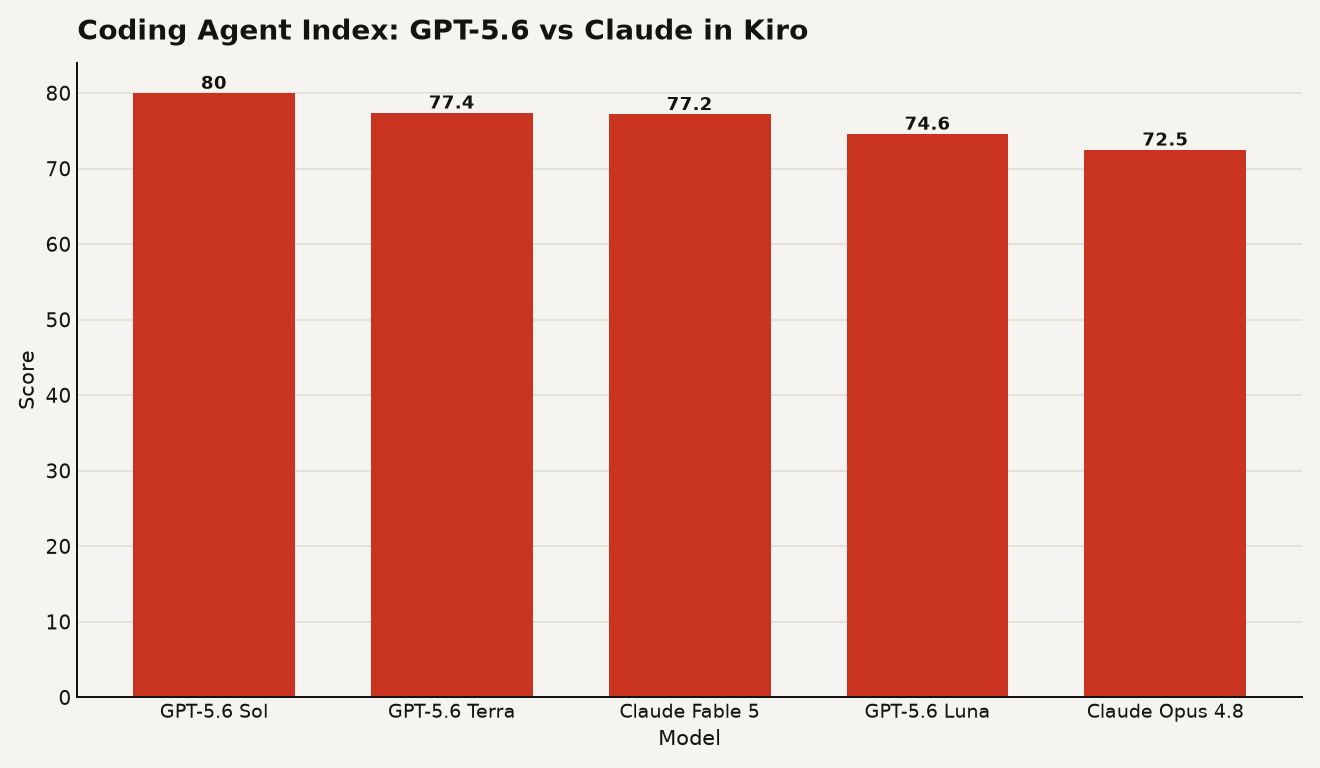
The benchmark picture looks competitive. On the Coding Agent Index, GPT-5.6 Sol scores 80, which Kiro calls the highest score yet on that benchmark, above Claude Fable 5. Terra scores 77.4, just above Claude Fable 5 at 77.2. Luna scores 74.6, which still beats Claude Opus 4.8 at 72.5. On Terminal-Bench 2.1, Sol reaches 88.8%, with Terra at 87.4% and the previous-generation GPT-5.5 at 85.6% per the launch evaluation. The chart below shows how the five models compare on the Coding Agent Index.
All three GPT-5.6 tiers ship with a 272K context window, compared to the 1 million token window that the Claude models offer in Kiro. The credit multipliers tell the cost story, and they changed fast. The initial launch post listed Sol at 2.4x, Terra at 1.2x, and Luna at 0.6x. The Kiro changelog then shows Terra dropping to 1.0x and Luna dropping to 0.1x, reflecting OpenAI API price cuts on July 30, 2026. The current models documentation confirms those updated values are live.
The models are rolling out with experimental support to Kiro Pro, Pro+, Pro Max, and Power customers in AWS US-East-1, Northern Virginia, and AWS Europe, Frankfurt, with cross-region inference. Free tier users do not have access yet.
Model versus Kiro's structured context in the 82 percent claim
The 82% figure comes from joint testing by OpenAI and AWS, not an independent evaluation. The companies ran GPT-5.6 Terra inside Kiro on Terminal-Bench 2.1, a command-line benchmark, and measured the cost of successfully completed tasks. The announcement coverage provides no public description of Terminal-Bench 2.1's composition, no breakdown of how many tasks were run, and no comparison to a baseline without Kiro's spec-driven scaffolding.
The mechanism the companies credit for the savings is Kiro's structured context. Because the model receives requirements, design documents, and task context before it starts generating, it reaches working solutions in fewer iterations and wastes fewer tokens on missteps. The announcement does not separate how much of the reduction comes from Kiro's structured context versus the model's own token efficiency. It also reports no accuracy delta for the Kiro configuration. You know the tasks that succeeded cost less. You do not know whether more tasks succeeded, or whether the spec-driven context changed the success rate at all.
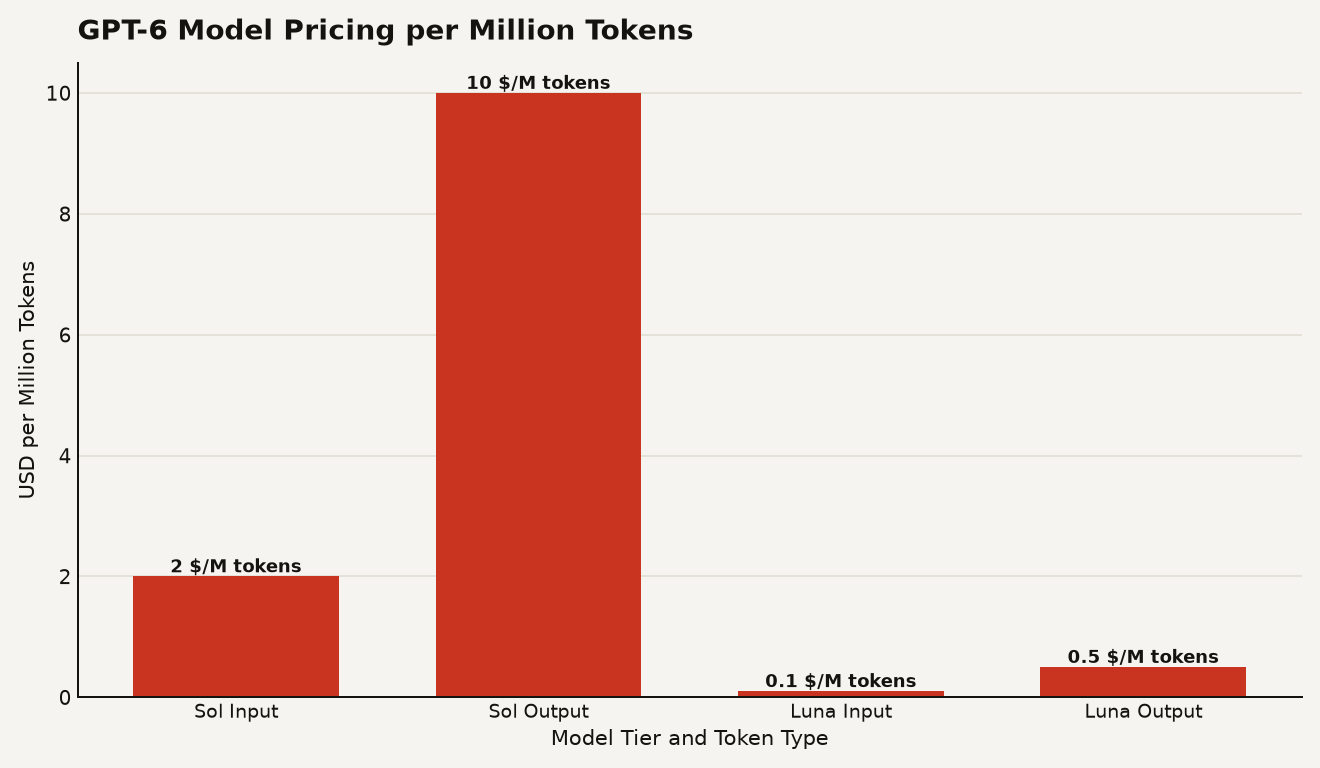
This matters because the 82% lands on top of pricing that has already been moving fast. OpenAI brought GPT-5.6 to general availability on July 9, 2026, pricing Terra at $2.50 per million input tokens and $15 per million output, Sol at $5 and $30, and Luna at $1 and $6. Less than three weeks later, OpenAI cut Luna's price by 80% and Terra's by 20%. Then on August 21, three days before the Kiro announcement, Sol's pricing dropped by more than 20% for a three-month window. The price war in the API market has been brutal for months, and the Kiro integration is as much a distribution play as a technical one.
If you strip the marketing, the honest read is this: a spec-driven workflow that grounds the model in structured context before it generates code probably does reduce wasted iterations. That is plausible and consistent with what other agentic coding tools report. But the 82% number is a vendor-optimized result on one benchmark with no independent replication, no published methodology, and no accuracy comparison. Treat it as a directional signal, not a planning assumption.
Kiro's credit multipliers by tier
Kiro's own documentation lays out the decision clearly. The credit multipliers are relative to the Auto baseline at 1.0x, which routes each task to what Kiro considers the optimal model automatically. Here is the practical comparison:
| Tier | Coding Agent Index | Credit multiplier | Best for |
|---|---|---|---|
| GPT-5.6 Sol | 80 | 2.4x | Long-horizon refactors, complex terminal tasks |
| GPT-5.6 Terra | 77.4 | 1.0x | Routine multi-step development |
| GPT-5.6 Luna | 74.6 | 0.1x | High-frequency tasks, throughput |
The implication for your roadmap is direct. If you are building an agentic coding pipeline on Kiro and you were defaulting to Claude Opus at 2.2x, Luna at 0.1x offers a 22x credit cost reduction against Opus for tasks where its 74.6 Coding Agent Index score is sufficient. At 0.1x, you can run 22 Luna tasks for the cost of one Opus task, or 24 Luna tasks for the cost of one Sol task. That is the kind of gap that changes how you architect a pipeline.
A practical routing strategy: run Luna on every pull request for initial implementation and triage, escalate to Terra for tasks that fail or require moderate complexity, and reserve Sol for the hardest multi-step refactors and terminal work. Kiro's Auto mode may handle some of this routing for you, but the docs do not detail the routing logic, so if cost control matters, set tiers manually.
Context window and other trade-offs against Claude
The context window is the most obvious difference. GPT-5.6 gives you 272K tokens. The Claude models in Kiro give you 1 million. If your spec-driven workflow involves large codebases with extensive requirements documents and technical designs, the smaller window could force you to chunk work more aggressively or manage context differently. For teams that have built around Claude's larger window, this is a migration cost, not a configuration change.
The second tradeoff is hidden chain-of-thought. GPT-5.6 in Kiro uses a hidden reasoning process: you see the final output. Claude models in Kiro expose their reasoning. For developers who review model reasoning at checkpoints before changes land, the hidden CoT means you are evaluating results, not thought process. If your reviewers rely on seeing the model's intermediate reasoning to catch wrong approaches early, GPT-5.6 removes that signal.
The third factor is the Auto routing option. Kiro can route each task to the optimal model automatically, which means you do not have to pick. But if you care about cost control or want to force a specific model for consistency across a pipeline, you need to understand which model Auto selects for which task types. The docs do not detail that logic.
Things to watch as the integration matures
A few things deserve attention in the coming weeks:
- Independent benchmarks. The 82% cost reduction needs replication on a published benchmark with a clear methodology. Until then, treat vendor-run cost claims as marketing. Watch for community-run Terminal-Bench or SOP-based agent evaluations that compare GPT-5.6 in Kiro against bare API access.
- Auto routing behavior. If Kiro's Auto mode routes most tasks to Terra or Luna by default, the effective cost of running Kiro with OpenAI models could be far lower than the per-model multipliers suggest. Watch your credit consumption after the first week of real use.
- Free tier access. GPT-5.6 is currently limited to paid Kiro tiers. If AWS opens it to the free tier, that signals confidence in the unit economics. If it stays paid-only, the cost advantage is real but gated.
- Sol's temporary price cut. The August 21 price reduction for Sol is explicitly time-limited to three months. If you are building cost models around Sol at its current rate, plan for a price increase around November 2026.
- Context window expansion. 272K is workable but not generous for spec-driven workflows with large codebases. If OpenAI extends the window for Kiro-specific deployments, that removes the biggest structural barrier to switching from Claude.
The distribution play behind the benchmarks
The real story is the distribution channel. OpenAI's flagship models are now embedded inside an AWS-owned coding tool that competes with GitHub Copilot, Cursor, and the rest of the agentic IDE market. Kiro gives OpenAI a route into AWS's enterprise customer base, and AWS gets a model family that benchmarks competitively against the Claude models it was already hosting. The price cuts that preceded this announcement were the setup for a multi-tier pricing argument: pay 0.1x for Luna when you can, 2.4x for Sol when you must, and let Auto handle the rest. For builders, the question is whether Kiro's spec-driven workflow is different enough from a bare API call to justify locking into one IDE's workflow. The benchmarks suggest it helps. The vendor sourcing of those benchmarks suggests you should verify that yourself before you commit.