Meta just dropped a 30B parameter vision-language model that can quantize itself, deploy itself to cloud endpoints, and benchmark its own inference engine on an H100. Muse Glimmer is a dense, open-source, multimodal model with day-0 support across transformers, vLLM, and llama.cpp, and it runs locally on consumer-class GPUs with quantization. The architecture choices tell you where Meta thinks the open-weight VLM market is heading, and the agentic demos tell you what they expect builders to do with it.
The model splits between a 2B vision encoder and a 28B text decoder, with no mixture of experts and no sparse routing. It processes images, video at 2 fps capped at 96 frames, and text, with multimodal tool calling and open-ended object detection built in.
Two modules: perception and language
Muse Glimmer is built as two modules: a 2B parameter Perception Encoder for vision and a 28B text decoder. The vision side is larger than what most VLMs use. Meta's announcement on the Hugging Face blog notes that unlike the "relatively small vision encoders used in other VLMs," this is a full 2B ViT-style model with 50 layers, GELU MLPs, and the same hybrid attention pattern as the text decoder.
The text decoder has 52 layers in a repeating pattern: three sliding window attention layers with a 2,048 token window using rotary position embeddings, then one full attention layer with no positional embedding. Meta calls this hybrid attention, and the pattern repeats 13 times. Sliding windows handle local context cheaply. The periodic full attention layer preserves global information without paying full attention costs on every layer.
The model uses Gated Grouped-Query Attention where each key-value head is shared by 16 query heads. That cuts KV-cache memory by 16x compared to standard multi-head attention. Before computing attention, Muse Glimmer applies RMS normalization to every query and key head and then multiplies queries by a scale factor that acts like an inverse temperature at the softmax level.
A DFlash speculative decoding drafter ships alongside the model. It uses a block-diffusion approach with a block size of 16 tokens: one anchor token plus 15 proposed tokens. Meta says the drafter is particularly well suited to structured content generation like coding. The drafter is optional, trading extra memory for faster generation.
Against Gemma 4 and other open VLMs
Google's Gemma 4 family, released around the same time, takes the opposite architectural bet. The Gemma 4 12B model is encoder-free, replacing the separate vision encoder with a single 35M parameter matmul that projects raw image patches directly into the LLM embedding space. Google's Gemma 4 technical report frames this as a way to simplify the model and reduce overhead. Muse Glimmer invests 2B parameters in a dedicated vision tower instead.
The chart below shows where Muse Glimmer sits among recent open-weight multimodal releases: Gemma 4 E2B at 2.3B, Gemma 4 12B at 11.95B, Muse Glimmer at 30B, and Gemma 4 31B at 31B parameters.
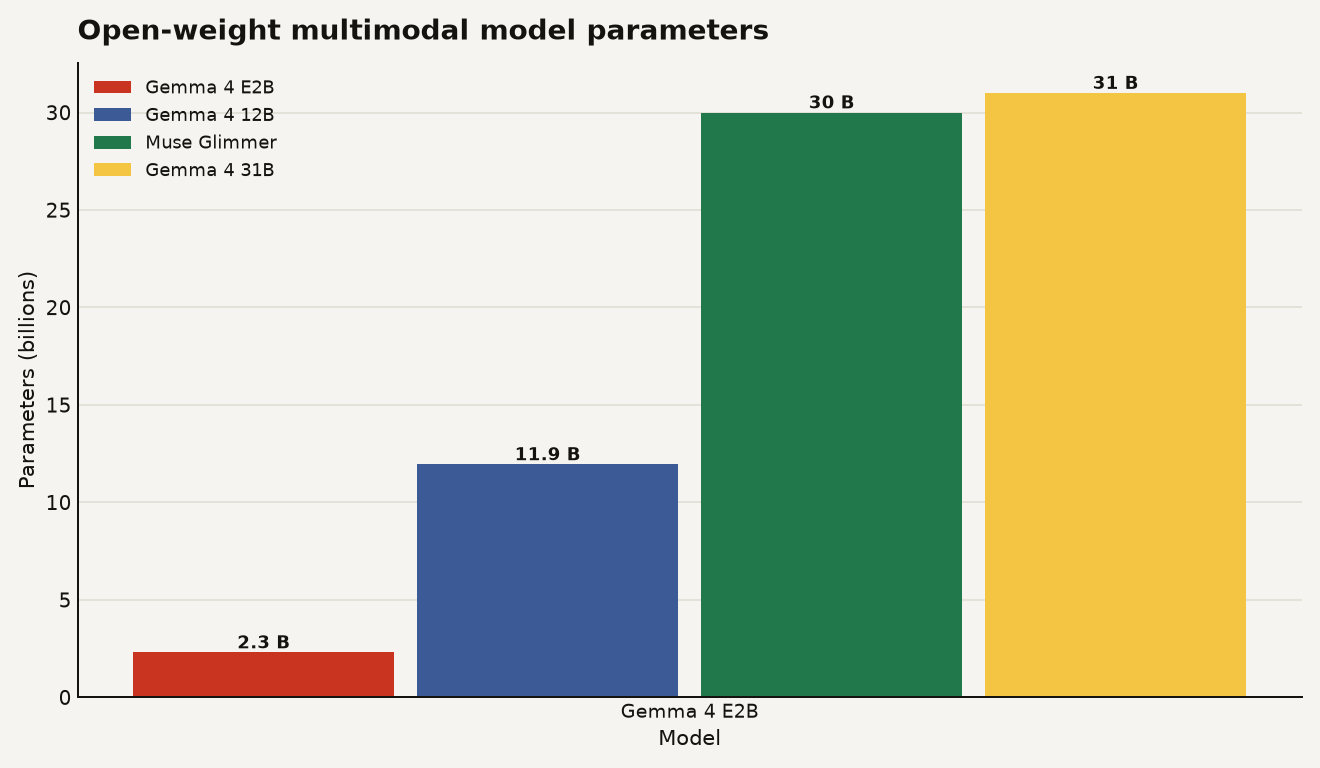
Gemma 4 12B runs on a laptop with 16GB of VRAM, while Gemma 4 31B and Muse Glimmer both need more serious hardware. The tradeoff: Meta's larger vision encoder may capture more spatial and perceptual detail, at the cost of more parameters dedicated to non-language tasks.
Gemma 4 also ships with built-in multimodal token prediction drafters and quantization-aware training. Muse Glimmer's quantization story is handled externally: Meta distributed calibrated quants through llama.cpp, and Unsloth is releasing optimized quants as well.
The hybrid attention pattern in Muse Glimmer is worth watching. Sliding window attention with periodic full attention layers is the same broad approach used in models like Jamba and Mistral's recent releases. The 2,048 token sliding window keeps the KV cache bounded for most of the network. That matters when you are running video through the model. At 2 fps with a 96 frame cap, a single video produces up to 192 frames of tokens. The sliding window keeps that manageable without losing global context entirely.
Self-managing local agent demos
The demos in the Hugging Face blog post are the most interesting part of the release. Meta and Hugging Face show Muse Glimmer doing four things:
- Quantize itself: hooked into the Hugging Face MCP, the model finds a Q4_K_M GGUF version of itself on the Hub, launches llama-server locally, and validates that chat completion works through an OpenAI-compatible API.
- Deploy itself: the model pins a specific revision, creates a protected Hugging Face Inference Endpoint, verifies health and model discovery, and connects an external agent with secrets and rollback preserved.
- Optimize itself: the model benchmarks its own serving stack on a single H100, testing one reversible change at a time while holding the workload fixed, and keeps only correctness-passing gains.
- Research the Hub: a Gradio Space connects the model to the Hugging Face MCP server for read-only tools to search and inspect repositories, models, datasets, and papers.
Each demo requires adding instructions to an AGENTS.md file and connecting the model to the Hugging Face MCP and CLI. The model is following a structured prompt with tools, not autonomously deciding to optimize itself. But the fact that a 30B model can reason through multi-step infrastructure tasks, call the right APIs, validate results, and recover from errors is the actual story. This is what agentic means in practice for a local model: enough capability to manage its own deployment lifecycle with the right scaffolding.
The model runs across NVIDIA, AMD, and Intel GPUs with a single code path using device_map="auto" in transformers. Fine-tuning works on Hopper-class GPUs with 80GB VRAM in bf16, using TRL for everything from supervised fine-tuning to Async GRPO on coding environments.
from transformers import AutoModelForMultimodalLM, AutoProcessor

model = AutoModelForMultimodalLM.from_pretrained(
    "meta/muse-glimmer", device_map="auto"
)
processor = AutoProcessor.from_pretrained("meta/muse-glimmer")
That snippet runs unchanged across all three GPU vendors. For a builder with an AMD or Intel stack, that matters more than any benchmark score.
Vision-language models in your stack
If you are building anything with vision-language models, here is the practical read:
- For local-first applications: Muse Glimmer at 30B with Q4 quants can run on a workstation with a single high-memory GPU. The DFlash drafter accelerates coding workloads, and the 16x KV-cache reduction from GQA keeps long video contexts feasible. If your product needs multimodal reasoning without sending data to a cloud API, this is a credible option.
- For agentic tooling: the self-deploying and self-optimizing demos show that a 30B model can handle multi-step infrastructure tasks when given the right tools and prompts. If you are building agent frameworks, Muse Glimmer is a test case for what a local model can do with access to MCP servers and CLI tools. The portable agent skill format is a natural fit here.
- For cost-conscious teams: running locally means no per-token API costs. The tradeoff is upfront hardware cost and the engineering effort to manage quantized weights and inference servers. For teams already running their own GPU infrastructure, the marginal cost of adding Muse Glimmer is small.
- For the open-weight ecosystem: Meta is pushing the boundary of what open-source VLMs can do. Where Qwen3.8-Max narrowed the open-weight frontier gap on the language side, Muse Glimmer does the same for multimodal. Whether the 30B dense approach scales or encoder-free designs like Gemma 4 12B win on efficiency is an open question.
The fine-tuning story is real but not trivial. You need Hopper-class GPUs with 80GB VRAM for bf16 training. If you are a solo founder or a small team, you are looking at cloud GPU rentals or a partnership with a provider. The TRL integration means the tooling is standard, but the compute floor is high.
The local AI loop just got a new operator
Muse Glimmer's architecture bets on dedicated vision processing, efficient attention, and speculative decoding. Its agentic demos bet on a model that can manage its own infrastructure. The open-weight VLM space is moving fast. Whether local deployment becomes as turnkey as an API call depends on the tooling around these models, from MCP servers to inference engines. Meta just shipped a model that argues the answer is yes.
Sources
- Hugging Face Blog - Meta is back with Muse Glimmer: local, agentic, multimodal, and open source
- Google Gemma 4 Technical Report - Gemma 4 Technical Report
- Google AI Blog - Introducing Gemma 4 12B
- Hugging Face Blog - Welcome Gemma 4: Frontier multimodal intelligence on device