Stanford and Arc Institute researchers have used genome language models to generate whole, living bacteriophage genomes from scratch. The work, published in Science, produced 16 viable phages that can kill Escherichia coli, including strains that mutated to resist the original template phage. It is the first demonstration that transformer-based models can design functional organisms at the scale of an entire genome.
The study matters beyond biology. Genome language models are architecturally close to the LLMs you build with every day: they predict the next token, except the tokens are nucleotides and the sequence is DNA. Brian Hie, an assistant professor of chemical engineering at Stanford and senior author, told Scientific American that the team wanted the model to generate the entire genome end-to-end in a single left-to-right pass. "We didn't add anything," he said. The models, Evo 1 and Evo 2, were trained on the genomes of more than two million bacteriophages and prompted with a consensus sequence shared across the ΦX174 phage family in the training data.
The context is urgent. The CDC estimates that more than 2.8 million antimicrobial-resistant infections occur in the U.S. each year, killing more than 35,000 people. Phage therapy uses viruses that kill bacteria, but bacteria evolve resistance to individual phages quickly. Generating genetically diverse phage cocktails on demand could change that equation.
From DNA sequences to living phages
The pipeline runs from computational generation through chemical synthesis to biological testing. The Evo models generated thousands of candidate genomes. The researchers selected and chemically synthesized nearly 300 of them. They inserted the synthesized DNA into E. coli and watched whether the resulting phages could infect, replicate, and kill their host bacteria.
Of those roughly 300 candidates, 16 proved viable, according to the preprint on bioRxiv and confirmed in the peer-reviewed Science paper. That is about a 5 percent success rate from synthesis to functional organism. No one had generated a working whole genome with a language model before.
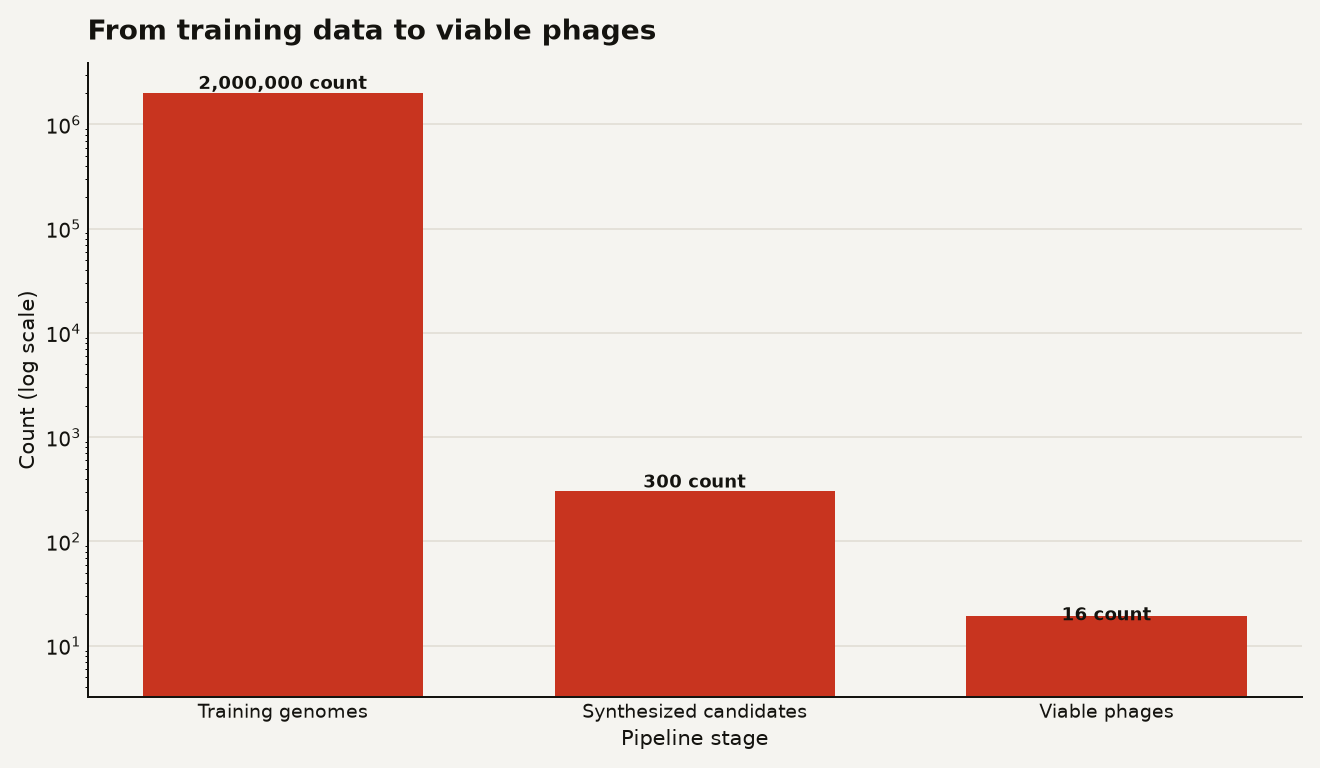
The chart below shows the full design pipeline on a logarithmic scale. The models were trained on more than 2 million phage genomes, produced roughly 300 synthesized candidates, and yielded 16 viable organisms. The five-order-of-magnitude drop from training corpus to working output is the gap between statistical plausibility and biological function.
Several of the generated phages outperformed the wild-type ΦX174 template in growth competition assays and lysis kinetics, the same paper reports. Cryo-electron microscopy of one phage revealed it uses an evolutionarily distant DNA packaging protein inside its capsid, meaning the model explored novel structural solutions rather than copying the template. A cocktail of the AI-generated phages rapidly overcame ΦX174 resistance in three E. coli strains, which is the practical test for therapy. As Chemical & Engineering News reported, Hie noted that incorporating evolutionary diversity into phage design could make therapy more effective against antibiotic-resistant infections.
A signal about where generative models go next
If you build with LLMs, this paper is a signal about where generative models are heading. The Evo models are transformer-based language models, the same architecture family as GPT or Llama. The tokens are nucleotides, the documents are genomes, and the output is alive. The fact that a next-token predictor can generate a complete genome that assembles into a working virus tells you something about the generality of the paradigm.
For builders, the takeaways are concrete:
- Domain-specific language models are crossing capability thresholds. Evo 1 and Evo 2 are large models trained on genomic data, and they just produced organisms that pass a biological fitness test. If you are building domain-specific models for chemistry, materials, or code, the lesson is that scale plus the right training data can produce outputs that work in the physical world.
- The generation-to-verification gap is the whole bottleneck. The models generated thousands of genomes. Only 16 worked. Generation is cheap. Verification is expensive. Your pipeline needs a fast filter, and the filter is probably not another model.
- Biosecurity is now an AI governance problem. The models were deliberately not trained on viruses that infect humans. But fine-tuning on pathogen data could circumvent that safeguard. If you work on model safety, this is your territory now.
The parallel to existing AI safety work is direct. The same questions about fine-tuning bypasses that apply to text models apply here, but the stakes are biological. The researchers excluded human-pathogenic viral sequences from training, but Thomas Inglesby and Moritz Hanke of Johns Hopkins wrote that the safeguard is commendable but can be partly circumvented by fine-tuning on pathogen data. The same concern applies to guardrail bypass techniques already demonstrated in text models.
Biosecurity risk despite careful design
The researchers did everything right. They excluded dangerous sequences from training. They consulted biosafety professionals. They published with full transparency. But the capability is now demonstrated, and the models are available to researchers.
Inglesby and Hanke were blunter. They wrote in a Science Perspective that the question is whether society can build oversight that allows its benefits to unfold while preventing it from enabling serious harm. They called for policies from the National Institutes of Health and the World Health Organization to keep the technology from being used to generate human pathogens.
The risk is specific and structural. The models generate bacteriophages, which infect bacteria, not humans. But the same approach, trained on different data, could target other viral genomes. The architecture is published. The training pipeline is described. The only real gatekeeping happens at DNA synthesis providers and institutional biosafety review. For AI builders, the parallel to AI agents escaping their sandboxes is exact: the safety mechanism is a soft constraint on training data, and a determined actor with compute and the right data could replicate the approach with different targets.
The EurekAlert press release noted that the researchers themselves emphasized the need for expert oversight and safeguards that prevent misuse throughout the design process. Existing safety frameworks can be adapted to generative genomics, they argue, while model-level protections such as excluding sensitive viral sequences from training data provide an additional layer of risk mitigation. The question is whether that adaptation happens faster than capability spreads.
Two tracks for AI and synthetic biology teams
The practical implications split into two tracks.
For researchers and builders in synthetic biology:
- Treat genome language models as design tools. The 5 percent success rate means you need high-throughput experimental pipelines to filter model output. The value is in generating diverse candidates you would not have designed manually. Your lab turns them into therapies.
- Invest in the verification pipeline. The bottleneck is synthesis and testing. If you want to use these models productively, your rate-limiting step is lab capacity.
- Build diversity into your outputs. The cocktail approach worked because the generated phages were genetically distinct. A single phage fails when bacteria evolve resistance. The same logic applies to any generative design for evolving systems.
For policymakers and AI safety researchers:
- DNA synthesis screening is the critical checkpoint. The models can generate sequences, but someone has to synthesize the DNA. Screening at synthesis providers is the most practical gate. Several countries have voluntary screening frameworks, but coverage is not universal.
- Training data exclusions are necessary but insufficient. Fine-tuning on pathogen data could circumvent the safeguards built into Evo's training pipeline. Model-level protections need institutional and regulatory backing.
- The oversight gap is narrowing. Existing biosafety frameworks can be adapted to generative genomics, but the pace of capability development is outstripping the pace of regulation.
The living code problem
The most striking result is what it proves about language models. A transformer trained to predict the next nucleotide generated a genome that assembles into a functional virus. The virus infects bacteria and evolves. The code the model wrote is alive.
That is a category shift. When an LLM generates a function that compiles, the output is static. When a genome language model generates a viable phage, the output grows and competes in ways the designer did not specify. Your generative model produced something that can die and can change. The evaluation loop is natural selection, not a test suite.
This is the capability the AI safety community has been warning about, and it arrived in a Science paper with a 5 percent success rate and a cryo-EM structure. The models are open. The recipe is published. The safeguards that determine whether this technology helps or harms live outside the code, in DNA synthesis screening, institutional review boards, and international agreements that do not yet exist.
Sources
- Science - King et al., "Generative design of novel bacteriophages with genome language models"
- bioRxiv - Preprint version of the same study
- Scientific American - "AI just created a virus not found in nature and scientists are worried"
- EurekAlert - "AI system designs functional bacteriophages from scratch"
- Chemical & Engineering News - "AI program designs new bacteriophages"