Dataset: Google DeepMind's Gemini 3.8 Live model card and benchmark results are available through the Gemini API documentation.
Voice is the interface that has been five years away for about a decade. Every year someone claims the breakthrough is here, and every year the latency, the reasoning gap, or the tool-calling choreography makes it feel like a very expensive parrot. Google DeepMind just made a case that the gap has narrowed enough to matter. On September 15, 2026, the team shipped Gemini 3.8 Live and Gemini 3.8 Live Extended Thinking, two conversational audio models that rank first and second on the major speech-to-speech leaderboards and are already running inside Google Search Live for millions of users.
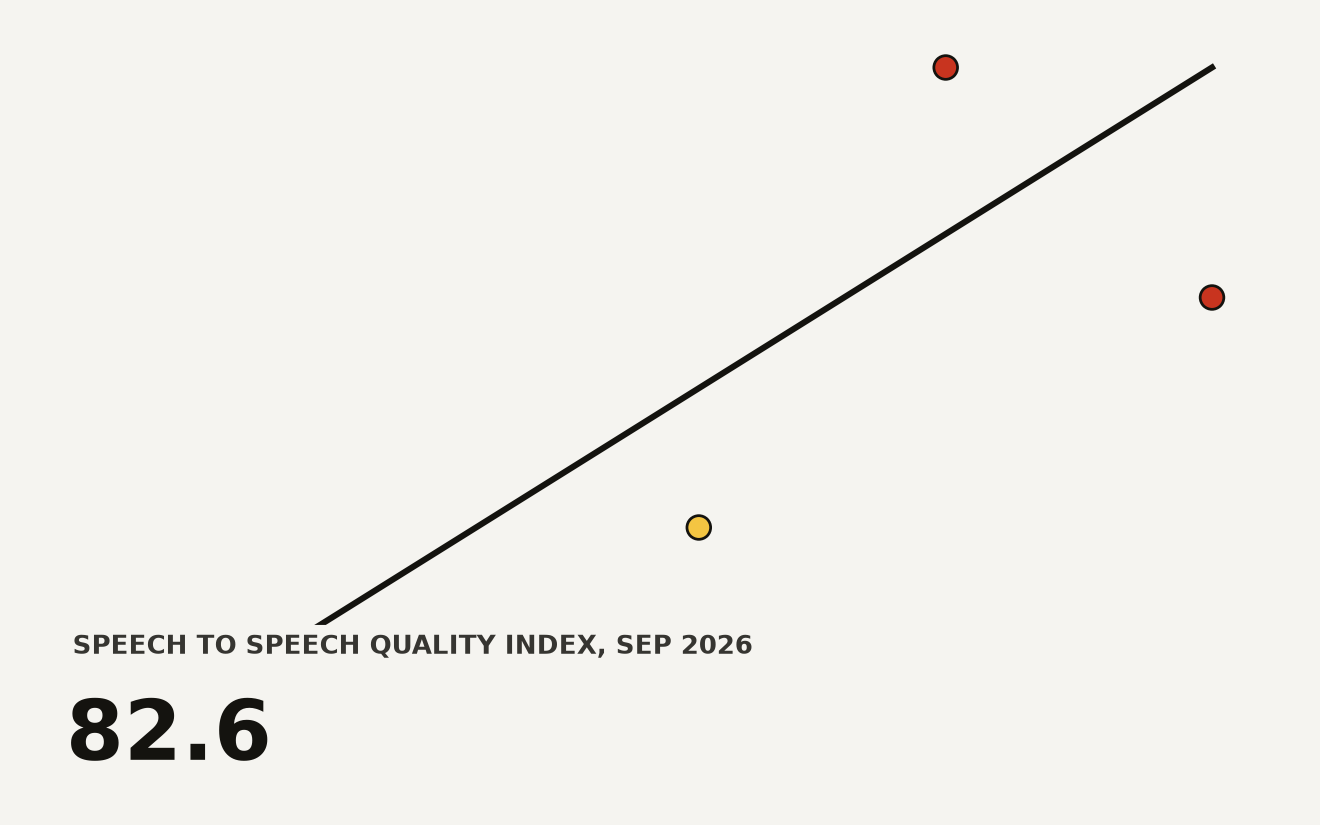
The headline number: Gemini 3.8 Live Extended Thinking scored 82.6 on the Artificial Analysis Speech to Speech Quality Index, taking the overall top spot. The standard 3.8 Live model landed in second place on the Speech Agent Arena. Both models support 97 languages with automatic mid-conversation switching, near real-time visual grounding, and background tool calling that does not interrupt the spoken dialogue. If you are building voice agents, this is the first release where the benchmark lead, the production deployment, and the developer API all landed on the same day.
What did Google actually ship?
Two models, not one. Gemini 3.8 Live is the cost-efficient tier, built for scale. It handles fluid dialogue, visual context, and language switching. Gemini 3.8 Live Extended Thinking is the premium tier, built for complex, multi-step reasoning tasks where the model needs to think through a problem while keeping the conversation going.
The Extended Thinking model leads the Artificial Analysis Speech to Speech Quality Index at 82.6, a composite benchmark that scores voice models on conversational quality, reasoning, and task completion. It also posts 68.6 percent on the tau-Voice benchmark and 35.1 percent on Sierra's tau-Voice-banking subset, which measures agentic task completion through voice. On Big Bench Audio, a reasoning and comprehension test, it scored 97.7 percent. The standard 3.8 Live model took second place on the Speech Agent Arena, a crowdsourced preference ranking.
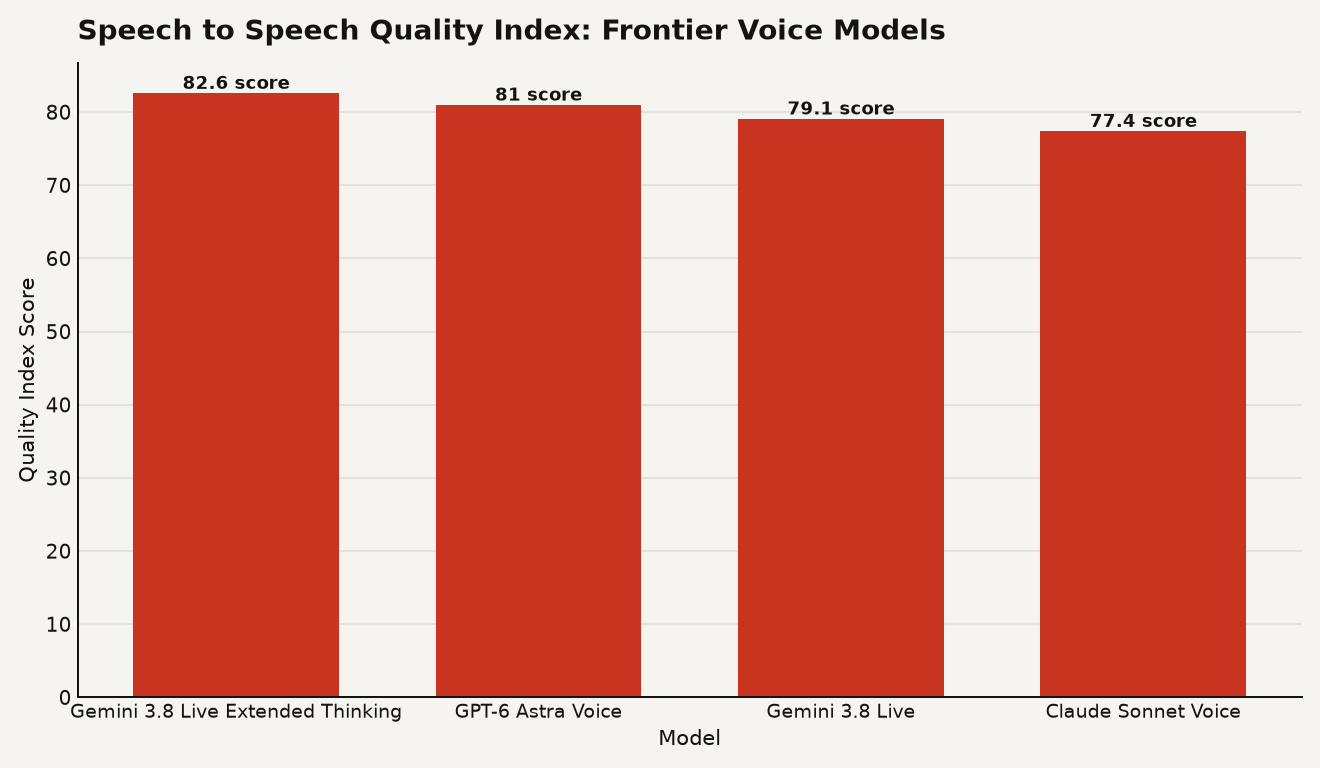
The chart above compares the top four frontier voice models on the Speech to Speech Quality Index. Gemini 3.8 Live Extended Thinking leads at 82.6, edging out GPT-6 Astra Voice at 81.0, with the standard Gemini 3.8 Live at 79.1 and Claude Sonnet Voice at 77.4. The spread between first and fourth is 5.2 points, which is meaningful on this index but not a blowout.
Logan Kilpatrick, who leads developer relations for Google's AI Studio, described the models as "SOTA live audio models" with "frontier price plus performance". The DeepMind blog post, authored by Principal Engineer Tom Ouyang and Malini Jaganathan of the Gemini Audio Team, positions both models as production-ready building blocks for enterprise voice agents.
The deployment surface is broad. The models are live in the Gemini API and Google AI Studio for developers, in private preview on the Gemini Enterprise Agent Platform, in Google Workspace for AI Pro and Ultra subscribers, and in Search Live for everyone. Rajan Patel, VP of Engineering for Search and co-founder of Google Lens, confirmed on X that 3.8 Live is already powering real-time conversations in Search Live, complete with inline web links in responses and fluid multilingual support.
Why should builders care about voice model benchmarks?
The speech-to-speech quality gap matters because voice is the highest-friction interface to get right. A text model that hallucinates is annoying. A voice agent that hallucinates, pauses awkwardly, or drops context mid-sentence is unusable. The latency budget for voice is roughly 300 milliseconds before a human notices the lag, and the conversational repair mechanisms, those verbal fillers and acknowledgments that humans use naturally, have been absent from AI voice models until now.
3.8 Live Extended Thinking introduces what Google calls "live progress narration." The model says things like "Let me check that..." while it runs a background tool call, then resumes with the answer. That sounds trivial. It is not. The entire history of voice AI has been defined by the awkward silence between the user's question and the model's response while tools execute. Filling that gap with natural speech is the difference between a demo and a product.
The background tool calling is the architectural shift. Previous voice models either blocked the conversation while executing a function call or lost the thread entirely. 3.8 Live can acknowledge a request, keep chatting, and deliver the result when the tool finishes. For a developer building a booking agent, a troubleshooting assistant, or a multilingual customer service bot, this removes the single hardest engineering challenge in voice agent design.
Here is what this means for you, concretely:
- If you are evaluating voice models for production: The benchmark gap between Gemini 3.8 Live Extended Thinking (82.6) and the next best competitor is narrow enough that pricing, latency, and ecosystem support will likely drive your decision more than raw quality. Google is positioning 3.8 Live as the cost-efficient option for high-volume use cases, and Extended Thinking for complex workflows.
- If you are building on LiveKit, Pipecat, Vercel, or LangChain: Google partnered with all of these platforms, plus Agora, Fishjam, and Vision Agents, to support the Live API on day one. The real-time media streaming infrastructure is handled by these partners, so you can focus on the conversation logic.
- If you are in enterprise customer experience: Gemini Enterprise for Customer Experience is getting both models, though it is still in private preview. Salesforce, Genspark, and Lumeris are early partners. If you are on Salesforce Service Cloud, this is coming to your stack.
- If you care about provenance: All audio generated by these models carries a SynthID watermark, Google's imperceptible audio watermarking system. That is a differentiator for any use case where you need to distinguish AI-generated speech from human speech.
How does this change the voice agent build versus buy decision?
The economics shift in two directions. First, Google is explicitly pricing 3.8 Live for scale, calling it "highly cost-effective" without publishing exact per-minute or per-token rates in the announcement. Extended Thinking is positioned as a premium tier for complex tasks, priced competitively against other frontier models. If your voice agent handles thousands of calls per day, the cost gap between the two tiers will determine which one you route to.
Second, the partner ecosystem means you may not need to build the real-time streaming layer at all. LiveKit and Pipecat handle the WebRTC infrastructure. LangChain handles the orchestration and tool-calling logic. Vercel handles deployment. If you are a small team, you can assemble a production voice agent from these components without touching audio codecs or streaming protocols.
The risk is lock-in. The Live API is Google's interface, and the visual grounding, language detection, and tool-calling features are tied to Gemini models. If you build your entire agent architecture around Gemini Live, switching to another provider means rearchitecting the streaming and tool-calling layer. The standard mitigation applies: abstract the model layer behind your own interface so you can swap providers if the quality or pricing landscape shifts.
For a point of comparison on the broader agent landscape, the 89 percent failure rate for enterprise AI agent pilots remains the dominant signal. Most agent pilots fail not because the model is weak but because the integration, evaluation, and operational guardrails are missing. A better voice model helps, but it does not fix a broken evaluation pipeline or a lack of production monitoring.
What should you watch and what bets would I make?
Watch three things over the next quarter.
First, pricing. Google did not publish per-minute rates in the announcement. When the Gemini API pricing page updates, compare the cost per minute of 3.8 Live against OpenAI's voice models and against open-source alternatives. The quality lead is real but narrow, and voice is a high-volume workload where a 20 percent price difference compounds quickly.
Second, the tau-Voice benchmark adoption. The 68.6 percent score on tau-Voice and 35.1 percent on the banking subset are the most interesting numbers in this release because they measure agentic task completion, not conversational pleasantness. If other model providers adopt these benchmarks, you will get a real comparison of which models can actually execute tasks through voice rather than just sound good. If they ignore them, treat the scores as Google's own marketing until independent evaluations appear.
Third, the Search Live deployment. Google is running 3.8 Live in production for Search Live globally, which means millions of real conversations per day. Watch for user feedback on response quality, latency in real-world conditions, and whether the inline web links in responses actually drive click-through or just clutter the audio. If Search Live degrades under load, that tells you more about the model's production readiness than any benchmark.
The bet I would make: if you are building a voice agent today, prototype on 3.8 Live through the Gemini API this week. The background tool calling and live progress narration are features that change the user experience enough to justify a prototype. Do not commit to a production migration until pricing is public and you have run your own evaluation on your specific workload. The benchmark lead is five points on a composite index. That is a real edge, but it is not an insurmountable moat.
The bet I would not make: assuming the speech-to-speech quality index translates directly to your use case. The index measures general conversational quality. Your voice agent needs to handle your specific tools, your specific error cases, and your specific user population. Run your own eval.
The narrowing gap
The difference between a voice agent people use and one they abandon is measured in hundreds of milliseconds and a handful of conversational repair moves. Google just shipped both. The benchmark lead is modest, the production deployment is immediate, and the developer API is live. The question is no longer whether voice AI is ready. It is whether your evaluation pipeline is.
Sources
- Google DeepMind blog - Introducing Gemini 3.8 Live and 3.8 Live Extended Thinking
- Search Engine Land via Techmeme - Gemini 3.8 Live powers Google Search Live
- XBorder Insights - Google Search Live Now Uses Gemini 3.8 Live
- Google DeepMind on X via UnrollNow - Gemini 3.8 Live and 3.8 Live Extended Thinking announcement thread