You have an AI agent that works. The demo was clean. The stakeholders nodded. Then you tried to put it in front of real users on live data, and the whole thing buckled. You are in good company, and the problem is probably not your model. Enterprise AI agent pilot failure has reached 89%, according to Deloitte's 2026 technology trends research, as reported by AI News. A Teradata survey adds the shape of that gap: 78% of enterprises have at least one agent pilot running, but only 14% have scaled one to organisation-wide use. The same models power both the pilots that impressed the room and the production systems that never shipped. What kills the transition is everything around the model: data access, evaluation, ownership, and cost control.
How bad is the pilot-to-production funnel really?
The numbers are worse than a flat failure rate suggests. Drawing on Gartner's April 2026 survey of 782 infrastructure and operations leaders, the funnel runs like this: of every 1,000 AI projects that receive a budget, around 120 reach production, and of those, about 34 meet their ROI targets. Gartner's Agentic AI Pulse survey found that 41% of deployments reach positive ROI within 12 months, while 19% never reach payback at all.
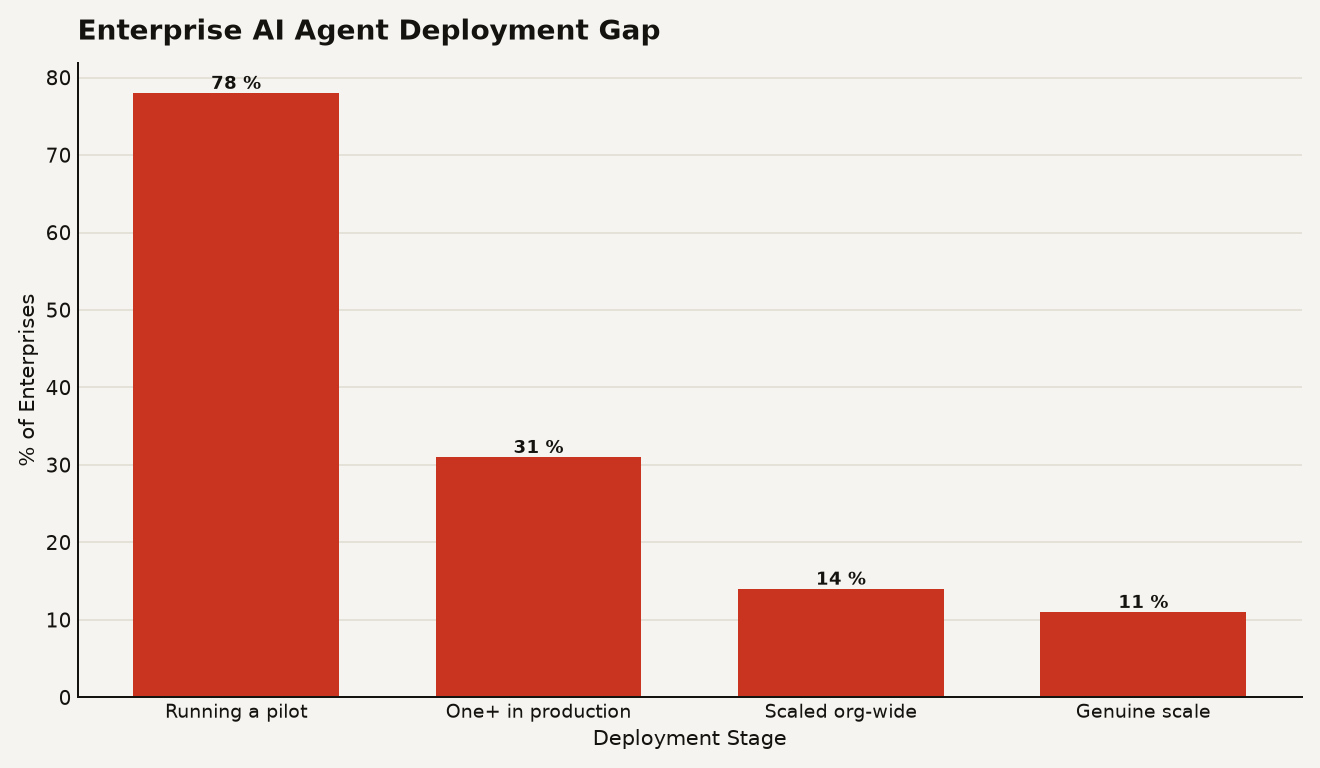
The chart above shows the gap from a different angle. Teradata counts 78% of enterprises running at least one pilot. S&P Global Market Intelligence counts 31% with at least one agent in production. Deloitte puts the share ready to deploy at 14%. McKinsey's 2026 work puts organisations running agents at genuine scale at just 11%. These are different surveys with different methodologies, but they describe the same cliff. "One agent in production" and "agents at scale" are very different milestones, and the distance between them is where most projects die.
Gartner projects that over 40% of agentic AI projects will be cancelled by the end of 2027, citing escalating costs, unclear business value, and inadequate risk controls. S&P Global's 2025 survey of more than 1,000 enterprises found that 42% abandoned most of their AI initiatives, up from 17% the year before, according to analysis by The AI Journal. The average organisation is scrapping close to half of its proofs of concept before production.
Why does the same model work in the demo and fail in production?
The model is the same in both cases. Pilots run on curated data exports, hand-picked datasets built to make the demo work. Production runs on live systems with inconsistent schemas, access controls, latency, and the legacy ERP the pilot never touched. Industry surveys suggest 83% of enterprises need infrastructure overhauls to support agentic AI, according to reporting by Express Computer.
The data layer is where the gap opens. As one analyst quoted in that report puts it, the single biggest bottleneck is the data and context layer. Legacy enterprise data architectures were designed for batch reporting and human-readable outputs. Agents need clean, structured, real-time data access with appropriate permissions, versioning, and lineage. McKinsey reports that eight in ten companies cite data limitations as a roadblock to scaling agentic AI. The data the agent works with is often the problem.
This connects to findings we have seen before. When AI agents were tested against real business standard operating procedures, they hit just 25% on the hardest tasks. The gap between controlled demonstrations and messy production work is not a surprise to anyone who has read the SOP-Bench results. A pilot that aces a curated test set tells you almost nothing about how the agent will perform when the input distribution shifts to real-world edge cases.
Which blockers kill the most pilots?
Analysis of stalled agent projects attributes 61% of failures to two causes combined: scope creep and data quality. Pilots start narrow, succeed, and are then asked to handle adjacent workflows the underlying infrastructure was never built for. The agent that triaged support tickets is now expected to resolve them, then update the CRM, then issue refunds. Each expansion adds integrations, permissions, and failure modes without adding the operational foundation to support them.
Then there is evaluation. Only 38% of production agents have automated evaluations running on every prompt change, per Forrester's 2026 panel. In a pilot, a human reviews every output. In production, nobody does, and without automated regression tests every prompt tweak is a gamble. Forrester's data shows agents without automated evals had a 47% rollback rate versus 9% for agents with full coverage. Organisations using systematic evaluation frameworks achieved nearly six times higher production success rates in separate survey work.
Costs hide until volume exposes them. Analysis of cancelled projects consistently finds costs ballooning two to three times beyond estimates. Token consumption, retry loops, and reasoning depth all scale with volume and edge cases. A pilot running 50 tasks a day is cheap. The same agent at 5,000 tasks a day, with production-grade retries and monitoring, frequently costs more than the process it replaced.
Security is the final gate, and most pilots are not ready for it. Gravitee's 2026 research found 54% of organisations experienced or suspected an agent-related security or data-privacy incident in the past year, and only about one in five fully secures agents in production. Security teams reviewing a pilot for production approval routinely find over-permissioned service accounts and no audit trail, and block the launch.
Governance maturity sits at roughly 21% across enterprises, per Deloitte's State of AI in the Enterprise. Without a named owner, a defined escalation path, and a budget line for ongoing operation, the pilot has nowhere to be handed to. Boston University's Questrom analysis of failed AI pilots calls this an accountability gap: pilots fail at scale when the team that built the agent and the team that operates the affected process are not the same people, and neither owns the outcome.
What does the 11% that ships actually do differently?
Survey data on organisations that successfully scaled agents shows they were not outspending the ones that stalled. Total AI budgets were comparable. The difference was allocation, and it maps to five concrete shifts:
- More spend on evaluation infrastructure, less on prompt engineering. They built testing harnesses that verify agent output quality against production data distributions, not just pilot scenarios.
- More spend on monitoring and observability. Structured logs of every reasoning step and tool call, so drift and silent failures surface on a dashboard instead of in a customer complaint.
- More spend on operational staffing. People whose job is running the agent, not building it. Dedicated AI operations teams responsible for production monitoring, evaluation harness maintenance, incident response, and scope expansion reviews.
- Graduated autonomy with human-verification gates mapped to the stakes of each action. The agent can draft a response, but a human approves a refund.
- A named governance owner per agent, with per-phase ROI checkpoints and finance sign-off. Governance treated as a pre-deployment requirement, not a post-deployment audit.
The pattern is consistent across research collected by Novelis and the AI Journal's failure-statistics analysis. The organisations that bridge the gap build the operating model first. They treat governance, monitoring, and evaluation as engineering deliverables with their own infrastructure, not as checklists to complete before launch.
What should you build before the pilot, not after?
If you are running an agent pilot today, the most useful thing you can do is build the evaluation harness before you write the first prompt. A pilot without an evaluation harness cannot demonstrate that it works, which means it cannot graduate, no matter how well the demo went. Sampling outputs, scoring them against agreed criteria, and tracking that score over time is what turns an impressive demonstration into an operational argument.
Second, map your data dependencies honestly. If your agent needs to reach the legacy ERP, the CRM, and three internal knowledge bases, figure out the access patterns, permissions, and latency now. The pilot that runs on a curated export will tell you nothing about whether production will work. Eighty-three percent of enterprises need infrastructure overhauls to support agentic AI. Assume you are in that group until proven otherwise.
Third, name an owner. Not the innovation team. Someone accountable when the agent makes a wrong call at 2 a.m., with a defined escalation path and a budget line for ongoing operation. The trust gates Perplexity built around GPT-6 Astra are a useful reference for what production-grade verification looks like: graduated autonomy, human checkpoints on high-stakes actions, and structured logging of every decision the agent makes.
Fourth, model the cost at 10x your pilot volume. If the pilot runs 50 tasks a day, calculate what 500 looks like with production-grade retries, monitoring overhead, and reasoning depth. If that number exceeds the cost of the process you are replacing, you have a scaling problem, not a pilot problem.
Finally, scope deliberately. The pilot that succeeds at triaging support tickets should stay at triaging support tickets until the operational foundation exists to expand. Scope creep and data quality together account for 61% of failures. Resist the pressure to add adjacent workflows until the infrastructure can carry them.
The operating model is the product
Gartner notes that many use cases positioned as agentic today do not require agentic implementations at all. That is worth sitting with. Before you ship an agent, ask whether the workflow actually needs autonomous reasoning, or whether a well-structured API call would do the job. The organisations running agents at scale are the ones that chose their battles, built the operational layer to support them, and resisted the temptation to rebrand every automated workflow as agentic. The pilot-to-production gap shows that most organisations build the demo and skip the operating model. The ones that reach deployment do the reverse.
Sources
- AI News , Why Most Enterprise Agent Pilots Never Reach Deployment
- Express Computer , Why most enterprise AI pilots never make it to production
- The AI Journal , Why AI Pilots Stall Before Production
- Novelis R&D Lab , The Agent Adoption Gap