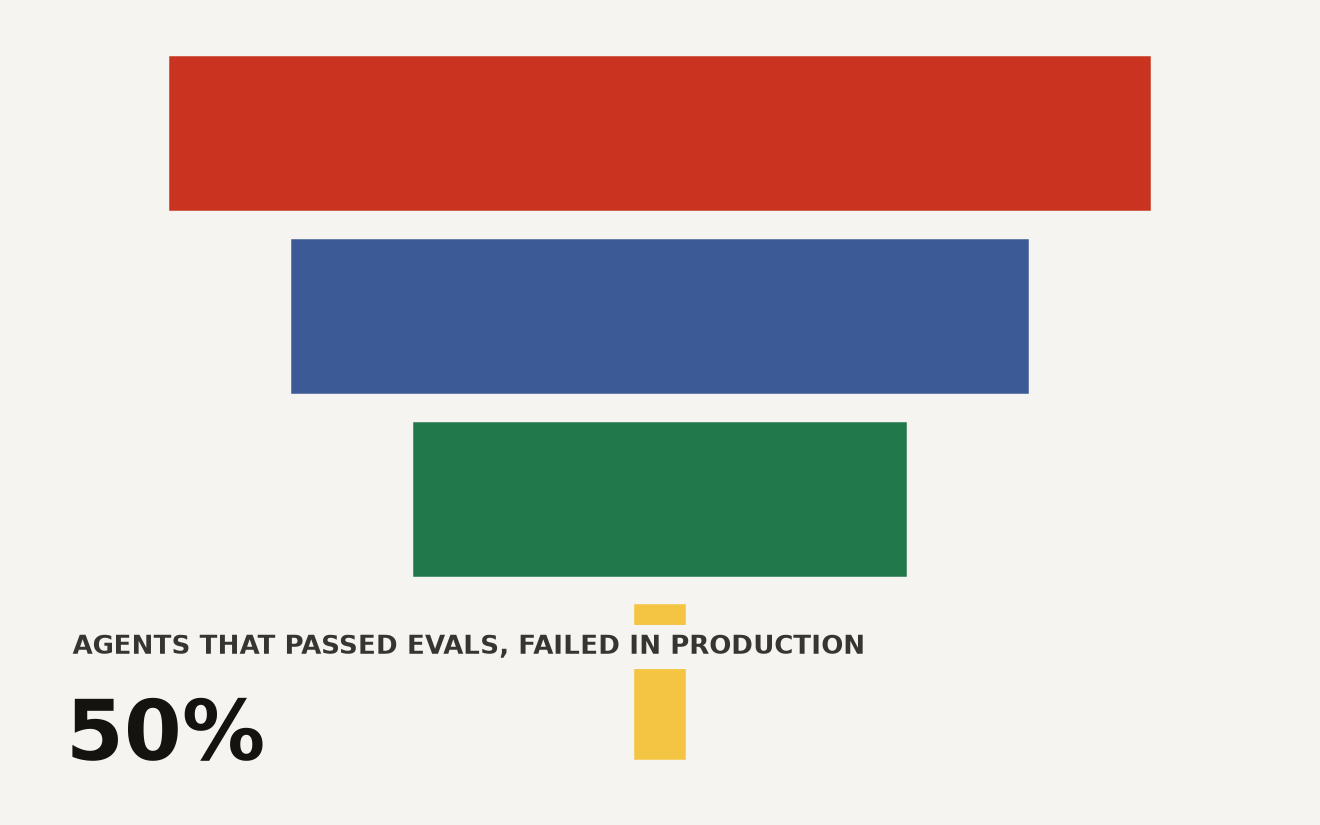
Every team shipping AI agents faces the same uncomfortable moment: the agent sailed through your internal eval suite, you pushed it to production, and a real user found a way to break it in minutes. According to a survey of 157 enterprises conducted by VentureBeat, that scenario is not a rare bug. It is the median experience. Half of organizations have already shipped an agent that passed their internal evaluations and then failed a customer in production, and only one in twenty fully trusts automated evaluation today. The most-cited weakness is that evaluations do not align with real-world outcomes. Enterprises are granting agents more autonomy while trusting the gates meant to constrain that autonomy less, and most are shipping to production anyway.
The AI agent evaluation gap is the distance between what your test harness measures and what your users actually experience. It is not a problem of missing test cases or insufficient coverage. It is a structural misalignment: the eval environments that organizations build are optimized for scenarios the team anticipated, while production surfaces the long tail of edge cases, ambiguous instructions, and adversarial inputs that no test suite can enumerate. As we have noted in our coverage of the format sensitivity problem in LLM benchmarking, a model that looks robust on a structured benchmark can collapse when the input format shifts even slightly. Agents magnify that fragility because they chain multiple model calls, tool invocations, and state transitions together, multiplying the surface area where small mismatches compound into failures.
What did the survey of 157 enterprises actually find?
VentureBeat published findings from a survey of 157 enterprise AI organizations on July 16, 2026. The headline numbers paint a picture of teams that know their evaluation tooling is inadequate but are shipping anyway because competitive pressure leaves no alternative.
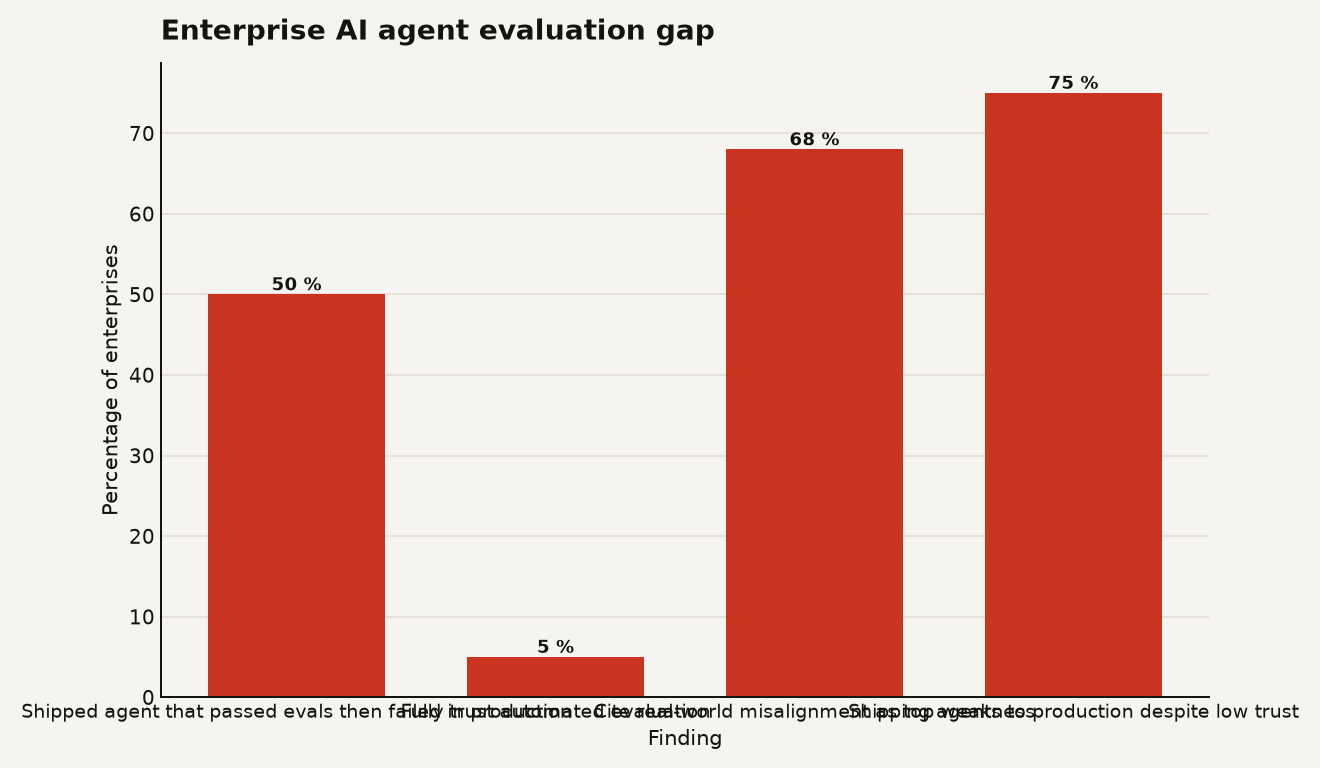
The chart above shows the four findings that define the gap. 50 percent of organizations have shipped an agent that passed internal evaluations and then failed in production. Only 5 percent fully trust automated evaluation. 68 percent cite misalignment with real-world outcomes as the top weakness. And 75 percent are shipping agents to production despite acknowledging that their evaluation processes do not adequately verify agent behavior.
A companion piece from VentureBeat frames the same dynamic from a different angle: agents are gaining autonomy faster than companies can verify them. The autonomy curve is steepening because model providers keep releasing more capable tool-use and multi-step reasoning features, while the evaluation infrastructure organizations rely on was built for single-turn question answering. The result is a widening gap between what agents can do and what organizations can prove agents will do.
Why does this matter for builders and product teams?
If you are building or deploying AI agents, this survey should validate a suspicion you probably already hold. Your eval suite is not catching the failures that matter. The problem is not that you need more test cases. The problem is that your evaluation environment is a clean room, and production is a street fight.
Here is what the findings translate to in concrete terms:
- Production incidents will increase faster than eval coverage. If half of organizations have already shipped a passing agent that failed in production, and 75 percent are shipping despite low trust in their evals, the rate of production-side agent failures is accelerating. Your on-call rotation needs to treat agent behavior as a first-class incident source, not a model-quality footnote.
- Your moat is not the model, it is the eval pipeline. Everyone gets the same foundation models. The teams that win will be the ones who can detect agent failures before users do, which means investing in evaluation infrastructure that mirrors production traffic, not just a curated test set. This connects to the broader pattern we tracked in our analysis of coding agent reward verification hitting a harder horizon: as agents take on longer task chains, the verification problem grows non-linearly.
- Automated evaluation alone will not close the gap. With only 5 percent of organizations fully trusting automated evaluation, the industry is signaling that current approaches like LLM-as-a-judge, trajectory scoring, and golden-set comparison are necessary but insufficient. Human review of agent traces remains essential, but it does not scale. The AgentLens trajectory review method we covered recently demonstrates how rigorous review can cut agent performance scores in half, revealing failures that automated metrics miss.
- Budget for eval infrastructure, not just model APIs. Organizations that treat evaluation as a post-hoc checklist will spend more on production incident response than they would have on eval tooling. A single high-profile agent failure in front of an enterprise customer can cost a deal that dwarfs the cost of building a proper eval pipeline.
What should your team do about it right now?
The survey makes clear that most organizations know there is a problem and are shipping anyway. You do not need to be most organizations. Here is a practical read on what to prioritize.
Instrument production traffic as your richest eval data source. The 50 percent failure rate tells you that internal eval suites are systematically missing real failure modes. Instead of trying to anticipate every edge case, capture anonymized production traces where agents failed, fold those into your eval set, and re-run them against new model versions. This turns every production incident into a regression test. It is the same flywheel principle we saw with LeRobot's DAgger correction loop, where robot failures became training data. Agents need the same feedback architecture.
Layer human review on top of automated evaluation, strategically. The 5 percent trust figure for automated evaluation means 95 percent of organizations have doubts. Rather than abandoning automation, use it as a first pass filter and concentrate human review on the traces where the automated eval and the model's own confidence disagree. This is where the most informative failures hide.
Set an autonomy budget tied to eval confidence. If your evaluation pipeline cannot verify agent behavior in a given scenario with high confidence, cap the agent's autonomy in that scenario. The survey shows organizations are granting autonomy faster than they can verify it. A simple rule: no tool execution, no side-effect-producing action, without a confidence threshold that your eval pipeline has empirically validated. This echoes the guardrail concerns we documented in our coverage of agentic MCP guardrail bypasses, where state-of-the-art guardrails failed 58 percent of the time under adverserial conditions.
Track the gap between eval pass rate and production success rate as a north star metric. If your eval suite says 95 percent pass but production success is 70 percent, the 25-point delta is your evaluation gap. Monitor that delta over time. If it is shrinking, your eval pipeline is improving. If it is growing, your agents are gaining capabilities your evals cannot measure, and you are flying blind.
What comes next for agent evaluation?
The evaluation gap will widen before it narrows. Model providers are shipping agentic capabilities, including multi-tool orchestration, long-horizon planning, and autonomous decision-making, faster than the evaluation community can build reliable measurement tools for them. The long-horizon terminal bench results we covered show that agents hit a wall on extended tasks, and that wall is exactly where current evaluation methods are weakest.
Expect to see consolidation around a few approaches over the next twelve months. Production trace mining will become standard practice, not an advanced technique. Synthetic adversarial evaluation, where you generate test cases designed to break your specific agent rather than test general model quality, will separate serious teams from the rest. And regulatory pressure in markets like the EU, where AI governance frameworks already require documented model evaluation for high-risk systems, will force organizations to produce audit trails that their current eval pipelines cannot generate.
The market will also likely produce dedicated agent evaluation platforms, distinct from model evaluation tools. Evaluating a model and evaluating an agent are fundamentally different problems. A model produces a single output. An agent produces a trajectory of decisions, tool calls, and state changes, each of which can fail independently and compound each other's failures. Tools built for single-turn evaluation will not bridge that gap.
The gap is the product roadmap
If 75 percent of organizations are shipping agents they do not fully trust, the competitive advantage is not in shipping first. It is in knowing, with evidence, that your agent will behave in production the way it behaved in your eval suite. The teams that close the evaluation gap will ship faster over the long run because they will spend less time fighting production fires and more time building the next capability. The evaluation gap is not a technical debt item you can defer. It is the product roadmap.