If you have opened Claude lately and stared at the screen wondering whether to click "Chat" or "Cowork," you were not alone. Anthropic's AI assistant had grown into three overlapping tools, and users spent more time deciding where a task belonged than doing the task. On September 16, 2026, Anthropic announced it is merging Claude Cowork and chat into a single interface. No more mode picker. Claude figures out what your task needs and routes it automatically.
Claude Cowork and chat merge into one interface, ending the need to pick a mode before starting.
Here is the background a beginner needs. Claude is Anthropic's AI assistant, comparable to ChatGPT. Over time, Anthropic split Claude into three separate surfaces: regular chat for quick questions, Cowork for longer multi-step tasks like research reports, and Claude Design for visual mockups. Cowork was a separate workspace where Claude could run code, read files, and keep working after you closed your laptop. Claude Design, introduced in April 2026, handled website prototypes and on-brand graphics. The overlap confused people. The new update folds everything into one conversation window. Alongside the merge, Anthropic shipped Claude Docs and Claude Slides, two new beta tools for creating documents and presentations directly in chat. The rollout starts on Pro and Max paid plans over the coming weeks, with Team, Free, and Enterprise plans to follow.
What exactly did Anthropic change?
Anthropic took three separate tools and made them one. Here is what each tool was before the merge:
| Tool | What it did | Who used it |
|---|---|---|
| Claude Chat | Quick questions, code snippets, Artifacts (interactive widgets like charts and code) | Everyone, including free users |
| Claude Cowork | Long tasks: research, reports, file access, running code in the background | Power users on paid plans |
| Claude Design | Visual mockups, website prototypes, on-brand graphics | Designers and builders |
After the merge, all three live inside a single conversation. You type what you need, and Claude decides which capabilities to use. A quick question still gets a quick answer. A request to "build a weekly report and put the highlights in five slides" triggers a longer multi-step task that runs in the cloud, even if you close your laptop. Anthropic said the unified interface also pulls in Artifacts, Claude's interactive workspace feature, so you can build charts, diagrams, and interactive visuals in the same conversation.
Two new tools ship alongside the merge. Claude Docs lets you write documents collaboratively with Claude and your team, living at a shareable link anyone can open. Claude Slides builds presentations you can edit, present directly from Claude, or download as PowerPoint or PDF. Both are in beta on paid plans. Enterprise administrators choose when to turn them on for their organizations. Anything you create with Docs, Slides, or Design lives at one shareable link you can open on your phone, where you can move elements or tell Claude what to change.
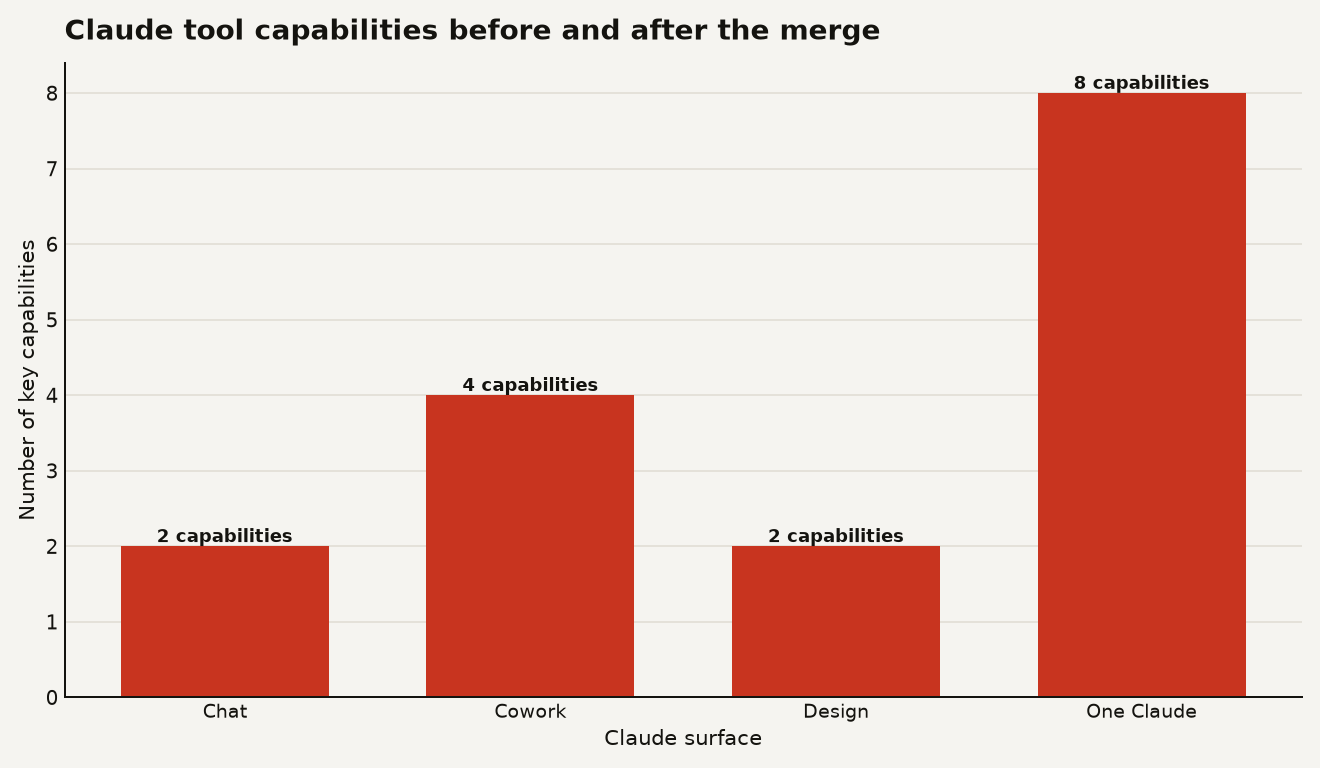
The chart above shows the feature count for each surface before the merge and the unified total after. Chat covered quick answers and web search. Cowork added background tasks, file access, and long-running research. Design added visual output. The merged One Claude combines all of those and layers Docs and Slides on top, reaching eight key capabilities in a single conversation window.
Anthropic also changed a few things under the hood that existing users should know about. Connectors, which let Claude reach into external apps and services like your email or calendar, still work but are now available from any conversation rather than only inside Cowork. Skills, which are specialized capabilities Claude can use for specific tasks, work the same way. The web search toggle is gone. Previously you could turn web search on or off in the chat box. Now Claude searches the web when it judges that searching helps, with no manual toggle.
Why does this matter for how I use Claude?
If you are a beginner who avoided Cowork because you did not understand the difference, the merge removes that barrier entirely. You no longer need to know what Cowork is. You just type what you want, and Claude handles the routing.
For people who were already using Cowork, the change is mostly positive but comes with a few adjustments:
- Your Cowork tasks and projects carry over. When the update hits your account, your existing chats, projects, connectors, skills, and files all move to the unified interface. You do not lose anything.
- There is no going back. Once your account moves to the new experience, you cannot switch back to separate Chat and Cowork options.
- Global instructions moved. If you had custom instructions set in Cowork, they are now in Settings under "Instructions for Claude." Check that they still say what you want.
- Deep research is still a separate command. Type /deep-research or click the plus button to start it. It does not happen automatically.
- Background tasks need the desktop app for local files. Tasks that use files or apps on your computer need Claude Desktop open. Cloud-based tasks keep running even if you close your laptop.
The bigger picture is about what "one Claude" signals for the market. Simon Willison noted that this echoes OpenAI's recent move to rename its Codex desktop app to ChatGPT. Both companies are consolidating their AI tools into single entry points that act as general agents. An agent, in plain terms, is an AI that works through a task on its own: searching, reading files, running code, and assembling results without you micromanaging each step. The merge means Claude is positioning itself as that kind of agent, not just a chatbot that answers questions one at a time.
For a beginner, the practical takeaway is simple. The tool you might have been intimidated by is getting simpler to use. You get one box. You type what you want. Claude does the rest.
What should I do when the merge reaches my account?
If you are on a Pro or Max plan, watch for the update over the next few weeks. Anthropic says even accounts on the same plan will see the change at different times, because the rollout is staged. If your message box still shows separate "Chat" and "Cowork" buttons, you do not have it yet. There is nothing to turn on. It just appears.
Here is what to check when it lands:
- Review your instructions. Go to Settings, then General, and confirm your global instructions are what you want. This is where Cowork's old custom instructions now live.
- Try one multi-step task. The best way to understand the merge is to give Claude something bigger than a quick question. Ask it to research a topic, write a short report, and put the key points in slides. Watch how it breaks the work into steps on its own.
- Test the exports. Claude Docs and Claude Slides are new and in beta. Ask Claude to create a document, then download it as a Word file or PDF. Ask for slides, then export as PowerPoint. If you rely on either format for work, confirm the output is usable before you depend on it.
- Find your old files. Files Claude creates now appear alongside the conversation. If you used Cowork's local folders on your desktop, the old Storage folder is still in Settings, and your trusted folders are still listed there.
If you are on a Team or Free plan, you will wait longer. Anthropic has not given a specific date for those tiers. Enterprise administrators will get at least 30 days of notice before anything changes for their organizations.
If you are still deciding which AI assistant to use in 2026, our beginner agent guide compares Claude against the other major options. The merge does not change which AI model powers Claude. It changes how you reach that model, and that is a change most beginners will welcome.
The real test is whether one Claude can route tasks well enough to stay invisible
Consolidating three tools into one is easy to announce and hard to execute. The risk is that "one Claude" becomes a tool that does nothing particularly well. A quick chat answer does not need the overhead of an agent planning steps, and a complex research report does not benefit from being treated like a casual question. Anthropic is betting that Claude can tell the difference automatically. That bet will live or die in the routing logic. When Claude guesses wrong about what a task needs, you will feel the friction that the merge was supposed to eliminate. For now, the direction is right. Fewer surfaces, fewer decisions, one place to start.
Sources
- claude.com - Claude Cowork and chat are now one Claude
- reuters.com - Anthropic to fold Claude AI features into one interface, launches document tools
- support.claude.com - Claude Cowork and chat are one Claude: Help Center
- theverge.com - Claude comes for Gemini with its own take on Docs and Slides
- techcrunch.com - Anthropic merges Claude chat and Cowork in one interface
- simonwillison.net - Claude Cowork and chat are now one Claude