A song that climbed to number 58 on the Billboard Hot 100 is now at the center of a question that music platforms, rights holders, and AI builders have been bracing for: is "Rubberz" by Fenix Flexin AI-generated music? The track, released by the Los Angeles rapper best known for his work with Shoreline Mafia, took a sharp left turn from trap-influenced West Coast rap into 80s UK synth pop, adopting what listeners describe as a fake British accent reminiscent of Morrissey. Almost immediately, producers and listeners began pointing to artifacts in the audio, lyrics, and cover art that suggest the song came from a generative model. Fenix has denied the allegations, but he has not released the raw session files that would settle the question. The Verge reports that five generic AI music detectors returned only a 20 to 30 percent probability that the track was AI-generated. When a specialized detector retrained on the suspected generation model, it flagged the song as fully AI-generated.
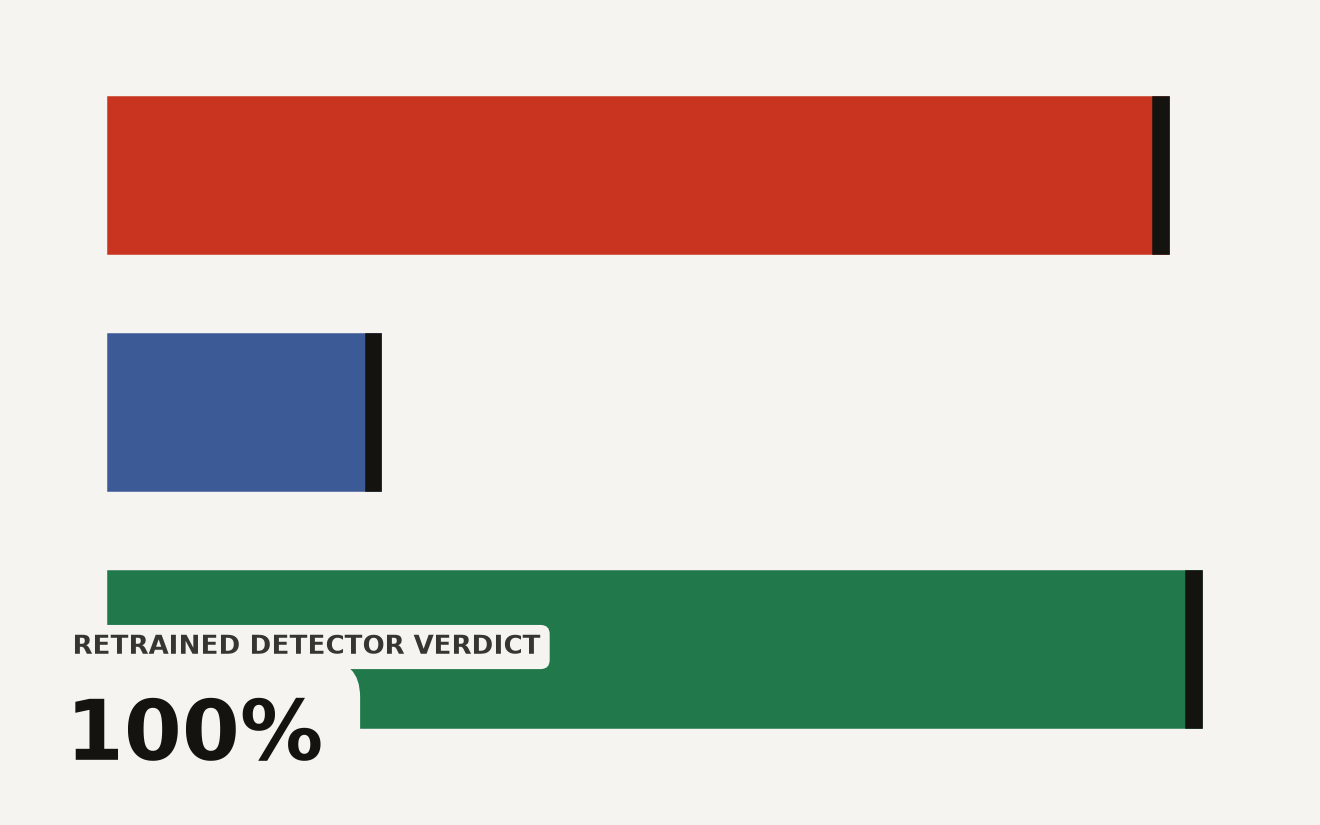
Generic detectors scored "Rubberz" at 25 percent AI probability while a retrained tool called it fully AI-generated, and that 75-point gap is the moderation problem.
What evidence points to AI-generated music in "Rubberz"?
The case against "Rubberz" rests on four categories of evidence: audio artifacts, lyric patterns, AI detector results, and live performance failures. None is a smoking gun on its own. Together they form a circumstantial case that is unusually thick for a charting track. The music analysis publication Stems.media has called it AI music's first Hot 100 doping controversy.
The audio is the strongest tell. Charlie Harding, a songwriter and co-host of the Switched on Pop podcast, told The Verge about specific artifacts: brittle hi-hats, chorus vocals with the character of a low-bitrate MP3, and reverb tails that cut off unnaturally. He tied the degradation directly to training-data quality, noting that most generative AI companies have trained their models on low-quality MP3s of unlicensed copyrighted material, which produces audibly degraded instrumentation. Producer and YouTuber Curtiss King and music critic Anthony Fantano both disputed Fenix's claim that the artifacts were AutoTune. King compared AutoTune to spellcheck: it corrects pitch, but does not extend vocal range or introduce accents. Fantano made the same structural point independently.
The lyrics read the way generative models write when forced to rhyme. The scheme is a rigid AA, BB format with no internal rhymes, no near rhymes, and no narrative coherence. Lines like "Swipin' cards and stackin' chips, I saw you sinkin' ships" raise questions the song never answers. The phrase "Hatin' that I'm able" repeats without specifying what the narrator is able to do or why he resents it. Harding described a "complete lack of flow" and noted that the title line is sung with syllabic emphasis in the wrong places, forcing an unnatural syncopation that no working rapper would choose.
Supporting materials tripped AI detectors independently. The single's cover art and a social media post celebrating the song's chart success were both flagged as AI-generated with over 97 percent certainty by multiple AI image detectors. The lyrics, fed into both Gemini and Claude, were flagged as AI-written by both systems. King separately dropped the lyrics into Claude and got the same result.
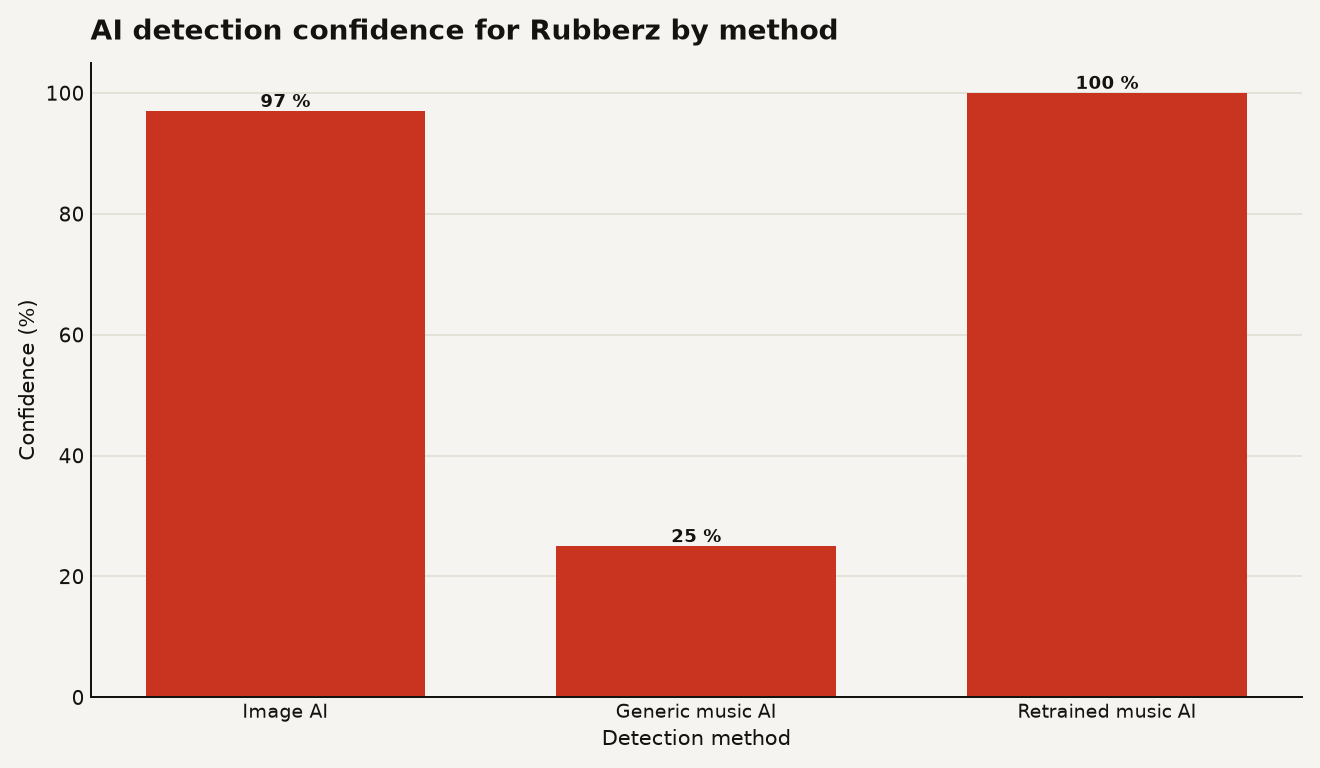
The chart above shows detection confidence across three categories of analysis. AI image detectors flagged the cover art at 97 percent certainty or higher. Five generic AI music detectors returned only a 20 to 30 percent confidence that the audio was AI-generated, shown here as 25 percent, the midpoint of that range. HumanStandard, retrained on the suspected Treblo generation model, returned a verdict of fully AI-generated. That gap between generic and retrained audio detection is the crux of the problem for any platform trying to moderate AI-generated music at scale.
Live performances made things worse. In multiple clips, Fenix appears to lip-sync while the original vocal track plays underneath. When he does sing, he cannot recreate the vocal range or the British accent heard on the recording. The DJ in some clips strategically drops the backing track to prove authenticity, but the attempt fails. Fenix blamed vocal processing and AutoTune for the discrepancy. Harding, King, and Fantano all rejected that explanation on structural grounds: AutoTune corrects pitch. It does not manufacture range or accent.
Why did generic AI music detectors miss it?
The most revealing detail is how thoroughly standard AI music detectors missed it. Five tools returned a 20 to 30 percent probability. Those results are technically inconclusive, but they point to a structural problem that anyone building detection systems should understand.
Generic AI music detectors are trained on outputs from known generation models. When a new model arrives or an existing model improves, detectors that have not been retrained on its specific outputs lose accuracy. This is the same adversarial arms race that undermines text-based AI detection tools, where narrow signals get treated as definitive verdicts and then collapse when the underlying generation model shifts.
The breakthrough came when Rasha Rahman, founder of the AI song detector HumanStandard, received a tip about a specific AI music generation model called Treblo. Rahman tested Treblo and found he could simulate Fenix's voice on "Rubberz" perfectly, and that the model even produced lyrics matching the song. After retraining HumanStandard's detection models on enough AI songs generated by Treblo, Rahman re-analyzed the track. The result came back as fully AI-generated.
This is the key insight for builders: detection without model-specific training data is nearly blind. The gap between 25 percent confidence from generic tools and 100 percent from a retrained tool reflects a training-set deficit. Both tools analyzed the same audio. One had the right reference data; the other was looking blind. If you are building a music authentication or moderation system, you need a pipeline to continuously ingest outputs from new generation models and retrain your classifiers. A static detector degrades every time a new model ships.
What does this mean for music platforms and AI builders?
The implications break down into three areas that affect your roadmap, your moderation stack, and your legal exposure.
Content authentication is the first problem. If a song can reach number 58 on the Billboard Hot 100 before anyone confirms whether it is AI-generated, your platform's moderation pipeline is already behind. The major streaming services, rights management organizations, and chart compilers do not currently require disclosure of AI-generated content. That gap will close, probably through litigation rather than legislation. Stems.media's reporting notes a copyright suit filed in Germany at the end of July, signaling the direction. Platforms that cannot distinguish AI-generated music from human-created music will face takedown requests, royalty disputes, and misattribution claims from artists whose voices or styles were used without consent.
Detection tooling is the second problem. The HumanStandard finding shows that model-specific retraining works, but it also shows that the window between a new generation model's release and your detector catching up is where the damage happens. "Rubberz" charted, accumulated streams, and generated revenue during that window. For a platform, that means:
- You need a continuous ingestion pipeline for AI-generated music samples, tied to each new model release, not a quarterly model refresh.
- Multi-modal detection beats single-modal. The image and text detectors caught what the audio detector missed. A pipeline that checks cover art, lyrics, and audio together will catch cases that any single modality misses.
- A 20 to 30 percent score from a generic detector is not a clean negative. It is a signal that your tool does not know enough to classify the input, and that should trigger escalation rather than a pass.
Voice and likeness rights are the third problem. The Treblo finding that the model could simulate Fenix's voice and produce matching lyrics raises a question that goes beyond this song: was Fenix's voice cloned without consent? If a generation model can reproduce a specific artist's vocal timbre, then every artist with a recorded catalog is a potential training target. The legal framework for voice cloning is still forming, but builders of music generation tools should assume that voice likeness claims are coming.
What should you watch and what bets would you make?
The "Rubberz" case is the first time AI-generated music has reached the Billboard Hot 100 under sustained public scrutiny. It will not be the last. Here is what to watch.
Fenix has not released his Pro Tools session files. Short of that, the circumstantial case is strong but unproven. If he never releases them, the market will treat the silence as confirmation. Watch for whether Billboard or any streaming platform adjusts its charting or metadata policies in response to this controversy.
The detection arms race will accelerate. HumanStandard's retraining approach works, but it is reactive. Watch for proactive detection methods that do not require model-specific training data, such as watermarking standards or provenance tracking. The industry groups working on these standards have been slow. Pressure from cases like this will force faster movement.
The bets you should and should not make:
- Do bet on multi-modal detection pipelines. The "Rubberz" case proves that combining image, text, and audio detection catches what single-modality tools miss.
- Do bet on continuous model ingestion. Your detector is only as good as its knowledge of current generation models. Build the pipeline now.
- Do not bet on static detection thresholds. A 20 to 30 percent confidence score from a generic detector is not a pass. It is an unknown. Treat it as one.
- Do not bet on voluntary disclosure. Fenix denied the allegations and posted partial Pro Tools clips that did not settle the question. Voluntary disclosure failed here, and it will fail in most cases where the incentive is to keep streaming revenue flowing.
The first chart hit, not the last
"Rubberz" might be a bad song made by a bad AI model. That is almost beside the point. The song charted at number 58. It accumulated streams. It generated revenue. And the tools designed to catch it failed until a specialized detector was retrained on the specific model suspected of generating it. The gap between generation capability and detection capability is the infrastructure problem of the next two years for anyone building music platforms, moderation tools, or rights management systems. The next "Rubberz" is already being generated. The question is whether your detector will know it when it arrives.
Sources
- The Verge - Is Fenix Flexin's Billboard Hot 100 hit Rubberz AI slop?
- Stems.media - Fenix Flexin, "Rubberz": AI Music's First Hot 100 Doping Controversy
- Billboard - Fenix Flexin Denies 'RUBBERZ' AI Allegations