The people you build for think your product is coming for their job. That is the blunt takeaway from a Pew Research Center survey of 42,151 adults across 37 countries, conducted between February 8 and May 13, 2026. In 34 of those 37 countries, more people expect AI job losses over the next 20 years than expect new jobs from the technology. The survey wrapped before the recent wave of executive warnings about white-collar automation, which means the public was already anxious before the CEOs started talking.
A 42,151-person Pew survey finds the people who use your products are bracing for displacement, and the anxiety is rising fastest where adoption is highest.
For anyone shipping AI products, this is your user base speaking. The same people who use ChatGPT, Claude, and Copilot are telling pollsters they expect those tools to eliminate their livelihoods. Whether or not they are right, that sentiment shapes adoption, regulation, and the social license under which every AI company operates.
What does the Pew survey actually find?
The headline number is the breadth of the pessimism. Pew surveyed adults in 37 countries spanning high-income economies like Australia and the United States and middle-income nations like Kenya and the Philippines. In 34 of those 37 countries, the plurality view is that AI will reduce jobs rather than create them. The fear is most acute in wealthy nations: 76 percent of adults in Australia and 76 percent in South Korea say AI will lead to job losses, followed by 71 percent in the United States. The Verge reported on the findings, noting that the survey predates Anthropic CEO Dario Amodei's warning that AI could eliminate half of entry-level white-collar jobs.
The United States is the only country where Pew has historical data, and the trend is moving the wrong way for AI optimism. The share of Americans who expect AI to cause job losses has risen 7 percentage points in two years, reaching 71 percent. That is a meaningful shift in a large population that has already seen heavy AI marketing and deployment.
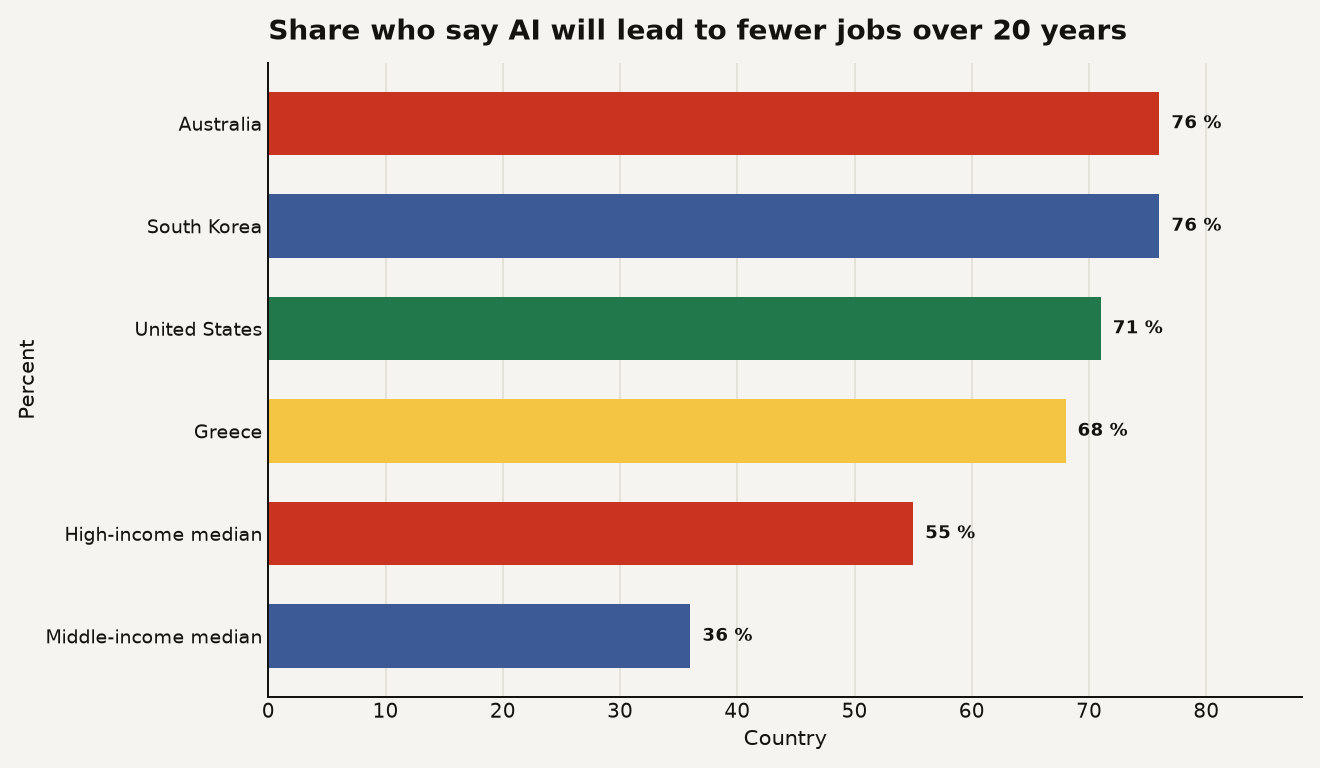
The chart below shows how the expectation of AI job loss varies by country and income tier. The top four countries are all high-income economies, with Australia and South Korea tied at 76 percent and Greece close behind at 68 percent. The high-income country median sits at 55 percent, while the middle-income median is just 36 percent. That gap tells you where the political backlash will land first.
Beyond jobs, the survey asked about AI's effect on inequality. A global median of 46 percent say AI will increase the gap between rich and poor. In no country do more than 25 percent of adults believe AI will decrease inequality, and in 29 nations that figure is in single digits. The public has a zero-sum read on AI economics: someone wins, most people lose.
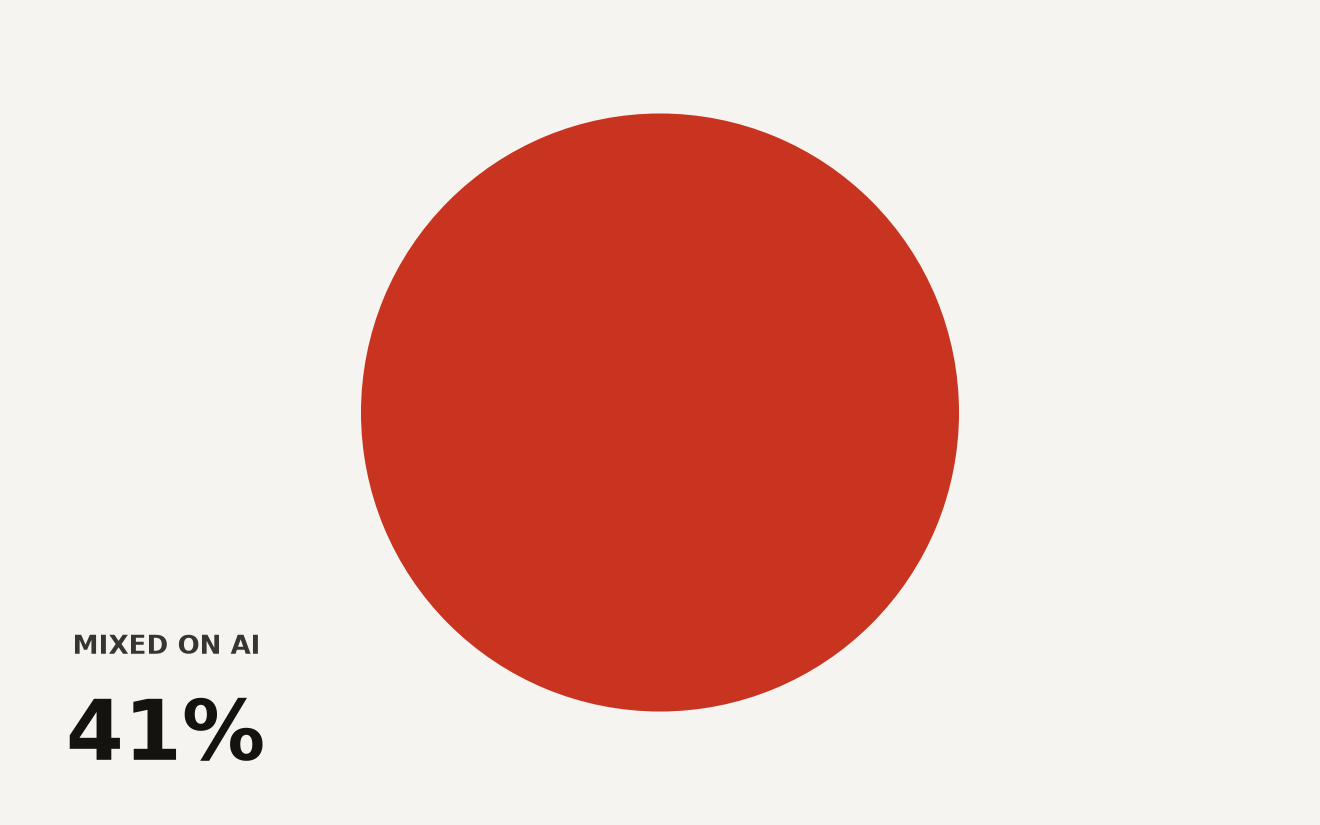
The sentiment about AI in daily life is more mixed than the job numbers suggest. A 37-country median of 41 percent say they are equally concerned and excited about AI's growing presence, compared to 37 percent who are primarily concerned and just 13 percent who are primarily excited. Israel is the only country where excitement outranks concern. The mixed-feelings plurality means the public has not made up its mind about AI as a daily tool, even as it has decided the job picture looks grim.
Why are wealthy countries more afraid of AI than developing ones?
The correlation between GDP per capita and AI job loss anxiety is one of the most striking patterns in the data. A Pew analysis of high-income versus middle-income countries found that a median of 55 percent of adults in 18 high-income countries say AI will lead to fewer jobs, compared to just 36 percent across 18 middle-income countries. The gap in uncertainty is just as telling: 34 percent of adults in middle-income countries say they are unsure how AI will affect jobs, versus 22 percent in high-income countries.
Three forces likely drive this divergence. First, the jobs most vulnerable to current AI capabilities, knowledge work and administrative roles, are concentrated in wealthy economies. A lawyer in Sydney has more reason to worry about a language model than a farmer in Kenya. Second, awareness tracks with GDP. People in higher-income countries have heard more about AI, and awareness breeds both concern and opinion. Third, middle-income respondents may see AI as a productivity tool that could help them close the gap rather than threaten their jobs. If you are building for global markets, this split matters: your value proposition in Bangalore is not the same as in Boston.
The age pattern complicates the story further. Pew found that in several countries, including Canada, France, Singapore, and Sweden, concern about AI job loss is now more common among adults aged 18 to 34 than among those 50 and older. That inverts the usual technology adoption curve, where younger people are the optimistic early adopters. In the US, concern among young adults has risen sharply over the past year, making them as worried as older generations. The generation that grew up with smartphones is the one now telling pollsters they fear what AI will do to their career prospects.
What does public fear mean for teams shipping AI products?
If you are building AI tools, this survey is a leading indicator of three problems heading your way.
- Adoption friction in your most lucrative markets. The countries where people are most afraid of AI are the countries where AI spending is highest. Australia, South Korea, and the US are top-tier markets for enterprise AI, and they are also the markets where three-quarters of the population expects job losses. Your sales team is walking into meetings with buyers who have read the same headlines and heard the same Amodei warnings. The question "will this replace my staff?" is now on the mind of every procurement officer, not just every columnist.
- Regulatory pressure that follows public anxiety. Politicians respond to voters, and voters in wealthy democracies are telling Pew they expect AI to widen inequality. When 46 percent of a global median says AI will increase the gap between rich and poor, that is a mandate for labor protection bills, AI training mandates, and corporate transparency requirements. The EU AI Act is the first draft, not the final word. If you build AI products, expect more jurisdictions to demand impact assessments, worker notification rules, and documentation of what your model trained on.
- A trust deficit with your own users. The 41 percent of adults who feel equally concerned and excited are your swing voters. They use your product, but they are not sure it is good for them. That ambivalence is fragile. A single high-profile failure, an agent that makes a catastrophic error, a data leak, a layoff attributed to AI, could tip them from cautious adoption to active resistance. As we have noted in our coverage of enterprise AI deployments, most AI pilots never reach production anyway. Public distrust adds a layer of friction on top of the technical debt.
Should you change your roadmap based on public anxiety?
The short answer is yes, but not by building less. The longer answer depends on what you are building and where.
If you build productivity tools for knowledge workers, your product page needs a "human-in-the-loop" story that is more than marketing copy. The buyers you are selling to are the same people who told Pew they fear job losses. Show them how your tool augments rather than replaces, with evidence, not adjectives. Anthropic's own pace-the-frontier guidance emphasizes responsible scaling, and that framing is now a market expectation rather than a nice-to-have.
If you build for middle-income markets, the data suggests a different opportunity. Lower concern and higher uncertainty mean an opening for tools that frame AI as capability expansion rather than cost cutting. A developer in Jakarta or Lagos who adopts your tool sees it as a leg up, not a threat. Tailor your positioning accordingly.
If you build AI agents that replace human tasks, brace for the backlash. The public has already decided that AI kills jobs. Your job is to prove that the specific jobs it kills are ones people do not want, or that the displaced workers find better ones. That case is not self-evident, and the burden of proof is on you. The gap between what AI agents can do in demos and what they do in production is still wide, and public skepticism will only make that gap harder to close.
Watch three things over the next year. First, whether the US number keeps climbing. A 7-point jump in two years is fast; if it accelerates, political pressure on AI companies will intensify. Second, whether middle-income concern rises as awareness spreads. The 34 percent who are currently unsure could become worried fast once they see AI in their workplaces. Third, whether any country's sentiment improves. Israel is the only outlier on excitement, and if that changes, the global picture could shift.
The fear is ahead of the reality
The most striking thing about the Pew data is the level of fear relative to actual deployment. Most enterprise AI projects are still in pilot. Most knowledge workers have not yet been replaced by a model. The public is ahead of the technology in its pessimism, which is unusual. People usually underestimate disruption until it arrives. This time, they are overestimating it before it gets there.
That gap between perception and reality is where builders live. If you ship something that genuinely helps people work better, you will find a receptive audience that is nervous but willing. If you ship something that confirms their worst fears, you will face the regulatory and social backlash that is already forming. The survey tells you the room you are walking into. It is up to you to decide what you do with that knowledge.
Sources
- Pew Research Center: Globally, More People Expect AI to Cause Job Loss Than Growth
- Pew Research Center: Concerns about AI are especially widespread in high-income countries
- The Verge: AI is feared globally as the destroyer of jobs
- Pew Research Center: Who has heard or read a lot about AI, and how is awareness changing?