The most interesting AI adoption number this week is a handoff number. People are starting to treat agents less like smart autocomplete and more like junior staff with terminal access, file access, and a clock.
Agentic AI work is moving from prompt exchanges to delegated execution, and OpenAI's Codex data puts a hard number on the shift: 70.2 percent of sampled individual Codex users made at least one request estimated to exceed one hour of human work.
OpenAI published a new Economic Research paper on June 25, 2026, analyzing Codex usage across individual users, organizational users, and OpenAI workers, and the headline is blunt: agentic AI work is becoming measurable as delegated production rather than chat volume. In the OpenAI paper, Codex accounted for 99.8 percent of output tokens across Codex and ChatGPT among OpenAI workers as of June 11, 2026, compared with 63.3 percent among organizational users and 16.5 percent among individual users.
That spread matters. OpenAI is the petri dish, with cheap internal usage, high model literacy, and workflows close to the product. Your company is probably messier. Still, the pattern is useful because it shows where the interface is headed: away from one prompt, one answer, and toward multiple agents running real tasks while a human reviews the work.
OpenAI's Codex usage study and its method
OpenAI and coauthors from Columbia Business School, Wharton, and Duke studied Codex usage data with automated classifiers rather than researchers reading user messages, and the paper says it compared three populations: individual users, organizational users, and workers inside OpenAI. Codex was initially released in April 2025 as a command line interface, and later releases broadened the surfaces and users who could access it.
The cleanest finding is that users are asking agents to take bigger bites. OpenAI's public summary says that by May 2026, 80.6 percent of sampled individual users made at least one Codex request estimated to exceed 30 minutes of human work, while 70.2 percent made at least one request estimated to exceed one hour. The same OpenAI summary says 25.6 percent of sampled individual users made at least one request estimated to exceed eight hours of human work.
The chart below shows the three thresholds that matter most for builders: half-hour tasks are already routine among sampled Codex users, one-hour tasks are close behind, and full-day tasks are no longer weird edge behavior.
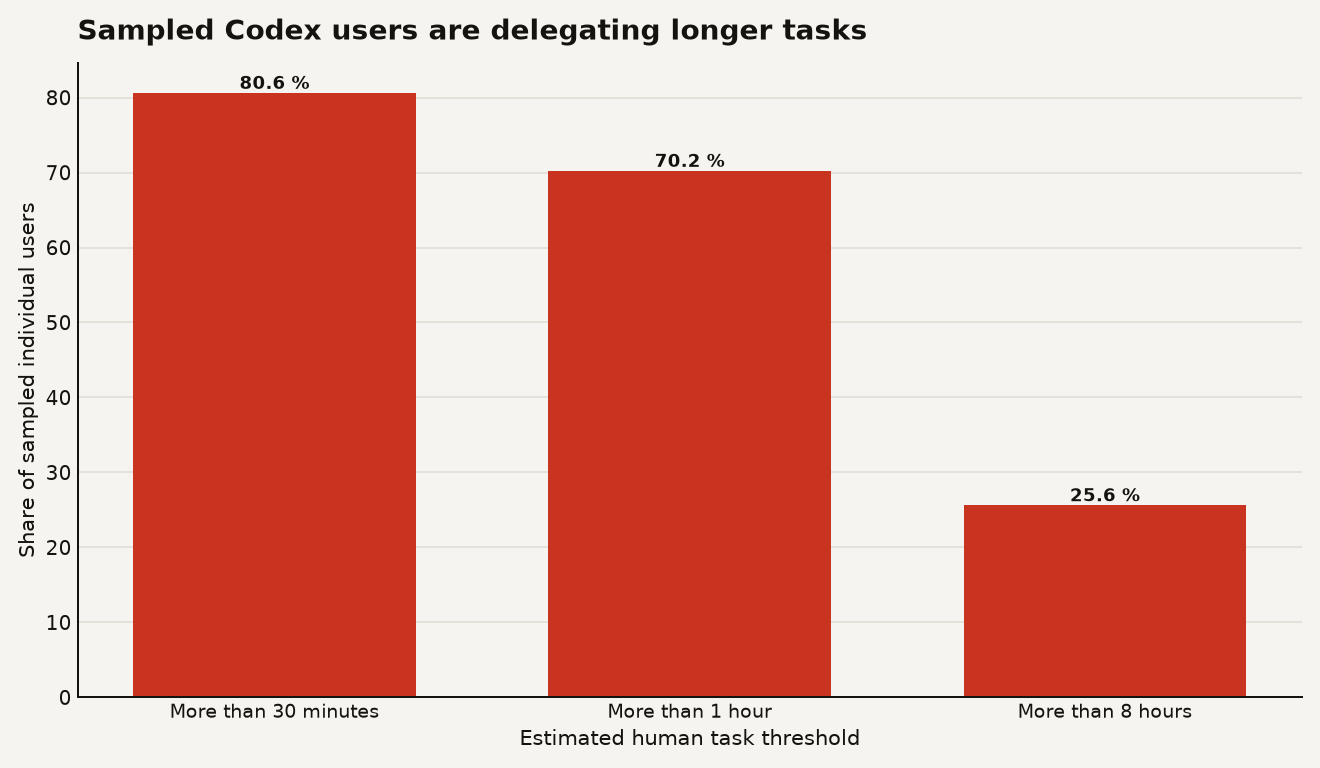
Treat the exact values with care. The paper says the task-horizon estimates come from an LLM judge applied to a 0.1 percent random sample of individual users who opted to allow their queries to be used for model training, so the numbers are directional rather than a stopwatch measurement.
The second finding is that tool use is a decent, imperfect marker of the agent shift. In the week before June 11, 2026, the paper reports that 60.3 percent of Codex turns invoked at least one external tool, compared with 21.9 percent of ChatGPT turns.
The third finding is parallelism. The same paper says more than 10 percent of Codex users managed three or more concurrent agents at some point in a week, and inside OpenAI, 28.6 percent of users managed five or more concurrent agents during the week before June 11, 2026.
That is the new workload shape. A manager of agents is not waiting for a response bubble. They are dispatching tasks, checking diffs, rejecting sloppy work, adding context, and deciding which outputs can touch production.
Non-developers are now Codex users
The lazy read is that Codex is still a coding product with broader marketing. The stronger read is that coding is becoming the most legible path into general operations work. If an agent can inspect a repository, run scripts, modify files, write artifacts, and use tools, then the boundary between engineering work and business work starts to blur.
OpenAI says non-developer Codex adoption has grown faster than developer adoption: since August 2025, non-developer users rose 137 times among individual users, 189 times among organizational users, and 12 times inside OpenAI. In the same OpenAI post, the company says Legal, Finance, and Recruiting crossed into majority Codex usage around April 2026.
That does not mean your recruiter should ship a migration script on Friday afternoon. It means your recruiter may soon ask an agent to transform candidate data, query an internal spreadsheet, draft a structured analysis, and build a small review tool. The software surface area of every function expands.
OpenAI's occupation heat map makes that concrete. Among OpenAI workers in finance and business operations, 31 percent of Codex output tokens were classified as engineering or coding, 16 percent as financial analysis, and 34 percent as knowledge work in the published table.
Here is what this means for you:
- Your internal tools backlog becomes a governance problem. The annoying spreadsheet converter that never made the roadmap may get built by a business analyst with Codex, which is great until it quietly becomes critical infrastructure.
- Your codebase needs safer paths for non-engineer contribution. Sandboxed repos, preview environments, test fixtures, and review gates become adoption infrastructure rather than developer niceties.
- Your moat shifts from access to execution discipline. Plenty of teams will buy agents. Fewer will build repeatable workflows, reusable skills, permission boundaries, and review rituals that turn agent work into reliable output.
- Your hiring bar changes. The valuable non-engineer is the person who can specify work, inspect artifacts, and know when to escalate to a specialist.
This is also where agent reliability stops being a benchmark sport and becomes an operating constraint. Data Today has covered the gap between demos and deployable workplace agents in workplace agent reliability, and the Codex usage data points at the same lesson: the winning workflow is reviewed delegation, not blind autonomy.
Permissions first, before agents become normal work
Start with permissions. Agentic AI work has a different blast radius from chat because the agent can use tools, inspect files, execute commands, and modify artifacts. The OpenAI paper defines agentic systems as tools that allow users to delegate multi-step tasks to AI systems that can autonomously use external tools, inspect files, execute commands, and create or modify artifacts.
If your answer to that is a company-wide AI seat and a cheerful policy PDF, you are underbuilding. The boring controls are the product:
- Create separate agent workspaces for production, staging, and exploration.
- Require human review before agents merge code, change customer data, send external messages, or update financial records.
- Log the prompt, files touched, tools used, output artifact, reviewer, and final disposition for each serious task.
- Build reusable skills for repeated workflows, then version them like software.
- Track agent runtime and concurrency, because one busy person can now create a surprising amount of parallel work for everyone downstream.
Skills deserve special attention. OpenAI says the share of active Codex users invoking any skill rose from 5.4 percent on March 1, 2026, to 26.6 percent on June 11, 2026, and skills let users share reusable instructions for complex workflows in the research paper.
That is a clue for roadmap planning. A good internal agent program should look less like prompt tips in a Slack channel and more like a library of maintained procedures: close the books, triage support logs, prepare a board metric pack, update a sales forecast, refactor a service, investigate a test failure. Each needs context, allowed tools, success criteria, and a reviewer.
Microsoft's 2026 Work Trend Index is useful context here because it surveyed 20,000 AI-using knowledge workers across 10 markets between February 18 and April 7, 2026. The Microsoft report frames the opportunity around human-agent teams, which is the right management unit for 2026 planning.
The budget line will move too. Today, many teams still treat AI spend as seats. Agent work pushes costs toward runtime, tool calls, test loops, cloud environments, and review time. If you already worry about AI coding costs, our earlier look at the Copilot spend meter is the same movie in a smaller room.
How far the OpenAI data travels
The OpenAI data is valuable because it is close to the frontier, and it is limited for the same reason. The paper says OpenAI workers are highly familiar with frontier models, usage is cheap at the margin, organizational buy-in is high, and internal knowledge sharing is common. That is a stacked deck.
External adoption looks much less saturated. The OpenAI paper says fewer than 1 percent of active individual users used Codex in the last 28 days, while 17.3 percent of organizational users did. That is a huge difference from OpenAI, where almost all active workers use Codex each week.
So the right conclusion is selective urgency. Do not reorganize a company of 400 people around agent swarms because OpenAI researchers are heavy users. Do reorganize the parts of your company where the work is digital, reviewable, repetitive, and bottlenecked by technical translation.
Good first targets have four traits:
- The input and output are already digital.
- The task has clear acceptance criteria.
- A failed attempt is cheap to catch.
- The workflow repeats at least weekly.
Bad first targets have the opposite traits: ambiguous judgment, high external consequences, weak logs, and no obvious reviewer. Legal can use agents, as OpenAI's own Legal team apparently does, but that does not make unsupervised contract edits a sane launch plan.
The bigger caveat is measurement. Tokens are a proxy for work, not value. Runtime is a proxy for delegated effort, not useful output. The paper is strongest when it shows behavior change: longer tasks, more concurrent agents, higher skill use, and cross-functional delegation. It is weaker as a productivity proof. For that, builders should demand accepted pull requests, cycle time, support resolution, finance close time, defect rates, and rework.
The org chart starts looking like a runtime
The sharpest implication of the Codex data is that the unit of AI adoption is changing. A worker with five agents running is closer to an orchestrator than a chat user. That makes taste, judgment, review skill, and process design more valuable, not less.
The companies that win this phase will stop asking whether employees are allowed to use agents and start asking which workflows deserve an agent lane. The answer will rarely be glamorous. It will look like sandboxes, logs, tests, permissions, and people who know enough to say, "No, that diff is cursed."
That is progress. Boring infrastructure is what turns magic into work.