The World Cup kicks off in six days, and for the first time in its 96-year history the price on your ticket is not a fixed number printed by a governing body. It is an output. FIFA has handed the world's biggest sporting event to the same kind of demand-driven pricing engine that runs airline seats and concert tiers, and the results are already eye-watering.
Here is the plain version for anyone who has not followed the ticketing saga. Dynamic pricing, which FIFA prefers to call "variable pricing," means the price of a seat moves up or down with live demand and remaining inventory instead of sitting at a published face value. FIFA confirmed in September 2025 that World Cup 2026 tickets would start at $60 for the cheapest group-stage seats and run to $6,730 for the most expensive seat at the July 19 final at MetLife Stadium, "but all of that is subject to change once sales begin." That last clause is the whole story.
The tournament itself is the largest ever: 48 teams, 104 matches, 16 cities across the United States, Canada, and Mexico, running June 11 to July 19. More matches mean more inventory to price, and FIFA built a machine to price every seat of it.
From Category 4 to the final
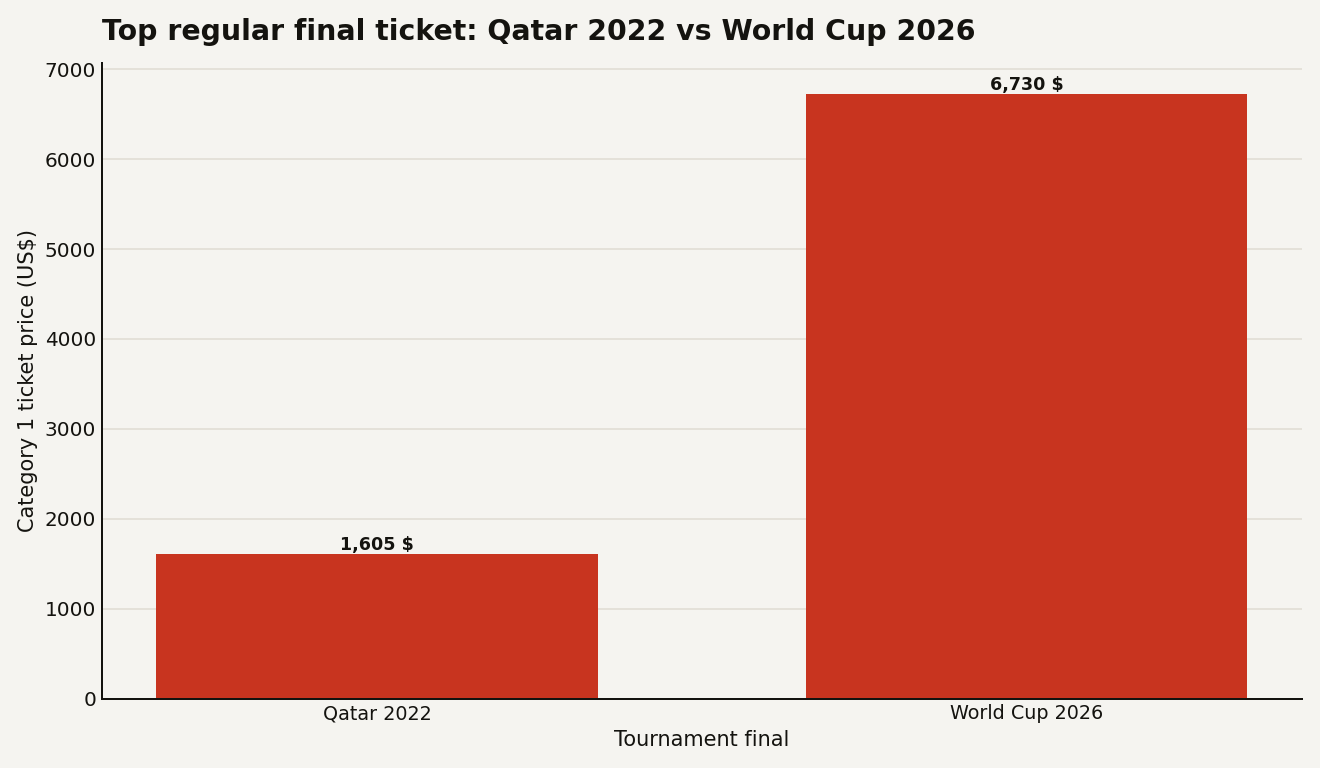
The headline range is wide on purpose. At the floor, a Category 4 group-stage ticket opened at $60. At the ceiling, a Category 1 seat at the final opened at $6,730, and that is a regular ticket, not a hospitality package. The hospitality tier is a different world: those seats range from $3,500 to $73,200 per person across the tournament.
The catch is that these were starting prices, and "variable pricing from Day 1" did what it always does. By the time FIFA reported its November 2025 sales update, group-stage tickets were starting around $700 rather than $60, and premium Category 1 final seats had pushed past $10,000. The $60 seat was real, but FIFA never said how many existed, only that the Category 4 share of a stadium would be "not insignificant." Dynamic pricing means the cheap seat is a doorbuster, not a tier.
To see how far the ceiling moved, compare it to the last tournament. A Category 1 ticket to the 2022 final in Qatar cost $1,605. The 2026 opening ceiling of $6,730 is more than four times that, before a single demand-driven increase.
That is the part fans feel. The 2026 World Cup is on track to be the most expensive tournament in history to attend, and the pricing model is the reason the ceiling has no real cap.
You may have seen a wilder number than $6,730 doing the rounds: an $11.5 million ticket. That one is real but needs context, because it is not a FIFA face value. It is a resale asking price. On FIFA's own resale platform, which is uncapped for US and Canada buyers, TIME spotted a final ticket listed at $11,499,998.55, eclipsing an earlier $2.3 million listing from April. No one is going to pay it, and it is not money FIFA collects unless it sells. But the fact that the platform lets a seat be listed for eleven million dollars at all is the point critics are making. Remove the resale cap and the ceiling stops meaning anything. A Northeastern business professor told TIME there is "an element of greed" in the model, and a European fan group called it a "monumental betrayal." So when you hear "$11 million ticket," read it as a symptom of uncapped resale, not the price on a seat FIFA is selling.
FIFA's revenue from dynamic pricing
A lot, and the ticket window is only one tap on the keg. FIFA runs its accounts in four-year commercial cycles, and the 2023 to 2026 cycle has a revised revenue target of $13 billion, up from an original $11 billion projection. The 2026 World Cup alone accounts for roughly $8.9 billion of that, a 56 percent jump on the $7 billion Qatar 2022 brought in and the largest single-edition increase the tournament has ever recorded.
Stack the editions and the trajectory is its own argument. World Cup revenue has climbed from $3.3 billion in 2006 to a projected $8.9 billion in 2026, roughly 170 percent growth in twenty years, driven by broadcasting, sponsorship, and now an aggressively monetized ticket.
| Revenue stream (2026 cycle) | Amount |
|---|---|
| Broadcasting rights | $3.92 billion |
| Hospitality and ticketing | $3.097 billion |
| Marketing and sponsorship | $2.693 billion |
| Licensing | $669 million |
The line that matters for this story is hospitality and ticketing. At $3.097 billion, it is up about $2.59 billion on the previous cycle and has, for the first time, effectively pulled level with broadcasting as FIFA's top revenue source. Two things drove that: 40 extra matches versus the 64-match Qatar format, and FIFA insourcing its hospitality operation instead of selling the rights to a middleman. Dynamic pricing is the third lever, and it is the one with no ceiling. A FIFA official put the combined hospitality-and-ticket take above $3 billion for the tournament.
It is worth being precise about "profit." FIFA is a non-profit that reinvests more than 90 percent of its budget back into football, so it books almost no headline surplus by design. The real scoreboard is its reserves, which sat at $2.95 billion at the end of 2024 and keep growing. The money is real; it just gets renamed "investment" on the way out.
The largest public pricing experiment yet
Because FIFA just ran the largest, most public A/B test in the history of demand pricing, and the lessons port directly to anything you sell.
- The algorithm is the product decision now. FIFA did not set 104 match prices by hand. It set rules and let automation adjust to demand and inventory. If you run a SaaS, a marketplace, or an events business, the pricing page is increasingly a model, not a number, and the model's defaults are your brand.
- A low anchor plus an uncapped ceiling is a revenue strategy, not a contradiction. The $60 seat generates the headlines and the goodwill; the dynamic ceiling captures the willingness-to-pay that used to leak to scalpers. This is the same logic behind metered and usage-based pricing in software, where a free tier anchors and consumption scales. We dug into how unevenly that plays out in the piece on inference prices.
- Owning the resale layer is owning the margin. FIFA is launching its own resale platform and, for the first time, removing the price cap for buyers in the US and Canada. Its reasoning is blunt: cap resale and fans route around you to StubHub, so capture the secondary market instead of fighting it. If your product has a secondary market, whoever controls it controls a second revenue line.
- Demand signals are the real asset. FIFA had 8.5 million people register interest before sales opened, against roughly 6 million tickets. That registration data is what makes confident dynamic pricing possible. The equivalent for you is your waitlist, your usage telemetry, your funnel. Price moves are only as good as the demand signal behind them.
The builder takeaway is not "charge more." It is that pricing is now a system you design and operate, with its own failure modes, and FIFA is showing both the upside and the blast radius in public.
Dynamic pricing cuts both ways
Dynamic pricing cuts both ways, and FIFA already has a fresh scar to prove it. At the 2025 Club World Cup, FIFA overestimated demand, set initial prices high, and then watched ticket prices plummet as it scrambled to fill empty seats. The same engine that pushes a final seat past $10,000 will mark a half-full group-stage match down to nearly nothing, on camera, the moment demand disappoints. For a tournament selling itself as the biggest ever, a visibly discounted stadium is a brand problem, not just a revenue one.
There is a fairness cost too, and it is not abstract. A fixed low price lets fans with less money attend; an uncapped dynamic ceiling, plus uncapped resale, optimizes for whoever can pay the most. FIFA's counter is that scalpers would have extracted that money anyway, so the surplus may as well fund football development. Whether you buy that depends on how much you trust the redistribution, and European clubs, whose players are the actual product, are already lobbying for a bigger cut of a $652 million prize pot that sits on top of $13 billion in cycle revenue.
Watch three things between now and July 19: how low the genuinely cheap seats stay once the lottery phases end, whether any host city sees a Club World Cup-style price collapse, and what cut FIFA takes from its own uncapped resale hub. Each one is a data point on whether algorithmic pricing at this scale serves the fan or just the balance sheet.
The World Cup used to be priced like a public event. In 2026 it is priced like an asset. The football will be the same; the math underneath your seat will never be the same again.
Sources
- FIFA to use dynamic pricing for World Cup 2026 tickets (The Athletic / New York Times)
- FIFA World Cup 2026 Revenue Statistics (The Global Statistics)
- The $13bn World Cup: how the numbers stack up (The Guardian)
- FIFA revenues projected to surpass $10bn with 2026 World Cup (The Athletic)
- World Cup ticket prices reach $11.5M as FIFA criticized for greed (Dexerto, citing TIME)