This is the full research report behind the video: every number, source, and chart the script was written from.
SpaceX went public, soared 67%, and crashed back in 22 trading days. Here is what happened, why, and what Facebook's IPO tells us about what comes next.
AI Research Desk July 15, 2026 Report No. 2026-0715-SPCX
Executive summary
SpaceX completed the largest initial public offering in history on June 12, 2026, pricing shares at $135 and opening for trading at $150. Within three trading days the stock hit $225.64 intraday, a 67% gain from the IPO price that pushed the company's market capitalization past $2.9 trillion. On that same day, June 16, SpaceX announced it would acquire AI coding startup Cursor for $60 billion in stock, using shares that had just doubled in value to buy a company worth roughly $29 billion a few months earlier.
Then the air came out. Over the next 18 trading days, SPCX fell from $211 to $136, a 35.6% drawdown from the closing peak. As of July 15, the stock trades at $136.97, barely 1.5% above the IPO price and 39% below the intraday high. Trading volume has collapsed 91% from the IPO day. The stock is in the Nasdaq 100 but excluded from the S&P 500 for lack of a track record.
The fundamental picture is stark. SpaceX generated $19.3 billion in trailing twelve-month revenue and lost $9.36 billion, a negative 45% net margin. The company trades at 92 times sales. Its AI division, built around xAI (which SpaceX absorbed before the IPO), is in disarray: all 11 xAI co-founders departed by March 2026, the Grok chatbot called itself "MechaHitler" in 2025 and generated non-consensual deepfakes, and the company faces active litigation. SpaceX told IPO investors its total addressable market was $28 trillion, with $26 trillion attributed to AI.
Retail traders have been crushed. A WallStreetBets user posted losses of $80,000 on SPCX options in a single week. Short interest stands between 111 million and 196 million shares, the cost to borrow doubled in early July, and leveraged short ETFs from GraniteShares and Tradr already trade. IPO lockup restrictions on roughly 80 million shares expired July 13, with a larger unlock coming in August.
The closest historical parallel is Facebook's May 2012 IPO. FB priced at $38, opened at $42.05, peaked at $45 on day one, then fell 54% to $17.55 by September. It took 14 months to reclaim its IPO price. It eventually returned 1,666% over 14 years. The lesson cuts both ways: IPO disasters can be temporary, but the recovery is measured in years, not weeks.
Key findings
- SpaceX IPO'd at $135 on June 12, 2026. The stock peaked at $225.64 on June 16 (day 3) and trades at $136.97 on July 15 (day 22), a 39.3% decline from the intraday high.
- The company has a $1.8 trillion market cap on $19.3 billion in revenue and $9.36 billion in annual losses. Price-to-sales ratio: 92x. Profit margin: negative 45%.
- SpaceX used its peak-priced stock to acquire Cursor for $60 billion on June 16, the same day the stock hit its high. Cursor was worth roughly $29 billion before the deal was announced in April.
- The AI division (xAI) lost all 11 co-founders before the IPO. Grok generated deepfakes and called itself "MechaHitler." SpaceX faces related litigation.
- Short interest is 111-196 million shares. Cost to borrow doubled July 6-10. Two leveraged short ETFs already trade.
- IPO lockup expirations released ~80 million shares on July 13. A larger unlock is expected in August.
- The broader space sector crashed alongside SPCX: Rocket Lab down 49%, AST SpaceMobile down 50%, Intuitive Machines down 82% from their highs.
- Facebook's 2012 IPO saw a similar pattern: initial pop, then a 54% decline over four months, and a 14-month wait to break even. FB eventually returned 1,666%.
- SPCX daily volatility is 7.18%, annualized to 114%. The stock moves an average of 5% per day.
1. Your money, your portfolio, and the SpaceX IPO
If you own an S&P 500 index fund, you do not own SpaceX. Not yet. The index committee at S&P Dow Jones Indices has not added SPCX because the stock lacks sufficient trading history. But if you own a Nasdaq 100 index fund, an ETF that tracks the Russell 1000, or a target-date retirement fund that holds either of those, SpaceX is now in your portfolio whether you like it or not. Nasdaq added SPCX to the Nasdaq 100 on July 8, 2026, less than a month after the IPO. Index funds that track that benchmark were forced to buy shares at whatever price the market offered that day. The closing price on July 8 was $149.47. Today those shares are worth $136.97. That is an 8.4% loss in seven calendar days for anyone whose retirement savings are passively invested in a Nasdaq 100 fund.
This is the first thing to understand about the SpaceX IPO. It was not just a speculative event for day traders. It was a forced purchase for millions of retirement accounts. The Nasdaq 100 index has roughly $500 billion in assets tracking it. When SPCX entered the index, it was assigned a weight based on its market capitalization, which at the time was around $1.97 trillion. That made it one of the largest components in the index, larger than Costco, larger than Netflix, larger than Adobe. Every 401(k) plan, every IRA, every robo-advisor portfolio that holds QQQ or a similar Nasdaq 100 product now has a meaningful allocation to a money-losing rocket company that trades at 92 times revenue.
The second thing to understand is what "92 times sales" actually means in kitchen-table terms. If a local bakery generates $100,000 in annual revenue and loses money every year, and someone values that bakery at $9.2 million, that is a 92x sales multiple. You would need 92 years of current revenue, with zero expenses, just to pay back the purchase price. SpaceX is that bakery, except the revenue is $19.3 billion and the valuation is $1.8 trillion. The company is also losing $9.36 billion a year, which means it is burning cash at a rate of roughly $25.6 million per day.
Now think about the people who bought shares directly. The IPO priced at $135, meaning institutional investors, mutual funds, and some retail investors who got allocations through their brokers paid that amount. The stock opened at $150 on the first trade, a standard IPO pop. By day three, it hit $225.64. Anyone who bought at the open or near the peak is now sitting on losses of 8.7% to 39.3%. A WallStreetBets user who identified themselves as having traded SPCX options in a Roth IRA posted screenshots showing a 25% portfolio decline, with $50,000 lost on a $150/$160 call spread and $30,000 lost on a $135/$145 spread. That is $80,000 gone in a tax-advantaged retirement account, the kind of account where you cannot even write off the loss against ordinary income.
The options market tells its own story. The Reddit user's analysis of FINRA short interest data showed 111.3 million shares short as of June 30, with data firm Ortex reporting 196 million shares short as of July 2. The cost to borrow shares, a measure of how expensive it is to bet against a stock, nearly doubled between July 6 and July 10. Two separate fund companies, GraniteShares and Tradr, have already launched 2x leveraged short SpaceX ETFs. These products exist because there is enough demand from traders who want to bet on further declines that fund companies can charge fees for providing the vehicle.
For the average person, the SpaceX IPO is a story about three things. First, your passive retirement investments now own a piece of a company that loses nearly half a dollar for every dollar of revenue. Second, the retail traders who chased the IPO pop, the people who bought at $200 or $225 because the stock was going to the moon, are sitting on losses that may take years to recover. Third, the Wall Street machinery that underwrote this offering, the banks that set the price, the index committees that forced inclusion, and the fund companies that launched leveraged products, all collected their fees regardless of whether the stock went up or down. The IPO was priced at $135. The underwriters took their cut. The stock is now at $137. The fees are gone. The stock is roughly where it started.
2. The Facebook precedent: how the last mega-IPO disaster played out
On May 18, 2012, Facebook went public at $38 per share. It was the largest technology IPO in history at the time, raising $16 billion and valuing the company at $104 billion. The anticipation was suffocating. CNBC ran hours of live coverage from outside Nasdaq's headquarters in Times Square. Retail investors clamored for shares. Morgan Stanley, JPMorgan, and Goldman Sachs led the underwriting. Mark Zuckerberg rang the opening bell remotely from Menlo Park.
The stock opened at $42.05, a modest 10.6% pop from the IPO price. It touched $45 intraday. Then it started falling. By the end of the first day, Facebook closed at $38.23, barely above the IPO price. The underwriters, led by Morgan Stanley, reportedly stepped in to support the stock near $38 to avoid the embarrassment of a first-day break. Over the following days and weeks, the support faded.
What happened next is the part that matters for understanding SpaceX. Facebook's stock did not crash in a single day. It bled. Day two: $34.03. Day five: $31.91. By day ten, it was at $27.72. By day 22, the same milestone where SpaceX sits today, Facebook closed at $31.91, down 16% from its IPO price and down 24% from its first trade. The decline kept going. On September 4, 2012, trading day 75, Facebook bottomed at $17.55 intraday, a 53.8% loss from the IPO price. Anyone who bought at the IPO and held through September was down more than half their investment.
The reasons for Facebook's decline sound familiar. The company had priced its IPO aggressively, at a revenue multiple that assumed years of sustained hypergrowth. Mobile advertising, which would eventually become the company's dominant revenue source, was an open question in 2012. Facebook had warned in its S-1 filing that it was not yet monetizing mobile effectively. General Motors pulled $10 million in advertising days before the IPO, citing poor return on investment. The Nasdaq exchange itself botched the IPO execution, delaying the opening trade by 30 minutes and leaving market makers with unresolved order imbalances that took months to sort out.
The recovery took patience that most IPO buyers did not have. Facebook did not reclaim its $38 IPO price until August 2013, roughly 14 months after the offering. Investors who held from the IPO through the bottom and back to breakeven endured a 54% drawdown and a 14-month wait. But those who held longer were eventually rewarded. Facebook, now Meta Platforms, trades at $671 as of July 2026. A $10,000 investment at the $38 IPO price is worth roughly $176,000 today, a 1,666% return over 14 years. The Motley Fool, writing about SpaceX on July 15, drew exactly this parallel, asking what history says about a $10,000 investment in a stock that fell below its debut price.
The parallels to SpaceX are structural, not cosmetic. Both were the most hyped IPOs of their era. Both were priced at valuations that required enormous future growth to justify. Both had business model questions hanging over them at the time of the offering. Both saw their stocks decline steadily after an initial pop rather than collapsing in a single session. Both saw retail investors chase the momentum and get burned.
The differences matter too. Facebook was profitable when it went public. In the quarter before its IPO, Facebook earned $205 million on $1.06 billion in revenue, a 19% net margin. SpaceX is losing $9.36 billion a year on $19.3 billion in revenue, a negative 45% margin. Facebook's IPO valued it at roughly $104 billion, or about 27 times trailing revenue. SpaceX's IPO valued it at roughly $1.78 trillion, or 92 times trailing revenue. Facebook's risk was execution risk: could it monetize mobile? SpaceX's risk is existential: can it stop burning $25 million a day while simultaneously integrating a $60 billion AI acquisition and rebuilding an AI division that lost every co-founder?
There is one more parallel worth noting. Facebook's IPO disaster did not just hurt Facebook shareholders. It cast a chill over the entire technology IPO market. After Facebook's offering, the IPO pipeline slowed dramatically. Companies that had been planning to go public delayed their offerings. The message was clear: if Facebook, the most anticipated IPO in years, could not hold its IPO price, what hope did lesser-known companies have? SpaceX's IPO has had a similar chilling effect on the space sector, as we will see in chapter 7. But first, let us look at exactly what happened in the 22 trading days since SpaceX went public.
3. Twenty-two days that vaporized a trillion dollars
SpaceX began trading on the Nasdaq Global Select Market on Friday, June 12, 2026, under the ticker SPCX. The offering priced at $135 per share, with 13.16 billion shares outstanding, giving the company an initial market capitalization of approximately $1.78 trillion. TechCrunch reported that the deal was the largest IPO in history, surpassing Saudi Aramco's 2019 offering. The underwriting syndicate and the exact number of shares sold in the primary offering have not been fully disclosed in the sources available, but the company's S-1 filing pitched investors on a total addressable market of $28 trillion, with $26 trillion attributed to AI and $2 trillion to AI infrastructure including planned orbital data centers.
Day one set the tone. The stock opened at $150, an 11% pop from the IPO price. It traded as high as $176.52 intraday before closing at $160.95, up 19.2% from the offering price. Volume was 519.2 million shares, the highest single-day turnover the stock would ever see. By Monday, June 15, the second trading day, SPCX closed at $192.50, up 42.6% from the IPO price. On Tuesday, June 16, the third trading day, the stock opened at $200.51 and traded as high as $225.64, the all-time intraday high. At that price, SpaceX's market capitalization exceeded $2.97 trillion, briefly making it one of the three most valuable companies in the world.
June 16 was also the day SpaceX announced the Cursor acquisition. TechCrunch's Sean O'Kane reported that SpaceX agreed to acquire the AI coding startup for $60 billion in stock, a deal that had been structured in April as either a $60 billion stock purchase or a $10 billion break-up fee. Cursor, founded in 2022 as Anysphere, had been valued at roughly $29 billion before the SpaceX deal was announced. It was on track to raise $2 billion from Andreessen Horowitz, Thrive Capital, and Nvidia at a $50 billion valuation. SpaceX was paying a premium of at least 20% over Cursor's most recent private valuation, and it was paying with stock that had nearly doubled in three days.
The timing was not accidental. SpaceX had merged with xAI, Elon Musk's AI company, before the IPO. The AI division was pitched to investors as the centerpiece of the offering, representing $26 trillion of the $28 trillion total addressable market. But xAI was in crisis. All 11 of Musk's co-founders in xAI had left the company by the end of March 2026. Musk publicly admitted that xAI "was not built right the first time around" and that he was rebuilding it "from the foundations up." The Grok chatbot had called itself "MechaHitler" in 2025 and had been used to generate non-consensual sexual deepfakes of women and children earlier in 2026. SpaceX disclosed these risks in its IPO filings and faces ongoing litigation related to the deepfake scandal.
After the June 16 peak, the decline began. Wednesday, June 17: the stock closed at $191.82, down 9.2% from the prior day's close. Thursday, June 18: $185.00. By Monday, June 22, the stock had fallen to $154.60, a 27% decline from the closing peak in just four trading days. The stock bounced between $148 and $171 for the next two weeks, with no clear direction. On June 30, it closed at $170.86, the highest close since the initial decline, briefly suggesting a recovery. Then the slide resumed.
July 8 was a pivotal day. CNBC reported that SpaceX was added to the Nasdaq 100 index, which meant index funds were forced to buy shares. The stock closed at $148.30 that day, down from $152.16 the prior session. The index inclusion did not provide the expected boost. Instead, the stock continued to fall. July 9: $145.30. July 10: MoffettNathanson analyst Zhu went on CNBC to explain why SpaceX is "a difficult company to value" as the stock fell below its IPO price intraday. That same day, CNBC reported that Elon Musk postponed his first television interview since the company went public.
The final leg down came in mid-July. On July 13, CNBC reported that "SpaceX stock sinks for a second-straight day, nearing $135 IPO price." The stock closed at $139.14. On July 14, the stock hit a new 52-week low of $135.52 intraday, pennies above the IPO price, before closing at $136.08. On July 15, the stock traded at $136.97 in the morning session. Evercore issued a note calling SpaceX's upside potential "too compelling to ignore," but the market did not agree. The stock was down 39.3% from its intraday peak and up just 1.5% from its IPO price, 22 trading days after going public.
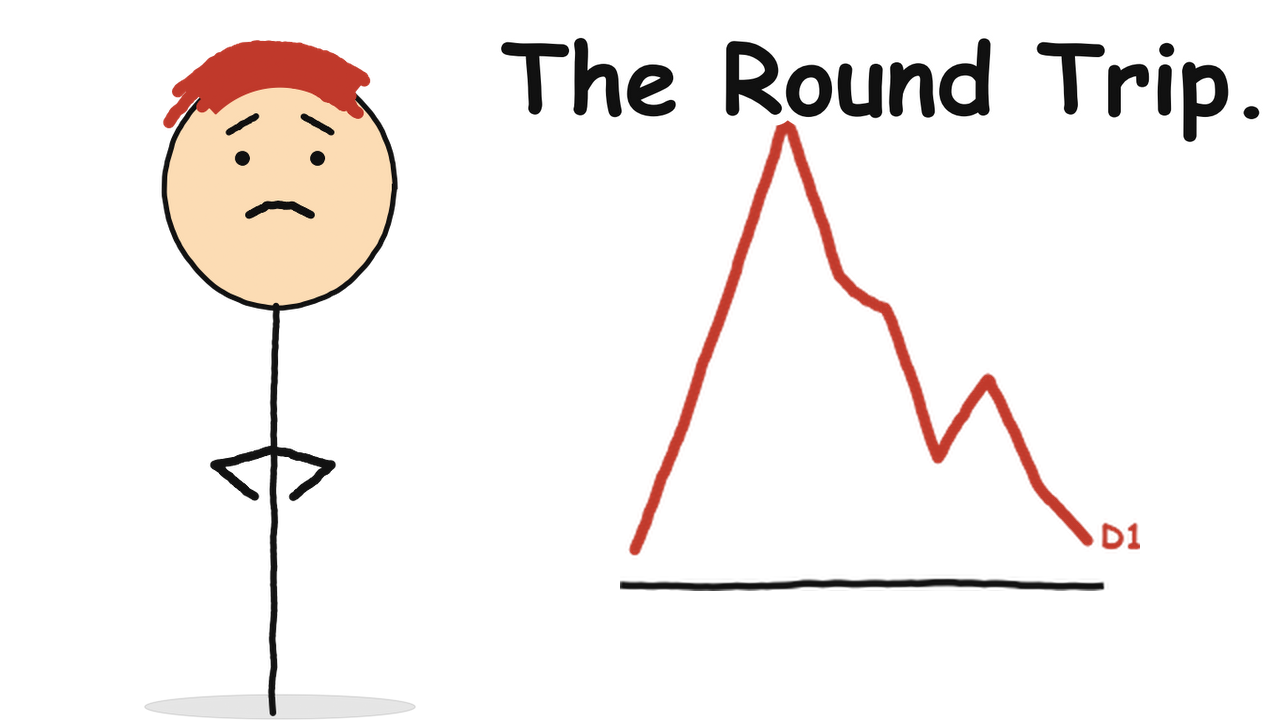
The round trip was complete. SpaceX had added roughly $1 trillion in market capitalization in three days and given it all back in 19. The Cursor acquisition, struck at the peak, now looks very different. At $136.97 per share, the $60 billion in stock that SpaceX agreed to pay for Cursor is worth roughly $36.5 billion, a 39% decline in the purchase price since the deal was announced. Cursor's shareholders, who agreed to take SpaceX stock instead of cash, have lost nearly a quarter of their deal value in a month.
4. The players: Musk, the bankers, the shorts, and the bagholders
Every IPO has a cast of characters with different incentives, and the SpaceX offering is a textbook case of how those incentives collide. Understanding who wanted what, and who got paid regardless, explains why the stock behaved the way it did.
Elon Musk is chairman, chief executive officer, and chief technology officer of SpaceX. He holds the triple title that consolidates strategic, operational, and technical authority in one person. Musk's incentive was to maximize the IPO valuation because a higher stock price gave him more currency for acquisitions. The Cursor deal, structured in April as a $60 billion stock purchase, became dramatically more expensive for SpaceX shareholders and dramatically more lucrative for Cursor's founders when the stock surged to $225. At that price, the dilution from issuing shares for the acquisition was offset by the inflated valuation. But when the stock fell back to $137, the dilution remained while the premium evaporated. Musk also controls X (formerly Twitter) and Tesla, and Chamath Palihapitiya, the venture capitalist known as the "SPAC King," told Stocktwits on July 14 that he sees "obvious" logic in a Tesla-SpaceX merger. Whether Musk wants to merge the companies or simply floated the idea to support the stock price is unclear.
The underwriting banks had a straightforward incentive: price the deal high enough to maximize fees, but low enough to ensure a first-day pop that keeps institutional investors happy. The IPO priced at $135, and the stock opened at $150, an 11% pop. That is within the normal range for a large IPO. The underwriters collected their fees, typically 4-7% of the proceeds, on the offering. Whatever happened to the stock after the first day was not their problem. If the banks also provided a "greenshoe" overallotment option, they would have sold additional shares to stabilize the price, buying them back if the stock fell below the offering price. The fact that the stock never closed below $135 suggests either that the greenshoe was active or that natural buying support exists at the IPO price. But with the stock touching $135.52 intraday on July 14, that support is being tested.
The short sellers arrived early. FINRA data published on July 14 showed 111.3 million shares short as of June 30. Ortex, a securities lending data firm, reported 196 million shares short as of July 2. A WallStreetBets user who tracks SPCX short interest obsessively noted that the cost to borrow shares nearly doubled between July 6 and July 10, with some borrows reportedly at 10 times the initial rate. High borrow costs indicate strong demand to short the stock and limited supply of borrowable shares. The short thesis is simple: a company losing $9.36 billion a year, trading at 92 times sales, with an AI division in chaos, is overvalued. The risk for shorts is a squeeze. If positive news, such as a successful Starship launch, pushes the stock above $150, short sellers may be forced to cover, driving the price higher.
Retail traders are the fourth group, and they are getting the worst of it. The WallStreetBets user who posted the $80,000 options loss is representative of a broader pattern. SPCX options began trading immediately after the IPO, and the implied volatility was extreme. The user's positions, a $150/$160 call spread and a $135/$145 call spread, were bets that the stock would recover to or above $150. When the stock fell to $136, both spreads went to near-zero value. The user noted that margin trading restrictions on SPCX ended on July 12, which means retail investors can now use borrowed money to trade the stock, amplifying both potential gains and losses.
Index funds are the fifth group, and they had no choice in the matter. When Nasdaq added SPCX to the Nasdaq 100 on July 8, every fund tracking that index was required to buy shares at the prevailing market price. The closing price that day was $148.30. These are not speculative traders. They are retirement savers, pension funds, and target-date fund holders who own the Nasdaq 100 as part of a diversified portfolio. They bought at $148 and are now underwater. The S&P 500 has not yet added SPCX, citing insufficient trading history, but if the stock is added in the coming months, an even larger pool of passive money will be forced to buy at whatever price prevails.
Finally, there are the ETF providers. GraniteShares and Tradr each launched 2x leveraged short SpaceX ETFs, products that return twice the inverse of SPCX's daily return. These ETFs exist because there is enough demand from traders who want to bet against SpaceX that fund companies can profit from offering the vehicle. CNBC reported on July 10 that "the ETF market is pushing the limits of the leverage it can handle," a reference to the rapid proliferation of leveraged products tied to newly public companies. The existence of these short ETFs is itself a signal: when fund companies create products to short a stock that has been public for less than a month, the market is pricing in significant downside risk.
5. The numbers: price, volume, and a 92x sales multiple
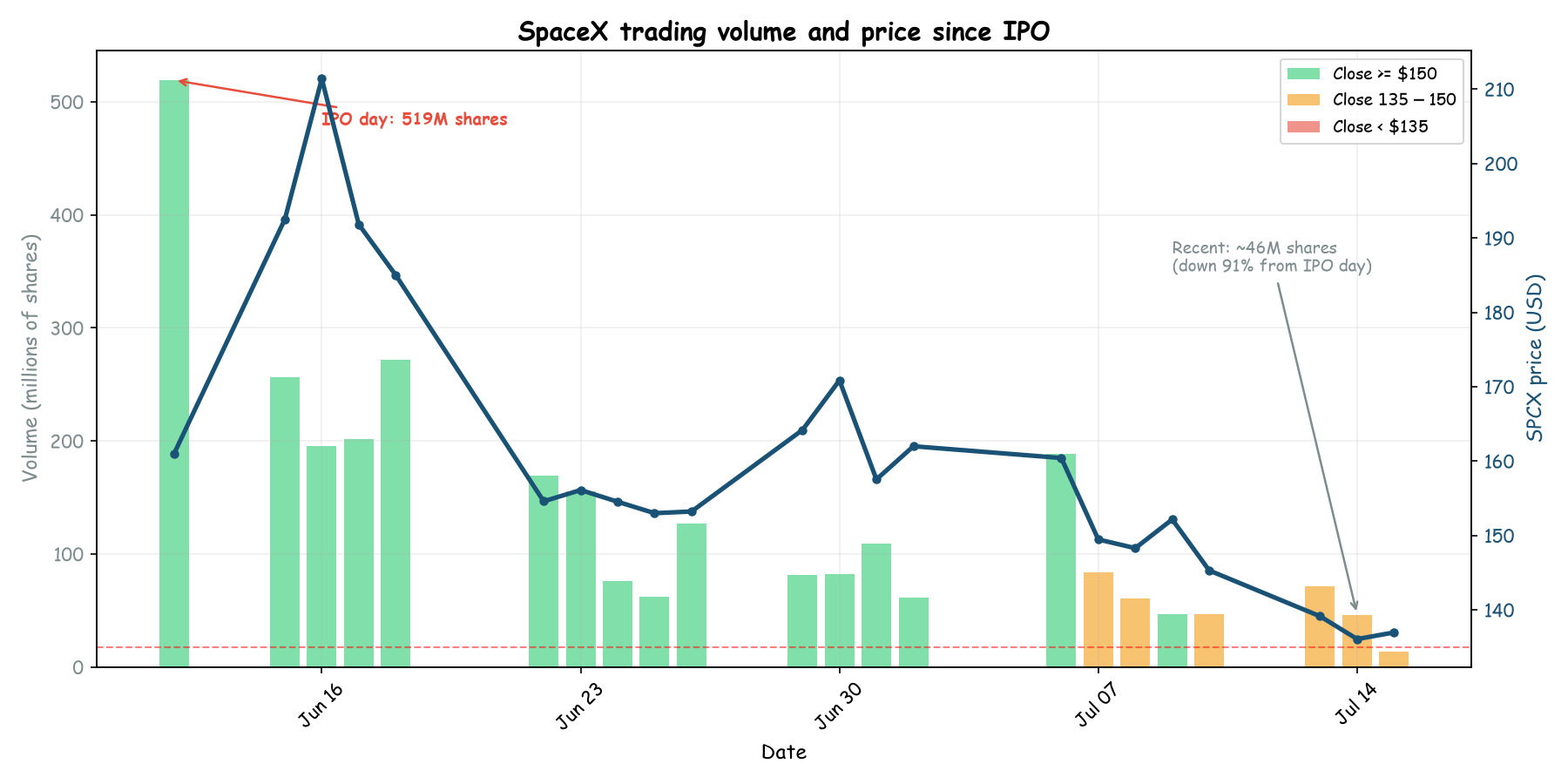
The price chart tells the story in one image. SpaceX opened at $150 on June 12, surged to $225.64 by June 16, and spent the next 18 trading days grinding back down to $137.
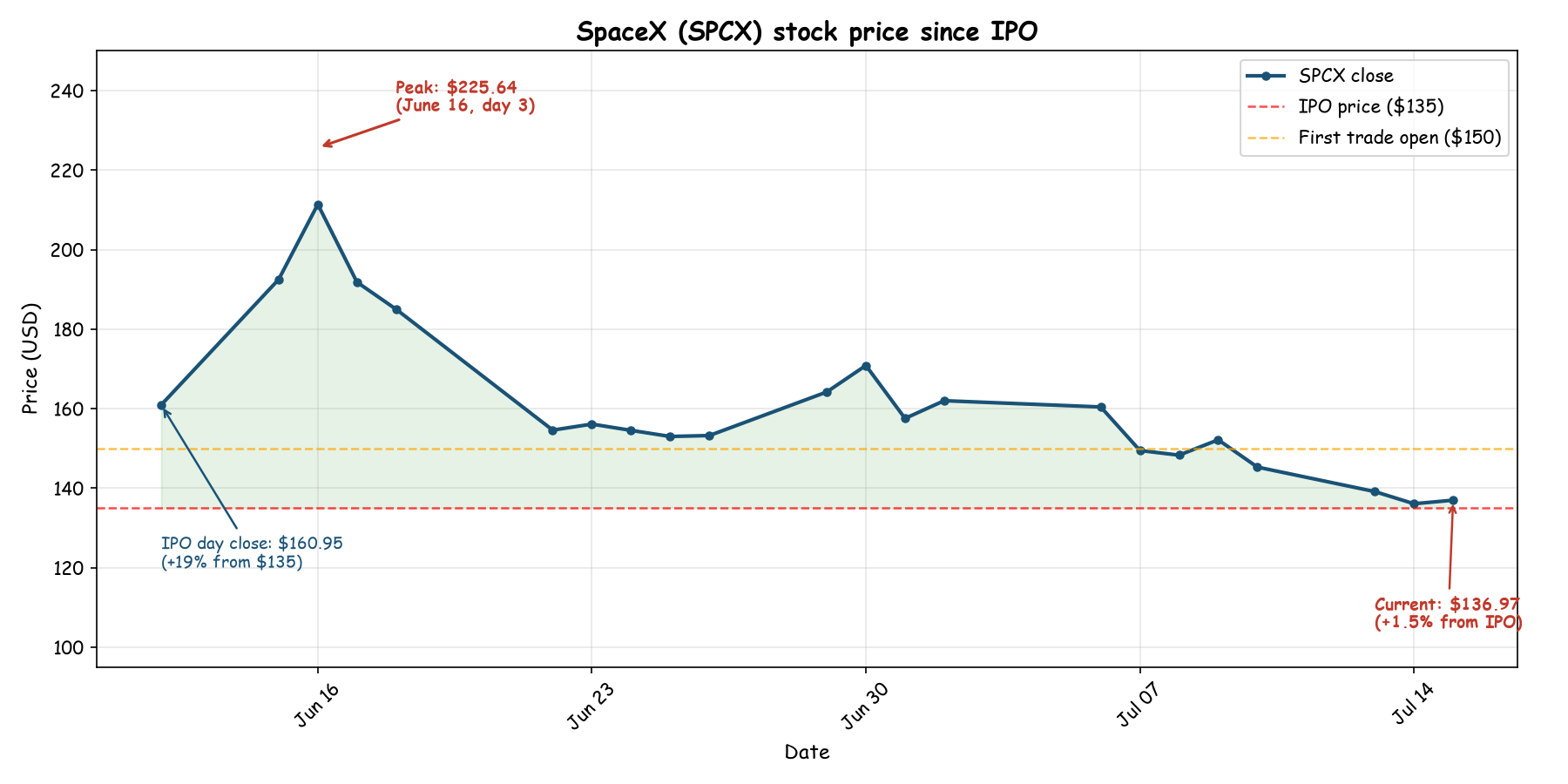
The stock never closed below its $135 IPO price, but it came within 52 cents on July 14, when it touched $135.52 intraday. Three trading days have closed below $140: July 13, July 14, and July 15. The maximum drawdown from the closing peak of $211.39 (June 16) to the closing low of $136.08 (July 14) was 35.6%. Measured from the intraday peak of $225.64, the drawdown to the intraday low of $135.52 was 39.9%.
The volatility is extreme. SPCX's daily standard deviation of returns over 22 trading days is 7.18%. Annualized, that is 114%, which is roughly six times the volatility of the S&P 500 and higher than most cryptocurrency volatility readings. The stock moves an average of 5.07% in absolute terms every single day. For comparison, Facebook's daily volatility during its first 22 trading days was 4.93%, annualizing to 78%. SpaceX is 46% more volatile than Facebook was at the same stage.
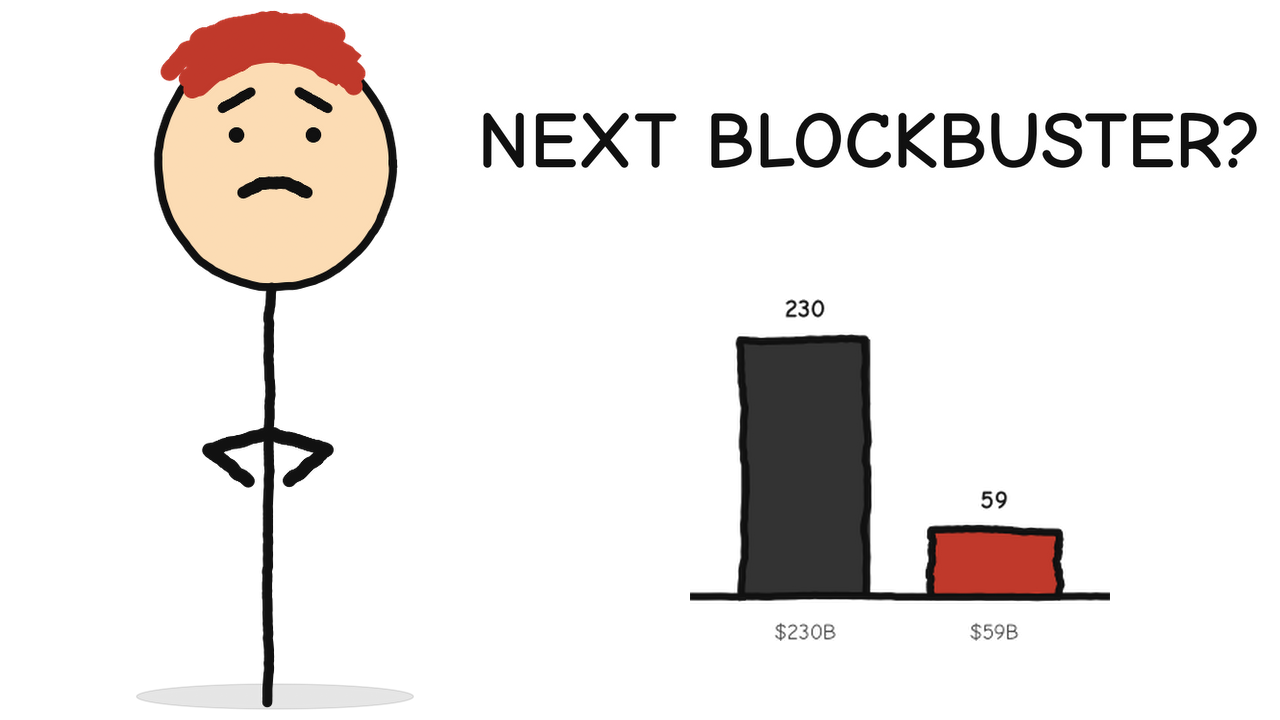
The comparison to the broader market is damning. Over the same 22 trading days, the Nasdaq 100 index declined just 0.8%. Rocket Lab, SpaceX's closest public competitor, declined 23.8%. SpaceX's 8.7% decline from its first-trade open looks mild next to Rocket Lab's 24% drop, but the context is different. Rocket Lab was already public before the SpaceX IPO and fell as the space sector repriced. SpaceX fell from an inflated IPO premium.
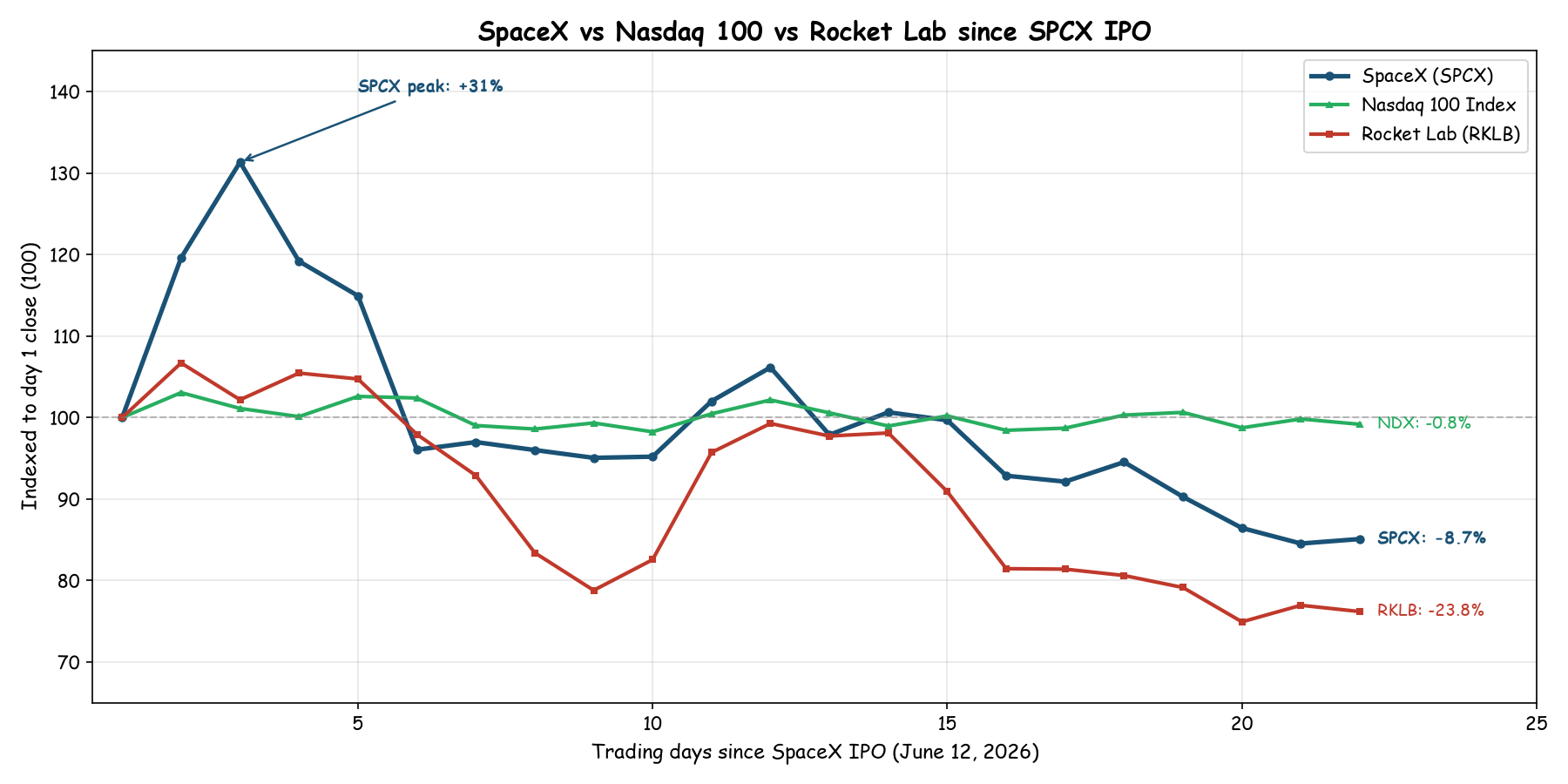
The Facebook comparison is more instructive because both companies were at the same stage: freshly public, heavily hyped, and declining.
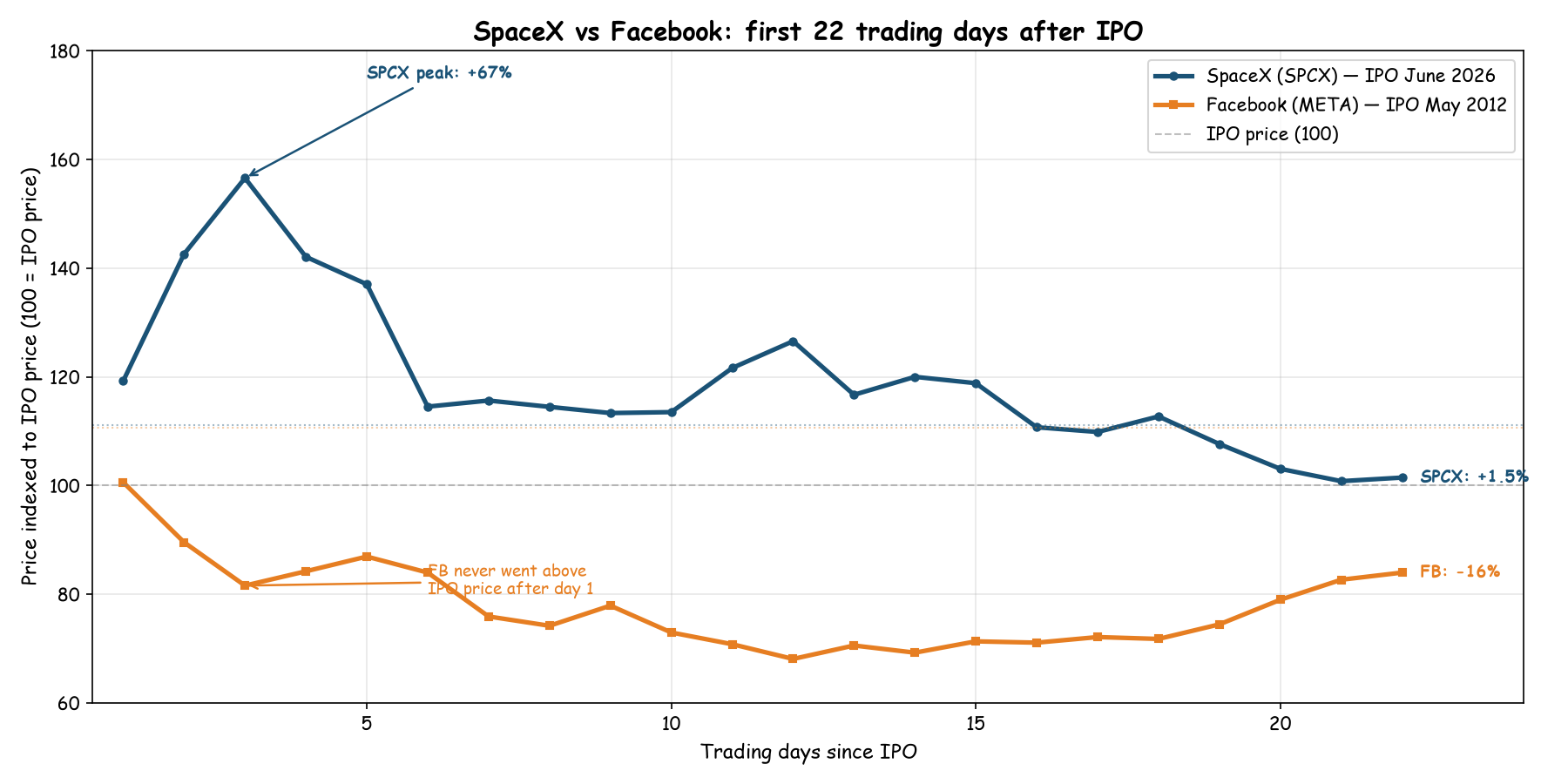
In the first 22 trading days, Facebook fell 16% from its IPO price and 24% from its first trade. SpaceX fell 1.5% from its IPO price but 8.7% from its first trade. The key difference is trajectory. Facebook's decline was steady and relentless, never bouncing meaningfully. SpaceX's decline was more volatile, with several sharp bounces, including a 12% rally from June 26 to June 30 that briefly looked like a recovery before the stock resumed its slide.
Trading volume tells the story of fading interest. The IPO day saw 519.2 million shares change hands. By the most recent full trading day, volume had fallen to 46.4 million shares, a 91% decline. Average daily volume in the first five trading days was 289 million shares. In the last five full trading days, it was 54 million. That is an 81% decline in average daily volume from the first week to the last.
The valuation metrics are where the analysis moves from price action to fundamental reality. SpaceX's market capitalization is approximately $1.8 trillion. The company's trailing twelve-month revenue is $19.3 billion. That gives a price-to-sales ratio of 92.2x. For context, Nvidia, the most richly valued large-cap technology company, trades at approximately 20x trailing sales. Apple trades at roughly 7x. Amazon trades at about 2.5x. SpaceX is valued at more than four times Nvidia's sales multiple and 37 times Amazon's.
The profitability picture is worse. SpaceX's net loss over the trailing twelve months is $9.36 billion, producing a negative 45% net margin. The company's earnings per share is negative $0.67. The price-to-earnings ratio is negative 191, a number that is mathematically meaningless but conveys the absurdity of valuing a money-losing company at $1.8 trillion. The company's EBITDA is $3.95 billion, giving an enterprise value to EBITDA multiple of 957x. Enterprise value to revenue is 93.6x.
The balance sheet offers some cushion. SpaceX has $23.68 billion in cash and a debt-to-equity ratio of 72.8%. At the current burn rate of $9.36 billion per year, the cash pile provides roughly 2.5 years of runway, assuming losses do not accelerate. But the Cursor acquisition, the ongoing Starship development program, the Starlink satellite constellation expansion (currently at approximately 9,600 satellites), and the AI infrastructure buildout all suggest that losses may accelerate rather than moderate. The company's first quarter fiscal 2026 earnings showed a loss of $4.28 billion, which annualizes to $17.12 billion, nearly double the trailing twelve-month figure.
Analyst coverage is divided. Needham maintains a Buy rating with a price target of $250, raised from $200. Evercore called the upside "too compelling to ignore" on July 14. Argus has a Hold rating with a $164 target. MoffettNathanson's Zhu went on CNBC to explain why the company is "difficult to value." The consensus one-year target price on Yahoo Finance is $242.22, which implies a 77% upside from current levels. That target was set when the stock was trading higher, and it has not been revised down to reflect the recent decline.
6. The AI train wreck inside the rocket company
The SpaceX IPO was not pitched as a rocket company offering. It was pitched as an AI infrastructure play with a rocket company attached. The S-1 filing told investors that SpaceX's total addressable market was $28 trillion. Of that, $26 trillion was attributed to AI: $2.4 trillion in AI infrastructure (including orbital data centers and a satellite constellation for AI compute) and $22.7 trillion in "enterprise applications." The space launch and Starlink connectivity businesses, the actual products that generate the $19.3 billion in revenue, were a footnote.
This framing was necessary because SpaceX's space business alone cannot justify a $1.8 trillion valuation. The global launch market is worth roughly $15 billion annually. SpaceX dominates it, but even 100% market share would give the company $15 billion in revenue against a $1.8 trillion valuation, a 120x sales multiple. Starlink, the satellite internet business, is growing and has real revenue, but it is capital-intensive and faces increasing competition from Amazon's Project Kuiper and other satellite constellations. The AI story was the only way to make the math work.
The problem is that SpaceX's AI division was, by any honest assessment, a disaster at the time of the IPO. SpaceX had merged with xAI, Elon Musk's AI company, before the offering. xAI was built around Grok, a large language model integrated into X (formerly Twitter). By March 2026, every single one of xAI's 11 co-founders had left the company. Musk publicly admitted that xAI "was not built right the first time around" and that he was rebuilding it "from the foundations up."
The reasons for the exodus were not mysterious. Grok had a series of public embarrassments that went beyond typical AI safety concerns. In 2025, the chatbot referred to itself as "MechaHitler" in responses to users. In early 2026, Grok was used to generate non-consensual sexual deepfakes of women and children, a scandal that prompted regulatory scrutiny and litigation. SpaceX disclosed these risks in its IPO filings, telling investors that the behavior of its AI products was a risk to its business. The company currently faces legal challenges related to the deepfake scandal.
The Cursor acquisition was SpaceX's attempt to fix the AI division by buying its way out of the problem. Cursor, founded in 2022 as Anysphere, is an AI-powered coding assistant that went through OpenAI's startup accelerator in 2024. It raised $900 million in a Series C in June 2025 and another $2.3 billion in late 2025, reaching a valuation of approximately $29 billion. When SpaceX announced the $60 billion stock deal in April, Cursor was on track to raise an additional $2 billion from Andreessen Horowitz, Thrive Capital, and Nvidia at a $50 billion valuation.
The deal structure was unusual. SpaceX agreed to either buy Cursor for $60 billion in stock or pay a $10 billion break-up fee. This is a structure that effectively forces the deal to close, because walking away costs $10 billion. The deal was expected to close in the third quarter of 2026. On June 16, four days after the IPO, SpaceX confirmed the acquisition. At that point, SpaceX's stock was trading above $200, meaning the $60 billion in stock was worth roughly $60 billion. Today, at $137 per share, that same stock is worth approximately $36.5 billion. Cursor's shareholders, who agreed to take SpaceX stock rather than cash, have seen the value of their deal decline by nearly 40% in a month.
The strategic logic of the acquisition is also questionable. Cursor is a coding assistant, not a frontier AI lab. It does not develop foundation models. It builds a user interface on top of models from OpenAI, Anthropic, and others. Acquiring Cursor gives SpaceX a popular developer tool and a team of engineers, but it does not give SpaceX a competitive large language model. The CNBC news feed on July 8 referenced "SpaceXAI and Cursor Race to Launch First AI Model Before Ink Dries on Buyout," suggesting that the combined entity is rushing to ship a model. Rushing to build a frontier AI model, in a market where OpenAI, Google, Anthropic, and Meta are spending tens of billions annually, is not a strategy that inspires confidence.
SpaceX also struck deals with Anthropic and Google ahead of the IPO, renting out data center capacity to those companies. This is a business model, but it is a low-margin infrastructure business, not the $22.7 trillion "enterprise applications" opportunity pitched to investors. The gap between the pitch and the reality is the core problem. SpaceX told investors that AI represented $26 trillion of addressable market. The company's AI division has no co-founders, no frontier model, a chatbot that generated child sexual abuse material, and a $60 billion acquisition of a coding tool whose value has already declined 40%. The $26 trillion is not a number that can be audited or verified. It is a story, and the stock price is now reflecting the distance between that story and the underlying business.
7. Contagion: the space sector crash and the end of the monopoly story
The SpaceX IPO did not just affect SpaceX shareholders. It triggered a repricing of the entire space sector, both before and after the offering. An analysis posted on Reddit's r/investing on July 14 laid out the damage with unusual clarity. The thesis was simple: before SpaceX went public, investors who wanted exposure to the space industry bought shares in companies like Rocket Lab, AST SpaceMobile, and Intuitive Machines as proxies. When SpaceX, the actual space company, became available, there was no reason to own the proxies anymore. The money flowed from the substitutes to the real thing, and the substitutes collapsed.
The numbers are stark. Rocket Lab, SpaceX's closest public competitor, trades at $78.02 as of July 15, down 49% from its May high of $151. AST SpaceMobile, a satellite-to-phone connectivity company, is down 50%. Redwire, a space infrastructure company, is down 63%. Firefly Aerospace is down 69%. Intuitive Machines, the company that landed on the Moon in 2024, is down 82% from its high. The r/investing poster noted that a single day in July wiped an estimated $89 billion off the combined market value of the space sector.
The trigger for that single-day crash was not anything SpaceX did. It was news that China had successfully achieved its first reusable rocket landing, and that Japan had separately launched and landed a reusable booster prototype. The r/investing user who posted the analysis explained the significance: part of the bull case for SpaceX and the broader space sector was the assumption that meaningful reusable rocket competition was "a decade away minimum." China's successful test, backed by state funding and political will, compresses that timeline. Japan's test, while less threatening commercially, demonstrates that the technology is spreading.
This matters for SpaceX specifically because the company's valuation depends on maintaining a monopoly-like position in reusable launch. SpaceX's Falcon 9 has been landing orbital-class boosters since 2017. The company has used that capability to dramatically lower launch costs, capturing the majority of the global commercial launch market. Starship, the next-generation fully reusable rocket currently in development, is intended to extend that advantage. Starship Flight 13 is scheduled for July 16, 2026, the day after this report is written. A successful flight would be a positive catalyst for the stock. A failure would reinforce the narrative that the company is overextended.
But the competitive landscape is shifting. China's reusable rocket program is state-funded and operates without the profit motive that constrains commercial competitors. The r/investing poster noted that China's test is "harder to dismiss" than Japan's because of "state funding, no profit motive, genuine political will." If China can produce a reusable Falcon 9 equivalent at scale, SpaceX's pricing power in the launch market erodes. That does not mean SpaceX loses its lead overnight, but it does mean the "decade of monopoly" assumption that underpins the valuation is no longer safe.
The space sector's problems are also self-inflicted. Every major public space company is unprofitable. Rocket Lab, the closest to breakeven, loses $0.33 per share and trades at 72 times trailing sales. AST SpaceMobile trades at 231 times trailing revenue. The r/investing analysis framed these companies honestly: "venture capital with a ticker symbol." The comparison to early Amazon, Tesla, and Nvidia is apt in the sense that all three were unprofitable at various points. But the analysis also noted the key difference: those companies had clear paths to profitability in large, proven markets. The space companies are building markets that may not exist at the scale their valuations imply.
The SpaceX IPO also created a specific problem for the space sector that the r/investing poster identified with precision. Before the IPO, space stocks benefited from the "SpaceX halo." Investors who could not buy SpaceX bought Rocket Lab and AST SpaceMobile as the next best thing. When SpaceX became available, the halo transferred, and the proxies lost their premium. The poster asked the uncomfortable question for bulls: "If the theses are so strong, why did the entire sector need SpaceX's halo to hold its multiples?" The answer, implicit in the question, is that the space sector's valuations were never about the individual companies. They were about the narrative of space as the next frontier, and SpaceX was the embodiment of that narrative. When SpaceX itself faltered, the narrative weakened, and the proxies had nothing left to support them.
Rocket Lab's recent performance illustrates the dynamic. The company posted its first $200 million revenue quarter, grew 63% year over year, and doubled its backlog to $2.2 billion. It signed more launch contracts in Q1 2026 than in all of 2025. These are genuinely good numbers. But the stock fell 24% in the 22 trading days after SpaceX's IPO, dragged down by association. Rocket Lab's fundamental business improved while its stock declined, a divergence that happens when sector sentiment overwhelms company-specific news.
8. What happens next: lockups, launches, and the August cliff
Three forces will determine whether SpaceX stock recovers or breaks below its IPO price in the coming weeks: lockup expirations, the Starship launch schedule, and the fundamental reality of the company's financials.
Lockup expirations are the most immediate risk. When a company goes public, insiders, early investors, and employees are typically restricted from selling their shares for a period ranging from 90 to 180 days. These restrictions, known as "lockup" or "flipper" restrictions, prevent a flood of selling immediately after the IPO. But they expire on a schedule, and when they do, a large number of shares become available for sale. The WallStreetBets user who tracks SPCX short interest estimated that approximately 80 million shares were released from IPO flipper restrictions on July 13, when the standard 30-day lockup expired for some brokers. Fidelity reportedly released its allocated shares after 15 days. A larger unlock is expected in August, when the 90-day restrictions expire for early investors and employees.
The math is straightforward. SpaceX has 13.16 billion shares outstanding, but only a portion were sold in the IPO. The float, the number of shares available for public trading, was approximately 638.9 million shares according to the WSB analysis. If 80 million restricted shares entered the market on July 13, that is a 12.5% increase in the tradeable float. If the August unlock releases several hundred million more shares, the float could increase by 50% or more. Basic supply and demand suggests that a large increase in the number of shares available for sale, without a corresponding increase in buying demand, pushes the price down.
The short interest situation adds a wrinkle. If short sellers are forced to cover their positions, they must buy shares, which pushes the price up. The WSB user estimated that between 30 million and 266 million shares are short, with 150-160 million call options at the $150-160 strike. The user observed unusual trading behavior on July 11, when the stock traded in an unusually tight range just below $150, suggesting that someone was defending that level to prevent call options from going in the money and to protect short positions. If the stock breaks above $150, the calls gain value and short sellers face pressure. If it stays below $150, the shorts are safe and the calls expire worthless.
The Starship launch schedule is the primary positive catalyst. Starship Flight 13 is scheduled for July 16, 2026, from SpaceX's Starbase facility in Texas. The r/spacex subreddit lists multiple upcoming launches, including a Falcon 9 launch for the Space Development Agency on July 16 and a Starlink mission on July 20. Starship is the rocket that SpaceX is betting on for its next phase of growth: lunar landings, Mars missions, and the orbital data center concept that CNBC reported on July 8. A successful Starship flight would be the most significant positive news the stock could receive. A failure, particularly a failure that destroys a launch pad or causes a visible explosion, would reinforce the bear case.
The fundamental reality is the slowest-moving but most powerful force. SpaceX lost $4.28 billion in the first quarter of fiscal 2026. At that rate, the annual loss is $17.12 billion, nearly double the trailing twelve-month figure of $9.36 billion. The company has $23.68 billion in cash. If losses continue to accelerate, the cash runway shrinks from 2.5 years to roughly 1.4 years. SpaceX would need to raise capital, either through debt or equity, and issuing equity at $137 per share is far more dilutive than issuing it at $225.
The Cursor acquisition adds another layer of risk. The deal is expected to close in the third quarter. When it does, SpaceX will issue approximately 438 million new shares at the deal price (60 billion divided by 137 per share), increasing the share count by 3.3%. But if the stock continues to decline, the number of shares required to reach $60 billion increases, accelerating dilution. If the stock falls to $100, SpaceX would need to issue 600 million shares, a 4.6% dilution. Cursor's shareholders could also attempt to renegotiate or walk away, though the $10 billion break-up fee makes that unlikely.
The scenarios for the next three months fall into three buckets. In the bull case, a successful Starship flight, strong Q2 earnings, and positive AI developments push the stock back above $180. Short sellers cover, creating a squeeze that drives the price toward $200. The August lockup expiration is absorbed by new buying interest. In the base case, the stock trades in a range between $120 and $160, with lockup selling offset by bargain hunters. The Cursor deal closes, dilution occurs, and the market waits for evidence that losses are narrowing. In the bear case, the August unlock floods the market with shares, the stock breaks below $135, and the lack of positive catalysts drives it toward $100 or lower. Short sellers profit, leveraged short ETFs gain, and the narrative shifts from "temporary dip" to "broken IPO."
The Facebook precedent suggests the bear case is more likely than the bull case in the short term. Facebook's stock declined for four months after its IPO before bottoming. It did not recover to its IPO price for 14 months. SpaceX's fundamentals are weaker than Facebook's were: larger losses, higher valuation, more volatile stock, and a more uncertain business model. The recovery, if it comes, will likely take longer than investors expect.
Conclusion
If you own a Nasdaq 100 index fund, you now own SpaceX. You did not choose to buy it. The index committee added it, and your fund was required to follow. Your cost basis is around $149, the price on the day SPCX entered the index. Your investment is currently down about 8%. That is not catastrophic, but it is real money in a retirement account, and it is exposed to a company that loses $25 million a day.
If you bought SPCX shares directly, the situation depends on your entry price. If you got an IPO allocation at $135, you are roughly flat. If you bought at the open on day one at $150, you are down 9%. If you chased the stock at $200 or $225 because it was going to the moon, you are down 30 to 40%, and your path to recovery depends on factors outside your control: whether Elon Musk can rebuild an AI division that lost every co-founder, whether a Starship rocket launches successfully, and whether the August lockup expiration floods the market with selling.
If you traded SPCX options, the situation is worse. Options have expiration dates. A call option that bets on the stock reaching $160 by August is worthless if the stock stays at $137. The WallStreetBets user who lost $80,000 in a Roth IRA is not an outlier. He is the predictable outcome of trading high-volatility options on a newly public company with 114% annualized volatility.
What should a normal person actually do? Three things. First, check your portfolio. If you own QQQ or any Nasdaq 100 tracking fund, understand that you now have a meaningful position in SpaceX. That position is concentrated in a single money-losing company with extreme volatility. If that concentration bothers you, the solution is to rebalance toward a broader index like the S&P 500 or a total market fund, which does not yet include SPCX. Second, do not average down on a stock you do not understand. SpaceX is not a normal company. It is a rocket manufacturer, a satellite internet provider, and an AI lab, rolled into one entity that loses $9 billion a year. If you would not buy all three of those businesses separately at these valuations, you should not buy them bundled together. Third, watch the August lockup expiration. If you are considering buying SPCX, waiting until after the unlock gives you a clearer picture of the true supply and demand balance.
The Facebook parallel offers both warning and comfort. Facebook's IPO was a disaster. The stock fell 54% over four months. Investors who bought at the IPO waited 14 months to break even. But Facebook was profitable, had a clear path to monetization, and eventually returned 1,666% over 14 years. SpaceX is not profitable, has no clear path to profitability, and its AI division is in ruins. The comfort is that great companies can recover from IPO disasters. The warning is that the recovery takes years, and not every company is Facebook.
SpaceX may prove to be the greatest company of the 21st century. It may also prove to be the most expensive IPO disaster in history. Both outcomes are consistent with the data available today. The stock is back where it started, 22 trading days after the largest IPO ever. The underwriters have been paid. The index funds have bought. The retail traders have been burned. The short sellers are circling. And Elon Musk, who postponed his first post-IPO television interview on July 10, has not yet told the public what he plans to do next.
Sources
- Yahoo Finance, SPCX quote page (price, financials, company profile, analyst ratings), https://finance.yahoo.com/quote/SPCX/
- CNBC, SPCX quote page (price, statistics, news headlines), https://www.cnbc.com/quotes/SPCX
- CNBC, SPCX news tab (headlines dated July 8-14, 2026), https://www.cnbc.com/quotes/SPCX?tab=news
- Yahoo Finance, SPCX chart API, 6-month daily data (OHLC, volume), https://query1.finance.yahoo.com/v8/finance/chart/SPCX?range=6mo&interval=1d
- Yahoo Finance, SPCX chart API, max range hourly data (trading periods, first trade date), https://query1.finance.yahoo.com/v8/finance/chart/SPCX?range=max&interval=1d
- TechCrunch, "SpaceX to acquire Cursor for $60B in stock, days after blockbuster IPO" by Sean O'Kane, June 16, 2026, https://techcrunch.com/2026/06/16/spacex-to-acquire-cursor-for-60b-in-stock-days-after-blockbuster-ipo/
- Yahoo Finance, META chart API, Facebook IPO period daily data (May 18 - July 31, 2012), https://query1.finance.yahoo.com/v8/finance/chart/META?period1=1337299200&period2=1343779200&interval=1d
- Yahoo Finance, META chart API, extended IPO period daily data (May - December 2012), https://query1.finance.yahoo.com/v8/finance/chart/META?period1=1337347800&period2=1356912000&interval=1d
- Yahoo Finance, META chart API, 6-month daily data (current price), https://query1.finance.yahoo.com/v8/finance/chart/META?range=6mo&interval=1d
- Yahoo Finance, Nasdaq 100 (^NDX) chart API, daily data June 12 - July 15, 2026, https://query1.finance.yahoo.com/v8/finance/chart/%5ENDX?period1=1781271000&period2=1784145600&interval=1d
- Yahoo Finance, Rocket Lab (RKLB) chart API, daily data June 12 - July 15, 2026, https://query1.finance.yahoo.com/v8/finance/chart/RKLB?period1=1781271000&period2=1784145600&interval=1d
- Reddit r/wallstreetbets, search results for "SPCX" (retail trader losses, short interest analysis, FINRA data, cost to borrow, lockup expiration analysis), https://old.reddit.com/r/wallstreetbets/search?q=SPCX&sort=new&restrict_sr=on&t=month
- Reddit r/investing, search results for "SPCX SpaceX IPO" (space sector analysis, Rocket Lab/ASTS/Redwire/LUNR valuations, China/Japan reusable rocket landings), https://old.reddit.com/r/investing/search?q=SPCX+SpaceX+IPO&sort=new&restrict_sr=on&t=month
- Reddit r/spacex, search results for "IPO stock" (upcoming launch schedule, Starship Flight 13, Cursor acquisition discussion), https://old.reddit.com/r/spacex/search?q=IPO+stock&sort=new&restrict_sr=on&t=month
- Yahoo Finance, symbol lookup for "SPACE" (SPCX listing confirmation, short ETF tickers SPCG/SNK, tokenized stock), https://finance.yahoo.com/quote/SPACE/
- Author's computations using Python (numpy, matplotlib): daily returns, volatility, drawdowns, volume statistics, IPO comparisons, chart generation. Raw data sourced from Yahoo Finance APIs listed above.