This is the full research report behind the video: every number, source, and chart the script was written from.
Executive summary
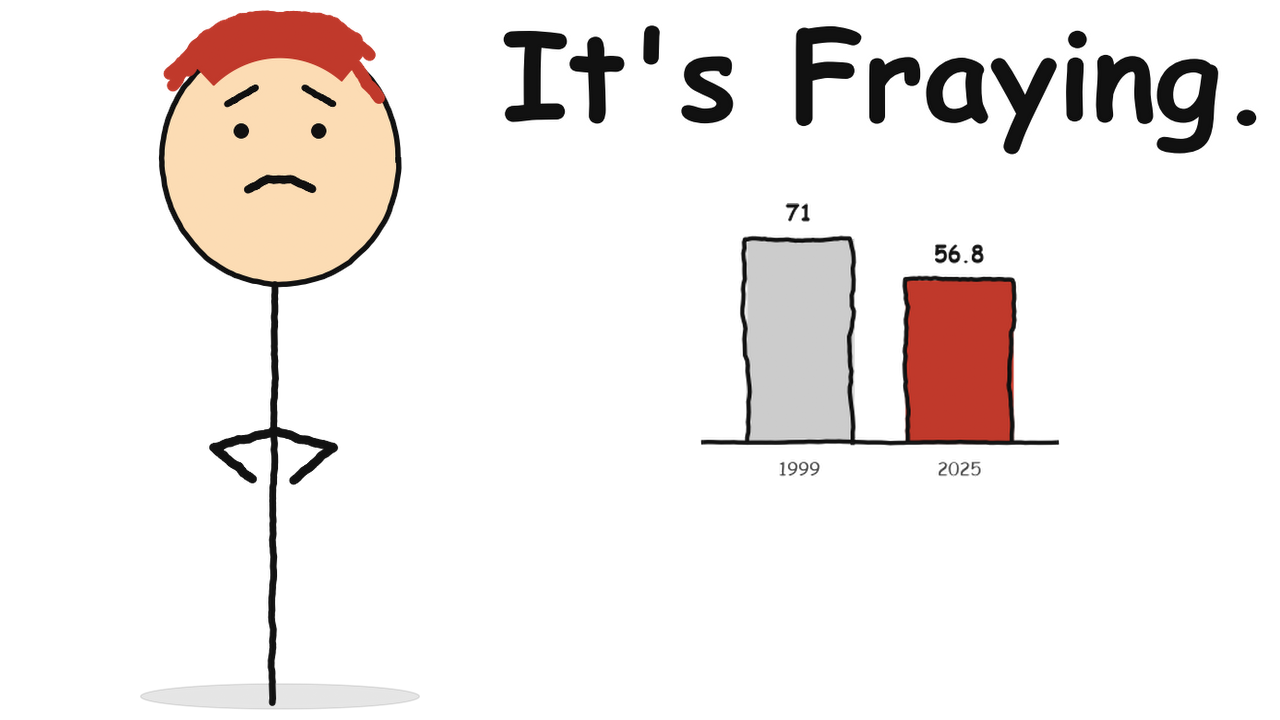
The US dollar has been the world's reserve currency since 1944. That arrangement is fraying. Not collapsing, not imploding, not being replaced tomorrow, but fraying in ways that compound over time. The dollar's share of global foreign exchange reserves fell from 71 percent in 1999 to 56.8 percent at the end of 2025, according to IMF COFER data. The Dollar Index (DXY) peaked at 114.1 in September 2022 and sat at 100.5 in July 2026, a decline of roughly 12 percent. Gold, the oldest alternative to fiat money, rose from about $1,600 per ounce in late 2022 to a record $5,318 in January 2026 before settling near $4,044 in July. The correlation between daily dollar returns and daily gold returns over that period was negative 0.39, meaning when the dollar sneezes, gold catches a cold in reverse.
Several forces are pulling at the dollar simultaneously. The Trump administration's tariff policies and public indifference to dollar depreciation have spooked foreign investors. China has been quietly urging its financial institutions to limit purchases of US Treasuries, and leaked reports suggest parts of the US-China trade deficit are now being settled in physical gold rather than dollars. Russia and China now settle roughly 95 percent of their bilateral trade without dollars. BRICS nations are building alternative payment systems, including China's CIPS (which processed over $26 trillion in 2024) and the mBridge digital currency network ($55.5 billion in cumulative volume by November 2025). The US-Iran war and the selective closure of the Strait of Hormuz have added energy-market pressure, with Iran demanding yuan payment for oil passage.
Yet the dollar is not about to be dethroned. It still accounts for 88 percent of foreign exchange turnover, roughly 60 percent of international currency claims, and remains the deepest, most liquid financial market on earth. No single alternative, not the euro, not the yuan, not gold, not Bitcoin, can match the dollar's network effects. The more likely outcome is a gradual, messy transition toward a more multipolar currency system, with the dollar still dominant but less hegemonic. The historical parallel is not the sudden collapse of Bretton Woods in 1971 but the slow erosion of British sterling between the 1920s and 1950s, a process that took three decades and two world wars to complete.
Key findings
- The dollar's reserve share has declined from 71 percent (1999) to 56.8 percent (2025), a drop of roughly 14 percentage points over 26 years.
- The DXY fell 12 percent from its September 2022 peak of 114.1 to 100.5 in July 2026.
- Gold rose 148 percent from its 2022 level to a January 2026 record of $5,318 per ounce, driven by central bank buying and private investor flight from dollar assets.
- China's CIPS processed over $26 trillion in 2024; mBridge reached $55.5 billion in cumulative transactions by November 2025.
- Foreign ownership of US Treasuries fell from about 50 percent in the early 2010s to roughly 30 percent today, though total foreign holdings hit a record $9.35 trillion in November 2025.
- Russia and China now settle approximately 95 percent of bilateral trade without dollars.
- The Trump administration's internal divisions on dollar policy, between those who want a weaker dollar to boost exports and those who want to preserve reserve status, create policy uncertainty that itself undermines confidence.
- The dollar-gold return correlation is negative 0.39, confirming the "debasement trade" where investors sell dollars and buy gold as a hedge against dollar depreciation.
1. Your money, their problem: what a weaker dollar means at the kitchen table
If you have traveled abroad recently, you already know what a weaker dollar feels like. The hotel room in Lisbon that cost 120 euros last year now costs you more in dollars, even though the price tag in euros has not moved. The sushi dinner in Tokyo that used to run $50 now runs $75, because the yen moved against you. A weaker dollar means your paycheck, denominated in dollars, buys less of everything priced in another currency. That includes foreign goods on Amazon, imported electronics, European wine, and, critically, oil.
Oil is the big one. Crude petroleum is priced in dollars globally, but the dollar price adjusts when the currency weakens. If the dollar falls 10 percent against a basket of currencies, oil producers need a higher dollar price to earn the same amount in their own money. So a weaker dollar tends to push gasoline prices up at the pump, even if nothing else changes. The average American fills up about 36 times a year. A 30-cent-per-gallon increase from dollar weakness alone, spread across 36 fill-ups of a 14-gallon tank, costs a household roughly $150 extra per year. That is real money, and it comes out of the same budget that pays for groceries and rent.
Then there is the mortgage. Mortgage rates in the United States track the 10-year Treasury yield, which is itself influenced by how much foreign money flows into US government bonds. When foreign investors get nervous about the dollar, they buy fewer Treasuries. Fewer buyers means the Treasury has to offer higher interest rates to attract them. Higher Treasury yields mean higher mortgage rates. The 10-year Treasury yield stood at 4.55 percent in July 2026, up from 3.61 percent in 2010. If foreign demand for Treasuries keeps eroding, that number could go higher, and the monthly payment on a $400,000 house could jump by hundreds of dollars.
Your 401(k) is also exposed, but in a more complicated way. A weaker dollar actually helps US companies that sell abroad, because their foreign earnings are worth more when converted back into dollars. Apple, Microsoft, and Johnson & Johnson all get a chunk of revenue from overseas, and a falling dollar gives that revenue a tailwind. So you might see your stock portfolio go up even as your purchasing power goes down. The two effects partially cancel out for investors, but not for people who do not own stocks. Roughly half of American households have no direct stock market exposure, so for them a weaker dollar is pure cost with no offsetting benefit.
The savings account angle is the quiet killer. If you have $10,000 in a bank savings account earning 0.5 percent interest, and the dollar loses 3 percent of its value against a basket of currencies over a year, you have lost 2.5 percent in real terms. You did nothing wrong. You saved your money. But the currency you saved in is worth less, and the interest rate did not keep up. This is what economists call the "inflation tax," and it hits people who hold cash hardest. Retirees with conservative portfolios, young people building emergency funds, and anyone who keeps a large cash balance all pay this tax silently.
There is one group that benefits from a weaker dollar: people who owe money. If you have a fixed-rate mortgage or student loans denominated in dollars, those debts get easier to pay off in real terms as the dollar loses value. Your salary might rise (in nominal terms) while your debt stays fixed. This is why some economists, including Trump's Council of Economic Advisers chair Stephen Miran, have argued that a weaker dollar could help American workers by making US exports cheaper abroad and eroding the real value of household debt. The trade-off is that everything imported gets more expensive, and foreign investors become less willing to finance US government borrowing.
The kitchen-table summary: a weaker dollar means higher prices for imported goods and gasoline, upward pressure on mortgage rates, a silent erosion of cash savings, a possible boost to stock portfolios and export-heavy employers, and easier debt repayment. Whether you come out ahead depends on whether you are a net saver or a net debtor, whether you own stocks, and how much of your spending goes to imported goods. For most middle-income Americans, the net effect is probably negative, because the cost increases on essentials like gas and food hit harder than the diffuse benefits.
2. The last time this happened: sterling's long goodbye, 1914 to 1956
The dollar's current predicament has a name in the history books. It happened to the British pound sterling, and it took about forty years to play out. Understanding that story tells you what to watch for now, because the mechanics of a reserve currency losing its grip are remarkably consistent across centuries.
Sterling became the world's reserve currency in the late 1800s, when Britain was the world's leading manufacturer, its biggest trader, and its dominant naval power. By 1913, over 60 percent of global trade was invoiced in pounds. London was the financial capital of the world. The Bank of England set interest rates that mattered everywhere from Buenos Aires to Bombay. Sterling was backed by gold, and Britain owned the largest gold reserves on earth. This is the same setup the dollar enjoys today: economic dominance, military reach, deep financial markets, and a currency everyone needs to do business.
The first crack came with World War I. Britain spent roughly 25 percent of its national wealth on the war, borrowing heavily from the United States. By 1918, Britain owed the US about $4.7 billion (roughly $85 billion in today's money). The US, which had been a debtor nation before the war, emerged as a creditor. Gold flowed from London to New York. The dollar began to displace sterling in central bank reserves in the late 1920s, well before any formal agreement made it official. This is the detail most people miss: the shift started quietly, through private decisions by banks and investors, not through a treaty or a proclamation.
Britain made a fateful error in 1925. Winston Churchill, then Chancellor of the Exchequer, decided to restore sterling's pre-war gold parity at $4.86 per pound. This meant returning to the gold standard at a rate that overvalued the pound by roughly 10 percent. The result was deflation, unemployment, and a loss of export competitiveness. British factories could not sell their goods abroad at the old exchange rate. John Maynard Keynes attacked the decision in a pamphlet called "The Economic Consequences of Mr. Churchill," arguing that Churchill was trying to restore the past instead of facing the present. The overvalued pound made British exports expensive and imports cheap, hollowing out the manufacturing base. The parallel to today is uncomfortable: the US dollar has been persistently overvalued for years, and the Trump administration's tariff policy is, in part, an attempt to correct that overvaluation.
The Great Depression finished the job. In 1931, facing a run on sterling and a collapse in gold reserves, Britain abandoned the gold standard. The pound fell 25 percent against the dollar within months. Countries that had kept their reserves in sterling took losses. The Sterling Area, a bloc of countries that used pounds for trade and kept reserves in London, continued to function, but it was shrinking. Britain survived by keeping the wealth of its empire locked into its banking system, a trick that worked only as long as the empire held together.
World War II was the final blow. Britain borrowed even more from the US, this time under Lend-Lease. By 1945, Britain's national debt exceeded 250 percent of GDP. The country was bankrupt. At Bretton Woods in 1944, the US, which controlled two-thirds of the world's gold and was the only economy left standing, insisted that the dollar, not sterling, anchor the new monetary system. The British delegation, led by Keynes, fought for a more balanced system but lost. The dollar was pegged to gold at $35 per ounce, and every other currency was pegged to the dollar. Sterling was demoted.
The process did not end there. Sterling remained a reserve currency for some countries, particularly in the Sterling Area, for another decade. But convertibility crises in 1947 and 1949 forced repeated devaluations. In 1949, Britain devalued the pound by 30 percent against the dollar. By 1956, the Suez Crisis exposed how far Britain had fallen: when Britain, France, and Israel invaded Egypt, the US simply threatened to sell its sterling holdings, which would have crashed the currency, and Britain backed down within days. The message was clear. The reserve currency was now the dollar, and the country that issued it could dictate terms to anyone.
What carries over to today? Three things. First, reserve currency transitions are slow, not sudden. The dollar started displacing sterling in the 1920s, but sterling was not fully dethroned until the 1950s. That is thirty years. Second, the shift is driven by economic fundamentals, not by political declarations. Countries switched to dollars because the US economy was bigger and its markets were deeper, not because anyone ordered them to. Third, the incumbent can accelerate its own decline through policy mistakes. Britain's return to gold at the old parity in 1925 was a self-inflicted wound. The US today faces a similar temptation: using tariffs and dollar depreciation to correct trade imbalances could undermine the very network effects that keep the dollar on top.
The dollar is not sterling. The US economy is still the largest in the world by nominal GDP. Its financial markets are deeper than any competitor. Its military is unmatched. But the pattern is familiar: a dominant currency, heavy debts, a rising challenger, and a policy establishment divided on whether to defend the currency's status or exploit it. Sterling took forty years to lose its crown. The dollar's decline, if it follows the same arc, is still in the early chapters.
3. The current crack-up: tariffs, gold, and a president who doesn't care
The dollar's current troubles have a specific starting point: April 2, 2025. That was the day President Trump announced his "Liberation Day" tariffs, a sweeping set of import duties on goods from dozens of countries. The tariffs triggered a brief selloff in US assets. Foreign investors sold $63 billion in US equities between March and April 2025, according to the Atlantic Council's Dollar Dominance Monitor. The dollar index fell 8 percent over the course of 2025. By January 2026, Trump publicly shrugged off the dollar's depreciation, saying a weaker dollar was good for business. The dollar slid to its lowest level since 2022 [1][4].
This was not supposed to happen. The conventional wisdom, repeated for decades, was that the dollar's reserve status made it bulletproof. Countries might complain about US sanctions, might grumble about American financial hegemony, might even set up small bilateral payment channels to bypass SWIFT. But when push came to shove, the argument went, they would keep buying dollars because there was no alternative. TINA, as the acronym goes: There Is No Alternative.
What changed is that the push came from inside the house. The Atlantic Council's Alisha Chhangani identified three competing factions within the Trump administration, each with a different view of what the dollar is for. Trump himself sees the dollar as a symbol of American nationalism, threatening 100 percent tariffs on BRICS countries that try to build alternative currency blocs. Stephen Miran, chair of the Council of Economic Advisers, sees the dollar's reserve status as a burden that forces the US to run trade deficits and maintain an overvalued currency, and he has proposed deliberately devaluing the dollar. Treasury Secretary Scott Bessent and Fed officials see dollar-backed stablecoins as a way to reinforce the dollar's primacy by creating new demand for Treasuries [7].
These views are not just different. They are contradictory. You cannot simultaneously threaten countries for leaving the dollar and work to make the dollar worth less. You cannot demand that foreign central banks keep buying Treasuries while signaling that you plan to erode the value of those Treasuries through depreciation. The internal incoherence is itself a source of dollar weakness, because foreign investors cannot predict which faction will win.
The gold market noticed first. Gold surged to a record $5,318 per ounce on January 29, 2026, before pulling back to around $4,044 by July. The Atlantic Council's Daniel McDowell, Bart Piasecki, and Jessie Yin described a "vibe shift" on the dollar, arguing that this time is different from previous de-dollarization scares because the political forces weakening the dollar's appeal apply far more broadly than sanctions risk, which only affected a small group of targeted countries. The perception that US policy is "wildly unpredictable" has spread to traditional allies, not just adversaries [4].
Then came the China signal. On February 10, 2026, the Atlantic Council's Jeremy Mark and Josh Lipsky reported that Chinese regulators had been urging domestic financial institutions to limit purchases of US Treasuries, telling those with large exposures to reduce their positions. The leak came within a week of the publication of a 2024 speech by Xi Jinping calling for the internationalization of the yuan. The timing was not accidental. China's central bank governor, Pan Gongsheng, had stated in a summer 2025 speech that multipolarity was the government's goal, with the dollar no longer playing such an outsized role. His deputy, Lu Lei, went further in December, doubling down on China's new cross-border payment systems designed to operate outside Western networks [5].
China has been reducing its Treasury holdings for years, falling from the largest sovereign holder to third, behind Japan and the United Kingdom. The People's Bank of China cut its holdings from $1.3 trillion in 2013 to $682 billion by November 2025. But as Hung Tran of the Atlantic Council pointed out, this tells only part of the story. Some of those sales may reflect assets transferred to other Chinese financial institutions and custodians in countries like Belgium. Total foreign holdings of US Treasuries actually hit a record $9.35 trillion in November 2025, split between private entities ($4.8 trillion) and official institutions ($3.8 trillion). The decline in the foreign share, from about 50 percent in the early 2010s to 30 percent today, mainly reflects the rapid expansion of US government debt, not a collapse in foreign demand [6].
The US-Iran war added another layer. The conflict, which began in early 2026, led to the selective closure of the Strait of Hormuz. Iran reportedly demanded that countries pay in Chinese yuan for safe passage through the strait, a direct challenge to the petrodollar system that has kept oil priced in dollars since the 1970s. The BBC reported on July 16, 2026, that the oil market "absorbed the war shock, but buffers are running low" [3]. Meanwhile, reports surfaced that the US had settled parts of its trade deficit with China in physical gold in three of the last four months, a development that, if confirmed, would mark a significant departure from dollar-based settlement [12].
The cumulative effect of these developments is a shift in sentiment that is hard to quantify but easy to feel. The dollar is still the default. But the default is being questioned in more places, by more people, with more seriousness than at any time since the Nixon shock of 1971. The difference is that in 1971, the US was strong enough to unilaterally change the rules and keep the dollar on top. Today, the US is changing the rules again, but this time the changes are unintentional, internally contradictory, and happening at a moment when the country's economic share of the world is shrinking.
4. How de-dollarization actually works: payment rails, swap lines, and the plumbing nobody sees
Most people think of de-dollarization as a dramatic event: countries dumping dollars, switching to yuan, the dollar crashing overnight. The reality is more boring and more powerful. De-dollarization happens in the plumbing, in the systems that move money between banks across borders, in the currency swap lines that central banks extend to each other, and in the invoicing conventions that determine what currency a contract is written in. None of these make headlines. All of them matter.
Start with trade invoicing. When a Brazilian company sells soybeans to a Chinese buyer, the contract specifies a currency. For decades, that currency was almost always the dollar, even though neither Brazil nor China uses dollars domestically. The reason was convenience: everyone had a dollar account, everyone trusted dollar clearing, and the dollar's liquidity meant you could convert in and out at minimal cost. This is what economists call a network effect. The more people use the dollar, the more useful it becomes, and the harder it is for anyone to switch.
But network effects can erode at the edges. China now settles roughly one-third of its foreign trade in yuan, up from about 20 percent in 2022, according to the Atlantic Council [6]. That is not a majority, but it is a meaningful shift. Each transaction settled in yuan instead of dollars is a small leak in the dollar's network. If enough leaks accumulate, the network effect weakens, and switching costs for the remaining dollar users fall. This is how sterling lost its trade invoicing dominance in the 1930s and 1940s: not all at once, but transaction by transaction.
The second layer is payment infrastructure. The dollar's dominance is reinforced by SWIFT, the Belgium-based messaging system that banks use to send payment instructions across borders. SWIFT does not move money itself, but it is the postal service of international finance, and the US Treasury has significant oversight of it. When the US sanctions a country, it can cut that country's banks off from SWIFT, effectively locking them out of the global financial system. Russia was partially removed from SWIFT in 2022 after its invasion of Ukraine.
The response has been a proliferation of alternatives. Russia built SPFS (System for Transfer of Financial Messages), launched in 2014 as a SWIFT alternative. By 2024, SPFS was connected to 550 organizations across twenty countries, including China, Kazakhstan, and Kyrgyzstan. It still lacks SWIFT's global reach, but it works for Russia's immediate needs [1]. China built CIPS (Cross-Border Interbank Payment System), launched in 2015, which combines messaging and settlement for cross-border yuan payments. As of December 2025, CIPS had 193 direct participants and 1,573 indirect participants. In 2024, its annual business volume exceeded $26 trillion. That is still a fraction of the dollar-clearing system, but it is growing fast [1].
The third layer is central bank reserves. Central banks hold foreign exchange reserves as a buffer against balance-of-payments crises and as a tool for managing their own currency's value. The dollar's share of these reserves has been declining slowly but steadily, from 71 percent in 1999 to 56.8 percent in 2025. But as Hung Tran noted, exchange-rate movements affect these numbers, since official holdings of other currencies are expressed in dollars. Once adjusted for exchange-rate effects, the dollar's share changed little during the second quarter of 2025, standing at 57.79 percent at the end of the first quarter [6]. The decline is real but slower than the headline numbers suggest.
The fourth layer is the most speculative: central bank digital currencies, or CBDCs. Project mBridge is a cross-border digital payments network connecting Hong Kong, Thailand, the UAE, Saudi Arabia, and China through their CBDCs. By November 2025, mBridge's cumulative transaction volume reached $55.49 billion, up from just $22 million in 2022. That is a 250,000-fold increase in three years, though from a tiny base. The Atlantic Council reports that all founding BRICS members are piloting their own CBDCs, and India has proposed including a discussion on the interoperability of BRICS central bank digital currencies on the 2026 summit agenda [1].
The fifth layer is gold. Central banks, especially in emerging markets, have been steadily increasing their gold reserves since the 2008 financial crisis. China has been a net purchaser of gold for fifteen consecutive months as of early 2026. JP Morgan estimates that global demand by central banks and investors for gold will average 585 tons per quarter in 2026 [5]. Gold is the oldest reserve asset, and its appeal is precisely that no government controls it. When central banks buy gold instead of dollars, they are voting with their balance sheets.
None of these layers, taken alone, threatens the dollar. CIPS is a fraction of dollar-clearing volume. mBridge is still tiny. Gold is a store of value, not a medium of exchange. The yuan is not freely convertible, which limits its appeal as a reserve asset. But the layers interact. A country that settles trade in yuan through CIPS, holds gold instead of Treasuries, and connects to mBridge for digital payments has reduced its dollar dependence across multiple functions simultaneously. The dollar does not need to be replaced by a single alternative. It needs to be eroded by a patchwork of alternatives that, together, shrink its role.
This is what makes the current moment different from previous de-dollarization scares. The infrastructure for a multipolar currency system is being built, piece by piece, and it is being built by countries that have both the economic weight and the political motivation to use it. Whether it works is another question. But for the first time since 1944, the question is being asked seriously.
5. The numbers: what the charts say about the dollar's trajectory
Talk is cheap. Data is not. This chapter looks at what the actual market numbers say about the dollar's position, using daily and monthly price data from Yahoo Finance and reserve composition data from the IMF's COFER database.
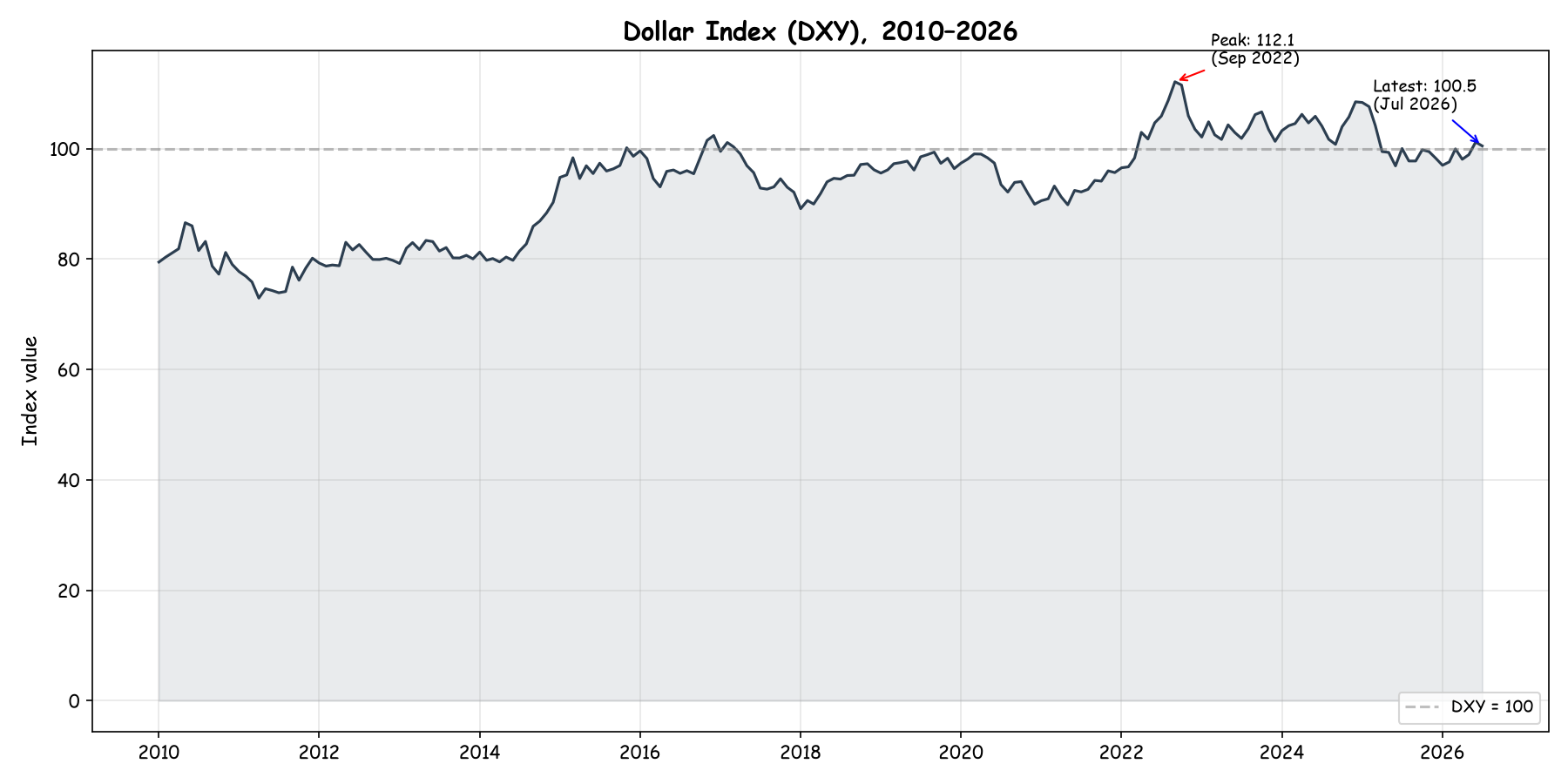
The Dollar Index (DXY) measures the dollar against a basket of six major currencies: the euro (57.6 percent weight), the yen (13.6 percent), the pound (11.9 percent), the Canadian dollar (9.1 percent), the Swedish krona (4.2 percent), and the Swiss franc (3.6 percent). A reading of 100 means the dollar is at its value relative to a 1973 baseline. The index rose from about 79 in 2010 to a peak of 114.1 on September 27, 2022, driven by Federal Reserve rate hikes and safe-haven demand during the early phase of the Russia-Ukraine war. Since then, it has fallen to 100.5 as of July 2026, a decline of 11.9 percent from the peak.
The decline is not dramatic by historical standards. The dollar fell much more in the late 1980s (after the Plaza Accord), in the early 2000s (during the tech bust), and in 2008-2009 (during the financial crisis). What is different this time is the context: the decline is happening alongside a gold rally, a reduction in foreign Treasury holdings, and active policy statements from the US president suggesting he is comfortable with a weaker dollar. In previous episodes, the US Treasury consistently reaffirmed a "strong dollar" policy. Today, that commitment is in doubt.
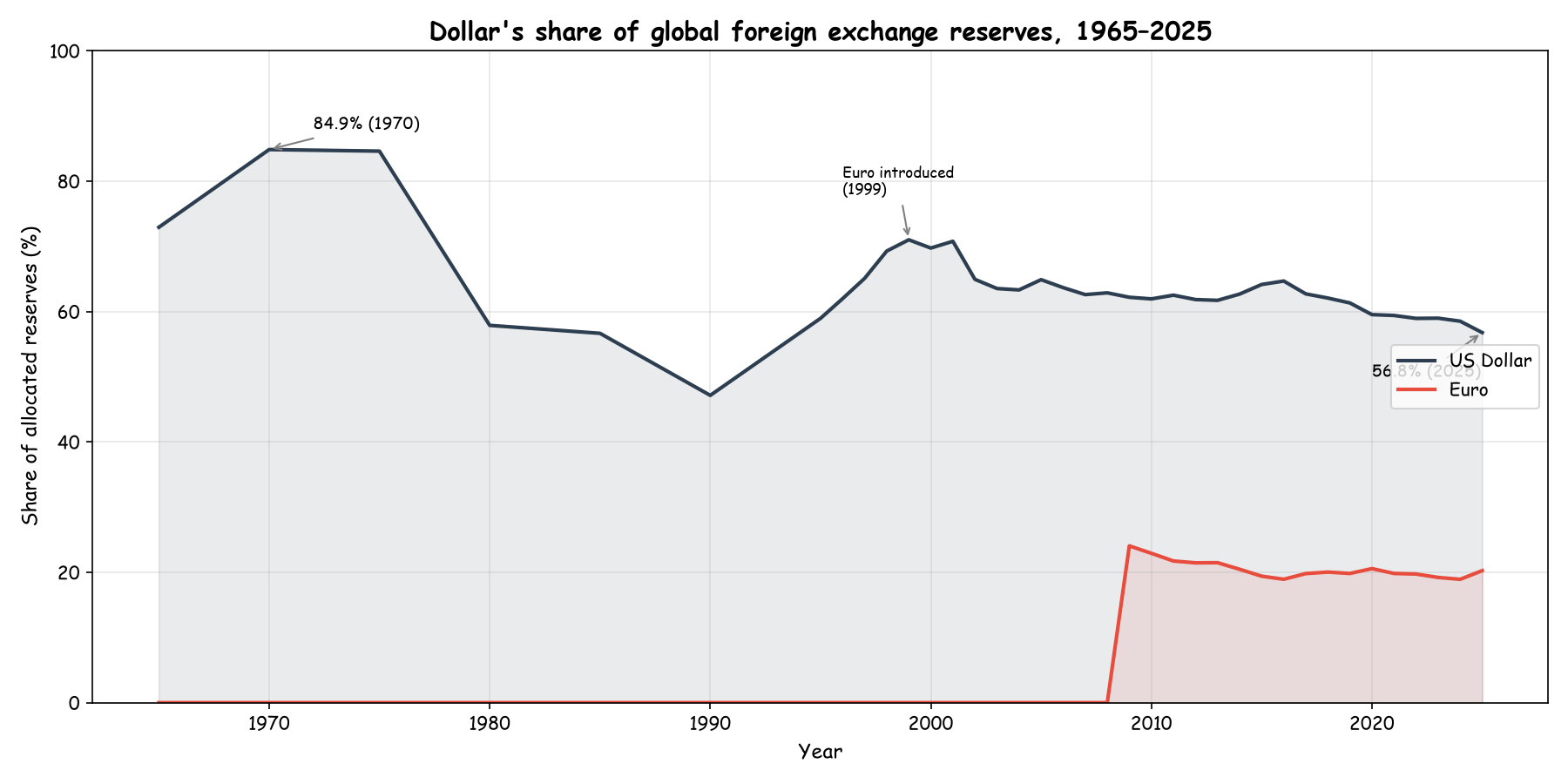
The IMF's COFER data tells the longer story. The dollar's share of allocated foreign exchange reserves has declined from 84.9 percent in 1970 to 56.8 percent in 2025. The decline was steep in the 1970s (as the euro's predecessor currencies gained ground), stabilized in the 1990s and 2000s, and resumed a slow grind downward after 2015. The euro, introduced in 1999, now holds about 20.3 percent of reserves. The yen holds 5.8 percent, the pound 4.4 percent, the Canadian dollar 2.5 percent, the Australian dollar 2.0 percent, and the Chinese renminbi 1.95 percent. The "other currencies" category has grown to 6.1 percent, reflecting diversification into nontraditional reserve assets.
The dollar's current share of 56.8 percent sits in the lower half of its fifty-year range, which runs from a high of 85 percent in 1976 to a low of 46 percent in 1991. As Hung Tran of the Atlantic Council noted, these swings suggest that global reserve composition is shaped by a wide range of economic and policy factors, not just confidence in the dollar [6]. The dollar has been lower than this before, in the early 1990s, and it recovered. But the structural pressures today, including rising US debt, tariff-driven trade disruption, and active de-dollarization efforts by BRICS nations, were not present in the same combination in 1991.
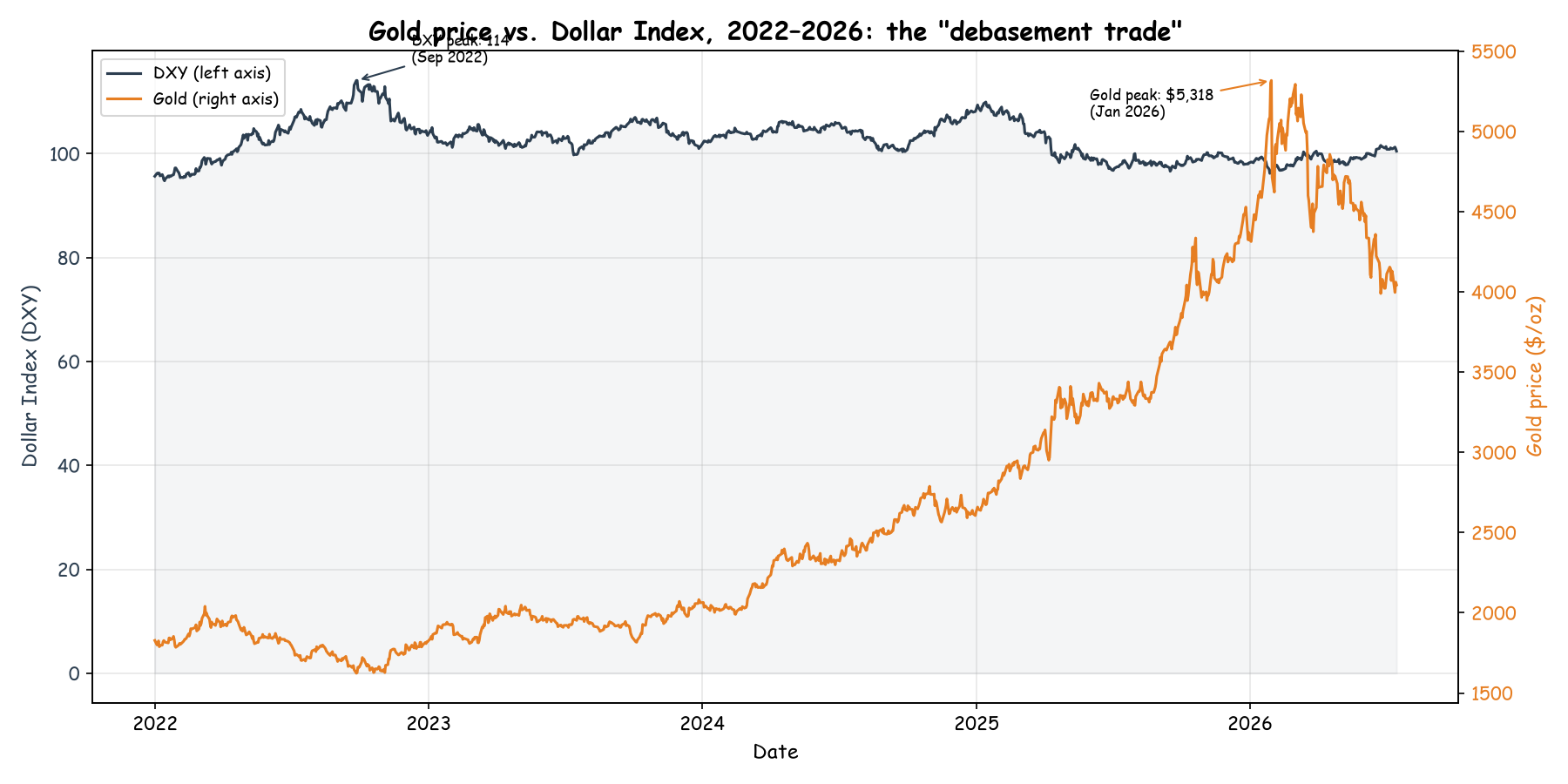
The gold-versus-dollar chart is the most visually striking. Gold rose from about $1,627 per ounce in September 2022 (when the DXY peaked) to a record $5,318 on January 29, 2026, before pulling back to $4,044 in July 2026. That is a 148 percent gain from the DXY peak. Over the same period, the DXY fell 11.9 percent. The correlation between daily dollar returns and daily gold returns from 2022 to 2026 was negative 0.39, meaning that on days when the dollar fell, gold tended to rise, and vice versa.
This is what market participants call the "debasement trade." The logic is simple: if you believe the issuing country is debasing its currency through debt accumulation, political instability, or deliberate depreciation, you sell that currency and buy something that cannot be debased. Gold cannot be printed. Its supply grows by roughly 2 percent per year through mining. When central banks and private investors buy gold, they are making a statement about the currency they are selling to buy it.
The gold rally has multiple drivers. Central banks, especially in China, Russia, India, and Turkey, have been accumulating gold for years. Private investors have piled into gold-backed ETFs in response to Trump's tariffs, threats to Federal Reserve independence, and geopolitical tensions. The US-Iran war added a premium. But the structural driver is the same one that has pushed gold higher since 2008: a slow loss of confidence in the dollar's long-term stability as a store of value.
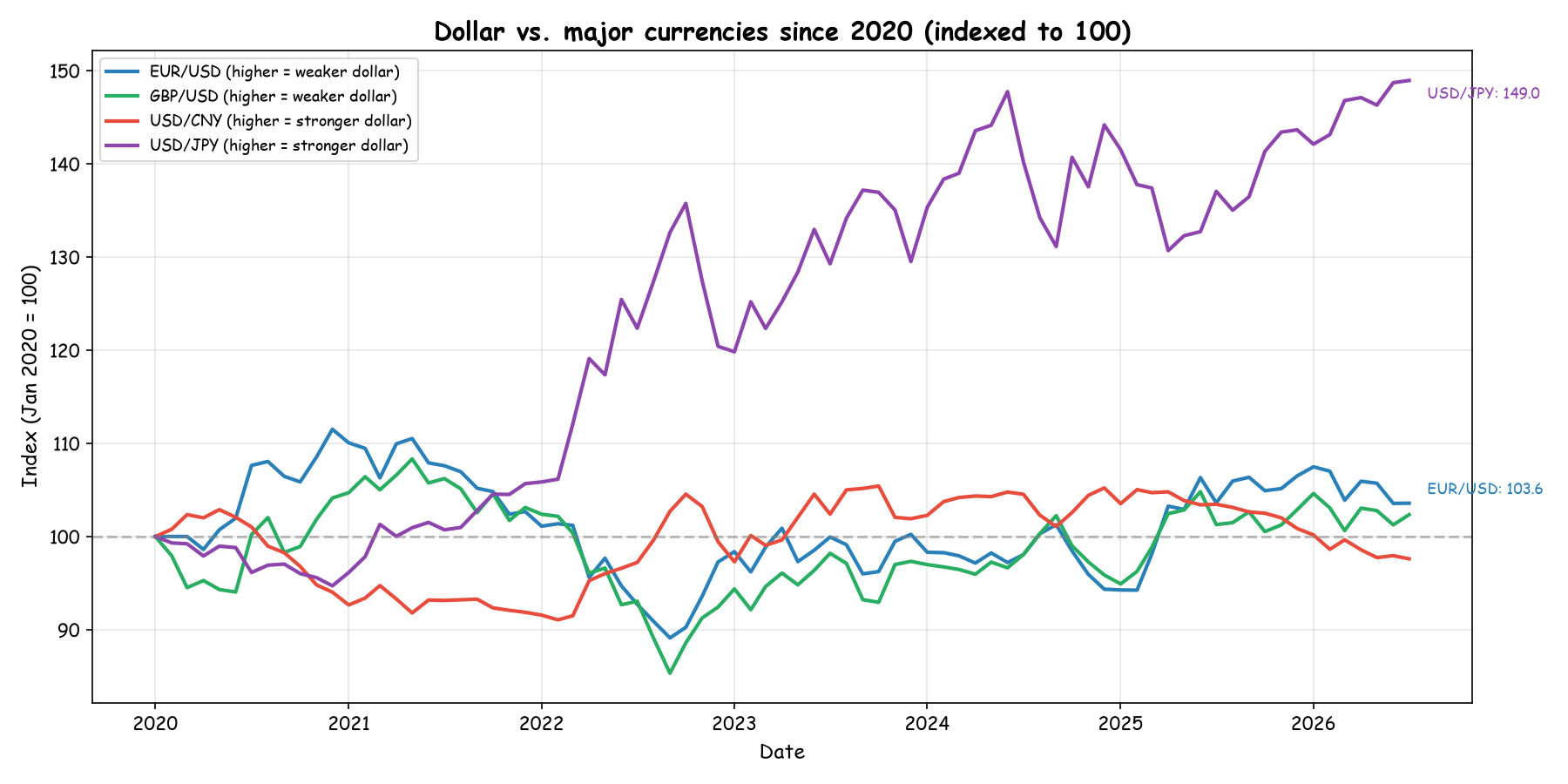
The currency comparison chart shows how the dollar has moved against individual currencies since 2020, indexed to 100 at the start of that year. The picture is mixed. The dollar strengthened dramatically against the yen, rising 49 percent (from about 109 yen per dollar to 162), largely because the Bank of Japan kept interest rates near zero while the Fed raised rates. The dollar weakened modestly against the euro (up 3.6 percent for the euro) and the pound (up 2.4 percent for the pound). Against the Chinese yuan, the dollar weakened 2.4 percent.
The yen's collapse is a separate story from de-dollarization. It reflects interest rate differentials, not a loss of confidence in the dollar. But the euro and yuan movements are more relevant. The euro's gain against the dollar since 2020 is modest, but it comes at a time when the European Central Bank has been discussing the euro's potential as a global currency. The Atlantic Council notes that rising US debt, trade tensions, and geopolitical instability have "renewed debate over the dollar's dominance and whether the euro could serve as an alternative," while cautioning that limited joint debt issuance, fragmented capital markets, and external pressures constrain the euro's global reach [1].
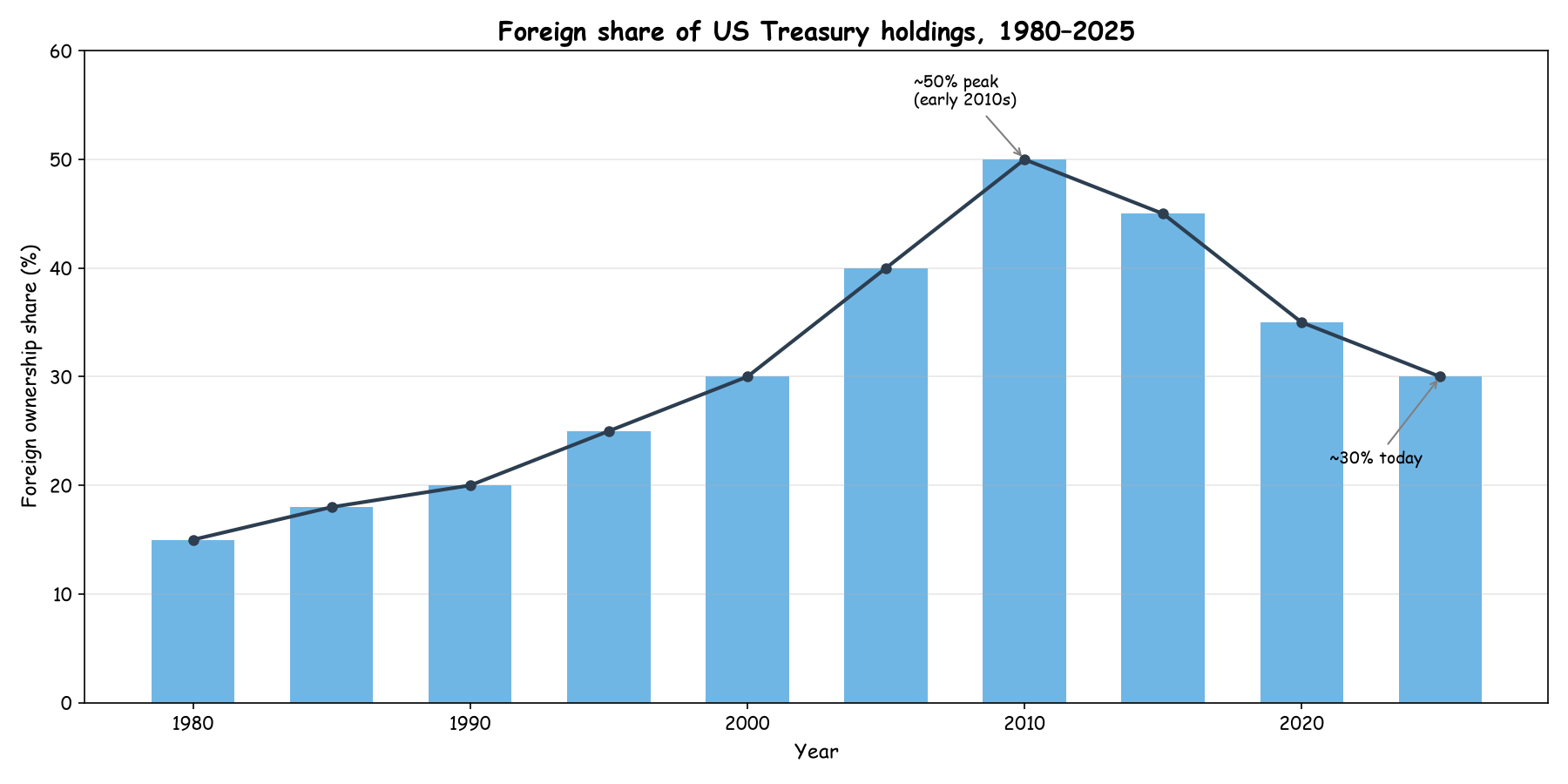
The Treasury holdings chart shows the foreign ownership share of US government debt. Foreign investors held about 15 percent of US Treasuries in the early 1980s. That share rose steadily to about 50 percent in the early 2010s, then fell to roughly 30 percent today. The decline is partly arithmetic: the US government debt has grown so fast that foreign buying could not keep up. The Federal Reserve's quantitative easing programs absorbed trillions in Treasuries, and when those holdings are excluded, the foreign ownership share stands at roughly 36 percent rather than 30 percent [6].
The numbers tell a story of gradual erosion, not sudden collapse. The dollar is weaker than it was, but not dramatically so. Its reserve share is lower, but still dominant. Gold is up, but gold is not a currency. The foreign share of Treasuries is down, but total foreign holdings are at a record. The data is consistent with a slow, structural shift, not a crisis. The risk is that slow shifts can accelerate.
6. The challengers: BRICS, CIPS, mBridge, and the architecture of an alternative
If the dollar is losing ground, what is gaining it? The honest answer is: nothing, yet. There is no single currency waiting in the wings to replace the dollar. The euro is too politically fragmented. The yuan is not freely convertible. Gold is a store of value, not a transaction medium. Bitcoin is too volatile and too small. But there is a coalition of countries, payment systems, and financial technologies that, together, are building the scaffolding for a more multipolar monetary system. The question is whether that scaffolding can bear the weight.
BRICS is the political vehicle. Originally an acronym coined by Goldman Sachs economist Jim O'Neill in 2001 to describe Brazil, Russia, India, China, and South Africa, the grouping has expanded to include Egypt, Ethiopia, Iran, Saudi Arabia, the UAE, and others. The Atlantic Council reports that the BRICS nations "now comprise more than a quarter of the global economy and almost half of the world's population" [8]. The 2025 summit was held in Brazil; the 2026 summit is scheduled for India, under the theme "Building for Resilience, Innovation, Cooperation, and Sustainability."
The Atlantic Council's Dollar Dominance Monitor notes that overt de-dollarization rhetoric at the 2026 summit is likely to remain subdued, as member states navigate uncertain economic relations with the United States [1]. India, in particular, has been cautious about antagonizing Washington. But the practical work continues. The BRICS Cross-Border Payments Initiative, first launched at the 2024 summit in Russia, is advancing discussions on expanding the use of domestic currencies in trade and settlement. India has proposed including a discussion on the interoperability of BRICS central bank digital currencies on the 2026 agenda.
China is the engine. The Atlantic Council identifies China as the leader of de-dollarization efforts within BRICS, with the renminbi dominating intra-BRICS trade. China has expanded CIPS to 1,573 indirect participants and 193 direct participants as of December 2025. In 2024, CIPS processed over $26 trillion in annual business volume [1]. For comparison, SWIFT processes roughly $5 trillion per day, or about $1.3 quadrillion per year. CIPS is still a fraction of SWIFT, but it is growing, and it is specifically designed to handle yuan-denominated transactions without touching dollar-clearing infrastructure.
China's swap lines are the other piece of the puzzle. The People's Bank of China has established bilateral currency swap agreements with numerous countries, allowing them to obtain yuan directly from China's central bank without going through dollar markets. These swap lines reduce the need for countries to hold dollars as a buffer for trade with China. The Atlantic Council tracks China's swap lines with BRICS countries as one of two key indicators of the strength of the alternative financial infrastructure being built [1].
mBridge is the most technologically ambitious project. It is a cross-border digital payments network connecting the central banks of Hong Kong, Thailand, the UAE, Saudi Arabia, and China through their CBDCs. By November 2025, mBridge's cumulative transaction volume had reached $55.49 billion, up from $22 million in 2022 [1]. That is a 250,000-fold increase in three years, though from a base so small that the absolute number is still modest. The significance is not the volume but the architecture: mBridge demonstrates that central banks can settle transactions directly with each other using digital currencies, without correspondent banks, without SWIFT, and without dollars.
The Atlantic Council reports that all founding BRICS members are piloting their own CBDCs and could leverage mBridge as a model for a "BRICS Bridge" project [1]. India has been running its own e-rupee pilot and has engaged with over 40 countries on BRICS payment alternatives, according to BlockNow [12]. The Reserve Bank of India has also launched a pilot bilateral CBDC initiative with the UAE.
Russia and China have gone the furthest in actual de-dollarization of bilateral trade. By May 2026, Russia and China were settling approximately 95 percent of their bilateral trade without dollars, according to BlockNow [12]. China switched to yuan to buy about $88 billion worth of Russian oil, coal, and metals in 2023 [2]. This is the most concrete example of de-dollarization in practice: two large economies conducting nearly all their bilateral trade in their own currencies.
The euro is the sleeping giant. The Atlantic Council notes that rising US debt, trade tensions, and geopolitical instability have renewed debate over whether the euro could serve as an alternative to the dollar [1]. Europe offers institutional stability and appeal for trade diversification. But the euro's global potential is constrained by limited joint debt issuance, fragmented capital markets, and external pressures from China. Without stronger political unity and a long-term strategy, the euro may remain regionally strong but globally constrained. The euro's share of global reserves is about 20 percent, roughly where it has been for a decade. It has not gained ground during the dollar's recent troubles, which suggests that investors are not fleeing the dollar for the euro so much as diversifying into a broader set of assets.
The challengers are real but incomplete. CIPS works but is small. mBridge works but is tiny. The yuan is used more in trade but is not freely convertible. The euro is stable but politically limited. Gold is popular but cannot settle transactions. The dollar's challengers are not ready to replace it. But they are ready to erode it, and that is what they are doing.
7. What breaks first: scenarios, tail risks, and the Triffin dilemma revisited
The dollar's decline, so far, has been orderly. The DXY is down 12 percent from its peak. Gold is up but has pulled back from its January 2026 high. Treasury yields are elevated but not spiraling. Foreign investors are nervous but have not fled. The question is whether this calm persists, and what could break it.
The Triffin dilemma is the place to start. Identified by Belgian-American economist Robert Triffin in the 1960s, it describes a fundamental tension: a country whose currency is the global reserve currency must supply the world with its currency by running trade deficits, but running persistent deficits eventually undermines confidence in that currency. The US goods trade deficit is currently on the order of $1 trillion per year [9]. Each year, the US sends a trillion dollars abroad to buy goods. Those dollars come back as investment in US assets, principally Treasuries. This cycle has worked for decades. But it requires foreign investors to keep buying US debt. If they stop, or even slow down, the US faces a choice: cut the trade deficit (which means fewer imports and higher prices for consumers) or accept higher interest rates to attract foreign capital (which means higher mortgage rates and slower growth).
The Triffin dilemma was identified in the 1960s and contributed to the collapse of Bretton Woods in 1971. The US was running deficits to fund the Vietnam War and Lyndon Johnson's Great Society programs. Foreign governments, led by France under Charles de Gaulle, began converting their dollar holdings into gold, draining US gold reserves. In August 1971, Nixon closed the gold window, ending dollar convertibility. The dollar floated, and the world moved to a system of fiat currencies. The dollar survived because it was already too embedded in the global financial system to abandon. The same network effects that had made it dominant kept it dominant even after the gold backing disappeared.
Today's version of the Triffin dilemma is more acute. US government debt has surpassed $37 trillion, according to Asia Times [11]. The US debt-to-GDP ratio has crossed 100 percent. The Treasury refinances roughly one-third of its marketable debt every twelve months, meaning that any spike in interest rates quickly translates into higher borrowing costs. Net interest outlays are now among the largest and fastest-growing components of the federal budget, typically ranking third or fourth among total expenditures [4]. If foreign demand for Treasuries weakens further, the US will need to either raise taxes, cut spending, or accept higher inflation as the Federal Reserve monetizes more of the debt.
Three scenarios are worth considering.
Scenario one: slow grind
The dollar continues its gradual decline. The DXY drifts lower by 2-3 percent per year. The reserve share falls to 50 percent by 2030. Gold continues to rise but at a slower pace. CIPS and mBridge grow but remain niche. The US economy muddles through with somewhat higher inflation and interest rates. This is the most likely outcome, and it is roughly what the current data supports. The dollar remains dominant but less hegemonic. The world becomes more multipolar, but not dramatically so. The kitchen-table impact is higher prices for imports and somewhat higher mortgage rates, absorbed slowly over years.
Scenario two: Trump's weak-dollar experiment
The administration actively pursues dollar depreciation, perhaps through a "Mar-a-Lago Accord" that attempts to coordinate a dollar devaluation with major trading partners, similar to the 1985 Plaza Accord. The dollar falls 20-30 percent over two years. US exports get cheaper, and the trade deficit narrows. But foreign investors demand higher yields to compensate for currency risk, pushing Treasury yields to 5.5 or 6 percent. Mortgage rates hit 8 percent. The housing market stalls. The fiscal deficit widens as interest costs explode. The administration is forced to reverse course, but the damage to confidence is done. This scenario is less likely but not implausible, given the internal administration divisions identified by the Atlantic Council [7].
Scenario three: a confidence shock
Some event, perhaps a debt ceiling crisis, a constitutional confrontation over Federal Reserve independence, or a botched tariff escalation, triggers a sudden loss of confidence. Foreign investors sell Treasuries en masse. The dollar drops 10 percent in a month. Gold spikes to $7,000 or $8,000. The Fed is forced to raise rates aggressively to defend the currency, tipping the economy into recession. This is the tail risk, the scenario that keeps Treasury officials awake at night. It is unlikely in the near term, because the dollar's network effects and the depth of US markets provide a large buffer. But the buffer is not infinite, and it erodes with each policy misstep.
The second-order effects of any of these scenarios extend beyond finance. A weaker dollar reduces America's ability to finance its military budget. The Atlantic Council's Martin Mühleisen and Valbona Zeneli argue that maintaining a global military presence would be harder to finance if the dollar lost its dominant reserve position, reversing the virtuous cycle between dollar dominance and US geopolitical influence [8]. The US currently spends about $880 billion per year on defense. If borrowing costs rise by 200 basis points across the debt stock, the additional interest cost would be roughly $740 billion per year, approaching the entire defense budget. The trade-offs would be brutal.
A weaker dollar also reduces the effectiveness of US financial sanctions. Sanctions work because so much global trade passes through dollar-clearing systems. As more trade moves to CIPS, mBridge, and local-currency settlement, the share of transactions the US can monitor and restrict shrinks. Russia has already demonstrated that a large economy can function, albeit with difficulty, while cut off from SWIFT. If the de-dollarization infrastructure matures, the US sanctions toolkit becomes less potent, which in turn reduces the dollar's political value to the US government.
The risk that nobody talks about much is the feedback loop. Dollar weakness leads to higher Treasury yields, which raise borrowing costs, which worsen the fiscal deficit, which makes the dollar less attractive, which leads to more dollar weakness. This is the doom loop that destroyed sterling in the 1940s. Britain's debts from two world wars made sterling less attractive, which forced devaluations, which increased the real burden of the debt, which made sterling less attractive still. The US is not at that stage. But the conditions for such a loop, high debt, rising interest costs, declining foreign demand for debt, and political dysfunction, are all present.
8. Conclusion: what a normal person should actually do
The dollar is probably not going to collapse. That is the first thing to say, because the internet is full of people who have been predicting dollar collapse for twenty years and have been wrong every year. The dollar is still 57 percent of global reserves, 88 percent of foreign exchange turnover, and the currency in which most of the world's trade is invoiced. It is backed by the world's largest economy, its deepest financial markets, and a military that can project power anywhere on earth. No single alternative comes close.
But "probably not going to collapse" is not the same as "fine." The dollar is eroding. Its reserve share is down 14 percentage points in 26 years. Its value is down 12 percent from its 2022 peak. Gold, the oldest competitor, is up 148 percent over the same period. The infrastructure for a multipolar currency system is being built, and the country that issues the reserve currency is run by an administration that cannot agree on whether it wants the dollar to be strong or weak. The trend is clear; the timeline is not.
For a normal person, the takeaway is not to panic but to pay attention. Here is what to watch.
Watch the 10-year Treasury yield. It was 4.55 percent in July 2026. If it starts climbing above 5 percent and stays there, that is a signal that foreign investors are demanding more compensation to hold dollar debt. Your mortgage rate will follow. If you are buying a house or refinancing, lock in a rate now rather than waiting for a better one that may not come.
Watch gold, not because you should buy it, but because it is a sentiment indicator. When gold spikes, it means someone with real money is worried about the dollar. Gold at $4,000 is a signal. Gold at $6,000 would be a warning. Gold at $8,000 would be a fire alarm. You do not need to own gold to benefit from watching it.
Watch the DXY. If it falls below 90, the dollar is in territory it has not visited since 2008. That would mean imported goods are getting significantly more expensive, and the "debasement trade" is accelerating. If it stays between 95 and 105, the decline is orderly and manageable.
Watch what China does with its Treasury holdings. If the People's Bank of China accelerates its sales, or if more reports surface of US-China trade being settled in gold, the de-dollarization story is moving from background noise to foreground signal. The Atlantic Council's Dollar Dominance Monitor is a good source for tracking this [1].
What should you actually do with your money? The boring answer is the right one: diversify. If all your savings are in dollars, in dollar-denominated bank accounts, in dollar-denominated bonds, you are making a concentrated bet on the dollar. That bet has paid off for eighty years, but the conditions that made it pay off are changing. You do not need to buy gold bars or move to Switzerland. You need to make sure your portfolio is not 100 percent dollar-denominated. An international stock fund, a bond fund that includes non-US government debt, or even a modest allocation to gold or gold miners, gives you some protection if the dollar's decline accelerates.
If you have a fixed-rate mortgage, keep it. A fixed-rate dollar debt is one of the best hedges against dollar depreciation, because you are paying back the loan in dollars that are worth less over time. If you are considering buying a house and can get a fixed rate below 7 percent, the dollar's structural weakness is actually working in your favor.
If you are a saver, the message is less cheerful. Cash in a bank account is the asset most exposed to dollar depreciation. If inflation runs at 3 percent and your savings account pays 0.5 percent, you are losing 2.5 percent per year in real terms. Move at least some of that cash into Treasury bills (currently yielding around 4.5 percent) or a money market fund. The difference between 0.5 percent and 4.5 percent, compounded over a decade, is enormous.
The dollar's eighty-year run as the world's reserve currency has been an extraordinary anomaly. No currency has dominated global finance for this long since the Roman denarius. Anomalies do not last forever. The dollar will probably remain the most important currency in the world for years to come, but its margin of dominance is shrinking, and the forces shrinking it are structural, not cyclical. The smart move is not to bet against the dollar but to stop betting everything on it.
Sources
- Atlantic Council, "Dollar Dominance Monitor," GeoEconomics Center, accessed July 16, 2026. https://www.atlanticcouncil.org/programs/geoeconomics-center/dollar-dominance-monitor/
- Wikipedia, "Dedollarisation," accessed July 16, 2026. https://en.wikipedia.org/wiki/De-dollarization
- BBC Business, "The Oil Market Absorbed the War Shock, but Buffers Are Running Low," July 15, 2026, and BBC Business homepage, accessed July 16, 2026. https://www.bbc.com/news/business
- Daniel McDowell, Bart Piasecki, and Jessie Yin, "Understanding the vibe shift on the dollar," Atlantic Council Econographics, February 4, 2026. https://www.atlanticcouncil.org/blogs/econographics/understanding-the-vibe-shift-on-the-dollar/
- Jeremy Mark and Josh Lipsky, "China's warning on US Treasuries, and why its timing matters," Atlantic Council Econographics, February 10, 2026. https://www.atlanticcouncil.org/blogs/econographics/chinas-warning-on-us-treasuries-and-why-its-timing-matters/
- Hung Tran, "What the data shows, and doesn't show, about the future of the dollar," Atlantic Council Econographics, February 4, 2026. https://www.atlanticcouncil.org/blogs/econographics/what-the-data-shows-and-doesnt-show-about-the-future-of-the-dollar/
- Alisha Chhangani, "What's the Trump administration's dollar strategy? It depends on who you ask," Atlantic Council New Atlanticist, May 27, 2025. https://www.atlanticcouncil.org/blogs/new-atlanticist/whats-the-trump-administrations-dollar-strategy-it-depends-on-who-you-ask/
- Martin Mühleisen and Valbona Zeneli, "Why the US cannot afford to lose dollar dominance," Atlantic Council Strategy Paper, May 20, 2025. https://www.atlanticcouncil.org/blogs/econographics/why-the-us-cannot-afford-to-lose-dollar-dominance/
- Wikipedia, "Triffin dilemma," accessed July 16, 2026. https://en.wikipedia.org/wiki/Triffin_dilemma
- Wikipedia, "Reserve currency," accessed July 16, 2026. https://en.wikipedia.org/wiki/Reserve_currency
- Asia Times, "$5,000 gold: logic, not lunacy, in a de-dollarizing world," October 2025. https://asiatimes.com/2025/10/5000-gold-logic-not-lunacy-in-a-de-dollarizing-world/
- Sahana Kiran, "De-Dollarization: US Pays China in Gold as Treasury Hits Record Buyback," BlockNow, March 17, 2026. https://blocknow.com/de-dollarization-us-pays-china-gold-treasury-record-buyback/
- Bidisha Bhattacharya, "De-dollarisation is just fashionable debate. Every global crisis sends world back to dollar," ThePrint, March 17, 2026. https://theprint.in/opinion/economix/de-dollarisation-is-just-fashionable-debate-every-global-crisis-sends-world-back-to-dollar/2880818/
- Wikipedia, "Bretton Woods system," accessed July 16, 2026. https://en.wikipedia.org/wiki/Bretton_Woods_system
- Wikipedia, "Petrodollar recycling," accessed July 16, 2026. https://en.wikipedia.org/wiki/Petrodollar
- IMF, "Latest Releases and SDR Rates," accessed July 16, 2026. https://www.imf.org/external/np/tre/tdrd/sdr/sdr_interest_rate.htm
- Yahoo Finance, historical price data for DX-Y.NYB (Dollar Index), EURUSD=X, GBPUSD=X, CNY=X, JPY=X, GC=F (Gold), ^TNX (10-Year Treasury), accessed July 16, 2026, via Yahoo Finance Chart API.
- Reddit r/Economics, search results for "de-dollarization," accessed July 16, 2026. https://old.reddit.com/r/Economics/search?q=de-dollarization&restrict_sr=on&sort=new&t=year