This is the full research report behind the video: every number, source, and chart the script was written from.
How a publicly traded company controlled by the sitting president began selling low-latency access to his social media posts, and why it feels like the market is rigged
AI Research Desk July 17, 2026 Report No. 2026-0717
Executive summary
On July 16, 2026, Trump Media & Technology Group (TMTG), the publicly traded parent company of Truth Social, announced a product called Truth API. The service promises to deliver posts from "the highest-ranking Truth Social accounts" to paying financial firms in "milliseconds," starting August 1. The company's interim CEO, Kevin McGurn, described it as part of a "strategy to monetise proprietary assets" and said he expected it to become a "meaningful, ongoing source of revenue." The press release did not specify pricing. It also did not say whether President Donald Trump's own posts, which routinely move global markets, would be included in the feed. The White House declined to comment. TMTG did not respond to questions from the Associated Press about whether Trump's posts would be excluded.
The story broke alongside a separate but related scandal: a White House teleprompter operator named Gabriel Perez was placed on unpaid leave after the prediction-market platform Kalshi accused him of using advance knowledge of Trump's speeches to place nearly $100,000 in bets on which words the president would say. Kalshi froze the account and reported Perez to the Commodity Futures Trading Commission. Federal prosecutors in Manhattan declined to open a criminal case.
Together, these two stories crystallize a fear that has been building since Trump's return to office: that the people closest to the president's words, whether a low-level staffer or a Wall Street firm paying for a data feed, can profit from seeing those words a few seconds before everyone else. Kathleen Clark, a government conflict-of-interest expert at Washington University School of Law, called the Truth API plan "brazen corruption, an improper exploitation of government power to enrich himself." Robert Frenchman, a partner at the law firm Dynamis, told Reuters the service is legal but "does not seem fair."
The financial backdrop is grim for ordinary shareholders. DJT stock has fallen 73.6% over the past two years, from $36.44 in July 2024 to $9.63 on July 16, 2026. The stock's annualized volatility of 85% is nearly five times that of the S&P 500. Trump indirectly owns about 53% of the company through a trust, giving him a paper stake of roughly $1.41 billion at current prices. He earned $2.2 billion in total during his first year back in office, according to a mandatory disclosure filed with the Office of Government Ethics.
Key findings
- TMTG launched Truth API on July 16, 2026, offering millisecond delivery of posts from top Truth Social accounts to paying institutional clients, starting August 1.
- The company did not disclose pricing and refused to confirm whether Trump's own posts would be included. The White House declined to comment.
- Trump owns approximately 53% of TMTG through a trust. His posts about tariffs, the Iran war, and trade policy regularly move stock, bond, and currency markets.
- DJT stock has lost 73.6% of its value over two years. Its annualized volatility of 85% dwarfs the S&P 500's 17%.
- A White House teleprompter operator was separately accused of using advance knowledge of Trump's speeches to make nearly $100,000 in prediction-market bets. Kalshi froze the funds.
- Conflict-of-interest laws exempt the president and vice president from provisions that would bar other officials from profiting off their own official statements.
- The historical parallel is Jay Gould's 1869 attempt to corner the gold market by buying influence with President Ulysses S. Grant, which caused the Black Friday panic when Grant intervened.
- Legal experts say tiered distribution of social media data is probably legal under current securities laws, but the optics are dire and the precedent is dangerous.
Chapter 1: Your money, their milliseconds
Imagine you are sitting at your kitchen table on a Tuesday morning, coffee in hand, checking your retirement account. You own a broad index fund, the kind your financial advisor recommended because it is boring and safe. You notice it dropped 2% yesterday. You scroll through the news and see that President Trump posted something about tariffs on Truth Social at 9:17 AM. The market tanked at 9:17 and three seconds. You shrug. That is just how it works.
Now imagine a different version of that morning. A hedge fund on the 42nd floor of a Manhattan office building received that same tariff post at 9:17:00.000, the exact millisecond Trump hit send, because they pay Trump Media for a data feed called Truth API. They had algorithms ready. In the 800 milliseconds between receiving the post and the rest of the world seeing it on the Truth Social app, their computers sold S&P 500 futures, bought gold, and shorted the companies most exposed to tariffs. By the time your index fund's price updated, they had already moved the market against you.
That gap, measured in milliseconds, is what this story is about. It is about whether the company he controls should be allowed to sell early access to those posts to the highest bidder, and whether that creates a two-tier market where Wall Street firms see the president's words before you do.
Here is why it matters to you specifically. If you own any broad stock fund, a 401(k), an IRA, or even just a few shares of an ETF, your returns are shaped by prices set in a market where speed is everything. When Trump posts about tariffs, the S&P 500 can swing hundreds of billions of dollars in minutes. The people who see the post first can trade on that information before the price moves. The people who see it second, which includes you and every other retail investor, trade at the post-move price. You are not losing money in a way you can see on a single trade. You are losing fractions of a percent on thousands of trades, over years, to firms that pay for a head start.
This is not a new concept in finance. Wall Street firms have paid for faster data feeds for decades. Bloomberg terminals, Reuters feeds, and direct exchange connections all give professionals an edge over retail investors. What is new here is the source of the data. The fastest, most market-moving feed is the personal social media account of the President of the United States, delivered through a company he controls and profits from.
The conflict is not subtle. Trump owns about 53% of TMTG through a trust he set up in December 2024, a month before taking office. Every dollar of revenue from Truth API increases the value of his stake. If a hedge fund pays $50,000 a month for the feed, a portion of that money flows to the company whose largest shareholder is the president. The same president whose posts the hedge fund is paying to see early. The same president whose policy decisions those posts announce.
You do not need to be a conspiracy theorist to find this uncomfortable. You just need to ask a simple question: if the president posts "Tariffs on China going to 60%!" and a firm that pays his company for early access shorts Chinese stocks before the post goes public, who got hurt? The answer is everyone who held those stocks at the old price and sold at the new price, not knowing what was coming. That is you, through your index fund.
The counterargument, and it is a real one, is that this happens already. Firms scrape Truth Social data without permission. McGurn said in the BBC interview that "some firms have been copying its data for months without permission" and that TMTG will "soon block these methods, forcing firms to buy the official feed instead." So the choice is between uncontrolled scraping and a paid, official channel. The paid channel at least has terms of service and a paper trail.
But that argument collapses when you remember who owns the company. A neutral platform selling a data feed is one thing. A platform controlled by the person whose posts are the feed's entire value proposition is another. The BBC quoted Mark Spiegel of Stanphyl Capital Management calling it "unprecedented" if Trump's posts are included. The Guardian quoted Kathleen Clark calling it "brazen corruption." Both are right. It is unprecedented, and it looks corrupt, and whether it technically breaks any law is a question nobody can answer with confidence right now.
Chapter 2: Jay Gould, President Grant, and the original Black Friday
The year was 1869. Ulysses S. Grant, the Civil War hero turned president, was in his first term. The United States was still on a shaky financial footing after the war, with paper greenbacks circulating alongside gold coin. The government held roughly $100 million in gold, and the price of gold fluctuated based on how much the Treasury decided to sell at any given time. The man who controlled those sales was Secretary of the Treasury George Boutwell, who consulted with Grant on a roughly monthly schedule.
Jay Gould saw an opportunity. Gould was a 33-year-old financier who had already made a fortune manipulating railroad stocks, bribing New York state legislators, and issuing fraudulent shares in the Erie Railroad. Britannica describes him as "one of the most unscrupulous robber barons of 19th-century American capitalism." He made them move.
Gould's plan was simple in concept and monstrous in execution: corner the gold market. If he could buy up enough gold and keep the government from selling its reserves, the price would skyrocket, and he would profit enormously. The problem was that the government, through Boutwell and Grant, could at any moment dump $4 million of gold onto the market and crash the price. Gould needed to know what Grant was going to do before Grant did it. He needed access.
So Gould bought access. He befriended Abel Corbin, a financier who had married Grant's sister, and through Corbin he got close to the president. Gould and his partner James Fisk wined and dined Grant, took him on boat trips, and plied Corbin with cash and gold. Gould also paid off a Treasury Department clerk named Daniel Butterfield, who agreed to tip him off whenever the government planned to sell gold. The scheme was elaborate: Gould would know the president's intentions before the market did, and he would trade on that knowledge.
Through the summer of 1869, Gould and Fisk began buying gold aggressively. The price climbed from around $130 per $100 in coin to $137, then $140, then higher. Gould kept buying, confident that his inside line to Grant meant the Treasury would not intervene. For a while, he was right. Grant seemed unconcerned, or perhaps did not fully understand what was happening.
The scheme worked until it did not. On September 23, 1869, Grant finally realized what Gould was up to. The president had been receiving warnings from Boutwell and others that the gold market was being manipulated. Grant ordered Boutwell to sell $4 million of government gold the next day. On September 24, a Friday, the Treasury dumped its gold. The price of gold, which had been driven up to $163.50, collapsed to $133 in hours. The panic was immediate and devastating. Stock prices cratered. Farmers who had locked in crop prices based on gold rates faced ruin. Dozens of brokerage houses failed. The day became known as Black Friday.
Gould, who had gotten word of Grant's decision through his network before the public knew, had quietly sold his gold positions before the crash. He walked away with a profit. His partner Fisk was less fortunate and lost heavily. Abel Corbin was ruined. Daniel Butterfield was forced to resign. Grant's reputation suffered a blow from which it never fully recovered, even though he was never personally implicated in corruption.
The parallels to today are not exact, but they are close enough to be uncomfortable. In 1869, a financier bought access to the president's decision-making process and traded on that access before the public knew. In 2026, a company controlled by the president is selling access to the president's public statements before the public sees them. The mechanism is different: Gould paid bribes and used a brother-in-law, while TMTG is launching a paid API. The technology is different: Gould used telegraph wires and whispered conversations, while Truth API uses fiber-optic cables and JSON endpoints. The principle is the same: someone with proximity to the president's words profits from seeing them first.
There is one difference that makes the current situation arguably worse. Gould was an outsider who had to corrupt the system. Trump is the system. He is both the president whose words move markets and the majority shareholder of the company selling access to those words. Gould had to buy influence. Trump already has it, and he is monetizing it directly.
The aftermath of Black Friday 1869 offers a lesson about what happens when the scheme breaks. Grant's intervention was swift and decisive once he understood what was happening. The gold market crashed, but the broader economy eventually recovered. Gould went on to build an even larger railroad empire and died in 1892 with a fortune of $77 million, which in today's dollars would be roughly $2.5 billion. The people who lost money in the panic never got it back. The system did not punish the manipulator. It punished everyone else.
After Black Friday, Congress passed no meaningful reforms. Grant's administration lurched from one scandal to the next. The lesson Congress took was that presidents should choose their friends more carefully. That lesson, obviously, did not stick.
Chapter 3: How Truth API works and who pays
The product is called Truth API. The name is corporate and bland, which is probably the point. Here is what we know from the TMTG press release dated July 16, 2026, and from reporting by the BBC and the Guardian.
Truth API is a licensed data service for "financial services partners." It delivers posts from Truth Social's "most influential accounts" to paying clients in "milliseconds." The service runs 24 hours a day, seven days a week. It launches on August 1, 2026. The company says it has already signed up customers, though it did not name them. It did not disclose pricing.
The technical mechanics are straightforward, at least in concept. When a user posts on Truth Social, the platform's servers process the post and make it visible to followers through the app or website. That process takes some amount of time, probably a fraction of a second. Truth API inserts a parallel pipeline: the same post is simultaneously pushed to paying clients through an API endpoint, a structured data feed that trading firms can plug directly into their algorithms. The claim is that this delivery happens in "milliseconds," which means the post reaches paying clients faster than it reaches ordinary users scrolling the app.
How much faster is the question that matters. If the gap is 50 milliseconds, it is meaningless for human traders but useful for high-frequency algorithms. If the gap is 2 seconds, it is enough for a human trader to read the post, make a decision, and execute a trade before the broader market reacts. The BBC reported that "for firms, a delay of even seconds can be costly." The Guardian noted that the service would allow firms to "profit off subsequent moves in stocks, bonds and interest rates."
The TMTG press release title refers to "the fastest access to Truth Social's most influential accounts." The Guardian reported that the service covers "the highest-ranking Truth Social accounts." Trump has 12.9 million followers on the platform, making him by far its most popular user. His eldest son, Donald Jr, is second. Eric Trump is close behind. The press release did not specify which accounts are included, but the implication is clear: if you are selling a feed of the most influential accounts, and the most influential account is the president's, the president's account is the product.
McGurn told the BBC that "markets already move on Truth Social posts" and that the service will create a steady profit. He also said that some firms have been scraping Truth Social data without permission for months, and that TMTG will block those methods, forcing firms to buy the official feed. This is a classic business move: create a paid version of something that was previously free, then shut down the free version. It is what X (formerly Twitter) did with its API in 2023, and what Reddit did with its API the same year. The difference is that X and Reddit are neutral platforms. Truth Social's most valuable user is its owner.
Who are the likely customers? The BBC described them as "financial traders who want to see market-moving news fast." In practice, this means quantitative hedge funds, proprietary trading firms, market makers, and possibly banks with trading desks. These are firms that already pay for fast data feeds from Bloomberg, Reuters, and direct exchange connections. A Truth Social feed would be an additional data source, plugged into algorithms that trade on news sentiment, tariff announcements, and geopolitical events.
The Guardian reported that Trump "regularly uses Truth Social to announce major decisions that affect markets, such as posts about the Iran war and tariffs." The article noted that "last year Trump made more than 100 posts in a single day as global stock markets fell sharply amid fears his economic policies could produce a 'Trumpcession' in the US." The Iran posts are especially market-moving because investors worry that higher oil prices will stoke inflation and force the Federal Reserve to raise interest rates. A single post about tariffs or Iran can move the S&P 500 by a percentage point or more in minutes. On a market capitalization of roughly $50 trillion for US equities, a 1% move is $500 billion.
The revenue potential for TMTG is modest in the context of a $2.67 billion company, but meaningful for a firm that is losing money. TMTG has been loss-making since its inception. The company has tried various strategies to generate revenue: advertising on Truth Social, a streaming service called Truth+, a financial services brand called Truth.Fi, cryptocurrency ventures, a merger with a fusion power company called TAE Technologies, and even a plan to distribute digital tokens to shareholders. None of these have turned the company profitable. Truth API is the latest attempt, and it has the advantage of requiring almost no capital investment. The data already exists. TMTG is simply packaging it and selling it.
The company's stock rose 0.6% to $9.63 on the day of the announcement, July 16. That is a rounding error for most stocks, but for DJT, which has been in a long decline, any positive reaction is notable. The market's muted response suggests investors do not expect Truth API to significantly improve TMTG's finances. The bigger story is what it signals about the company's willingness to monetize the president's words, and what that means for the integrity of the market.
Chapter 4: The teleprompter operator, Kalshi, and the $100,000 question
The Truth API announcement landed on July 16, 2026. On the same day, the BBC reported a story that, in any other week, would have been the scandal of the month. A White House teleprompter operator named Gabriel Perez was placed on unpaid leave after being accused of using advance knowledge of President Trump's speeches to place nearly $100,000 in bets on a prediction-market platform called Kalshi.
The details, as reported by the BBC and confirmed by CBS News and ABC News, read like a caper script. Perez had worked at the White House since 2016. His job was to operate the teleprompter, which means he saw the text of Trump's speeches before the president delivered them. Kalshi is a regulated prediction-market platform where users can bet on real-world events, including "mention markets," contracts that pay out if a speaker uses specific words during a public address. You can bet on whether Trump will say "tariff" during the State of the Union. You can bet on whether he will mention China, or use a campaign slogan, or reference a specific country.
Kalshi's analysts noticed unusual betting activity on these mention markets in March 2026. The bets were consistently correct, which is a red flag in any gambling context. The platform investigated, traced the account, and discovered that the user was a federal employee who operated White House teleprompters. Kalshi froze more than $90,000 in the account before it could be withdrawn. Robert DeNault, Kalshi's head of enforcement, said the firm flagged the trades and handed evidence to the CFTC, which regulates prediction markets.
White House press secretary Karoline Leavitt confirmed that Trump was aware of the situation and that Perez was on unpaid leave and would no longer work at the White House. Sources told ABC News that Perez was "fully cooperative" with the CFTC. Federal prosecutors in Manhattan declined to open a criminal case. The CFTC said it could not "confirm or deny" any probe.
The story is small in dollar terms. Ninety thousand dollars is nothing in the context of global markets. But it illustrates the exact problem that Truth API creates at scale. Perez allegedly profited from seeing the president's words before the public heard them. He had a few hours or days of advance notice, not milliseconds. The mechanism was a prediction market, not a stock exchange. But the principle is identical: proximity to the president's words has financial value, and people who have that proximity can exploit it.
The difference between Perez and a hedge fund paying for Truth API is one of degree, not kind. Perez allegedly used his position to gain an edge on a prediction market. A hedge fund paying for Truth API uses its wallet to gain an edge on the stock market. Perez's edge came from being in the room. The hedge fund's edge comes from being on the client list. Both are converting advance access to the president's words into money.
Kalshi itself made a striking observation in its statement to the BBC. "The words of political leaders like Presidents and Fed chairs cause billions of dollars of movement in FX markets, oil futures, [and] the stock market," the platform said. This is the same argument TMTG is implicitly making when it sells Truth API: the president's words are valuable, and that value can be monetized. The difference is that Kalshi was describing the problem. TMTG is selling the solution.
There is a regulatory irony here. The CFTC regulates prediction markets like Kalshi. The SEC regulates stock markets. Neither agency has clear jurisdiction over a social media company selling a data feed of the president's posts. The teleprompter operator was caught because Kalshi, a regulated entity, noticed the suspicious activity and reported it. If a hedge fund uses Truth API to trade ahead of Trump's posts, there is no Kalshi equivalent watching. The trades would look like ordinary algorithmic activity. The edge would be invisible.
The Perez story also raises a question about the culture around the president's words. If a teleprompter operator can allegedly figure out how to monetize advance access, how many other people in the White House, in the Trump family, or in TMTG itself have similar opportunities? The Truth API product formalizes what was previously informal. It takes the gray market of advance access and turns it into a product with a price tag. That is either a step toward transparency or a step toward institutionalized corruption, depending on your perspective.
Chapter 5: DJT stock: the numbers behind the meme
DJT, the ticker for Trump Media & Technology Group, is one of the most volatile stocks on the Nasdaq. It is also one of the worst-performing stocks of the past two years. The numbers tell a story that is partly about Trump's political fortunes and partly about the disconnect between a company's fundamentals and its stock price.
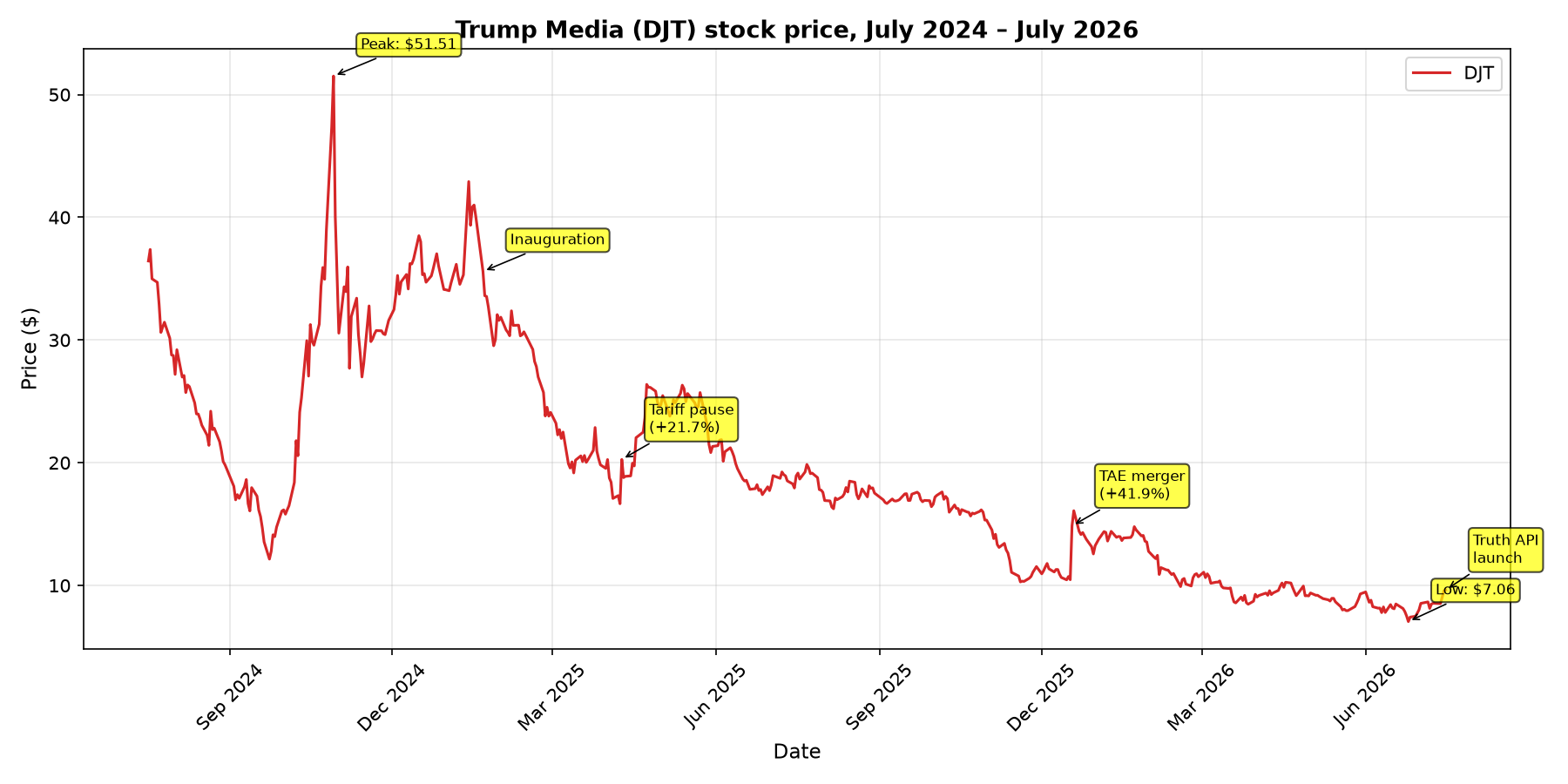
The chart above shows DJT's daily closing price from July 2024 to July 2026. The stock started the period at $36.44, peaked at $51.51 on October 29, 2024 (a week before the presidential election), and then began a long decline. The all-time low of $7.06 came on June 25, 2026. The stock closed at $9.63 on July 16, 2026, the day Truth API was announced. That is a 73.6% decline over two years.
For context, the S&P 500 returned 34.8% over the same period, and the Nasdaq 100 (QQQ) returned 46.5%. An investor who put $10,000 in DJT in July 2024 would have $2,640 today. The same $10,000 in the S&P 500 would be worth $13,480.
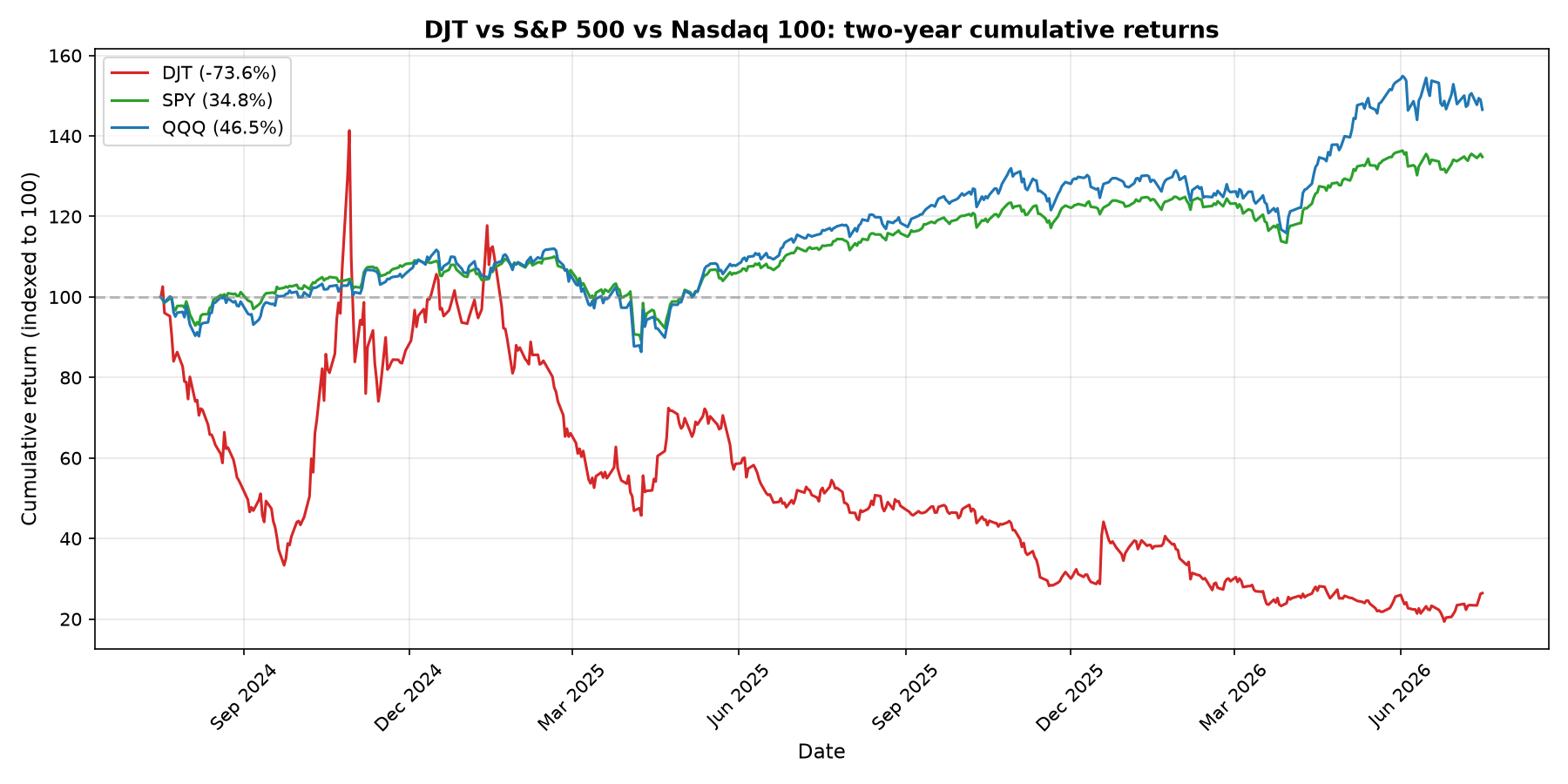
The divergence is extreme. DJT did not just underperform the market. It moved in the opposite direction. While the broad market rose steadily, DJT fell steadily, with occasional violent spikes. The stock's beta versus the S&P 500 is 1.79, meaning it tends to move about 1.8 times as much as the market on any given day. But the correlation is only 0.357, which means the market explains only about 13% of DJT's daily movement. The other 87% is driven by something else, probably Trump-specific news, political sentiment, and retail trading behavior.
The volatility numbers are staggering. DJT's annualized volatility over the two-year period is 85.1%, compared to 17.0% for the S&P 500 and 22.2% for the Nasdaq 100. That means on any given day, you can expect DJT to move about 5.4% up or down, compared to about 1.1% for the S&P 500. The stock's biggest single-day gain was 41.93% on December 18, 2025, when TMTG announced its merger with TAE Technologies, a fusion power company, in an all-stock deal valued at more than $6 billion. Its biggest single-day loss was 22.97% on November 7, 2024.
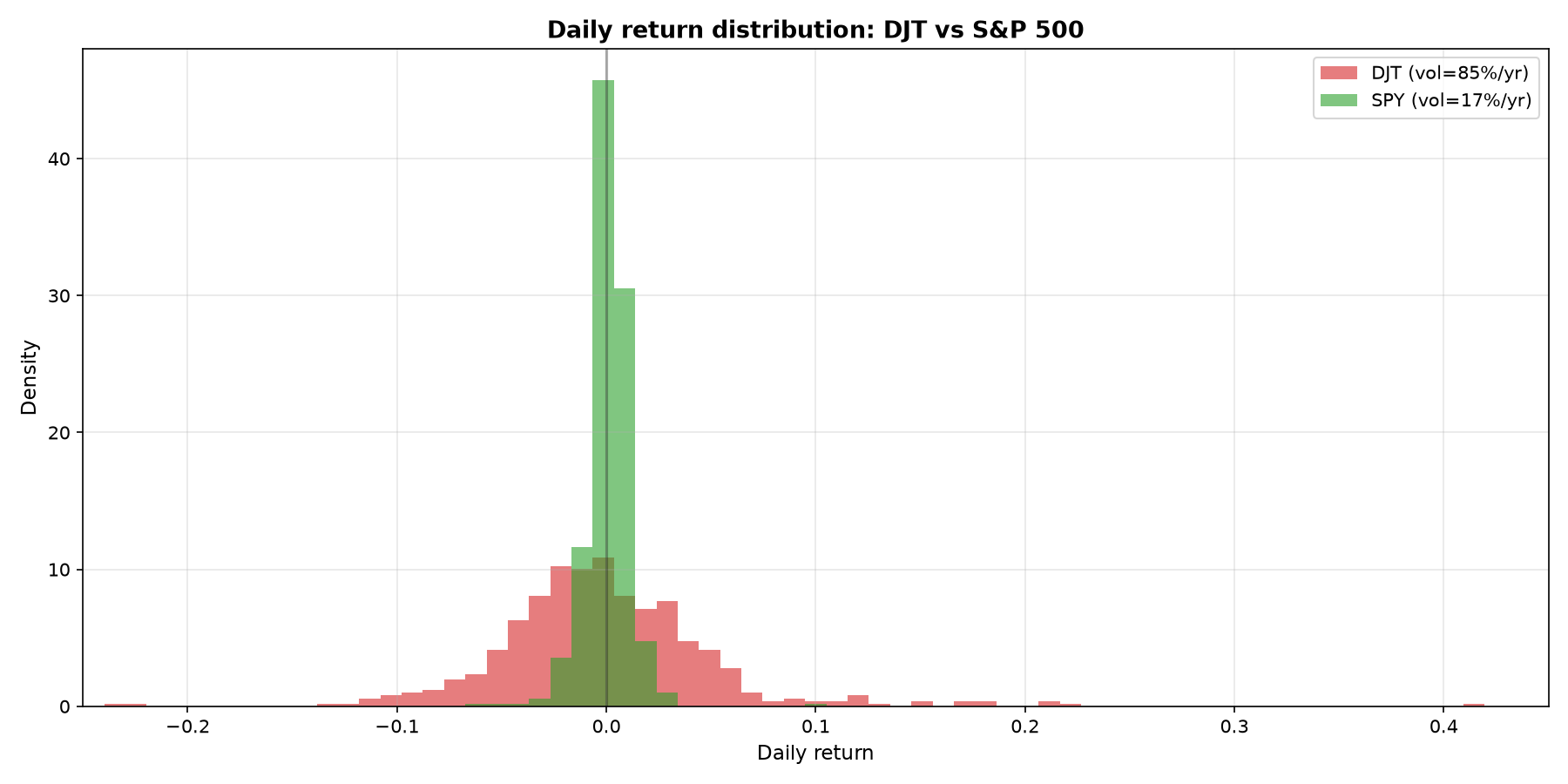
The distribution chart above shows how different DJT's daily returns are from the S&P 500's. The red bars (DJT) are spread wide, with fat tails on both sides. The green bars (SPY) are clustered tightly around zero. DJT's return distribution has a kurtosis of 13, meaning extreme moves happen far more often than a normal distribution would predict. The skewness is 1.40, meaning the stock has a tendency toward large positive surprises (the TAE merger spike, the tariff-pause rally) mixed with a slow grinding decline. This is the signature pattern of a meme stock: long periods of decay punctuated by explosive rallies that fade.
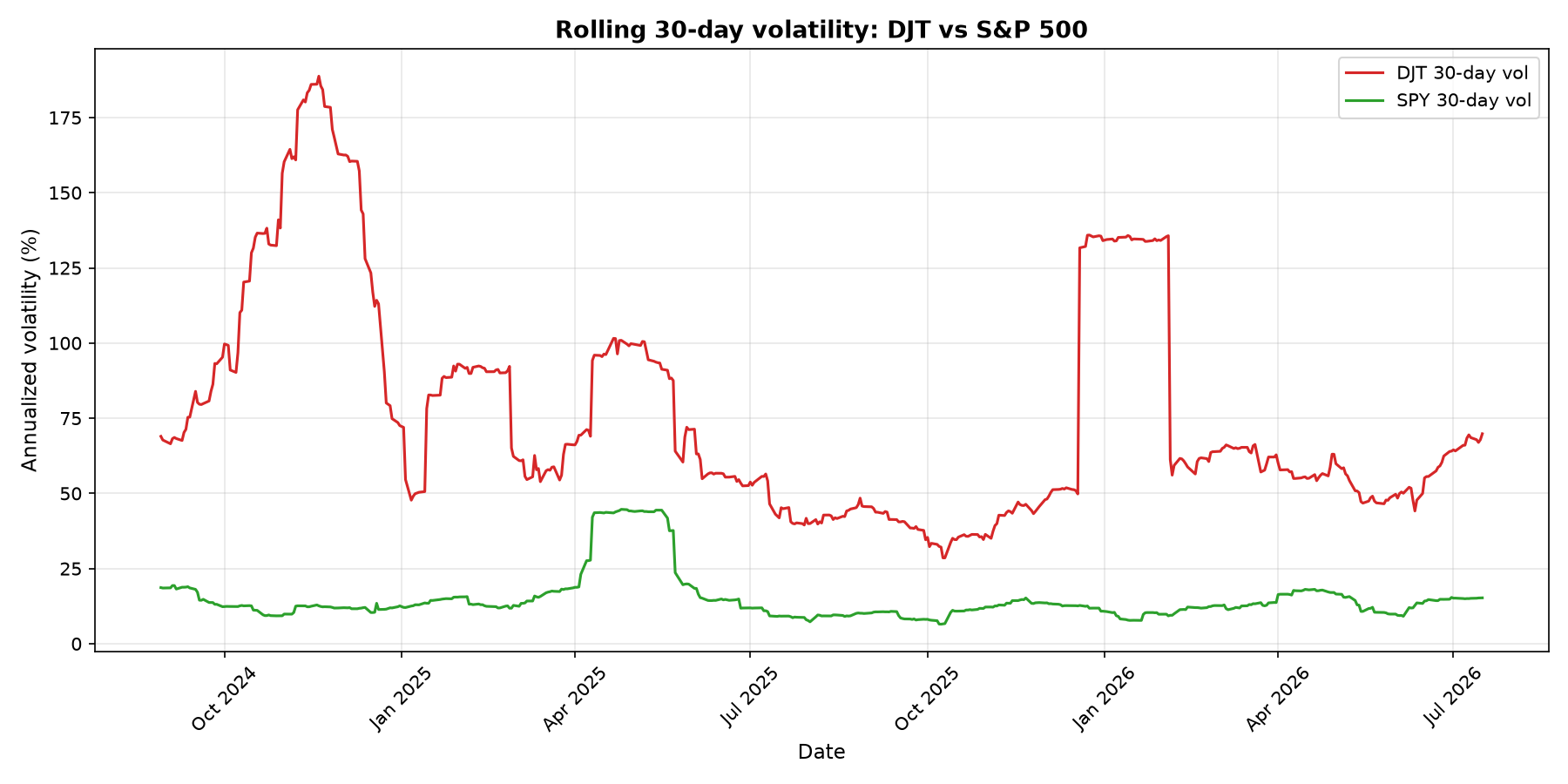
The rolling volatility chart tells the story of when DJT was most unstable. Volatility spiked during the October 2024 election period, again in early 2025 around inauguration and the first tariff announcements, and then again in late 2025 around the TAE merger. In mid-2026, volatility remains elevated, hovering around 60-80% annualized, even as the stock has settled into a lower price range. The market has not calmed down. It has just gotten cheaper.
What does this have to do with Truth API? The product is, in part, a response to the company's financial distress. TMTG is losing money. The Guardian reported that the company's stock has "plunged more than 70% since the president took office last year, erasing $6bn in shareholder wealth." The company has tried multiple revenue strategies, from streaming to crypto to fusion power, and none have worked. Truth API is the first product that directly monetizes the one asset TMTG has that nobody else can replicate: the president's social media feed.
The market's reaction to the announcement was muted. DJT rose 0.6% on July 16, from $9.57 to $9.63. That is barely a wiggle for a stock that routinely moves 5% in a day. Investors do not seem to believe Truth API will generate enough revenue to change the company's trajectory. They may be right. Even if TMTG charges $50,000 per month per client and signs up 50 clients, that is $30 million a year, which is meaningful for a company with $2.67 billion in market cap but not enough to turn the company around. The real value of Truth API may be in what it reveals about the company's strategy: when the core business fails, monetize the president.
Chapter 6: Is it legal? The regulatory vacuum
The short answer is: probably yes, and that is the problem.
Robert Frenchman, a partner at the US law firm Dynamis, told Reuters: "It certainly does not seem fair, but yes, a tech platform can tier its distribution of information without violating federal securities laws." This is the core of the legal analysis. A social media company can choose to deliver its data to some users faster than others. X does it. Reddit does it. Bloomberg does it. The practice of selling tiered data access is well established in the financial information industry. What makes Truth API different is the source.
The relevant legal framework has three layers, and none of them cleanly covers this situation.
The first layer is securities law. The Securities and Exchange Commission regulates trading on material non-public information. The key word is "non-public." If Trump posts on Truth Social, the post is public the moment it appears on the platform. The question is whether delivering it to paying clients a few milliseconds before it appears on the app makes it "non-public" during that gap. The answer is almost certainly no. The post is published. It is just being delivered to some readers faster than others. This is no different from a news wire service delivering a press release to subscribers before it appears on a website. The SEC has not pursued cases against news wires for tiered delivery. It is unlikely to pursue one against TMTG.
The second layer is conflict-of-interest law. The Guardian quoted Kathleen Clark of Washington University School of Law explaining that "conflict of interest laws would bar US government officials from owning a company that profited off their office by selling access to their decisions through public posts." But there is a catch. "The president and vice-president, she notes, are excluded from the provision." The federal conflict-of-interest statute, 18 USC 208, applies to executive branch employees but explicitly exempts the president and vice president. This exemption was intended to prevent the statute from being used to politically harass a sitting president. In practice, it means the president can own businesses that profit from his own official actions, and no statute directly prohibits it.
Every president before Trump has acted as if the law applied to them anyway. Jimmy Carter put his peanut farm in a blind trust. Ronald Reagan sold his individual stocks. Barack Obama put his assets in a blind trust. Bill Clinton did the same. The tradition was politically enforced: voters expected it, and the press would have punished a president who violated the norm. Trump has broken that norm. He transferred his TMTG shares to a trust in December 2024, but it is not a blind trust. He knows what he owns. He knows the value of his stake. And he knows that every dollar of Truth API revenue increases that value.
The third layer is market manipulation law. The SEC can pursue cases against traders who use deceptive or manipulative practices. If a hedge fund used Truth API to trade ahead of Trump's posts, would that be manipulative? Probably not. The hedge fund is not creating false information. It is reacting to real information faster than other market participants. This is what high-frequency trading firms do all day. The SEC has not successfully prosecuted HFT firms for being fast. It is unlikely to prosecute a firm for paying for a fast social media feed.
The regulatory vacuum is real. No single agency has clear jurisdiction over a social media company selling a data feed of the president's posts. The SEC regulates securities trading but not social media platforms. The CFTC regulates prediction markets but not stock trading. The Federal Trade Commission regulates consumer protection but not institutional data feeds. The Office of Government Ethics oversees financial disclosures but has no enforcement power over the president. Congress could pass a law, but with Republicans controlling the Senate and Trump in the White House, no such law is likely.
The result is a situation that is probably legal, clearly unfair, and politically explosive. The legal system was not designed for a president who owns a social media company and sells access to his own posts. The conflict-of-interest exemption for the president was written in an era when presidents owned peanut farms and stock portfolios, not tech platforms with millions of followers and real-time market impact. The securities laws were written for an era when information traveled at the speed of the telegraph, not the speed of light.
Mark Spiegel of Stanphyl Capital Management told the BBC that including Trump's posts in the paid feed would be "unprecedented." He added a caveat that is worth holding onto: "But to put this in context, remember that Trump's posts constitute just a tiny fraction of what moves markets." This is true. The S&P 500 moves on Fed decisions, earnings reports, economic data, and geopolitical events. Trump's Truth Social posts are one input among thousands. But they are an input that the president controls, and that he can sell early access to. That is the precedent that matters, not the dollar amount.
Chapter 7: What happens next: scenarios and second-order effects
Truth API launches on August 1, 2026. Nobody knows what will happen. But we can sketch a few scenarios, ranging from boring to catastrophic.
Scenario 1: The product fizzles
TMTG signs up a handful of small trading firms. The revenue is negligible. The big hedge funds decide that scraping Truth Social, or simply having a human monitor the app, is good enough. Truth API becomes a footnote, like Truth+ streaming or the digital token initiative. The stock continues its slow decline. The story fades from the news cycle within two weeks. This is the most likely outcome, and it is the one TMTG's muted stock reaction suggests the market expects.
Scenario 2: The product works, and it becomes a scandal. A major hedge fund or proprietary trading firm signs up. A Trump post about tariffs moves the market, and someone notices that the price moved a few hundred milliseconds before the post appeared on the public Truth Social app. A reporter at Bloomberg or the Wall Street Journal traces the early trades back to a Truth API subscriber. The story becomes "Wall Street firm paid the president's company to see his posts before you did." Congressional Democrats hold hearings. Republican senators are forced to comment. The SEC opens an inquiry, not into TMTG but into the trading firm, asking whether it disclosed its use of the feed. The political damage is significant even if no law was broken.
Scenario 3: Trump posts something that moves the market, and a Truth API client profits in a way that looks like insider trading. This is the nightmare scenario. Trump posts about a specific company, say a defense contractor that will get a new government contract. A Truth API client buys that company's stock milliseconds before the post goes public. The stock jumps. The client sells. The profit is large and obvious. The SEC investigates and discovers the client was a Truth API subscriber. The argument that the post was "public" the moment it was sent to the API becomes harder to sustain when the public could not see it for another two seconds. This scenario could trigger a real legal test of whether tiered delivery of market-moving information constitutes a securities law violation.
Scenario 4: A foreign government subscribes
The Guardian noted that Truth API is available to "financial services partners" without specifying nationality. A sovereign wealth fund from the UAE, China, or Saudi Arabia could plausibly subscribe. The UAE connection is not hypothetical: the Guardian reported that Trump earned about $500 million after an investment firm tied to the UAE bought almost half of his World Liberty Financial crypto venture. If a foreign government's investment arm pays for early access to the president's social media posts, the national security implications are obvious. The Committee on Foreign Investment in the United States (CFIUS) has jurisdiction over foreign acquisitions of US businesses, but it is unclear whether a data subscription service would trigger CFIUS review. This scenario is the one that keeps national security lawyers awake.
Scenario 5: The product works too well, and it changes how Trump posts. If Truth API generates meaningful revenue, TMTG has an incentive to make Trump's posts more market-moving. The more dramatic the post, the more valuable the feed. This creates a perverse incentive: the president's company profits when the president says things that move markets. A post about a 60% tariff on China is worth more to Truth API subscribers than a post about a routine meeting. Over time, the financial incentive could shape the content of the president's posts, making them more extreme, more market-moving, and more profitable for the company he owns. This is the most insidious scenario because it is invisible. Nobody can prove that a post was written to generate Truth API revenue. But the incentive exists, and incentives shape behavior.
The second-order effects extend beyond TMTG. If Truth API succeeds, other politicians will notice. Governors, senators, and cabinet secretaries with large social media followings could launch similar services. The market for "fast access to politicians' posts" could become a new asset class. Every major social media platform would face pressure to offer tiered delivery of posts from influential accounts. The concept of a "public statement" would fracture into multiple tiers: the fastest tier for paying institutions, the middle tier for app users, and the slowest tier for everyone else.
There is also a market structure risk. If enough trading firms subscribe to Truth API, their algorithms will all react to Trump's posts at the same time, in the same direction. This could create flash crashes. When every algorithm sells simultaneously, liquidity vanishes. The SEC has studied this problem in the context of economic data releases, where multiple algorithms react to the same number at the same millisecond. Truth API would introduce the same dynamic but with a far less predictable trigger: the president's words, which can be ambiguous, sarcastic, or later deleted.
Finally, there is the question of what happens when Trump leaves office. If Truth API is generating revenue in 2029, does the next president inherit the precedent? Does a President Vance or a President Newsom get to sell early access to their social media posts? The norm against presidents profiting from their own statements has held for 250 years. Truth API breaks it. Once broken, it is hard to rebuild.
Conclusion: what to watch for
If you have read this far, you are probably angry or confused or both. That is a reasonable response. Here is what you should actually do with that feeling.
First, do not panic about your 401(k). The amounts of money that Truth API clients might extract from retail investors through millisecond advantages are tiny per trade. If a hedge fund sees a tariff post 200 milliseconds before you do and trades on it, the impact on your index fund is probably less than a penny on a $100 share. Over a year of trading, this might cost you a few dollars. It is not going to bankrupt you. The damage is real but small in dollar terms.
The damage that is not small is the damage to trust. Markets work because participants believe the game is roughly fair. Not perfectly fair, but roughly fair. Everyone knows that Wall Street has faster data feeds and better algorithms. Everyone knows that hedge funds pay for Bloomberg terminals and retail investors do not. But there is a line, however blurry, between paying for better tools and paying for the president's words before the public gets them. Truth API crosses that line. When the line is crossed, people stop believing the market is roughly fair. When enough people stop believing that, they stop investing. When they stop investing, the market stops working. That is the real risk, and it is not measured in pennies.
Second, watch for three things in the coming weeks. Watch whether TMTG confirms that Trump's own posts are included in Truth API. The company has refused to say, and the White House has declined to comment. If they are included, the scandal escalates. If they are excluded, the product is much less valuable and much less controversial. Watch whether any major financial institution publicly subscribes. If Goldman Sachs or Citadel or Jane Street buys the feed, it legitimizes the product. If they all decline, it dies. Watch whether the SEC or Congress opens any kind of inquiry. Neither is likely under current political conditions, but a single well-placed news story about a Truth API client profiting from a Trump post could change the calculus.
Third, remember the Jay Gould parallel. In 1869, the scheme worked until the president figured out what was happening and intervened. Grant ordered the Treasury to sell gold, and the corner broke. The manipulator escaped with his profits, but the system survived because the president ultimately chose the public interest over the private interest. In 2026, the president is the private interest. There is no Grant to intervene. The only check is public pressure, press scrutiny, and the possibility that the market itself rejects the product as too toxic to touch.
The market has a way of enforcing norms that the law cannot. If enough investors decide that Truth API is beyond the pale, the firms that subscribe will face reputational risk. They will be named in news articles. Their clients will ask questions. Their compliance departments will worry about the optics. The product could fail not because it is illegal but because it is embarrassing. That is a thin reed to lean on, but it is the one we have.
In the meantime, the next time you see the market move suddenly and you wonder why, check Truth Social. The president probably posted something. And somewhere on the 42nd floor of a Manhattan office building, a computer already knew.
Sources
- BBC News, "Trump Media to sell fast feed of 'market-moving' posts to Wall Street," July 16, 2026, https://www.bbc.co.uk/news/articles/c79gw4lj89eo
- The Guardian, "'Brazen corruption': critics denounce Trump Media plan to sell priority access to Truth Social posts," July 17, 2026, https://www.theguardian.com/us-news/2026/jul/16/trump-media-truth-social-posts
- BBC News, "White House teleprompter operator accused of making $100k from Trump speech bets," July 16, 2026, https://www.bbc.co.uk/news/articles/cjrvdqyr5d5o
- Associated Press, "Trump firm plans to sell priority access to Truth Social posts, possibly his own," July 2026 (headline visible on AP News business page), https://apnews.com/business
- Trump Media & Technology Group, press release: "Trump Media and Technology Group Launches Truth API, a New Licensed Data Service for Financial Services Partners That Provides the Fastest Access to Truth Social's Most Influential Accounts," July 16, 2026, https://www.tmtgcorp.com/press-releases
- Encyclopaedia Britannica, "Black Friday (1869)", https://www.britannica.com/event/Black-Friday-1869
- Encyclopaedia Britannica, "Jay Gould", https://www.britannica.com/biography/Jay-Gould
- Yahoo Finance, DJT (Trump Media & Technology Group Corp.) historical price data, 2-year daily interval, https://query1.finance.yahoo.com/v8/finance/chart/DJT?range=2y&interval=1d
- Yahoo Finance, SPY (SPDR S&P 500 ETF Trust) historical price data, 2-year daily interval, https://query1.finance.yahoo.com/v8/finance/chart/SPY?range=2y&interval=1d
- Yahoo Finance, QQQ (Invesco QQQ Trust) historical price data, 2-year daily interval, https://query1.finance.yahoo.com/v8/finance/chart/QQQ?range=2y&interval=1d
- CNBC, market news and headlines, July 17, 2026, https://www.cnbc.com/world/?region=world
- BBC News, US & Canada headlines, July 17, 2026, https://www.bbc.com/news/world/us_and_canada
- The Guardian, US news headlines, July 17, 2026, https://www.theguardian.com/us-news