Every hour, a new global weather forecast lands at 5-kilometer resolution. That is the headline from Google DeepMind and Google Research, which announced WeatherNext 3 on September 3, 2026. The model ingests live geostationary satellite data and raw weather station observations, bypassing the traditional numerical weather prediction pipeline that introduced a six-hour lag. Independent evaluations by Brightband rank it as the most accurate global weather model currently live. For developers and businesses, the real shift is that this data is queryable in BigQuery, Earth Engine, and Google Cloud Storage with no model setup required. WeatherNext 3 produces hourly forecasts at 5km resolution, roughly five times sharper than its predecessor WeatherNext 2, which ran on a 25km grid in six-hour increments.
The architecture shift from WeatherNext 2
The architecture shift is the story. Previous AI weather models, including WeatherNext 2, trained on outputs from numerical weather prediction systems. Those NWP models are physics simulations run on supercomputers, and they carry a six-hour data lag. If a storm system materializes in hour two of that cycle, the model does not see it until the next initialization. WeatherNext 3 ingests a mosaic of live geostationary satellite data as a direct input, allowing it to initialize a new forecast every hour.
The model also trains directly on sparse weather station observations rather than relying exclusively on reanalysis grids. This matters because temperature and humidity can fluctuate dramatically over just a few kilometers, particularly near coastlines, valleys, and mountain ranges. Reanalysis grids smooth those local extremes away. Station-trained output at 0.05 degrees, roughly 5km, preserves them.
The technical specs, drawn from Google's developer documentation, tell the rest of the story:
| Attribute | WeatherNext 2 | WeatherNext 3 |
|---|---|---|
| Spatial resolution | 25km | 5km (surface temp), 10km (surface), 25km (atmospheric) |
| Temporal resolution | 6 hours | 1 hour |
| Initialization frequency | 4 per day | 24 per day |
| Training data | NWP reanalysis | Live satellite + station obs + IMERG + radar reanalysis |
| Ensemble members | Not specified | 64 |
| Forecast horizon | Not specified | 15 days (6-hourly cycles), 48 hours (hourly) |
| Architecture | Not specified | Functional Generative Network mesh transformer |
The architecture is a Functional Generative Network, or FGN, mesh transformer. It takes in live one-hour satellite mosaics alongside traditional historical analysis and outputs dense gridded fields, discrete cyclone tracks, and station-level sparse coordinates from a single forward pass. The 64-member ensemble gives probabilistic outputs, which is essential for precipitation forecasting where uncertainty is the whole product.
Precipitation forecasting improvements
Precipitation is the hardest problem in weather AI. Rain and snow systems are driven by cloud processes on scales too small for traditional physics simulations to resolve cleanly. AI forecasts have historically produced blurry precipitation estimates or missed the boundaries of severe storms entirely.
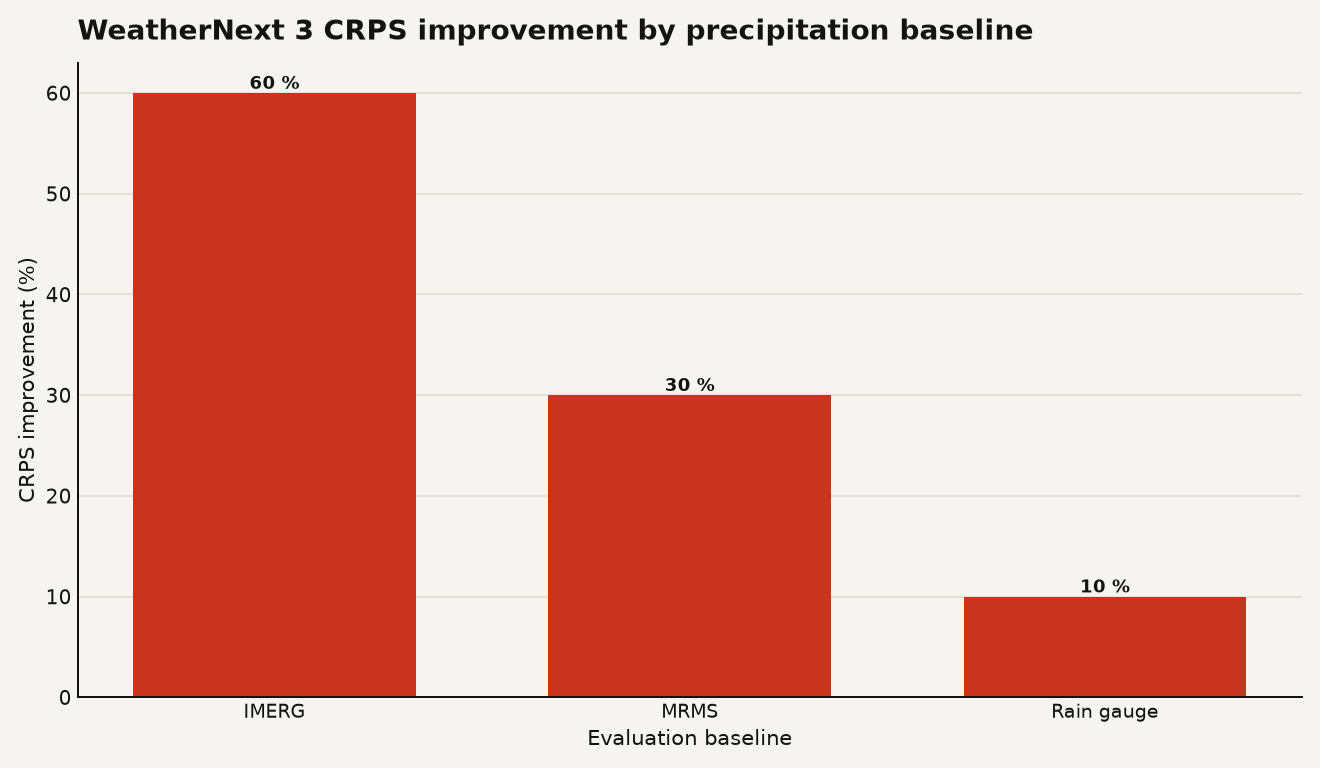
Google trained WeatherNext 3 on two high-quality precipitation sources: NASA's satellite-based Integrated Multi-satellite Retrievals for GPM, known as IMERG, and Google's own global precipitation reanalysis based on satellite radar. The results, evaluated against baselines, show a Continuous Ranked Probability Score improvement of up to 60 percent against IMERG observations, 30 percent against MRMS, and 10 percent against rain gauge measurements for early lead times. The Brier score, which measures the accuracy of probabilistic predictions, improved by up to 50 percent compared to NWP baselines when evaluated against IMERG.
For end users, Google says people will see up to 50 percent more accurate precipitation forecasts when planning a day or more ahead, with the greatest improvements in regions where forecasts have historically been less reliable. That last detail matters: Latin America, Africa, and Asia-Pacific have been underserved by high-resolution forecasting because traditional regional models require immense supercomputing resources. WeatherNext 3 brings 5km resolution to those regions at no marginal compute cost to local meteorological agencies.
The chart above shows the CRPS improvement percentages across the three evaluation baselines. The IMERG figure of 60 percent is the standout: it means the model's probabilistic precipitation forecasts are dramatically more accurate when measured against satellite-derived ground truth, which is the most globally complete precipitation dataset available.
A new access model for weather data
If you build anything that depends on weather data, the access model here is the real news. Google is making global weather predictions updated hourly available through BigQuery, Earth Engine, and Google Cloud Storage with no model setup required. That means you can query forecast data with SQL or bulk-download it for offline processing.
The clean energy variables are specifically engineered for renewable energy applications. The model forecasts 100-meter wind speeds at turbine height, full cloud layer distributions, and complete solar irradiance components including surface solar radiation downwards and direct normal irradiance. If you are building software for grid operators, solar farm operators, or wind energy traders, this is a data feed you previously had to license from specialized providers at significant cost.
Here is what changes for different builders:
- Agriculture tech teams: Hourly 5km temperature and moisture data means you can build frost-detection alerts or irrigation scheduling with spatial precision that was not available outside of paid regional models. The station-trained output matches what a physical sensor in the field would measure, not what a smoothed reanalysis grid estimates.
- Renewable energy developers: The 100-meter wind speed forecast and solar irradiance components let you model expected power output from wind and solar assets without maintaining a separate physical model. For a wind farm operator, the difference between 10km and 5km resolution in wind forecasting can translate to meaningful differences in turbine-level output predictions.
- Logistics and supply chain: Precipitation forecasting at 60 percent CRPS improvement against satellite ground truth means route planning and delivery ETAs can account for weather disruption with higher confidence. The hourly refresh cycle catches rapidly developing systems that six-hour models would miss entirely.
- Insurance and risk modeling: The 64-member ensemble gives you a probabilistic distribution of outcomes, not a single deterministic forecast. For catastrophe modeling and parametric insurance products, that distribution is the raw material your pricing models need.
Google also integrated WeatherNext 3 into the Google Maps Platform Weather API, so if you already use Maps Platform in your stack, weather data is available without a new vendor relationship.
Constraints to understand
The model is impressive, but there are constraints you should understand before building on it.
The hourly initialization cycle produces a 48-hour forecast horizon. If you need longer-range forecasts, the 6-hourly cycles extend to 15 days, but those carry the same temporal resolution as WeatherNext 2. The hourly detail is a short-range product. For applications that need both hourly granularity and a two-week horizon, you will need to blend the two cycle types yourself.
The 5km resolution applies specifically to station-trained variables: 2-meter temperature and dew point. Other surface variables like wind, pressure, sea surface temperature, cloud layers, and solar radiation fields run at 10km. Three-dimensional atmospheric pressure levels run at 25km and are only available in the 6-hourly cycles. If your application needs high-resolution upper-atmosphere data, WeatherNext 3 does not provide it.
Historical forecasts are available for 2026, and Google says data for 2024 and 2025 is being backfilled. For backtesting and model evaluation, that means you currently cannot run a full multi-year evaluation. If your use case requires historical weather data for training or validation, check the Earth Engine data catalog for the latest backfill status before committing.
Google's own disclaimer is worth noting: for official weather forecasts, severe weather warnings, and public safety advisories, refer to your local meteorological agency or national weather service. WeatherNext 3 is a research-grade model with strong benchmark numbers, but it has not replaced government weather services for emergency alerts.
Competitors are advancing their own AI weather models at a similar pace. The European Centre for Medium-Range Weather Forecasts has its own AI forecasting initiative, and NVIDIA's Earth-2 platform targets similar use cases. Google's advantage here is distribution: the data is already in BigQuery and Earth Engine, behind auth flows that most developers already have. The disadvantage is lock-in. If you build your entire weather pipeline on Google Cloud and the pricing model changes, you are dealing with a single-vendor dependency for a critical data feed.
For a parallel story on how AI models handle specialized benchmarking tasks, the hourly LLM benchmark variance research we covered shows why temporal granularity in model evaluation matters. The same principle applies here: a weather model that refreshes hourly is fundamentally different from one that refreshes every six hours, and the benchmarks need to reflect that.
The data is the moat
The model architecture is interesting. The resolution numbers are impressive. But the strategic move here is Google pulling live satellite data, station observations, IMERG, and its own radar reanalysis into a single pipeline and exposing it through infrastructure developers already use. The barrier to entry for building weather-dependent applications just dropped. The question is whether Google keeps this data accessible at a price that makes sense for startups and independent developers, or whether the pricing eventually reflects the value of having the best global weather model on the market. Watch the BigQuery pricing page.