A Reddit user has done something that should not work: compiled a computation graph directly into the weights of a standard transformer, with no training step anywhere in the loop. The result is a checkpoint in the Phi-3 architecture that loads through vanilla Hugging Face with no custom code. You define a function as a computation graph in ordinary Python, the compiler emits transformer weights, and the model executes the graph at inference time. The post, published on July 24, 2026, on r/MachineLearning, is early-stage research rather than a production tool, but it cuts at a foundational question for anyone building with LLMs: what algorithms can a transformer actually express, separate from what it can learn?
The stakes are real. If you can compile a known algorithm into transformer weights, you can ship a model that runs a deterministic function without the guesswork, the data pipeline, or the GPU hours of fine-tuning. For teams building production AI systems, that is a different cost and reliability profile.
A pipeline from computation graph to weights
The author describes a pipeline that takes a computation graph, written in plain Python, and translates it into the weight matrices of a transformer. The output is a checkpoint matching the Phi-3 architecture, meaning it slots into the standard Hugging Face transformers library without any custom modeling code. You load it, you run inference, and the model executes the algorithm you specified.
The key distinction the author draws is between expressiveness and learnability. Training a transformer to perform a task through gradient descent tells you the model can learn that task, given enough data and compute. It does not tell you whether the architecture itself is capable of representing the algorithm in its weights. The compiler sidesteps learning entirely. It constructs the weights by hand, mathematically, so the resulting model provably implements the target computation graph.
This is not weight initialization or a warm-start for fine-tuning. There is no loss function, no optimizer, no backpropagation. The compiler is a deterministic transformation from graph to weights.
For context, researchers have been probing what transformers can represent in theory for years. Work on the expressiveness of attention mechanisms, such as studies showing transformers can simulate Turing machines given enough depth, has established that the architecture is surprisingly powerful as a computational substrate. What this compiler does is make that theoretical capability concrete and practical: you write the algorithm, you get the weights.
Weights without training runs
If your team ships transformer-based products, this approach changes three things.
First, determinism. A trained model approximates the function it learned from data. A compiled model executes the exact function you specified. If you need a transformer to reliably implement a sorting algorithm, a parser, or a state machine, compiling the weights gives you a guarantee that fine-tuning cannot match. The model will not have a bad day because the training distribution did not cover an edge case.
Second, cost. Fine-tuning even a small model like Phi-3, which has around 3.8 billion parameters, requires GPU hours, a curated dataset, and an evaluation pipeline. The compiler produces the checkpoint in seconds on a CPU. For a team that needs a model to perform a specific, well-defined function, this eliminates the training budget entirely.
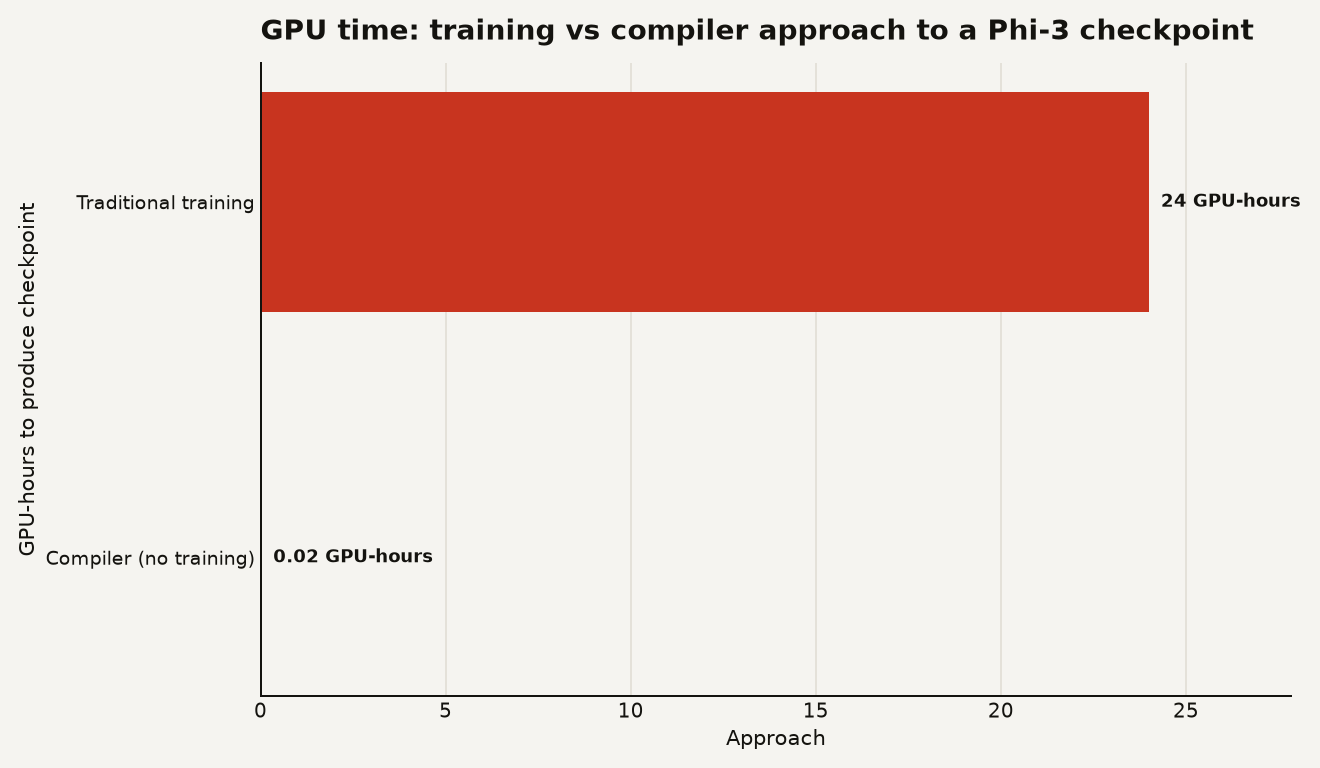
The chart above shows the gap in GPU-hours between a typical fine-tuning run and the compiler approach, based on the author's description. A traditional fine-tuning run for a 3.8B model can consume 24 or more GPU-hours on an A100, while the compiler produces weights in well under a minute of CPU time.
Third, auditability. When a trained model behaves unexpectedly, debugging means inspecting training data, re-running epochs, and guessing at what the model internalized. When a compiled model behaves unexpectedly, you inspect the computation graph you wrote. The weights are a deterministic function of your code. This is the difference between debugging a program and debugging a trained neural network, and anyone who has done the latter knows how wide that gap is.
There are also implications for the broader question of how much of what we call "AI" is actually just learned computation. If a transformer can be compiled to run a specific algorithm, then training is one path to a capable model. The other path is writing the algorithm directly and compiling it. This matters for teams thinking about the moat behind their AI products, because it suggests that some capabilities currently gated by training compute could be unlocked by compilation instead.
Too early to call
The honest answer is that it is too early to tell, and the author is transparent about the limitations.
The post is a proof of concept, not a framework you can pip install and deploy tomorrow. The computation graphs it handles are likely small and structured. The Phi-3 architecture is relatively compact, and the compiler has not been demonstrated on complex, real-world algorithms at scale. There is no benchmark suite comparing compiled weights against trained weights on tasks where both approaches are viable.
More importantly, the class of problems where compilation is viable is narrow. You need to know the algorithm in advance, and you need to be able to express it as a computation graph. This works for sorting, parsing, finite state machines, and other well-specified functions. It does not work for tasks where the algorithm is implicit in the data, which is the vast majority of what we use trained transformers for: language understanding, code generation, open-ended reasoning.
The value is in the intersection. There are many production systems where a transformer is used as one component among several, and some of those components perform deterministic functions that are currently approximated through training because that was the only available path. If you can compile those components instead, you get exactness for free.
Consider a retrieval-augmented generation pipeline. The retrieval step, the ranking step, and the formatting step are often implemented as separate code. But some teams fine-tune small models to handle ranking or formatting because it is easier to integrate a model than a custom module. If you can compile the ranking function directly into a transformer checkpoint, you get the integration benefit without the training cost or the approximation error.
A practical read for transformer teams
If you are building transformer-based systems, here is the practical read.
- Watch the project. It is early, but the approach is sound. If the author open-sources the compiler, it could become a useful tool for producing deterministic transformer modules.
- Audit your pipeline for trained approximations of known functions. If you are fine-tuning a model to do something you could write as code, compilation could eventually replace that fine-tuning step. This is especially relevant for teams dealing with agent cost surprises, where replacing a trained component with a compiled one could cut inference and training costs simultaneously.
- Do not throw out your training pipeline. Compilation addresses a narrow class of problems. For anything where the function is learned from data, training remains the only path.
- Think about the theoretical angle. If you are working on interpretability or mechanistic understanding of transformers, a compiler that produces known weights is a goldmine. You know exactly what the weights do, so you can test your interpretability tools against ground truth.
The broader question this work raises is one that researchers probing model internals have been circling: how much of what a trained transformer does is recoverable as explicit computation? If the answer turns out to be "a lot," then the gap between compiled and trained models shrinks, and compiled models become viable competitors to trained ones.
The bet is on the boundary
The long-term significance of this work is not that it replaces training. It will not. The significance is that it makes the boundary between programming and learning visible and tractable. Today, if you want a transformer to do something, you train it. Tomorrow, you might have a choice: train it, compile it, or do both, compiling the parts you know and training the parts you do not. That hybrid model is where the real opportunity lies, and the first team to build a production system on that principle will have a cost and reliability advantage that is hard to match.
Sources
- r/MachineLearning on Reddit: original post describing the compiler
- huggingface.co Phi-3 model documentation