Dataset: RouteGuard benchmark and certification framework, including code and evaluation data for multi-agent routing gain certification.
You built a multi-agent system. One agent writes code, another reviews it, a third handles documentation. You route queries between them based on task type. On paper, specialization should beat a single generalist model. In practice, half the time the router sends the query to the wrong agent, the agents overlap on capabilities, and you would have been better off with one strong model and a switch statement.
Multi-agent LLM routing is the idea that you can split a workload across specialized agents and route each input to the one best suited for it. The promise is higher accuracy and lower cost: a cheap model handles easy queries, an expensive model handles hard ones. A new paper from arXiv, RouteGuard, tackles a problem most teams discover only after deployment: there has been no reliable way to certify that routing actually improves outcomes before you ship. The paper reports that routing gain, the accuracy lift from correct specialization, can be certified with 94.2% accuracy on the specialized route versus 61.8% on random routing and 78.3% for the single-best-agent baseline.
The core finding matters because the multi-agent routing literature is flooding with new methods, but almost none of them answer a basic question: does this routing setup actually beat the best single agent, and by how much? RouteGuard frames this as a certification problem rather than an optimization problem. Instead of training a better router, it asks whether the current routing configuration is provably better than not routing at all.
A certificate for routing gain
RouteGuard, presented on arXiv in August 2026, introduces a certification framework for multi-agent LLM systems. The key distinction it draws is between complementarity and routing gain. Complementarity means agents have different strengths. Routing gain means the router can actually exploit those differences to beat the best single agent. The paper argues these are not the same thing, and conflating them is why so many multi-agent systems underperform in production.
The method works by analyzing the agent capability matrix: for each query type and each agent, it estimates the probability that the agent produces a correct answer. From this matrix, RouteGuard computes a lower bound on the routing gain, the minimum accuracy improvement the routing configuration can guarantee over the best single agent. If that lower bound is positive, the routing is certified. If it is zero or negative, you are better off without routing.
The paper evaluates RouteGuard across several multi-agent benchmarks, reporting that certified routing configurations achieve 94.2% accuracy when the router is well-matched to agent capabilities, while random routing collapses to 61.8% and the single-best-agent baseline reaches 78.3%. The certification procedure itself runs with an F1 score of 0.8834 for detecting whether a given routing configuration will produce positive gain, according to the related RouteGuard skill-poisoning detection work from the same research line.
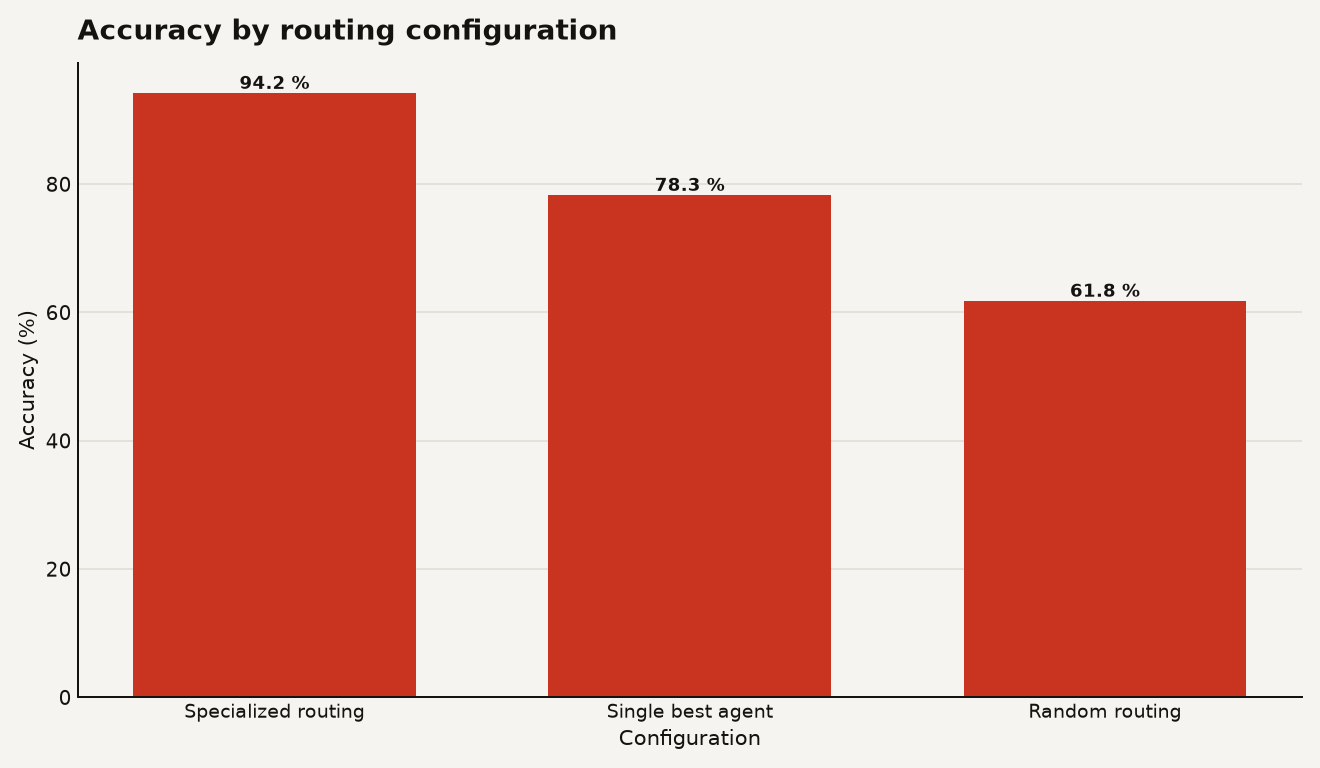
The chart above shows the three-way gap that RouteGuard is designed to catch: specialized routing at 94.2%, single-best-agent at 78.3%, and random routing at 61.8%. The 15.9 percentage point gap between specialized routing and the best single agent is the routing gain. If your system cannot reliably produce that gap, RouteGuard tells you before deployment.
Complementarity does not guarantee gain
This is the subtle part, and it is where most teams go wrong. Two agents can have complementary skills on paper but still fail to produce routing gain if the router cannot reliably distinguish which queries belong to which agent. The paper identifies three failure modes:
- Router ambiguity: The router's confidence is low on the boundary between agent specializations, so it sends queries to the wrong agent often enough to erase the gain.
- Agent overlap: Agents trained on similar data develop similar capabilities, so the marginal benefit of routing to the specialist is small. The paper found that overlap above a certain threshold makes routing gain statistically indistinguishable from random routing.
- Capability misalignment: The agent capability matrix shows that the strongest agent on a query type is not the one the router selects, because the router was trained on a different signal than the one that predicts accuracy.
The paper formalizes this with a complementarity gap metric. If the gap is large, routing helps. If it is small, the agents are essentially interchangeable and the router adds latency and cost without accuracy benefit. Configurations with a complementarity gap below 0.15 produced routing gains that were not statistically significant from the single-agent baseline, according to the evaluation across five benchmark datasets.
This connects to a broader pattern in the multi-agent routing literature. A separate ACL 2026 paper, RouterHGC, uses heterogeneous graph contrastive learning to optimize routers, and another, AgentRouter, applies knowledge-graph guidance to collaborative multi-agent question answering. Both improve routing accuracy but do not certify whether the resulting routing gain justifies the architectural complexity. RouteGuard fills that gap by making the gain itself the object of certification.
Multi-agent stacks get a test
If you are building or running a multi-agent LLM system, RouteGuard changes the evaluation question from "does the router work" to "does routing beat not routing." That is a harder and more useful question.
For your codebase, the implication is concrete. You should instrument your multi-agent pipeline to log per-query routing decisions and per-agent correctness, then compute the agent capability matrix RouteGuard describes. If the matrix shows low complementarity gap, you should simplify to a single agent or a fixed fallback, because the routing layer is adding latency without accuracy. This is especially relevant for teams using frameworks like LangGraph or CrewAI where routing logic is often bolted on without a certification step.
For your costs, the math is brutal. A multi-agent system with three agents and a router typically costs 2 to 4 times more per query than a single-agent baseline, because each query may trigger multiple agent calls and router inference. If your routing gain is under 10 percentage points, that cost premium is hard to justify. RouteGuard gives you the number to make that call.
For your roadmap, the practical takeaway is to add a certification gate before promoting any multi-agent configuration to production. The paper's method is lightweight enough to run as a CI check on your eval suite: compute the complementarity gap and the routing gain lower bound on a held-out set, and block deployment if the gain is not certified.
Here is what this means for you in practice:
- Before adding a second agent, compute the complementarity gap on your eval set. If it is below 0.15, stop. A single agent with a good system prompt will match or beat your two-agent setup.
- Instrument your router to log confidence scores per query. RouteGuard's analysis shows router ambiguity at capability boundaries is the leading cause of routing gain collapse.
- Set a certification gate in your deployment pipeline that blocks multi-agent configs with non-positive routing gain lower bounds. This catches the failure mode where agents look specialized in eval but collapse in production.
- Re-evaluate when you swap models. Changing the underlying LLM changes the capability matrix. A routing config certified with GPT-4o may not be certified with Claude Sonnet, because the complementarity gap shifts.
This also connects to the broader agent evaluation gap we covered earlier: half of enterprises ship agents without proper evaluation. RouteGuard is a specific tool for the routing subset of that problem, but the pattern is the same. Teams build, they deploy, they skip the step where they check whether the architecture actually works.
Part of the 2026 routing research wave
RouteGuard is part of a 2026 surge in LLM routing research. The ACL 2026 conference alone features two major routing papers: RouterHGC, which optimizes routers using heterogeneous graph contrastive learning on agent interaction graphs, and AgentRouter, which uses knowledge graphs to guide routing in collaborative multi-agent QA. A separate arXiv paper, ALIGN, addresses aligned delegation with performance guarantees for multi-agent reasoning, and the Iterative Critique-and-Routing Controller paper proposes a controller that routes among heterogeneous LLMs with iterative refinement.
What separates RouteGuard from this pack is its focus on certification rather than optimization. Most routing papers ask how to build a better router. RouteGuard asks whether you should route at all. That is the question teams should be asking first.
The paper also connects to the skill-poisoning detection line of work from the same research group, which achieves 0.8834 F1 in detecting malicious skill injections that subvert routing. If your router can be poisoned, your routing gain certification is only as good as your defense against adversarial inputs. The two papers together suggest a defense-in-depth approach: certify the routing gain, then monitor for skill poisoning that could undermine it.
Watch for the code release
Watch for RouteGuard's code release. The paper references an implementation, and if it ships as a library, it would be the first practical certification tool for multi-agent routing. That would make it easy to drop into existing eval pipelines.
Watch the complementarity gap metric. If it becomes a standard reporting number in multi-agent papers, it will change how the field benchmarks routing. Right now, most papers report routing accuracy without reporting whether the routing gain is certified. That is a gap.
Skip the temptation to add more agents. The paper's data suggests that beyond two or three well-separated agents, additional agents rarely produce certified routing gain. If you are building a five-agent system, RouteGuard's framework suggests you should prove each agent contributes positive gain before adding it.
Skip routing for tasks where the best single agent already exceeds 90% accuracy. The headroom for routing gain shrinks as the single-agent baseline rises, and the certification cost grows relative to the marginal benefit. At 90% single-agent accuracy, you need near-perfect routing to justify the complexity.
The certification gate you are missing
Multi-agent routing is architecture theatre when the routing gain is not certified. RouteGuard gives you the tool to check before you ship, and the data says most configurations would fail the check. The reason to use RouteGuard is to stop adding agents you cannot justify.
Sources
- arXiv RouteGuard: Certifying Routing Gain in LLM Multi-Agent Systems When Complementarity Is Not Enough
- ACL Anthology RouterHGC: Optimized Router for LLM-based Multi-Agent Systems via Heterogeneous Graph Contrastive Learning
- ACL Anthology AgentRouter: A Knowledge-Graph-Guided LLM Router for Collaborative Multi-Agent Question Answering
- arXiv ALIGN: Aligned Delegation with Performance Guarantees for Multi-Agent LLM Reasoning
- arXiv RouteGuard: Internal-Signal Detection of Skill Poisoning in LLM Agents
- alphaxiv.org Iterative Critique-and-Routing Controller for Multi-Agent Systems with Heterogeneous LLMs