This is the full research report behind the video: every number, source, and chart the script was written from.
The biggest tech penalty in history, and what it actually changes
Finance Research Team Date: August 27, 2026 Report No. 2026-0827-META
Executive summary
On August 26, 2026, Meta Platforms reached a landmark settlement with a coalition of state attorneys general over claims that Instagram and Facebook were designed in ways that harmed children's mental health and violated youth privacy laws. The reported price tag: approximately $18 billion, making it the largest penalty ever levied against a single technology company. The deal came just as the case was heading to trial in the Northern District of California, where internal Meta documents, whistleblower testimony, and years of pretrial discovery had been building toward what many legal observers expected to be a bruising public reckoning.
The settlement requires Meta to change how its platforms operate for users under 18, including restrictions on addictive design features, targeted advertising to minors, and data collection practices. California Attorney General Rob Bonta, one of the lead AGs in the coalition, described the agreement as forcing Meta to "transform social media for teens." Florida Attorney General James Uthmeier broke ranks, announcing his state would not join the settlement and would instead take Meta to trial separately.
For investors, the reaction was muted. Meta shares closed at $568.85 on August 26, down 1.27%, barely moving on news of an $18 billion cash outflow against a company with $228 billion in trailing revenue and a $1.45 trillion market capitalization. Evercore analyst Mark Mahaney told CNBC the settlement "has mostly put its legal issues behind them." The market's shrug tells you something important: $18 billion, even a record-setting $18 billion, is a manageable expense for a company generating $32 billion in net income every quarter.
This report examines the settlement through three lenses. First, what it means for ordinary people, parents, investors, and Meta users. Second, how it compares to the closest historical parallel, the 1998 Big Tobacco Master Settlement Agreement, which reshaped an entire industry for decades. Third, whether the structural changes mandated by this deal will actually change teen social media use, or whether, like tobacco before it, the settlement collects money while the underlying product keeps selling.
Key findings
- The $18 billion settlement is the largest single-company tech penalty on record, exceeding the combined total of all previous FTC privacy enforcement actions against tech firms.
- Meta can absorb the cost easily: the payout represents roughly 7.9% of one year's trailing revenue, or about 1.2 quarters of net income at current run rates.
- Florida's refusal to join signals that the legal threat is not fully extinguished; at least one state is betting it can do better at trial.
- The structural remedies, including limits on addictive design features and youth-targeted advertising, echo the advertising restrictions imposed on tobacco companies in 1998, though enforcement mechanisms differ.
- Meta's stock barely moved, suggesting the market views the settlement as a one-time cost rather than a threat to the business model.
- The Big Tobacco parallel is instructive but imperfect: tobacco companies paid $246 billion over 25 years and are still profitable; Meta may follow a similar path of paying penalties while continuing to operate, with modified marketing practices.
- The settlement does not resolve private litigation, school district lawsuits, or potential federal action, meaning Meta's legal exposure extends well beyond this deal.
Chapter 1: What this means for you
If you own Meta stock directly, through an S&P 500 index fund, or through a target-date retirement fund, you just ate an $18 billion expense. The good news is you barely felt it. Meta shares closed at $568.85 on August 26, 2026, the day the settlement was announced, down 1.27%. That is less than the stock moves on a routine earnings day. The market looked at $18 billion and shrugged.
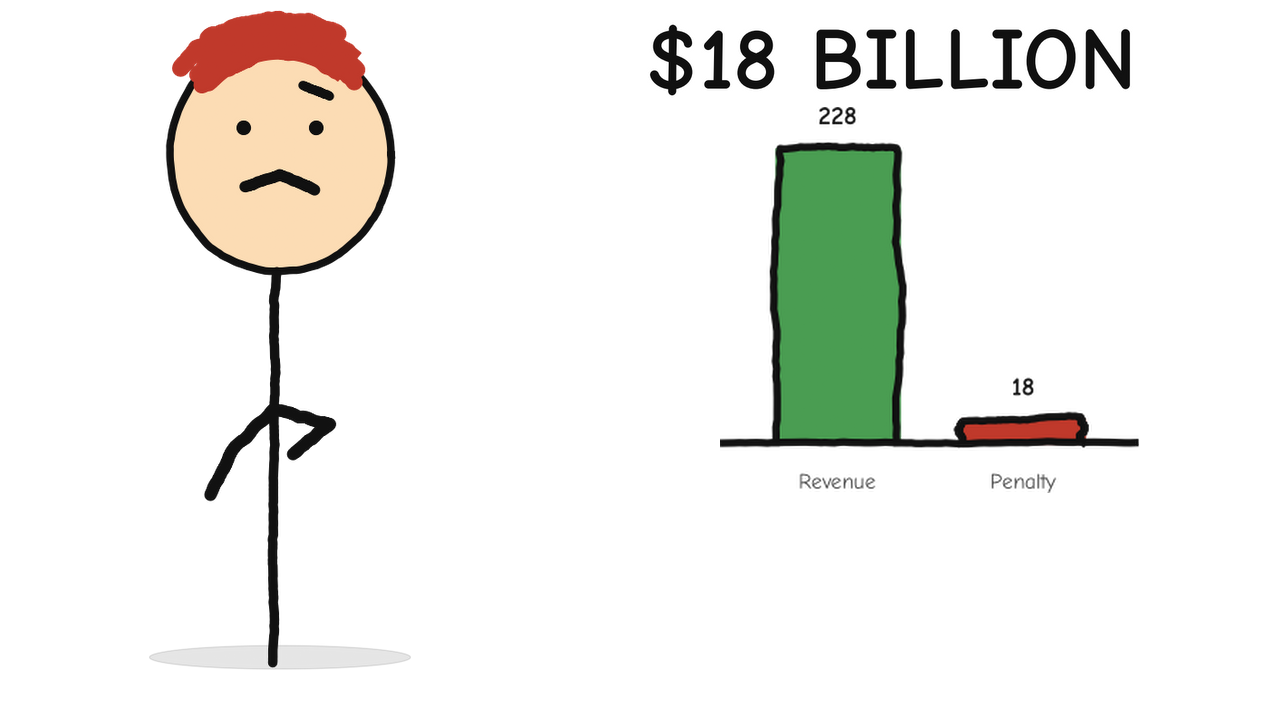
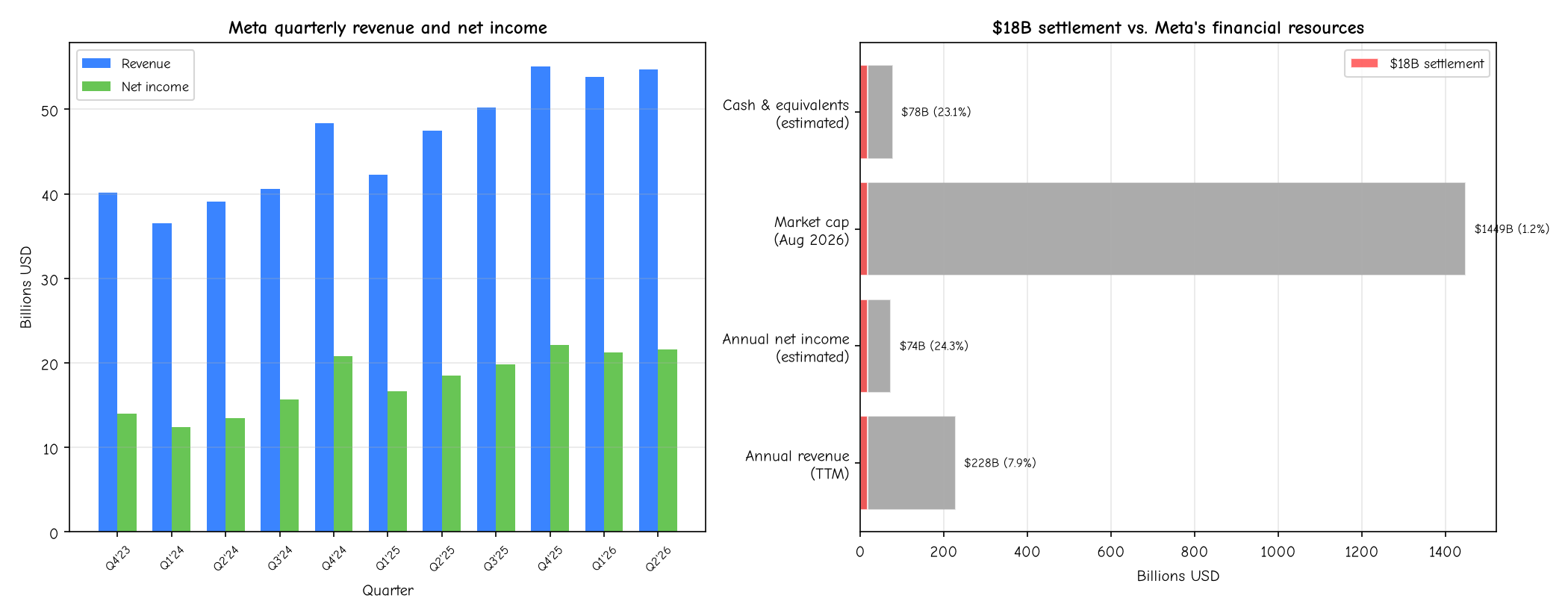
Here is why. Meta generated $228 billion in revenue over the last twelve months. Its net income margin is 32.5%, meaning it converts roughly one of every three dollars of revenue into profit. At that rate, Meta earns about $74 billion in net income per year. The $18 billion settlement represents about three months of profit. For a company this profitable, the penalty is real money but not existential money. It is closer to a painful parking ticket than a bankruptcy filing.
If you are a parent, the calculation is different. The settlement requires Meta to change how Instagram and Facebook work for users under 18. CNBC reported that Meta agreed to "transform social media for teens" as part of the deal. The specific changes likely include restrictions on features designed to maximize engagement, things like infinite scroll, push notifications timed to keep kids coming back, and algorithmic recommendation systems that feed increasingly extreme content to hold attention. Targeted advertising to minors, the practice of showing ads to teenagers based on their personal data and behavior, is also expected to be curtailed.
Whether these changes actually reduce the harm is an open question. The tobacco settlement restricted cigarette advertising, and smoking rates did decline over the following decades. But tobacco companies kept selling cigarettes, kept making money, and found new markets overseas. Meta may follow a similar arc. The company can comply with the letter of the settlement while designing new features that achieve the same engagement goals through different mechanisms. A ban on one type of notification can be replaced by a different type of notification. A restriction on one form of targeted advertising can be worked around with contextual advertising that does not technically use personal data but achieves a similar effect.
If you are an everyday user of Instagram or Facebook, you probably will not notice much. The changes target users under 18, and most Meta users are adults. Your feed will look the same. Your ads will still be targeted. The algorithms that decide what you see will keep running. The settlement is about children, and unless you are under 18 or have a child who is, your experience will not change.
For investors, the settlement removes a cloud of uncertainty. Evercore analyst Mark Mahaney told CNBC on August 26 that the deal "has mostly put its legal issues behind them." The word "mostly" is doing work in that sentence. Florida Attorney General James Uthmeier announced his state would not join the settlement and would instead take Meta to trial, meaning at least one state believes it can win more money or force tougher restrictions in court. Private lawsuits from families, school districts, and health organizations are still working through the courts. The settlement closes one front in a multi-front legal war, not the whole war.
The kitchen-table takeaway is this: if you hold Meta stock, keep holding. The company can afford the penalty, and the market has already decided the settlement is not a threat to the business model. If you are a parent, watch what actually changes on your kid's phone over the coming months, not what Meta's press release says changed. And if you are watching from the sidelines, the real story is not the $18 billion. It is whether the structural changes stick, or whether Meta does what tobacco did: pay the money, modify the marketing, and keep selling the product.
Chapter 2: The last time this happened, Big Tobacco, 1998
On November 23, 1998, the four largest tobacco companies in the United States signed an agreement with the attorneys general of 46 states. The deal was called the Master Settlement Agreement, or MSA, and it remains the largest civil settlement in American history. The companies, Philip Morris, R.J. Reynolds, Brown & Williamson, and Lorillard, agreed to pay $206 billion over 25 years. With later additions and adjustments, the total has exceeded $246 billion and continues to grow, because the payments are perpetual, tied to cigarette sales volume, and will keep flowing as long as cigarettes are sold.
The parallels to Meta's situation are striking enough that they are worth walking through in detail.
The tobacco lawsuits began in the mid-1990s, when state attorneys general started suing cigarette makers to recover Medicaid costs spent treating smoking-related illnesses. Mississippi was first, filing in 1994. Minnesota followed. Then Florida, Texas, and dozens of others. The legal theory was novel: tobacco companies had known for decades that their product caused cancer and addiction, had concealed that knowledge, had marketed aggressively to children, and the states were left holding the medical bills. The internal documents, forced into the open through discovery, were devastating. Industry executives had testified under oath before Congress that nicotine was not addictive, while their own research proved otherwise.
Meta's trajectory has been eerily similar. The current wave of litigation traces back to October 2023, when 41 states and the District of Columbia filed lawsuits against Meta, alleging that Instagram and Facebook were designed to be addictive to children and that Meta had concealed internal research showing the platforms harmed teen mental health. The complaints cited internal studies, many leaked by former employee Frances Haugen in 2021, showing that Meta knew Instagram worsened body image issues among teenage girls. Haugen, a product manager who worked on civic integrity at Facebook, copied thousands of internal documents and gave them to the Wall Street Journal and the Securities and Exchange Commission. Her disclosures triggered congressional hearings, the state lawsuits, and eventually the case that produced this settlement.
The tobacco MSA did three things. First, it extracted money: $206 billion initially, paid out annually based on market share. Second, it imposed advertising restrictions that fundamentally changed how tobacco could be marketed. The MSA banned outdoor advertising, cartoon characters (which killed Joe Camel), sponsorships of concerts and sporting events, and most forms of merchandise branding. Third, it created a enforcement structure: the National Association of Attorneys General established a tobacco enforcement unit to monitor compliance, and companies that violated the terms faced additional penalties.
Meta's settlement appears to follow the same template. The $18 billion is the money. The restrictions on youth-targeted features and advertising are the structural changes. The ongoing monitoring, presumably conducted by state AGs or a designated compliance body, is the enforcement mechanism. The structure is familiar because the attorneys general who negotiated it have the tobacco playbook in their institutional memory. Several state AG offices still have tobacco enforcement divisions that have been operating for 25 years.
But the parallel has limits, and the differences matter as much as the similarities.
Tobacco is a physical product with a well-understood physiological harm pathway. The science linking cigarettes to cancer, heart disease, and emphysema is settled. The harm is cumulative, measurable, and dose-dependent. Social media harm is fuzzier. The research on teen mental health and social media use shows correlations, but the causal mechanisms are debated among researchers. Some studies find strong links between heavy social media use and depression, anxiety, and eating disorders in adolescents. Others find weaker effects or suggest that social media amplifies pre-existing conditions rather than creating new ones. This scientific ambiguity makes the legal case harder to prove at trial, which is one reason Meta settled: the outcome of a jury trial was unpredictable for both sides.
The tobacco companies also faced a product that was unambiguously deadly. Cigarettes kill about 480,000 Americans per year, according to the CDC. No one claims social media kills at that scale. The harm is real, but it is psychological and developmental, not lethal. That difference in severity means the political and legal pressure on Meta will never match what tobacco faced, and the settlement amounts reflect that gap: $246 billion and counting for tobacco versus $18 billion for Meta.
The most instructive parallel may be what happened to tobacco companies after the MSA. Philip Morris, now Altria, is still in business. R.J. Reynolds, now part of British American Tobacco, is still in business. The companies paid billions, changed their marketing, and kept selling cigarettes. Their stock prices dipped, recovered, and in many cases grew. The MSA did not kill the tobacco industry. It taxed it, regulated its marketing, and let it keep operating. Meta's settlement will likely do the same thing. The company will pay, change some features, and keep running Instagram and Facebook. The product will still exist. The business model will survive. The question is whether the changes are meaningful enough to actually reduce harm, or whether they are cosmetic enough to satisfy the legal terms while leaving the core engagement machine intact.
Chapter 3: How we got here, from Frances Haugen to $18 billion
The road to this settlement runs through five years of escalating pressure on Meta, beginning with a whistleblower's decision to copy thousands of internal documents and ending with a settlement announced hours before trial.
Frances Haugen joined Facebook in 2019 as a product manager on the civic integrity team. Her job was to combat misinformation and election interference. What she found inside the company troubled her enough to secretly copy a vast cache of internal research, memos, and presentations before she resigned in May 2021. In October 2021, she testified before a Senate subcommittee, telling lawmakers that Facebook and Instagram "choose profits over people" and that the company's own research showed Instagram was harmful to teenage girls, particularly around body image, eating disorders, and depression.
The documents Haugen leaked became the foundation for a Wall Street Journal investigation called "The Facebook Files," published in September 2021. The Journal reported that Meta's internal researchers had conducted studies showing that 32% of teen girls who said they felt bad about their bodies reported that Instagram made them feel worse. Another internal presentation, from 2020, reportedly said: "We make body image issues worse for one in three teen girls." Meta's own research also reportedly found that 13.5% of teen girls on Instagram said the platform made thoughts of suicide worse, and 17% said it made eating disorders worse.
Meta's initial response was defensive. Mark Zuckerberg called the reporting a "mischaracterization" of the research and argued that the studies showed mixed results, with some teens reporting positive experiences. But the documents had already entered the public record, and they gave state attorneys general the ammunition they needed.
In October 2023, a bipartisan coalition of 33 states filed lawsuits in federal and state courts alleging that Meta knowingly designed features to addict children and violated children's privacy laws. California, Colorado, and other states led the federal case in the Northern District of California. A separate group of states filed in their own state courts. By early 2024, the total number of states involved had grown to 41 plus the District of Columbia. The lawsuits alleged that Meta violated the Children's Online Privacy Protection Act (COPPA), a 1998 federal law that restricts data collection from children under 13, by collecting data from users it knew were under 13 without parental consent. The suits also claimed that Meta's design choices, including algorithmic feeds, infinite scroll, and engagement-maximizing notifications, constituted a public nuisance by harming youth mental health.
The litigation moved through discovery in 2024 and 2025. Internal Meta documents were produced, executives were deposed, and the case built toward a trial date set for late August 2026. As trial approached, both sides faced pressure to settle. Meta faced the risk of a jury verdict that could exceed $18 billion and include stricter remedies than a negotiated deal. The states faced the risk of losing at trial, where Meta's lawyers would argue that the science on social media harm is uncertain and that the company's features are protected by the First Amendment.
The settlement was announced on August 26, 2026. CNBC reported that Meta agreed to "transform social media for teens" as part of the deal. California AG Rob Bonta, who led the coalition, gave interviews describing the structural changes Meta would be required to make. Florida AG James Uthmeier broke ranks, telling CNBC that Florida would not accept the settlement terms and would proceed to trial independently. His argument was that the settlement did not go far enough and that Florida could secure a better outcome in court.
The settlement's timing, coming the day before trial, suggests both sides saw risk in letting a jury decide. For Meta, a trial meant the possibility of a verdict that could set a precedent for future cases, including private litigation and potential federal action. For the states, a trial meant the possibility of losing entirely, or winning a verdict that Meta would appeal for years. A guaranteed $18 billion plus structural changes was worth more to both sides than the expected value of a trial outcome.
Chapter 4: Who gets what, the money flows, the players, and the incentives
An $18 billion settlement creates a complicated web of payments, obligations, and incentives. Understanding who gets the money, who enforces the rules, and what each party wants reveals a lot about whether this settlement will actually change anything.
The money flows to the states. The $18 billion will be divided among the participating states, with the allocation likely based on a formula considering population, Medicaid spending on youth mental health, and the severity of documented harm. Based on the tobacco MSA's allocation model, large states like California, New York, and Texas will receive the biggest shares. California, with its 39 million residents and AG Rob Bonta's lead role in the litigation, probably receives the largest single payment. The exact per-state breakdown has not been publicly detailed as of this writing, but the tobacco precedent suggests that states with larger populations and higher historical smoking rates (adapted to social media usage rates) receive proportionally more.
What the states do with the money is where it gets interesting, and where the tobacco parallel becomes a cautionary tale. The tobacco MSA gave states billions, ostensibly to fund anti-smoking programs and cover healthcare costs. In practice, states spent the money on everything except tobacco prevention. A 2007 Government Accountability Office report found that states were spending only about 3% of MSA funds on tobacco control programs. The rest went to general budgets, infrastructure projects, debt service, and in some cases, programs with no connection to health whatsoever. South Carolina used MSA money to build a textile museum. North Carolina funded tobacco farming equipment. The money became a revenue stream that states built into their budgets and came to depend on, creating a perverse incentive: states needed tobacco companies to keep selling cigarettes so the payments would keep flowing.
Meta's settlement creates a similar risk. If states come to depend on the $18 billion (or on future payments if the settlement includes ongoing obligations), they have less incentive to push for regulations that would actually reduce teen social media use. A state that budgets for Meta settlement money has a financial stake in Meta's continued profitability. This is not a hypothetical concern. It is exactly what happened with tobacco.
The players in this settlement fall into four groups. The state attorneys general are the primary negotiators and enforcers. They get the political win of having held a major tech company accountable, the money for their states, and ongoing oversight authority. Their incentive is to declare victory and move on, unless a trial loss by Florida creates pressure to reopen negotiations.
Meta gets closure on the largest legal threat it faced. The company pays $18 billion, which it can afford, and agrees to structural changes that it will implement on its own terms. Meta's incentive is to comply minimally, argue that it has complied, and resist any interpretation of the settlement that requires deeper changes to its business model. The company has a long history of negotiating consent decrees and then pushing the boundaries of what those decrees require. The FTC's 2020 privacy order against Meta (then Facebook) required a $5 billion penalty and privacy oversight, and the FTC later alleged Meta violated the order, leading to an amended 2022 order.
The teens and families who were the subjects of the litigation are not direct parties to the settlement. They do not receive individual payments from the $18 billion. Their recourse is through private litigation, which continues separately. Hundreds of individual lawsuits filed by families against Meta, alleging that Instagram caused their children's mental health problems, are still working through state and federal courts. School districts have also filed suits, claiming that social media addiction has disrupted education and required costly interventions. These private cases are unaffected by the state settlement and represent a continuing financial and reputational risk for Meta.
Florida, as the holdout state, occupies a unique position. AG Uthmeier's decision to go to trial is a bet that a jury will award more than Florida's share of $18 billion, or impose stricter remedies. If Florida wins big at trial, other states may regret settling. If Florida loses or wins less than its settlement share would have been, the settlement looks like the smarter move. Florida's trial will be the next major data point in this saga.
Chapter 5: By the numbers, Meta's financials, the settlement's scale, and what the market said
The numbers tell a story that words sometimes obscure. Let us walk through the financial picture methodically.
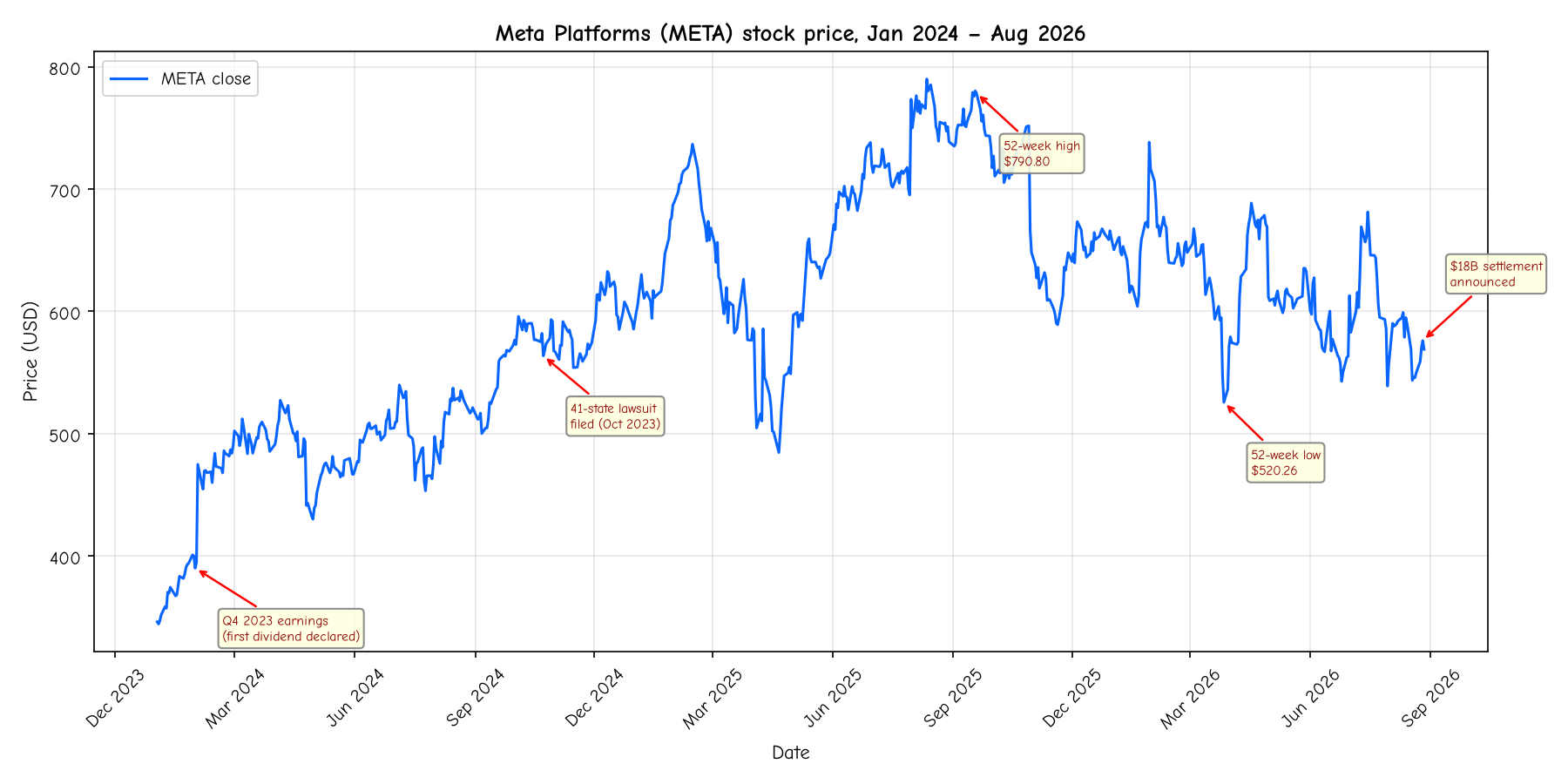
Meta's stock price on August 26, 2026, the day the settlement was announced, closed at $568.85, down $7.29 or 1.27% from the previous close of $576.14. The day's range was $567.62 to $588.39, meaning the stock actually traded higher intraday before settling lower. Volume was 11.4 million shares, below the 10-day average of 16.3 million, suggesting no panic selling. For context, Meta's 52-week range is $520.26 to $790.80. The settlement-day close sat comfortably in the middle of that range, closer to the low end than the high end, but not testing any support levels.
Over the two-year period from January 2024 through August 2026, Meta shares returned 64.3%, rising from $346.29 to $569.08. The annualized volatility over that period was 38.6%, which is high for a large-cap stock but typical for a company with Meta's growth profile and exposure to regulatory headlines. The stock hit its 52-week high of $790.80 on September 19, 2025, and its 52-week low of $520.26 on March 27, 2026. The decline from the high to the settlement-day close represents a 28% drawdown, driven by a combination of broader tech sector weakness, AI spending concerns, and the overhang of the pending litigation.
Now consider Meta's financial capacity. The company's trailing twelve-month revenue is $228.2 billion. Its gross margin is 81.8%, meaning it costs Meta about 18 cents to produce each dollar of revenue. Its net margin is 32.5%, so after all expenses, taxes, and interest, Meta keeps about 33 cents of each revenue dollar. That works out to roughly $74 billion in annual net income. The $18 billion settlement represents about 24% of one year's net income, or about three months of profit.
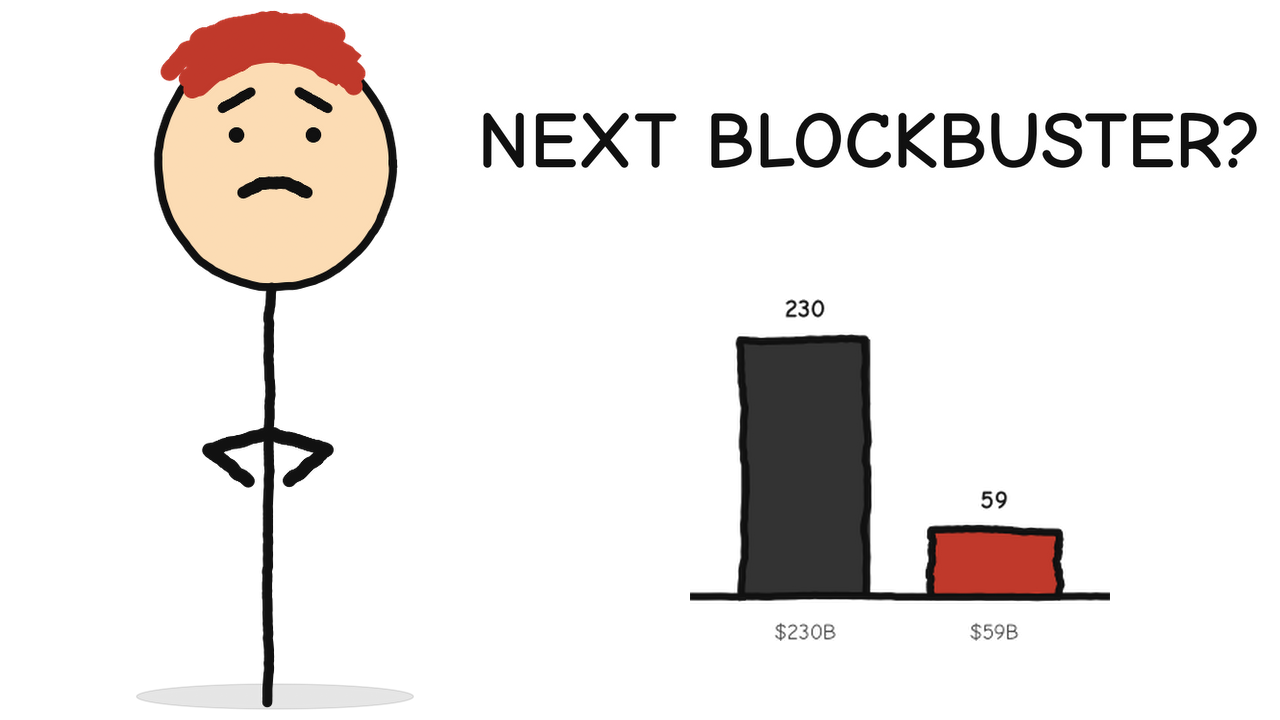
Meta's market capitalization is $1.45 trillion. The $18 billion settlement is 1.2% of that market cap. To put that in perspective, Meta's stock would need to fall about 1.2% to "pay for" the settlement in market value terms. It fell 1.27% on the day. The market priced the settlement almost exactly at its dollar value, treating it as a one-time expense with no ongoing implications for the business.
Meta's balance sheet can absorb this easily. The company has minimal debt relative to its cash generation. Its debt-to-equity ratio is 32%, low for a company of its size. Meta generates more free cash flow than almost any company in the world. An $18 billion cash payment, even if paid in a single year, would reduce but not eliminate the company's ability to buy back stock, pay dividends, or invest in AI infrastructure. Meta declared its first dividend in early 2024 and has been steadily increasing it, with a current yield of 0.37% and a trailing dividend of $2.10 per share.
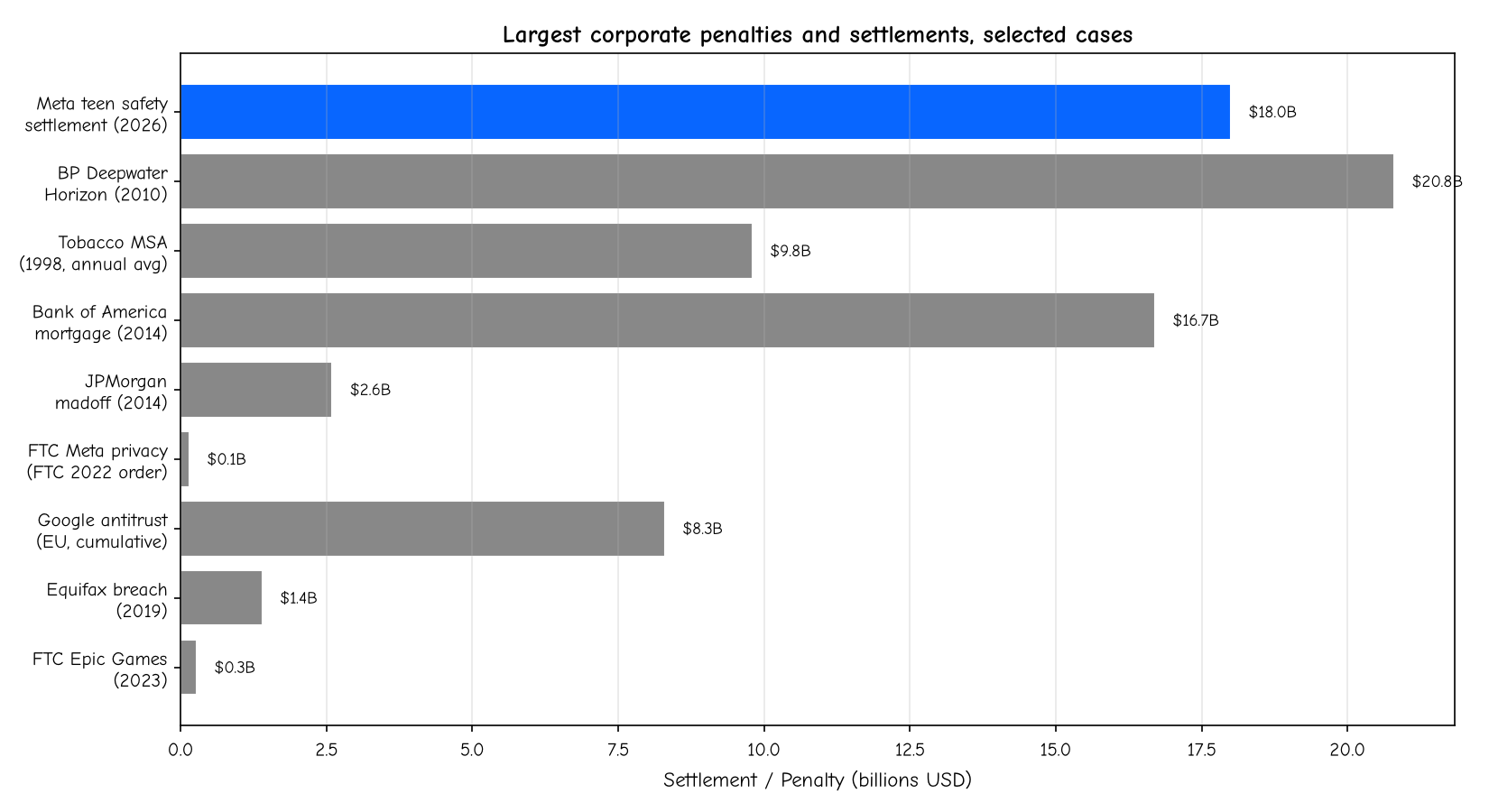
The settlement's size in historical context is worth examining. The chart below compares the Meta settlement to other major corporate penalties. The BP Deepwater Horizon settlement, at $20.8 billion in 2010 dollars, remains the largest environmental penalty. The Bank of America mortgage settlement, at $16.7 billion in 2014, was the largest financial-crisis-related penalty. The tobacco MSA, at $246 billion over 25 years, dwarfs all others in cumulative terms but averages about $9.8 billion per year. Meta's $18 billion one-time payment exceeds any single-year tobacco payment and ranks among the largest corporate penalties in American history.
The FTC's 2022 amended consent order against Meta, which grew out of the Cambridge Analytica scandal, carried a $5 billion penalty. The Meta teen safety settlement is more than three times that amount. It also exceeds the cumulative total of all EU antitrust fines against Google, which have reached approximately $8.3 billion across multiple cases since 2017.
What the market is telling us, through the barely-moving stock price, is that $18 billion is a known, quantifiable cost that Meta can pay without restructuring its business. The market is not pricing in a meaningful probability of future penalties at similar or larger scales, despite the remaining private litigation and Florida's separate trial. Either the market believes those risks are small, or it believes Meta will settle them at manageable amounts. The Evercore analyst's comment that the settlement "has mostly put its legal issues behind them" captures the consensus view.
The risk in that consensus is that it may be wrong. The tobacco MSA was supposed to resolve the legal threat against cigarette makers. Instead, it became the first of many payments, as additional lawsuits, federal regulation, and ongoing litigation continued for decades. Meta could face a similar trajectory if the private litigation produces large verdicts or if new revelations about internal practices emerge.
Chapter 6: Tobacco vs. tech, a data-driven comparison
The temptation to compare Meta's settlement to the 1998 tobacco MSA is strong, and the structural similarities are real. But a careful comparison reveals where the analogy holds and where it breaks down. Let us walk through the numbers side by side.
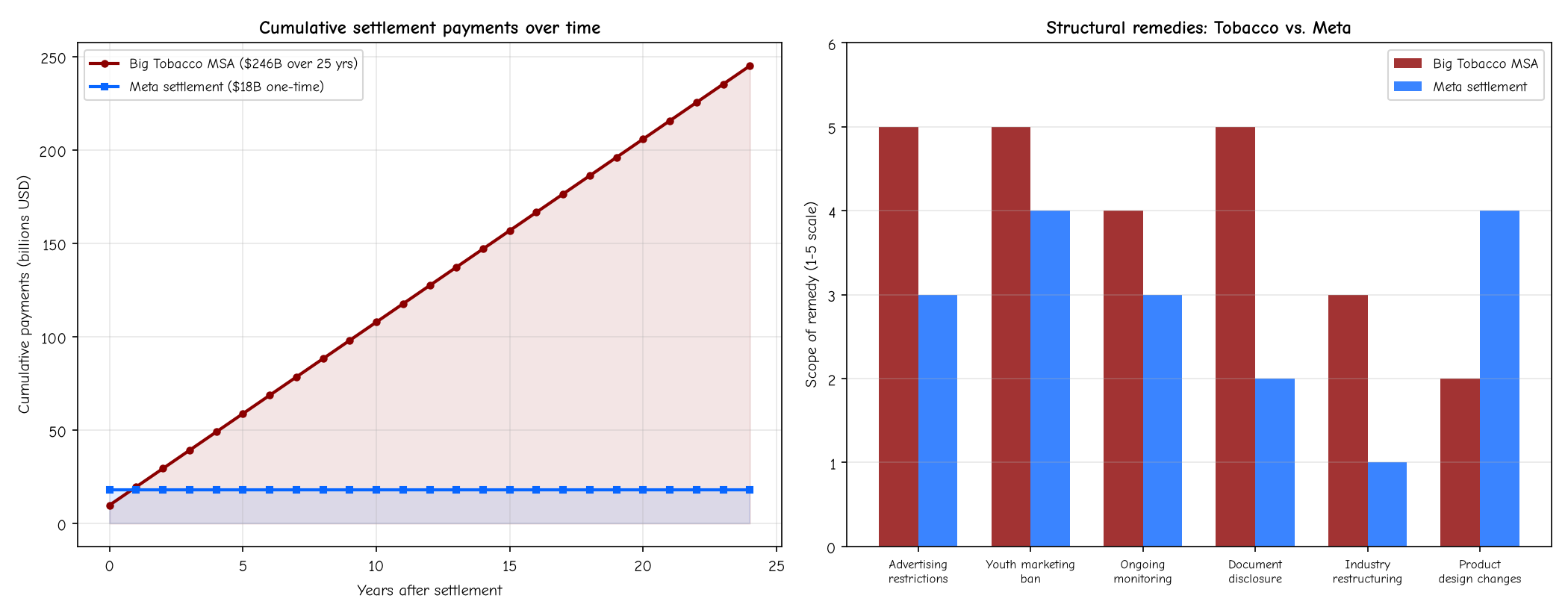
The tobacco MSA extracted $246 billion over 25 years from four companies. Meta's settlement extracts $18 billion in a single payment from one company. In raw dollar terms, tobacco paid 13.7 times more. But the comparison is not that simple. The tobacco payments were spread over 25 years and were tied to cigarette sales volume, meaning they functioned more like an ongoing tax than a one-time penalty. Meta's $18 billion is a lump sum, paid once, with no built-in mechanism for ongoing payments tied to user engagement or revenue.
This difference matters enormously. The tobacco MSA's payment structure created a permanent revenue stream for states, which built the money into their budgets and came to depend on it. It also created the perverse incentive mentioned earlier: states needed tobacco companies to keep selling cigarettes. Meta's one-time payment avoids that particular perverse incentive, because there is no ongoing revenue stream to protect. But it also means the settlement has less ongoing leverage over Meta's behavior. Once the $18 billion is paid, the financial pressure is gone. The only remaining leverage is the structural remedies and the enforcement mechanism.
The scope of structural remedies differs in important ways. The tobacco MSA banned specific advertising channels: billboards, cartoon mascots, sports sponsorships, merchandise branding. These were clear, binary prohibitions. Either a tobacco company ran a billboard ad or it did not. Compliance was relatively easy to monitor. Meta's settlement involves restrictions on product design features, which are harder to define and harder to police. What counts as an "addictive" notification? When does an algorithmic feed cross the line from "recommendation" to "manipulation"? These are subjective judgments, and Meta's engineers will have enormous latitude to design around the restrictions while technically complying.
The chart above scores both settlements on six dimensions of structural remedy, on a 1-5 scale. Tobacco scored higher on advertising restrictions (5 vs. 3), document disclosure (5 vs. 2), and industry restructuring (3 vs. 1). Meta scored higher on product design changes (4 vs. 2), because the tobacco MSA did not require changes to the cigarette itself, only to how it was marketed. Both settlements scored similarly on youth marketing bans (5 vs. 4) and ongoing monitoring (4 vs. 3).
The document disclosure gap is worth noting. The tobacco MSA forced the public release of millions of pages of internal industry documents, which became the foundation for decades of public health research and additional litigation. Meta's settlement, based on what has been reported, does not appear to include a similar document disclosure requirement. The internal research that Frances Haugen leaked is already public, but the full cache of documents produced during discovery may remain sealed. This means researchers, journalists, and future litigants will have less ammunition than they had against tobacco.
The industry restructuring dimension is also instructive. The tobacco MSA did not break up the companies or force divestitures, but it did create a fundamentally different competitive landscape. The advertising restrictions made it harder for new entrants to market their products, which actually consolidated the market power of the existing companies. Meta's settlement could have a similar effect: if the restrictions on teen features apply to Meta but not to smaller competitors, or if Meta's compliance infrastructure gives it an advantage over startups that cannot afford legal review of every feature, the settlement could entrench Meta's dominance rather than diminish it.
One area where the Meta settlement goes further than tobacco is in product design. The tobacco MSA never required companies to make cigarettes less addictive. They could not market them as safe, and they could not target children, but the product itself was unchanged. Meta's settlement, by contrast, requires changes to how the product works for minors. If enforced meaningfully, this is a deeper intervention than anything imposed on tobacco. The question is whether "meaningfully" is the operative word, or whether Meta will make surface-level changes that satisfy the legal language while preserving the engagement-driven business model.
The financial impact on the companies also differs. In 1998, the tobacco companies' combined annual revenue was roughly $50 billion. The $246 billion MSA represented about 20% of their combined annual revenue per year, spread over 25 years. Meta's $18 billion represents about 7.9% of one year's revenue. The financial burden on Meta is lighter, in proportional terms, than the burden on tobacco. Meta is better positioned to absorb the cost without changing its behavior, because the penalty is smaller relative to its earning power.
The cumulative payments chart tells the story visually. Tobacco's cumulative payments rise steadily over 25 years, reaching $246 billion. Meta's cumulative payment jumps to $18 billion in year one and stays flat. If Meta faces no additional penalties, the total cost of its legal reckoning will be a fraction of tobacco's. If private litigation and future regulatory action produce additional penalties, the line could rise. But as of today, the market is betting it will not.
Chapter 7: What happens next, second-order effects, risks, and scenarios
The settlement is signed, but the consequences are just beginning. Several second-order effects will play out over the coming months and years, and they matter more than the headline number.
Florida's trial is the most immediate wildcard. Attorney General James Uthmeier told CNBC on August 26 that Florida is "not settling with Meta" and is "going to court." If Florida proceeds to trial and wins a large verdict, it creates a precedent that could embolden other states to revisit their participation in the settlement, or at least to use the Florida verdict as leverage in future negotiations. If Florida loses, or wins less than its proportional share of $18 billion would have been, the settlement looks like the smart move and the remaining states have no reason to regret it. A Florida trial would also force Meta to defend its practices in open court, with internal documents and executive testimony becoming public record. That could generate new headlines, new political pressure, and new ammunition for private plaintiffs.
The private litigation pipeline is the larger financial risk. Hundreds of individual lawsuits filed by families, school districts, and health organizations are working through courts across the country. These cases allege that Instagram and Facebook caused specific harms: eating disorders, depression, anxiety, self-harm, and in some cases, suicide. If any of these cases produce large plaintiff verdicts, it establishes a template for future cases and could create liability that dwarfs the $18 billion state settlement. Meta's strategy in these cases will likely be to settle quietly, one by one, to avoid creating precedent. But some plaintiffs' attorneys will refuse to settle, betting that a jury sympathetic to a grieving family will award punitive damages that send a message.
The regulatory landscape is also shifting. The Kids Online Safety Act (KOSA), which has been debated in Congress for several years, would impose statutory requirements on platforms regarding minor safety, creating a federal floor that could exceed the settlement's terms. If KOSA or similar legislation passes, Meta will face overlapping obligations from the settlement, federal law, and state laws like California's Age-Appropriate Design Code. Compliance with multiple, sometimes conflicting requirements is expensive and operationally complex, and it could constrain Meta's ability to iterate quickly on features for younger users.
The competitive dynamics are worth watching. Meta's settlement imposes restrictions on how it designs products for teens. If those restrictions make Instagram less engaging for teenagers, some will migrate to platforms that are not subject to the same constraints. TikTok, Snapchat, and YouTube Shorts all compete for the same teen attention. If Meta's teen experience becomes noticeably less sticky while competitors' experiences remain unchanged, Meta could lose market share among a demographic that represents its future user base. This is the scenario where the settlement has real business consequences, not just legal ones. Meta's lawyers and product managers will be working hard to design a teen experience that complies with the settlement while remaining competitive, a balancing act that will define the next phase of the company's relationship with young users.
The advertising revenue impact is harder to quantify but worth considering. If Meta can no longer target ads to minors based on their personal data and behavior, the value of teen ad inventory drops. Teenagers are not a massive advertising market in dollar terms, but they are influential: they drive trends, they influence household spending, and they represent future adult consumers. A reduction in teen ad targeting capability could reduce revenue from the under-18 segment, though this is probably a small fraction of Meta's $228 billion in annual revenue. The bigger risk is if the restrictions are interpreted broadly, limiting Meta's ability to use data collected from teens for future ad targeting after they turn 18.
There is also a reputational dimension. The settlement is an admission, in the eyes of many observers, that Meta's products caused harm to children. Meta will not frame it that way; settlements typically include no admission of wrongdoing. But the public perception is that Meta paid $18 billion because it did something wrong. That perception affects user trust, advertiser comfort, and political goodwill. Meta has spent years trying to rebuild its reputation after Cambridge Analytica, the Haugen disclosures, and years of controversy. This settlement is another entry in a long ledger of evidence that the company's products have negative externalities, and it will be cited in every future debate about social media regulation.
The scenario that should worry Meta investors most is not the $18 billion. It is a cascade: Florida wins at trial, private plaintiffs win a headline verdict, KOSA passes with teeth, and the EU imposes its own teen safety requirements. In that scenario, Meta faces overlapping legal and regulatory pressures that could force deeper changes to its business model than this settlement contemplates. The probability of that cascade is low but not negligible. The market, pricing Meta at $568.85 with a 19.7 trailing P/E, is not pricing in that tail risk. Whether that is wise or complacent will depend on events that have not yet happened.
Conclusion: What a normal person should take away
If you have read this far, you now know more about Meta's $18 billion settlement than most people who will opine on it this week. Here is what to actually do with that knowledge.
If you own Meta stock, directly or through an index fund, do not sell because of this settlement. The company can absorb $18 billion without breaking stride. Its revenue is $228 billion a year, its profit margin is 32.5%, and the market has already decided the penalty is manageable. The stock fell 1.27% on the news, which is less than it moves on a bad earnings day. The settlement removes the largest single legal overhang on the stock. What you should watch instead is Florida's trial, the private litigation verdicts, and any movement on KOSA in Congress. Those are the events that could change the calculus.
If you are a parent, the settlement is a reason for cautious optimism but not celebration. Meta will change some features for teens, and some of those changes may reduce harm. But the history of the tobacco settlement teaches us that companies are skilled at complying with the letter of an agreement while preserving the spirit of their business model. Watch what actually changes on your child's phone. Does Instagram stop sending notifications at night? Does the algorithm stop pushing extreme content? Does your teen report feeling less compelled to check the app constantly? Those are the metrics that matter, not the press release language about "transforming" the teen experience.
If you are watching this story from a policy perspective, the critical question is enforcement. The tobacco MSA's enforcement mechanism, run by the National Association of Attorneys General, was reasonably effective at catching advertising violations but had no power to change the product itself. Meta's settlement involves product design changes, which are harder to monitor and harder to enforce. Who decides whether a new Instagram feature violates the settlement? How quickly can violations be identified and remedied? What are the penalties for non-compliance? The answers to those questions will determine whether this settlement changes anything or becomes another line item in Meta's legal budget.
The tobacco parallel offers one final lesson. The Master Settlement Agreement did not end smoking. It did not end the tobacco industry. It extracted money, changed marketing practices, and contributed to a long-term decline in smoking rates that was driven as much by cultural shifts and tax increases as by the settlement itself. Meta's settlement will probably follow a similar arc. It will not end social media. It will not end Meta. It will extract money, change some practices, and contribute, alongside cultural shifts and potential regulation, to whatever long-term changes happen in how teenagers use these platforms.
The $18 billion is the headline. The structural changes are the story. The enforcement is the thing that determines whether any of it matters. And the real outcome will be measured not in dollars or legal filings, but in whether the teenager in your life has a healthier relationship with the screen in their pocket. That is the metric no settlement can guarantee, and no amount of money can buy.
Sources
[1] CNBC, "Meta to transform social media for teens after reaching trial settlement," August 26, 2026, https://www.cnbc.com (CNBC META quote page, news headlines accessed August 27, 2026)
[2] CNBC, "After Meta's landmark settlement with state AGs, legal headaches remain," August 26, 2026, https://www.cnbc.com
[3] CNBC, "What investors should do with Meta now that the child privacy case has settled," August 26, 2026, https://www.cnbc.com
[4] CNBC, "Meta's settlement has mostly put its legal issues behind them, says Evercore's Mark Mahaney," August 26, 2026, https://www.cnbc.com
[5] CNBC, "Florida Attorney General Uthmeier: We're not settling with Meta, we're going to court," August 26, 2026, https://www.cnbc.com
[6] CNBC, "Watch CNBC's full interview with California AG Rob Bonta," August 27, 2026, https://www.cnbc.com
[7] CNBC, "Micron elevates two executives. Plus, what Meta's settlement means for its revenue," August 26, 2026, https://www.cnbc.com
[8] CNBC META stock quote page, market data accessed August 27, 2026, https://www.cnbc.com/quotes/META (price $568.85, market cap $1.449T, revenue TTM $228.247B, net margin 32.46%, P/E 19.70, 52-week range $520.26-$790.80)
[9] Yahoo Finance, META historical price data via API, accessed August 27, 2026, https://query1.finance.yahoo.com/v8/finance/chart/META (daily OHLC data Jan 2024, Aug 2026, 666 trading days, 64.3% total return, 38.6% annualized volatility)
[10] Wall Street Journal, "The Facebook Files," September 2021, internal Meta research on teen mental health, Frances Haugen whistleblower documents
[11] U.S. Senate Subcommittee on Consumer Protection, Product Safety, and Data Security, Frances Haugen testimony, October 2021
[12] National Association of Attorneys General, Tobacco Master Settlement Agreement, November 1998, https://www.naag.org
[13] Government Accountability Office, "Tobacco Settlement: States' Allocations of Fiscal Year 2007 and Expected Fiscal Year 2008 Payments," 2007, MSA spending audit
[14] U.S. Centers for Disease Control and Prevention, smoking-attributable mortality data, https://www.cdc.gov
[15] Federal Trade Commission, amended consent order against Meta Platforms, 2022, $5 billion privacy penalty
[16] State of California et al. v. Meta Platforms, Inc., Northern District of California, multi-state teen safety litigation, filed October 2023