Open-source robotics just got a CUDA-grade performance upgrade and an AI agent workflow to match. NVIDIA Isaac ROS 5.0, released today at ROSCon in Toronto, brings two things to the ROS 2 ecosystem: a CUDA buffer backend that lets nodes exchange GPU-resident data with zero host copies, and a set of agent-ready skills that let AI coding agents refactor existing nodes to use it.
For the roughly 1.3 million ROS users worldwide, the release matters because it attacks the most common performance bottleneck in perception-heavy robotics: unnecessary memory copies between nodes. The key contribution is a standard data-handling interface called rosidl::Buffer that NVIDIA contributed upstream to ROS Lyrical through the Open Source Robotics Alliance. When publisher and subscriber meet runtime requirements, payloads move between co-located nodes without serialization or host copies. Otherwise, ROS 2 falls back to the standard CPU path automatically.
This is a framework-level change, not a custom wrapper. Every node in Isaac ROS 5.0 has been updated to use the CUDA buffer backend.
What exactly did NVIDIA ship?
The CUDA buffer backend implements rosidl::Buffer<uint8_t> storage using CUDA Virtual Memory Management (VMM). The technical blog post describes the mechanism in detail. When a publisher and subscriber share the same host, same CUDA device, same Linux user, and a supported RMW implementation (such as rmw_fastrtps_cpp or rmw_chemoh_cpp), the payload moves through GPU memory without hitting the CPU. If any of those conditions are not met, ROS 2 transparently falls back to the CPU path that is compatible with any existing ROS 2 node.
The supporting cast of features in 5.0 makes this transport path easier to adopt and deploy. Support for ROS 2 Lyrical (the latest ROS release) and Ubuntu 24.04 is now official. A new migrate-node-to-rosidl-buffer skill gives AI coding agents a structured workflow to audit existing CUDA-accelerated nodes, trace data movement field by field, and apply a minimal, interface-preserving patch. NVIDIA also shipped performance-oriented updates to FoundationStereo (a stereo perception model) and FoundationPose (object pose estimation), which now provides an agent-ready inference library that enables robots to perceive and track objects up to 5.5x faster than the previous version.
The transport change itself is deliberately small. NVIDIA's own Depth Anything 3 TensorRT ROS 2 node demonstrates the migration. The entire ROS-level patch consists of one subscription option, one CUDA allocation, two stream-aware handle extractions, and one publish. No custom message types. No duplicate CUDA topic. No CPU/CUDA publisher branch.
How much faster is zero-copy GPU transport?
NVIDIA's performance tables show the gains are real and measurable across multiple nodes. The TensorRT inference node running PeopleSemSegNet at 544p resolution hits 566 fps on Jetson AGX Thor T5000, 407 fps on AGX Thor T4000, and 594 fps on DGX Spark. For comparison, an x86_64 system with an RTX 5090 reaches 1570 fps on the same workload. The DNN Stereo Disparity node at 576p delivers 175 fps on the T5000 and 68.5 fps on the T4000.
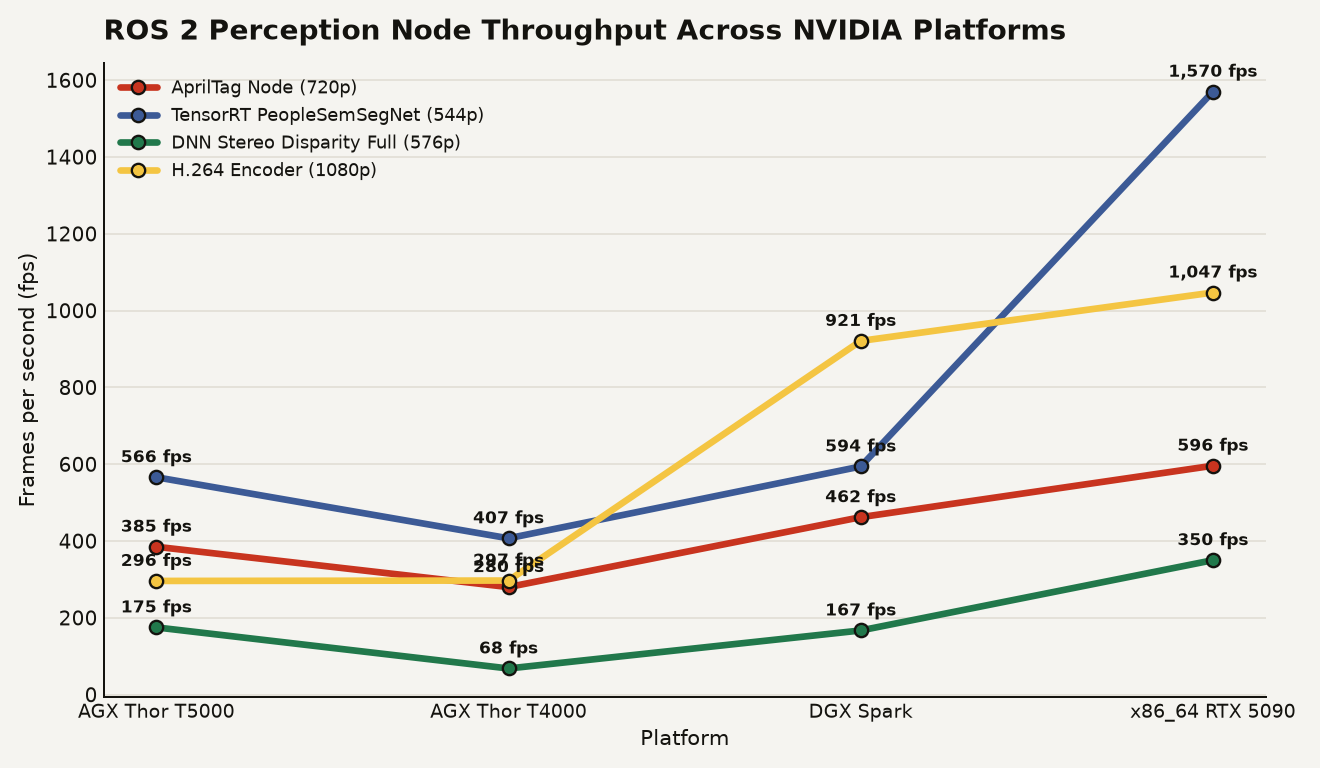
The chart above breaks down perception node throughput across the four NVIDIA platforms NVIDIA supports. The throughput numbers are a direct result of eliminating serialization overhead and unnecessary host-device copies, which historically consumed a large share of per-frame cycle time in ROS 2 perception pipelines. On the H.264 encoder node at 1080p, AGX Thor T5000 sustains 296 fps while DGX Spark hits 921 fps and the RTX 5090 system reaches 1047 fps.
The point is not just raw fps. It is the shape of the workload. The rosidl::Buffer abstraction moves memory-sharing and data-lifetime management behind a standard ROS 2 field. You write node logic. The backend negotiates transport. CPU fallback handles incompatible peers automatically.
Why does this matter for robotics builders?
If you are building or deploying ROS 2-based robotics applications, the CUDA buffer backend changes three things about your architecture decisions.
Your perception pipelines can get denser without rearchitecting. Nodes that were previously bottlenecked by host-to-device copies can now exchange GPU-resident data directly. A stereo depth node feeding a segmentation node feeding a motion planner no longer needs to serialize and deserialize image payloads at each hop. The same sensor_msgs/msg/Image message type carries the data. No new message definitions, no custom transport topics.
Your team can use AI agents for performance refactoring, not just code generation. The migrate-node-to-rosidl-buffer skill is a structured workflow that an AI agent can execute: audit data movement, plan a minimal patch, implement it, and verify the CUDA transport path is active using msg->data.get_backend_type() checks. This is a concrete example of agents doing systems-level optimization work, not just writing boilerplate.
Your edge deployment story now spans from Orin Nano to Thor. Isaac ROS 5.0 supports scalable compute from entry-level NVIDIA Jetson Orin Nano to high-performance Jetson Thor devices. Companies like Mentee Robotics, Universal Robots, and ROBOTIS are already running this stack on physical robots. Universal Robots built Isaac ROS into its AI Accelerator SDK to help integrators deploy perception and motion capabilities without writing complex robotics software from scratch.
Here is what this means for your roadmap if you are in the middle of a robotics build:
- If you have existing CUDA-accelerated ROS 2 nodes: You can adopt the CUDA buffer backend with minimal code changes. The migration skill automates the audit. Your node interfaces stay the same. Your downstream subscribers do not need to know whether they are receiving CPU or CUDA-backed payloads.
- If you are starting a new robotics project: ROS 2 Lyrical with Isaac ROS 5.0 gives you a modern baseline. Ubuntu 24.04, ROS 2 Lyrical, and CUDA-accelerated perception are all first-class. You get zero-copy transport from day one.
- If you are evaluating edge platforms: The performance gap between Jetson Orin and Jetson Thor is significant. The DNN Stereo Disparity node jumps from 68.5 fps on AGX Thor T4000 to 175 fps on AGX Thor T5000. That is a 2.5x difference within the same product family. Your platform choice should be driven by your perception workload density, not just cost.
- If you are hiring: Look for engineers who understand systems-level data movement, not just model deployment. The skills that matter now include CUDA memory management, ROS 2 middleware internals, and the ability to profile end-to-end pipelines with tools like NVIDIA Nsight Systems.
What is the catch with zero-copy GPU transport?
The CUDA buffer backend has requirements, and they are worth understanding before you refactor your codebase.
The optimized path requires the same host, same CUDA device, same Linux user, and a supported RMW implementation. If you are running nodes across multiple machines, containers with different user IDs, or multiple GPUs in a single host, you will hit the fallback path. The fallback is transparent and compatible with all existing ROS 2 nodes, but it does not give you the zero-copy benefit.
The from_input_buffer() API handles CPU-to-GPU promotion automatically when a subscriber receives a CPU-backed payload but needs GPU access. This means you do not need to write separate CPU and CUDA code paths in your callback. But the promotion does involve a copy, so if your pipeline mixes CPU and GPU nodes inconsistently, you will pay the copy cost at each boundary.
NVIDIA's verification approach is worth copying. The technical blog recommends using NVIDIA Nsight Systems to confirm that no payload-sized host-to-device or device-to-host transfers occur at the ROS boundary on an eligible CUDA path. The migrated node should also be checked with msg->data.get_backend_type() reporting `