Nvidia has found a cleaner answer to the ugliest local objection to AI infrastructure: water. Its new pitch is that 45C liquid cooling for Rubin-era AI racks can let data centers dump heat through closed-loop dry coolers instead of evaporating millions of gallons through cooling towers.
That sounds like a technical footnote until a county board meeting turns into a referendum on your cloud roadmap. Water has become the easiest symbol of the AI buildout because it is visible, local, and emotionally legible. People may not know what NVLink does. They know what a low reservoir looks like.
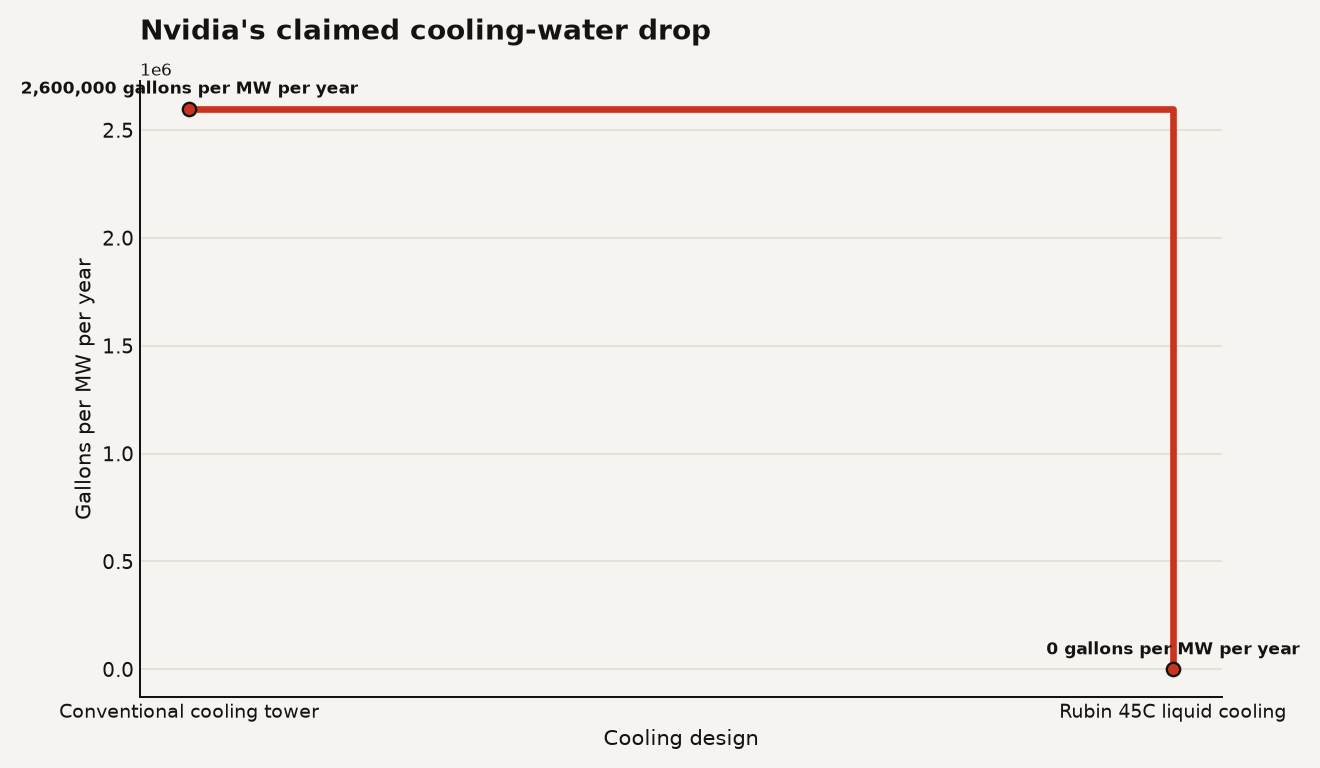
The key number is stark: Nvidia says its Rubin reference design can take annual cooling-tower water use from roughly 2.6 million gallons per megawatt per year to near zero, according to The Verge's report on Nvidia's Rubin cooling claim. That does not settle the data center fight. It changes which spreadsheet matters.
If you build AI products, this is a cost, siting, and capacity story. The water fight is turning into a permitting constraint. Permitting constraints become GPU scarcity. GPU scarcity becomes inference pricing, model access, and the boring backlog item called gross margin.
Rubin's two-part cooling design
Nvidia's Rubin story has two parts: move more heat into liquid, then run that liquid hotter. In its Vera Rubin technical write-up, Nvidia says MGX racks are designed to operate with 45C, or 113F, warm-water inlet temperatures, and that this enables many data centers to use ambient air and closed-loop dry coolers instead of leaning on compressors or evaporative systems in its Rubin platform technical blog.
That temperature matters. A traditional data center often fights to keep air cold enough to protect servers. A Rubin-style rack captures heat directly at the chip, moves it through a facility liquid loop, and rejects it outdoors through a radiator-like dry cooler. The warmer the allowable coolant, the more hours in the year the outside air is useful without spraying water into a cooling tower.
Nvidia also says the Rubin rack is a 100 percent liquid-cooled design and that the closed-loop coolant can last up to 10 years with minimal maintenance, depending on the customer and facility design in the same Rubin technical post. That is the part builders should care about. It is a chip vendor prescribing the building.
The chart below shows the size of Nvidia's on-site water claim: 2.6 million gallons per megawatt per year for conventional cooling-tower systems, compared with near zero for the Rubin warm-water reference design.
Nvidia has been preparing this argument for more than one generation. In its 2025 Blackwell cooling post, the company said the GB200 NVL72 system delivered 300x more water efficiency than traditional air-cooled architectures and that dense AI racks had pushed beyond what air could handle cleanly in its Blackwell liquid-cooling blog. Rubin extends that claim from a rack efficiency story into a site-design story.
There is a quiet admission buried in all of this: AI infrastructure is becoming too dense for yesterday's mechanical plant. Nvidia says the Vera Rubin NVL72 rack contains 72 Rubin GPUs and 36 Vera CPUs, connected through NVLink as one rack-scale engine in the Rubin technical blog. The facility around that rack now matters almost as much as the silicon inside it.
Power and water become the limits
Because the limiting resource for AI products is drifting from model quality to deployable capacity. The constraint used to be: can the model do the task? Then it became: can you afford the tokens? Now the new question is uglier: can someone get the power, water, permits, substations, cooling gear, and political consent to run the cluster you are counting on?
Nvidia claims 45C liquid cooling can free enough facility power to allocate up to 10 percent additional Vera Rubin NVL72 racks in the same power budget in its Rubin platform technical post. If that number holds in real deployments, it is capacity expansion without asking the utility for another slice of the grid.
For a product team, the consequences are practical:
- Inference costs: If warm-water cooling lowers cooling power and lets operators pack more racks into a constrained site, the savings can show up as better token economics, especially for high-utilization inference.
- Region strategy: A provider that can run with dry coolers in more climates has more freedom to place capacity near users, power contracts, or enterprise customers.
- Procurement risk: If your roadmap assumes a specific GPU region will arrive on schedule, water objections and cooling-plant lead times now belong in the risk register.
- Moat design: Efficient infrastructure does not protect a weak product, but it can widen the gap between a model wrapper and a company with predictable serving costs.
This also explains why the water announcement lands during a political moment, not just a hardware cycle. Gallup found in a March 2 to 18, 2026 survey that 71 percent of Americans oppose building AI data centers in their local area, including 48 percent who strongly oppose them in its May 2026 poll release. Among opponents, Gallup found that 50 percent mentioned resource effects, with 18 percent specifically mentioning water and 18 percent mentioning energy in the same Gallup article.
That is why Nvidia's water claim is useful even if you never touch a coolant manifold. A cloud provider can walk into a community meeting and say the next site will use little operating water for cooling. That does not win the room by itself. It removes one of the easiest attack lines.
The catch is that water is only one line item. The Lawrence Berkeley National Laboratory's 2024 report found that U.S. data centers consumed 176 TWh of electricity in 2023, equal to 4.4 percent of total U.S. electricity use in the federal data center energy report. The same report estimated nearly 800 billion liters of indirect water consumption tied to electricity generation for U.S. data centers in 2023 in that same LBNL report.
Dry cooling can shrink the water footprint inside the fence. It does not erase the water embedded in gas, coal, nuclear, or hydro-heavy power supply. If a hyperscaler solves cooling water by buying fossil generation with its own cooling needs, local residents may still see the burden, just through a different pipe.
Data Today has covered this broader tradeoff before in the earlier 45C liquid cooling fight and in the grid-flexibility argument for AI data centers. The pattern is now clear: the winners in AI infrastructure will be the operators who can optimize chips, racks, power contracts, cooling, and local politics as one system.
Facilities questions for cloud vendors
Start asking infrastructure questions that sound like facilities questions. The old buying motion was simple: choose model, region, latency target, and price. The next buying motion needs a small sustainability and capacity appendix, even for software teams.
Ask your provider for three numbers before you bet a major feature on a region:
| Question to ask | Why it matters | Bad answer |
|---|---|---|
| What is the site's water usage effectiveness under peak summer load? | Average annual WUE can hide the hours that trigger local backlash. | A global average with no regional detail. |
| Is the AI capacity direct liquid cooled, hybrid cooled, or air cooled? | Cooling architecture affects density, power overhead, and expansion speed. | A vague claim about efficient data centers. |
| What power source backs incremental AI load? | On-site water can fall while indirect water and emissions rise through electricity generation. | A renewable energy certificate total with no hourly or local match. |
Amazon's latest public water story shows why those questions matter. The company said its global data center operations used 0.12 liters per kilowatt-hour in 2025, over 7x more water-efficient than the 0.84 L/kWh industry average it cites, and that its data centers use free air cooling about 90 percent of the time in Amazon's June 2026 water efficiency post. Amazon also said it withdrew approximately 9.5 billion liters of water across its global data center footprint in 2025 in the same post.
Microsoft is making a similar move from the cloud operator side. The company said in December 2024 that a new AI-optimized data center design consumes zero water for cooling and that the first new sites using it will begin coming online in late 2027 in its Microsoft Cloud blog.
Those claims point in the same direction: cooling water is becoming a design requirement, not a corporate social responsibility slide. The serious buyers will stop accepting fleet-level averages. They will ask how the next megawatt is cooled.
There is also a hiring consequence. If you run infrastructure, you need people who understand power and thermal systems alongside Kubernetes and Terraform. If you build on top of AI APIs, you need someone in finance or platform engineering who can translate facility constraints into cost forecasts. The GPU is still the star. The chiller, dry cooler, CDU, and utility interconnect are now in the credits.
Plenty still breaks
Plenty.
The first caveat is cost. A fully liquid-cooled facility asks more of the rack, manifold, coolant distribution unit, leak detection, service process, and operator training. Nvidia says its MGX ecosystem has more than 80 global partners supporting rack-scale systems in the Rubin technical blog. That is impressive, and it also tells you the transition is a supply-chain project.
The second caveat is retrofit reality. New Rubin halls can be designed around warm-water loops. Existing cloud regions were built over years, with mixed server generations and cooling assumptions. A provider can announce a near-zero-water future while much of the present fleet still uses evaporative cooling during heat spikes.
The third caveat is total demand. The International Energy Agency says global data center electricity demand could more than double to around 945 TWh by 2030 in its base case in its Energy and AI analysis. Better cooling per rack can reduce water per token, while the total number of racks keeps rising.
That is the uncomfortable engineering truth. Efficiency gains are necessary because the buildout is large. The same gains can also make the buildout easier to justify.
For builders, the right response is neither panic nor applause. Treat 45C liquid cooling as a material improvement in the infrastructure stack, then keep your dependency map honest. A provider with dry cooling, flexible power demand, transparent WUE, and credible local power procurement is a stronger partner than one with a cheaper headline token price and a murky site plan.
A simple rule helps: if the model feature is strategic, the serving region is strategic too. Ask where the capacity sits, how it is cooled, and whether that facility can survive a local permitting fight.
The hotter rack moves the fight to the meter
Nvidia's warmer liquid loop gives AI infrastructure a better answer to water anger. That is real progress. It also sharpens the next fight.
Once cooling water falls toward zero, the public will look at electricity, power plant water, land, noise, tax breaks, and who pays for grid upgrades. The rack can run hotter. The politics will too.
Sources
- The Verge: Nvidia says its AI data center design runs hotter to use a lot less water
- Nvidia Technical Blog: NVIDIA Vera Rubin POD
- Nvidia Blog: Blackwell platform boosts water efficiency
- Gallup: Americans oppose AI data centers in their area
- Lawrence Berkeley National Laboratory: 2024 United States Data Center Energy Usage Report
- Amazon: Data centres are seven times more water-efficient than the industry average
- Microsoft Cloud Blog: Next-generation datacenters consume zero water for cooling
- International Energy Agency: Artificial Intelligence