AI infrastructure has a strange new bottleneck: the fastest way to get more compute may be to promise you will use less power at the worst possible moments. Flexible data centers are facilities that can reduce grid draw on command while keeping critical workloads alive. The key number is 76 GW: Duke University researchers found that the largest 22 US balancing authorities could integrate that much new flexible load if those customers could be curtailed for just 0.25 percent of their maximum uptime, roughly the shape of a few peak hours rather than a new lifestyle.
This matters because AI buildout has run into the physics and politics of the electric grid. A GPU cluster can be ordered faster than a substation can be permitted. A data hall can rise faster than a new power plant can clear interconnection. And when a proposed AI campus lands near voters who already see rising bills, the pitch cannot just be: trust us, the jobs will be amazing.
The new bet, pushed by Emerald AI, Nvidia, Digital Realty, EPRI, National Grid, and PJM, is that AI factories can become controllable load instead of permanent peak demand. That sounds like utility poetry. For builders, it is closer to an SRE problem with megawatts attached: classify work, protect latency, shed batch jobs, prove the behavior, and write contracts that make failure expensive.
What actually happened in the flexible AI factory test?
In December 2025, Emerald AI, EPRI, National Grid, Nebius, and Nvidia ran a five day UK demonstration at a London AI data center to test whether AI infrastructure could respond to grid stress signals. National Grid said the team sent more than 200 real time simulated grid events to the site to test Emerald AI’s Conductor software, including a recreated British “TV pickup” demand surge tied to the England versus Germany Euro 2020 match, when millions of kettles can turn a halftime break into a grid event through synchronized tea making.
The important detail is that this was not a blackout drill where the whole site simply turned off. Nvidia said the London system ran production grade AI workloads on 96 Nvidia Blackwell Ultra GPUs, with Conductor slowing lower priority work while keeping high priority workloads at peak throughput across the simulated power targets in the Nebius AI factory demonstration.
That is the product claim: flexible data centers do not need to be dumb demand response, where a factory gets a phone call and shuts down a line. They can be workload aware. Inference serving, customer workloads, and critical control planes get one treatment. Training, indexing, synthetic data generation, batch evaluation, and speculative jobs get another.
The next test is live grid behavior, not another tidy simulation. In October 2025, Emerald AI and partners announced the 96 MW Aurora AI Factory in Manassas, Virginia, with Digital Realty, Nvidia, EPRI, and PJM involved, and said it was slated to open in the first half of 2026 as a power flexible reference design for AI infrastructure built around Aurora.
The reason this has traction is simple: peak grid constraints are sparse, while data center interconnection delays are brutal. Duke’s 2025 report estimated 76 GW of headroom at 0.25 percent curtailment, 98 GW at 0.5 percent, and 126 GW at 1 percent across balancing authorities serving 95 percent of US load in its Rethinking Load Growth report. The chart below shows the curve builders should care about: very small curtailment permissions create a lot of theoretical room.
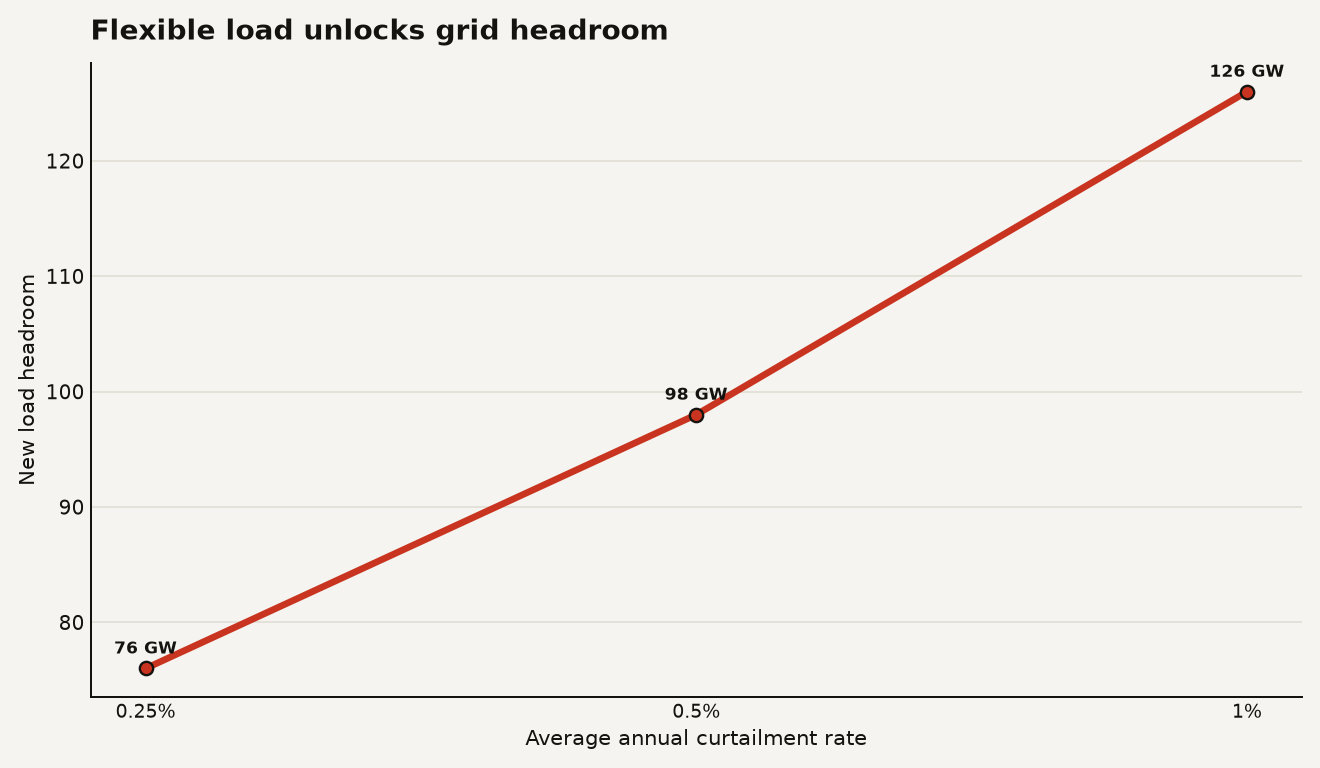
The chart is not a permission slip to plug in anywhere. It is a map of why the argument is suddenly credible. The current grid is engineered around rare peaks. If AI load can step out of the way during those peaks, it can use capacity that already exists during the other 99 percent plus of the year.
Why should a builder care about 22 hours of curtailment?
Because “speed to power” is becoming a product constraint. If your roadmap assumes another 50 MW, 100 MW, or 500 MW of compute, your limiting dependency may no longer be chip allocation. It may be whether a utility believes your load is firm, flexible, or pretending.
Duke’s 0.25 percent curtailment case is roughly 22 hours per year if applied to full annual uptime. That is less than one bad day on a distributed system calendar, but it changes the utility conversation. You are no longer asking the grid to build for your worst hour as if it happens all year. You are offering a control surface.
That control surface has to be real. PJM’s own 2026 market design report draws the useful boundary: AI inference is latency sensitive and “effectively firm load,” while AI training is throughput oriented and has “natural flexibility.” PJM also cited Google’s estimate that 40 percent of its AI energy use comes from training in a section on workload flexibility and advanced load control architectures that can reduce demand by 10 percent, 20 percent, or 30 percent in seconds through software controlled load management.
That means the engineering task is not “make the data center flexible.” It is more specific:
- Assign every workload an energy service level objective, not just a latency SLO.
- Separate firm inference from interruptible training and batch jobs at the scheduler level.
- Keep enough observability to prove megawatt reductions in seconds, not in a monthly sustainability PDF.
- Price internal jobs against power scarcity so teams stop treating electricity as a flat background constant.
- Make customer contracts honest about which workloads can slow down during grid stress.
The business consequence is sharper. If two AI companies have equal models and equal chips, the one with credible flexibility may get connected earlier, finance capacity more cheaply, and face less local opposition. That is a moat made of telemetry, contracts, and boring grid compliance. Not glamorous. Very useful.
It also changes how you should read AI infrastructure announcements. A company saying it has secured land is less interesting than a company saying it has secured interconnection terms. A company saying it has backup turbines is less interesting than a company saying which jobs it can curtail, for how many hours, with what customer impact, and under which measurement regime.
We have already covered the broader version of this shift in virtual power plants meeting AI’s power wall. The flexible data center version is more concentrated. A single AI campus can swing hundreds of megawatts. That makes the upside bigger and the blast radius less forgiving.
Can flexibility actually lower costs, or does it just hide them?
This is where the story gets political fast. Data center developers like flexibility because it can shorten waits. Utilities may like it because it can postpone expensive upgrades. Neighbors will ask a harder question: who pays when the model fails?
The optimistic case is that flexible load absorbs fixed grid costs without forcing everyone else to fund new capacity for a handful of peak hours. Duke researchers argued in a February 2026 report on the economic benefits of data center load flexibility that flexible operations will be central to lowering costs for all customers, with rate impacts depending on the scenario and market design in the large load flexibility analysis.
The PJM region shows why this is not theoretical. PJM said in April 2026 that it expects electricity demand to increase by more than 30 GW between 2024 and 2030, driven largely by data centers, while its new interconnection cycle included 811 projects and 220 GW of nameplate capacity seeking to connect under the reformed process.
That sounds like plenty of supply until you remember nameplate capacity is not delivered capacity, and projects die for ordinary reasons: permits, financing, equipment, local fights, and time. PJM serves 67 million people across 13 states and the District of Columbia, so a bad assumption about firm AI load becomes everybody’s reliability problem.
A March 2026 Johns Hopkins analysis put the stakes in starker terms. It found 8.8 GW of data centers already under construction in PJM and 16.2 GW to 57.4 GW planned, then modeled non firm service as the dominant lever for cost containment, reducing total annual system costs by $15 billion to $16 billion per scenario versus $4.2 billion from successfully interconnecting all new generation in the queue in its PJM data center flexibility study.
That finding should make both sides uncomfortable. For AI builders, it says flexibility is not a green garnish. It may be the only way to get large projects through a constrained grid without triggering a ratepayer revolt. For regulators, it says paper flexibility is dangerous. If the site cannot or will not curtail when called, the promised savings turn into a reliability hole.
The risk is performative flexibility. A data center can market itself as grid friendly while carving out so many exceptions that only decorative workloads remain interruptible. If the curtailment stack depends on heroic operator judgment during a heat wave, it is not a stack. It is a wish with a dashboard.
What should you build if your AI roadmap depends on power?
Start treating power as a schedulable resource in 2026, even if you do not own a data center. The public numbers are already large enough to reach your cloud bill. Lawrence Berkeley National Laboratory found US data centers used 176 TWh in 2023, or 4.4 percent of total US electricity, and projected 325 TWh to 580 TWh by 2028, equal to 6.7 percent to 12 percent of US electricity in its 2024 data center energy usage report.
If you buy cloud compute, ask your provider boring procurement questions. Which regions are constrained? Which workloads are eligible for demand response? Do reserved GPU commitments include power related interruption clauses? Are batch discounts tied to grid events or only to fleet utilization? The answers will shape cost and reliability.
If you build infrastructure, the technical direction is clear:
- Put workload classes into the scheduler, with explicit curtailment behavior for each class.
- Build checkpointing and resume paths for long training jobs so a 30 minute power event does not become a 12 hour recovery tax.
- Move non urgent evaluation, embedding refreshes, synthetic data generation, and precomputation into flexible queues.
- Track watts per job alongside GPU hours, because a megawatt promise cannot be audited from token counts alone.
- Design customer facing products so degraded compute is graceful: slower batch completion beats broken inference.
Do not oversell it. Flexible data centers will not remove the need for new transmission, generation, storage, and better permitting. The US grid still needs steel in the ground. Flexibility is a bridge for the years when AI demand is arriving faster than infrastructure can be built.
The underrated part is organizational. Someone has to own energy reliability the way someone owns database reliability. That person needs authority over schedulers, customer tiers, facility telemetry, and finance models. If power sits only in sustainability, it will produce reports. If it sits only in facilities, it will miss workload context. If it sits only in engineering, it will ignore tariff reality.
Will flexible data centers become a moat or a mercy button?
The likely answer is both. In normal times, flexibility is a moat: faster interconnection, better utility relationships, fewer local fights, and lower capital risk. In stressed hours, it is a mercy button: the grid asks for relief, and the AI factory gives back megawatts without dropping the workloads that actually need to run.
The winners will not be the companies with the loudest claims about “grid aware AI.” They will be the ones that can show, on a hot Tuesday in July, exactly which jobs slowed down, exactly how many megawatts came off the grid, and exactly which customers noticed.
That is a very practical definition of responsible AI infrastructure. The model can be clever. The data center has to be courteous.
Sources
- National Grid: UK first trial of AI grid technology successfully demonstrates the ability of data centres to adjust power needs
- Nvidia: How power flexible AI factories can stabilize the global energy grid
- Emerald AI, Nvidia, EPRI, Digital Realty, and PJM: Power flexible AI Factory announcement
- Duke University Nicholas Institute: Rethinking Load Growth
- PJM: Powering Reliability Through Market Design
- Duke University Nicholas Institute: Rethinking Load Growth, Potential Economic Benefits of Data Center Load Flexibility
- PJM: Over 800 new generation projects seek to connect under PJM’s reformed process
- Johns Hopkins Ralph O’Connor Sustainable Energy Institute: Data Center Flexibility and Grid Infrastructure Needs in PJM
- Lawrence Berkeley National Laboratory: 2024 United States Data Center Energy Usage Report