A data center used to prove its seriousness by feeling like a meat locker. NVIDIA is now selling the opposite idea: run the coolant hotter than a hot tub, keep the chips inside spec, and stop spending so much of the AI budget on moving cold air around a warehouse.
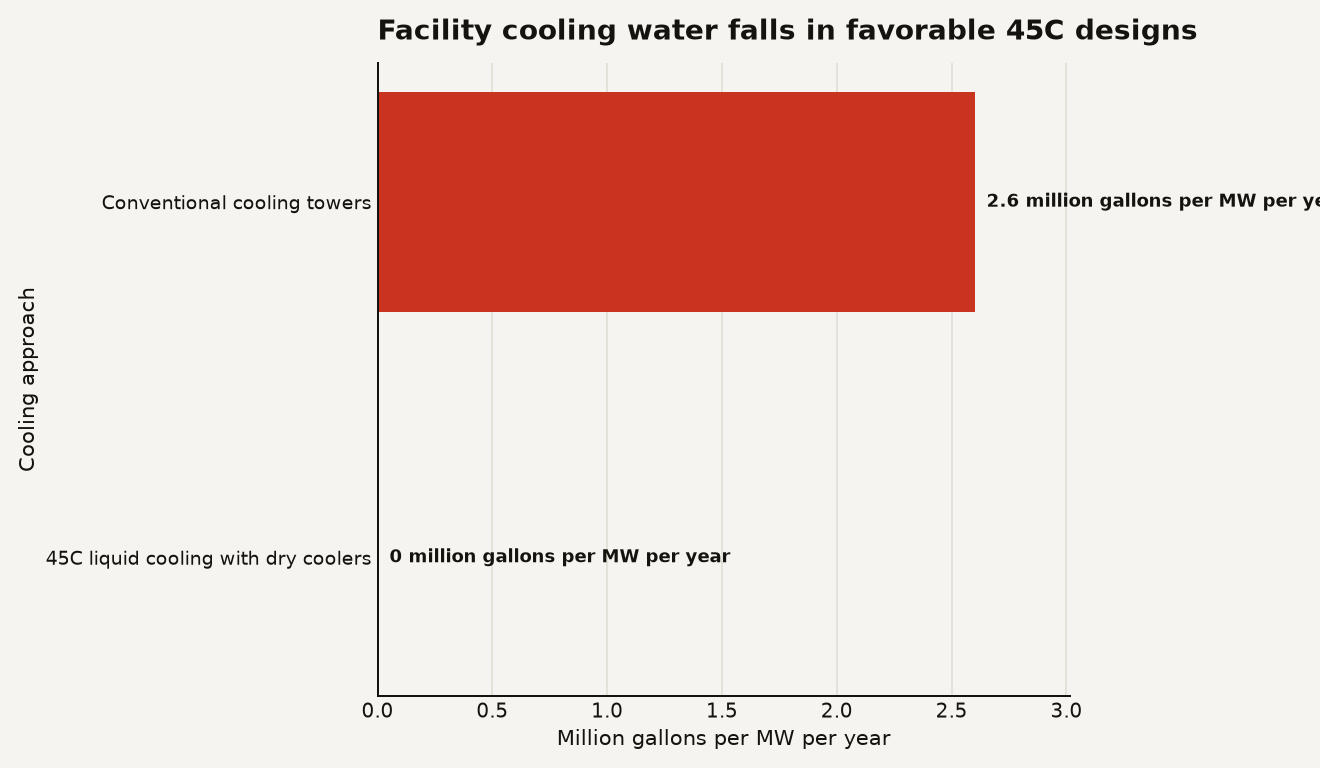
45C liquid cooling is NVIDIA’s Rubin pitch: the company says its newest AI servers can take coolant at 45 degrees Celsius, exit around 55 degrees Celsius, and in favorable climates cut facility cooling water use from roughly 2.6 million gallons per megawatt per year to near zero through dry cooler designs in a closed loop in its liquid cooling announcement. The claim matters because U.S. data centers consumed 176 TWh in 2023, equal to 4.4 percent of total U.S. electricity consumption, and Lawrence Berkeley National Laboratory projects 2028 demand of 325 TWh to 580 TWh under its scenario range in its 2024 report to Congress.
The useful read is blunt: liquid cooling is moving from facilities plumbing to product strategy. If you build AI software, your inference margin, deployment region, customer carbon story, and uptime plan are getting pulled into the thermal stack. The rack is becoming part of the roadmap.
What did NVIDIA actually announce with Rubin?
NVIDIA says Rubin is its first AI infrastructure generation built around 100 percent liquid cooling, meaning chips and networking components are cooled by liquid with no fans in the system according to the company’s announcement. That is a stronger claim than the direct to chip systems already appearing in AI clusters, where GPUs and CPUs often get cold plates while the rest of the board still relies on airflow.
The engineering change is simple to describe and hard to ship. Coolant flows through cold plates attached to hot components, absorbs heat directly, and carries it to a facility loop. NVIDIA says the Rubin coolant mix is 75 percent water and 25 percent propylene glycol, and that moving heat at 45 degrees Celsius allows many sites to reject heat outside without mechanical chillers for much of the year in the same Rubin cooling post.
That temperature is the trick. Traditional data centers burn energy to make cold air and push it through racks. Rubin’s claim is that the server can tolerate a much warmer liquid supply because the cold plate keeps device temperatures inside validated limits. NVIDIA says the coolant can enter the rack at 45 degrees Celsius and leave near 55 degrees Celsius after absorbing heat across the chip surface in its technical explanation.
The design also lines up with NVIDIA’s broader rack program. In October 2025, NVIDIA said Vera Rubin NVL72 would use an energy efficient 45 degrees Celsius liquid cooling rack design and would be supported by more than 50 MGX system and component partners in an OCP focused Rubin update. Translation: this is less a one off thermal flourish than a supply chain instruction.
That matters because AI factories are no longer bought as a pile of GPUs. They are bought as interlocked systems: accelerators, networking, power shelves, busbars, coolant distribution, controls, and utility interconnection. The moat shifts from owning a clever model wrapper to being able to place capacity where power, water, permits, and cooling can survive contact with reality. We covered the same pressure from the grid side in flexible data centers becoming a power dial; Rubin pushes that logic into the rack.
How much water does 45C liquid cooling take off the bill?
NVIDIA’s cleanest number is water. The company puts the conventional cooling tower baseline at 2.6 million gallons per megawatt per year, while saying favorable Rubin style dry cooler designs can bring facility cooling water consumption near zero in its June 2026 post. The chart below shows the scale of that claim: one megawatt of conventional cooling tower capacity is a water user, while a favorable closed loop dry cooler design is closer to an asset you fill and maintain.
The caveat is geography. NVIDIA’s own description says chiller free operation is tied to favorable climates, and quotes Ali Heydari, its director of data center cooling and infrastructure, saying dry cooler based DSX designs may need chillers for maybe 1 percent of the year in some climates in the same announcement. Scotland and Phoenix do not get the same answer from a dry cooler. The spreadsheet knows the difference, even if the press deck squints.
The broader water accounting also gets messy fast. Lawrence Berkeley National Laboratory estimated that 2023 U.S. data center electricity use had an indirect water footprint of nearly 800 billion liters, because electricity generation itself consumes water depending on the regional grid mix in its 2024 report. Cutting facility water is a big deal for local permitting and community acceptance, but it does not erase the water embedded in power generation.
Still, site water is where a lot of public fights start. We have already seen the AI infrastructure argument turn into a local bill of materials for water, land, and noise, as in Amazon data centers putting 2.5 billion gallons on the AI bill. A closed loop cooling design gives operators a sharper answer at town hall: less evaporative cooling, fewer cooling towers, and less visible water draw.
Why does warmer coolant matter to your roadmap?
The obvious benefit is operating cost. ENERGY STAR says data centers can save 4 percent to 5 percent in energy costs for every 1 degree Fahrenheit increase in server inlet temperature in its data center temperature guidance. Rubin is not just raising inlet air temperature, since the core change is liquid heat capture, but the principle rhymes: warmer allowable heat rejection expands the hours when a site can use outside conditions instead of refrigeration.
For builders, that shows up in less glamorous places than model quality. Your cost per million tokens depends on GPU utilization, power price, cooling overhead, and the ability to get new capacity online. If liquid cooling lets a landlord fit denser racks and avoid some chiller plant work, the benefit eventually hits your inference contract, even if the line item arrives as a vague capacity premium.
Here is the practical breakdown:
- Codebase: capacity constraints will shape architecture choices, including batching, caching, model routing, and whether your agents call the largest model by default.
- Roadmap: regional availability may diverge, because a 45C dry cooler site in a cool climate can have a different cost curve than a hot, water stressed metro.
- Costs: NVIDIA says a 50 MW hyperscale facility can save more than 4 million dollars annually in cooling related energy and water costs by moving to liquid cooled infrastructure in its liquid cooling announcement.
- Hiring: teams that treat infrastructure as somebody else’s problem will need at least one person who understands power, cooling, and capacity procurement.
- Moat: if your product depends on low latency inference at high volume, the winning capacity contract may matter as much as the clever prompt layer.
The underrated consequence is density. NVIDIA says a fully liquid cooled Rubin system that previously occupied six rack units can fit in two rack units in its engineering description. That sounds like a facilities win, but it also changes failure domains. More compute in less space raises the importance of coolant monitoring, leak detection, maintenance windows, and software controls that can drain load away from a thermal event before customers notice.
The annoying consequence: your sustainability story needs better verbs. Saying an AI feature is efficient because the model is smaller misses the facility layer. Saying a data center is water light because it uses dry coolers misses the power generation layer. The honest version separates three claims: IT energy per useful task, facility overhead, and local water use.
What should builders and operators do before copying this design?
Treat 45C liquid cooling as a design option with constraints, not a magic sticker for AI infrastructure. The vendor claim is credible enough to matter and conditional enough to price carefully.
Start with procurement. Ask cloud and colocation vendors to state whether your reserved AI capacity runs in air cooled, hybrid liquid cooled, or fully liquid cooled racks. Ask for the facility PUE and WUE definitions they use. LBNL warns that site WUE can hide source water effects, because source WUE depends on the electricity used by the facility in its discussion of data center water metrics.
Then map the operational blast radius. A liquid cooled rack moves risk from airflow management to fluid management. You want answers to specific questions before you place core inference there:
- What telemetry do you get for coolant temperature, pressure, flow, and leak detection?
- How quickly can workloads evacuate a rack if the cooling distribution unit trips?
- Does your contract define thermal incidents as capacity outages for service credit purposes?
- Are chillers installed as backup for the hottest 1 percent of annual hours, or is the site depending entirely on dry coolers?
For software teams, the right move is to assume capacity will be heterogeneous. Build schedulers that can route background jobs to cheaper regions, reserve low latency paths for customer facing inference, and degrade model selection before you degrade user experience. If you are already doing multi model routing, add facility and region metadata to the same decision loop. The model router should know when the expensive cluster is thermally or economically expensive today.
For business teams, ask a sharper sales question: can you prove this product’s gross margin under constrained power? The AI boom has made GPU supply feel like the scarce input, but the LBNL range for 2028 says the United States could see data center demand reach 580 TWh in a high scenario in the federal report. When power and cooling become gating factors, the companies with boring capacity plans ship the fun features.
The cold aisle is losing its veto
For years, the data center told software what was possible through a cold aisle, a power cap, and a construction queue. Rubin’s 45C liquid cooling suggests a different bargain: let the rack run warmer, move heat more directly, and spend less water proving the building is cold enough.
That does not make AI infrastructure clean by default. It makes the bill more visible. The next serious AI roadmap will have a model plan, a data plan, and a thermal plan. Skip the third one and the hot tub will have better operating discipline than your agent stack.