Japan has spent years being treated as the country where robots were always just about to arrive. This week, Tokyo put a number on the promise: the Japan AI robots plan now targets 10 million AI equipped robots by 2040 across 18 fields, according to industry minister Ryosei Akazawa's June 30 press conference.
That number will get the attention. The useful story is the machinery behind it. Japan is trying to build a national physical AI stack, with Noetra and AIST commissioned to develop a domestic multimodal foundation model that can handle language, images, video, audio, sensor data, and eventually real world physical context.
If you build AI products, this is a warning shot from outside the chatbot lane. The next sovereign AI fight will be about who owns operational data, who gets access to real world feedback loops, and who can turn models into reliable action without sending every factory, hospital, and logistics workflow through a foreign cloud.
METI's physical AI project from June 30
METI said on June 30 that it had started the "AI robot and physical AI multimodal foundation model development project" with NEDO, and that Noetra and Japan's National Institute of Advanced Industrial Science and Technology were selected to begin the work in the official project announcement.
NEDO's procurement page adds the part that matters for execution: it reviewed 15 applications and selected Noetra and AIST for a project called "research and development of physical AI foundation technology for real world native AI" in its implementation decision.
The split is sensible. Noetra owns model development and delivery, while AIST handles theory, component technologies, architecture, and research links with domestic and overseas institutions, according to NEDO's proposal summary. This looks like industrial policy, but it also looks like product architecture: one builder for the deployable model, one national lab for the slower research layer.
The project runs from fiscal 2026 to fiscal 2030, but NEDO says the initial contracts cover only fiscal 2026 and 2027, with annual stage gate reviews deciding whether the work continues in the same decision notice. That clause matters. It turns the giant national plan into a sequence of deliverables instead of a blank check.
The budget is already large enough to be real. METI's budget sheet lists 3,873億 yen, roughly 387.3 billion yen, for the new multimodal foundation model project in its evaluation scenario document.
The same METI document says the project aims to provide at least one trained weight release per fiscal year from 2026 to 2030 for domestic model developers and users in its logic model. That is the first milestone builders should watch. A national robotics model without usable weights is a press conference with servos.
A huge target against today's base
Japan's target is huge against the installed base. METI's minister set the 2040 goal at about 10 million robots across 18 implementation fields in his June 30 remarks. The International Federation of Robotics reported 435,299 industrial robots operating in Japanese factories in 2023 in World Robotics 2024 Japan.
The chart below compares those two real figures. The categories are different, so read it as a scale check rather than a like for like installed base forecast: 435,299 factory robots in 2023 versus 10,000,000 AI robots targeted for 2040.
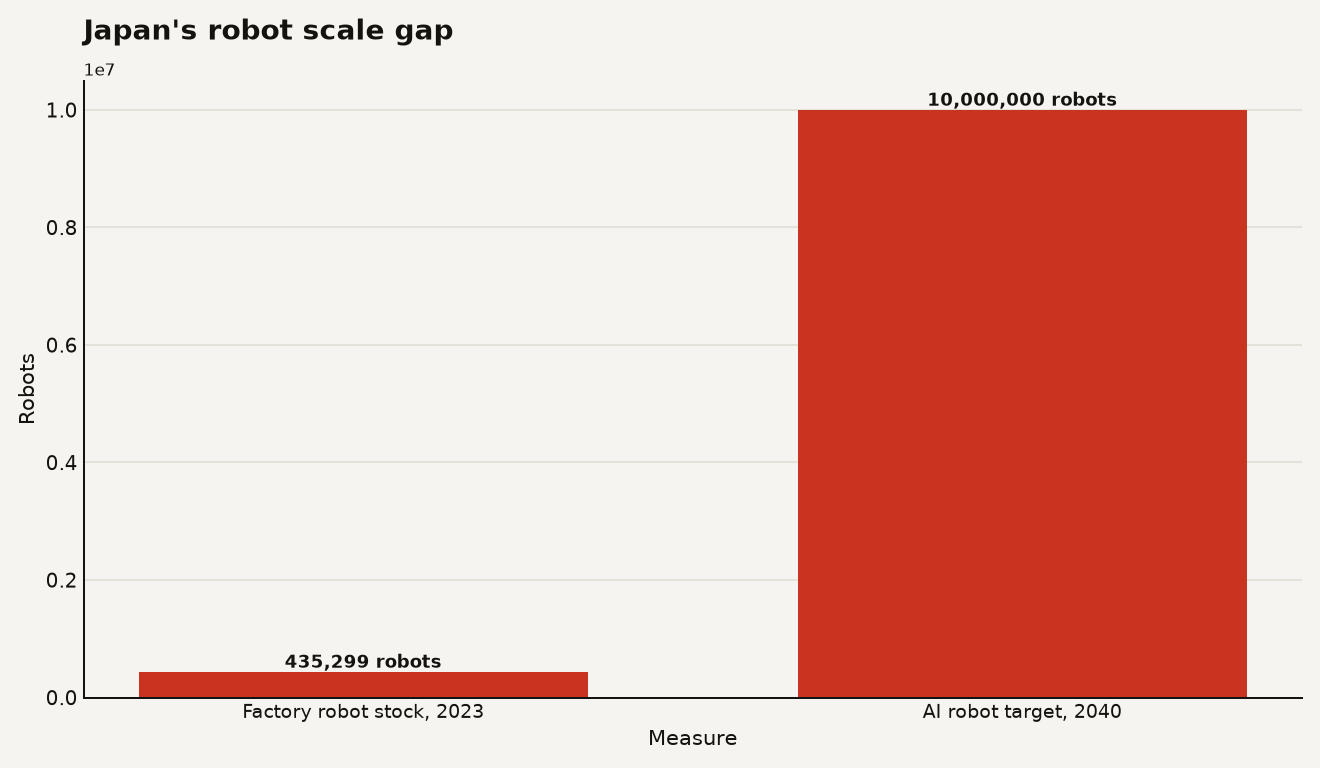
That gap explains why the model matters more than the hardware photo. A robot count this large cannot be reached one custom integration at a time. Japan needs reusable perception, planning, evaluation, synthetic data, and deployment tooling that can travel from a factory cell to food production to elder care without each project becoming a bespoke systems integration swamp.
The labor backdrop is severe. Recruit Works Institute estimated that Japan faces more than 11 million workers of labor supply shortfall by 2040 in its Future Predictions 2040 report. That is why the first wave of physical AI will chase dull operational pain before humanoid spectacle: logistics gaps, inspection routes, food preparation, maintenance, care support, and dangerous cleanup work.
Japan is also starting from a strong but narrow base. IFR said Japan accounted for 38 percent of global industrial robot production in 2023 in its country release. The policy bet is that manufacturing know how plus domestic operational data can offset weaker positioning in frontier language models.
The physical version of the data moat
Because this is the physical version of the data moat argument. A chatbot can train on public text, licensed media, and user interactions. A robot model needs video, sensor streams, force data, failure cases, maintenance logs, layout constraints, human intervention records, and domain specific safety rules. Much of that data lives inside firms that hate leaking process knowledge.
METI says the project exists because Japan needs a domestic multimodal foundation model that lets companies use on site data while protecting it, and that claim appears in the ministry's launch release. That is the sovereign AI argument with steel toes.
For you, the consequences are practical:
- APIs will follow data rights. If physical AI models must learn from proprietary operations, expect enterprise buyers to demand deployment patterns that keep raw data local or under national jurisdiction.
- Evaluation will become a product surface. A robot policy that works in a demo and fails around wet floors, dim lighting, or a tired nurse is a liability engine.
- Vertical datasets will matter more than generic benchmarks. The best model for restaurant prep, plant inspection, or hospital logistics may come from workflow coverage rather than parameter count.
- Integration talent gets scarcer. Teams that can connect robotics, safety engineering, edge inference, observability, and process redesign will price like cloud migration experts did during the last platform shift.
This also changes the roadmap math for AI software companies. If you sell agents into operations, the endpoint may stop being a browser, a ticket queue, or a spreadsheet. The endpoint becomes a machine that moves, senses, and can break things. That makes reliability work feel less optional, a point we also saw in Data Today's coverage of agentic AI work moving from chat to delegation.
The underrated line in METI's documents is energy. METI says Japan's low energy self sufficiency makes power saving for AI use especially important in the project announcement. Physical AI will be judged on watts, latency, uptime, and maintenance windows ahead of leaderboard scores.
A demand signal, not a procurement calendar
Treat Japan's plan as a demand signal, not a procurement calendar. A first model may appear quickly, but useful deployment will take years of tooling, safety cases, and business process redesign.
If you run an AI product team, three moves make sense now.
First, map which parts of your workflow generate real world operational data. The valuable layer may be the messy logs your company currently throws away: exception handling, operator overrides, inspection photos, incident reports, and maintenance notes. In a physical AI economy, these are training assets.
Second, build your architecture around data boundaries. Noetra's project says trained weights will be provided domestically, and METI's logic model describes broad access for Japanese developers and users in the model delivery plan. If your product crosses borders, assume customers will ask where weights run, where telemetry lands, and how private process data gets separated from shared model improvement.
Third, hire or partner for safety and systems integration earlier than feels fashionable. A browser agent can embarrass you. A warehouse agent can injure someone. A hospital logistics robot can block care. The engineering bar moves from "does it answer" to "does it recover safely at 3 a.m. when a sensor lies."
The next public checkpoint is boring by design: stage gate review. NEDO says continuation after fiscal 2027 will be judged each year through a stage gate process in its implementation decision. Watch for weight releases, evaluation protocols, participating data partners, and whether companies outside the original consortium can build against the stack without political handshakes.
Also watch the market ambition. METI's evaluation document points to a 2040 goal of more than 30 percent world share in AI robots, equal to about 20 trillion yen of market capture, in its outcome model. That number is industrial policy language, but it tells vendors where budgets may flow: model infrastructure, robot middleware, simulation, edge compute, data governance, and deployment services.
The robot plan is really a data plan
Japan's 10 million robot target sounds like a hardware story because robots photograph well. The real wager is quieter: convince enough companies to turn proprietary operational data into a shared national learning loop without giving away the crown jewels.
If that works, Japan gets more than robots. It gets a domestic feedback system for physical work.
If it fails, the country will still have impressive machines, just each one trapped in its own little factory kingdom.
Sources
- METI: Minister Akazawa press conference, June 30, 2026
- METI: AI robot and physical AI multimodal foundation model project launch
- NEDO: Implementation structure decision for the multimodal foundation model project
- NEDO: Implementer list for the multimodal foundation model project
- NEDO: Proposal summary for Noetra and AIST
- METI: Multimodal foundation model project evaluation scenario and logic model
- International Federation of Robotics: World Robotics 2024 Japan
- Recruit Works Institute: Future Predictions 2040