If you build forecasting systems, you know the routine. A separate model for every dataset. Retraining when distributions drift. A graveyard of bespoke ARIMA and Prophet pipelines that nobody on your team wants to maintain. Time series foundation models promise to break that cycle: pretrain one model on enough diverse series, then generate forecasts on new data zero-shot, with no fine-tuning and no dataset-specific fitting.
IBM just made that promise harder to dismiss. On September 9, 2026, IBM released Granite Time Series PatchTST-FM-r2, a time series foundation model with roughly 385 million parameters that ranks second among replicable zero-shot models on the GIFT-Eval benchmark and first among models available under a permissive, commercial-friendly license. IBM announced the release with full open weights, architecture, inference pipeline, and benchmark reproduction code on Hugging Face. The model is dual-licensed under Apache 2.0 and OpenMDW 1.0.
The gap between the best zero-shot time series model you can download and the best one you can ship in a commercial product is now thin enough that licensing may matter more than accuracy when you choose.
What did IBM actually ship with PatchTST-FM-r2?
PatchTST-FM-r2 is the newest entry in IBM's Granite Time Series family, building on the original PatchTST architecture and its zero-shot predecessor PatchTST-FM-r1. The model card on Hugging Face lays out the headline specifications.
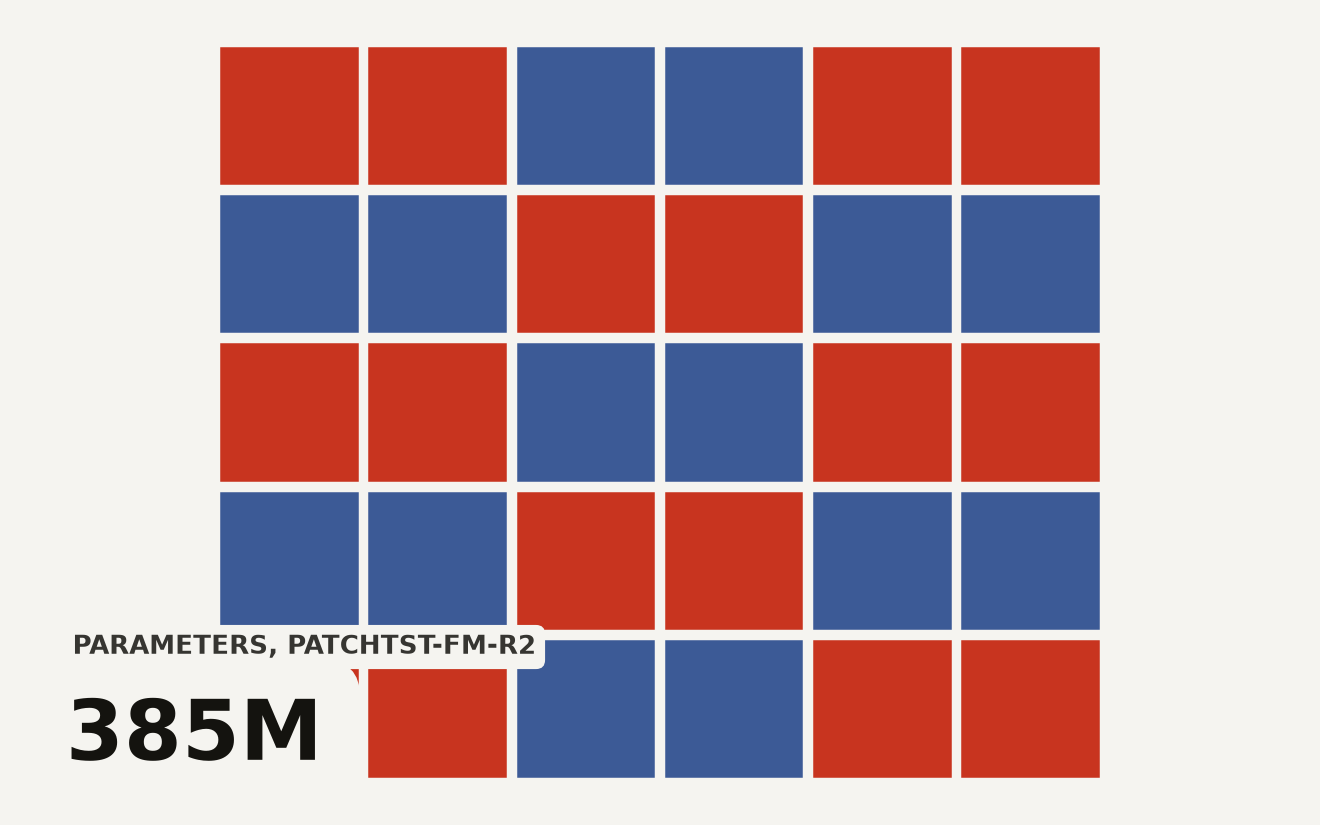
The model has approximately 385 million parameters arranged across 30 conformer blocks, up from 20 blocks in r1. It supports a context length of 8,192 steps, matching the previous version. A 99-quantile prediction head generates probabilistic forecasts, giving you both point estimates and full distributional outputs with uncertainty intervals. It also handles imputation of missing values, expanding its utility beyond pure forecasting.
The model targets general-purpose zero-shot forecasting across demand, prices, energy loads, traffic, telemetry, and other regularly sampled time series. You load it from Hugging Face, pass in recent history, and get a forecast with quantiles. No fine-tuning, no task-specific fitting.
IBM also documented the pretraining corpus, which matters more than it sounds for enterprise adoption. The training data consists of four sources: selected datasets from GiftEvalPretrain, custom synthetic data based on KernelSynth with modified periodic kernels, a TSMixup corpus restricted to datasets outside the GIFT-Eval evaluation set to prevent leakage, and approximately 500,000 synthetic CauKer sequences each of length 4,096. That documented corpus gives enterprise teams something concrete to review during model governance that an opaque pretraining setup never could.
How does r2 perform on the GIFT-Eval benchmark?
GIFT-Eval is a comprehensive time series forecasting benchmark that evaluates models across diverse datasets and forecasting scenarios. When the leaderboard is restricted to models that are zero-shot, replicable, and evaluated without test leakage, PatchTST-FM-r2 ranks second for both CRPS and MASE as of September 8, 2026. Lower values are better for both metrics.
The model achieves a geometric-mean CRPS of 0.467 and a geometric-mean MASE of 0.6846, according to IBM's benchmarking results, placing it immediately behind TimesFM-3 in the zero-shot replicable category. Among models with permissive, commercial-friendly licensing, PatchTST-FM-r2 is the top performer. Every model ranked above it on the zero-shot leaderboard carries licensing terms that complicate or block commercial deployment.
The chart below shows how r2's ranking shifts when pretrained models enter the comparison.
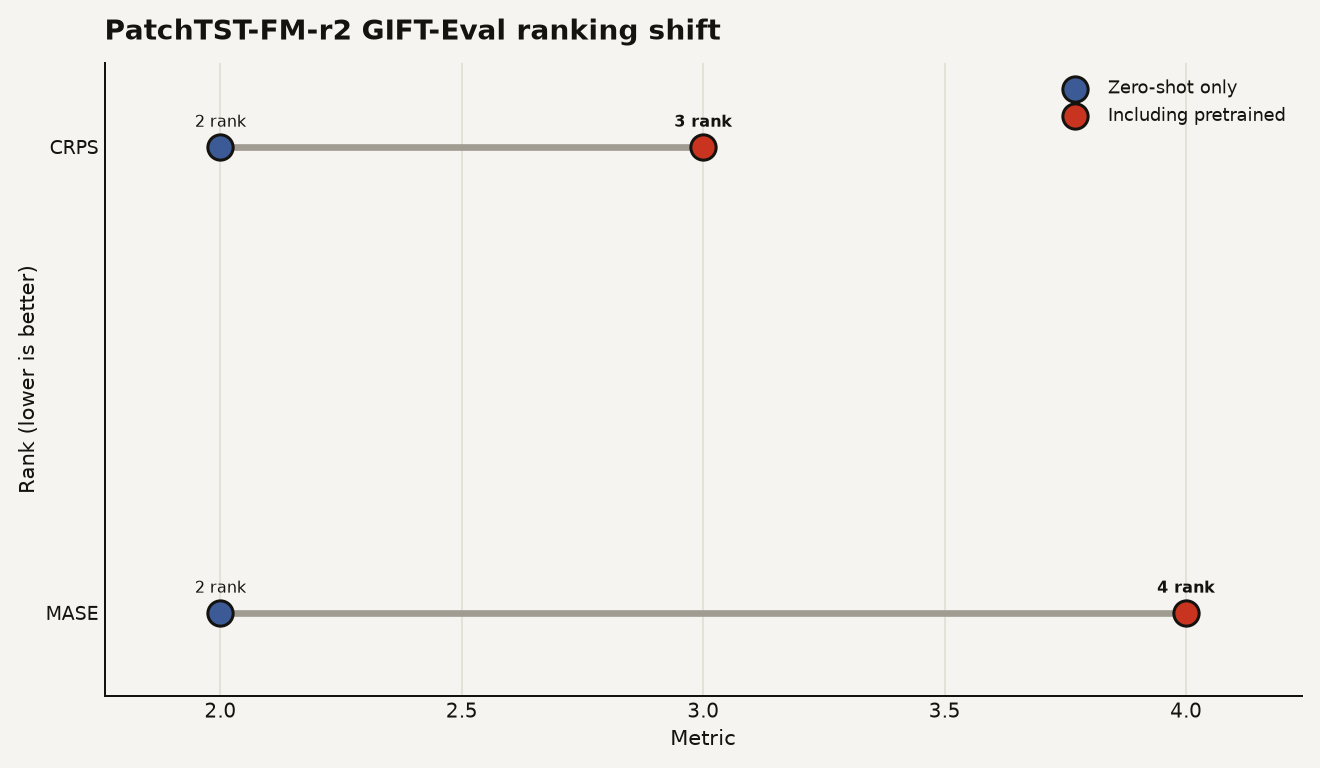
Pretrained models on GIFT-Eval are allowed to include the training portions of GIFT-Eval evaluation datasets in their pretraining corpora, giving them an inherent advantage on the benchmark. Even so, PatchTST-FM-r2 holds its ground: it ranks third for CRPS and fourth for MASE among all replicable models, zero-shot and pretrained combined. The same IBM results show it outperforms several pretrained models, including Chronos-2, Timer-S1, and Toto variants, some of which are considerably larger.
That resilience matters. A zero-shot model that competes with models allowed to train on the benchmark data is a model you can trust to generalize to your data, not just to the test set.
What architectural changes drove the accuracy gains?
The biggest structural change from r1 to r2 is the move from standard transformer layers to conformer blocks, an architecture that originated in speech recognition. Each conformer block sandwiches multi-head self-attention and a temporal convolution layer between two half-step feed-forward networks.
The logic is straightforward. Self-attention captures long-range relationships between patches. Temporal convolution provides an inductive bias toward local structure. Splitting the work this way lets the attention layers focus on long-distance patterns while the convolution handles short-term interactions. IBM observed this directly in attention maps from the ETTh1 dataset: the conformer version shows far-off-diagonal focus, while the original transformer's attention concentrates near the diagonal because it is busy modeling local relationships that the convolution now handles.
The conformer blocks use alternating convolution kernel sizes of 3 and 5 in a repeating pattern of {5, 5, 3, 3} across all 30 blocks. The model also adds a pre-head layer norm for training stability and expands from 20 to 30 blocks to absorb the larger training corpus.
Two other changes target prediction smoothness. PatchTST-FM-r2 uses 50 percent overlapping patches with Hamming-window weighting during training and an overlap-and-add approach during inference. This smooths patch boundaries and measurably improves forecast accuracy. These are the kind of engineering details that sound minor in isolation but compound into real benchmark gains.
What does an open 385M time series model mean for your stack?
The developer consequences are concrete enough to plan around.
- You can prototype forecasts without a training pipeline. Load the model from Hugging Face, pass your recent time series, and get quantile forecasts in a few lines of Python. If you have been evaluating whether foundation models work for your domain, the barrier to finding out is now a notebook afternoon, not a training run.
- The Apache 2.0 license removes the procurement bottleneck. Models with restrictive or ambiguous licensing terms often require legal review before they can ship. Apache 2.0 and OpenMDW 1.0 are permissive enough that most legal teams will clear them quickly. That changes the calculus for teams comparing proprietary forecasting APIs against open alternatives that previously were not competitive on accuracy.
- 385M parameters is a laptop-scale model. You do not need a GPU cluster to run inference. A model this size can run on a single consumer GPU or even CPU for batch forecasting, which changes the unit economics of forecasting as a service.
- Probabilistic forecasts come built in. The 99-quantile head means you get prediction intervals and full distributions without bolting on a separate uncertainty estimation step. For teams building inventory optimization, risk modeling, or any system where point forecasts are insufficient, this is a meaningful shortcut.
- Missing value imputation is part of the package. Real-world time series have gaps. A model that handles imputation natively saves you a preprocessing step that is often more painful than the forecasting itself.
For broader context on where deep time series methods stand against simpler approaches, our coverage of why linear models beat deep learning for time series anomaly detection is worth reading. Foundation models are not always the answer, and knowing when a simpler method wins is half the battle.
Should you replace your fine-tuned forecasters today?
Not yet. Here is the honest read.
PatchTST-FM-r2 is a zero-shot model. Zero-shot means you get a strong baseline without any training, but it does not mean you get the best possible forecast for your specific dataset. If you have a well-tuned model trained on years of domain-specific data, a zero-shot foundation model will likely not beat it on every metric. What it gives you is a strong starting point that is good enough for many use cases, and a fallback when you do not have the data or the expertise to train a custom model.
The model also expects regularly sampled time series. If your data is irregular, sparse, or high-frequency, you will need preprocessing to reshape it into something the model can consume. The 8,192-step context window is generous for most business time series but could be limiting for very high-frequency sensor data.
IBM has also been building the production deployment story. The company recently made several Granite Time Series models available through an Early Access program in Confluent Cloud, bringing foundation model inference into streaming applications via Apache Flink. The initial portfolio includes PatchTST-FM-r1, FlowState-r1.1, TTM-r3, and TSPulse. PatchTST-FM-r2 is not yet in that lineup, but the integration pattern signals where IBM is headed: forecasts generated from live streams rather than batch DataFrames.
IBM's broader Granite strategy, which we covered when Granite 4.2 shipped with native reasoning and agent RL, is to be the open-weights alternative that enterprises can adopt without licensing anxiety. PatchTST-FM-r2 extends that strategy to time series.
Three things will determine whether this release matters for your roadmap. Watch how quickly r2 lands in the Confluent streaming pipeline. If IBM ports r2 to the same Early Access program, the combination of zero-shot forecasting and stream processing becomes a serious alternative to building and maintaining custom forecasting microservices. Watch the GIFT-Eval leaderboard over the coming months. TimesFM-3 currently leads the zero-shot category, and if the gap between first and second narrows with minor updates to r2, the competitive picture shifts fast. And run r2 on your own data. The model is free to download and the inference pipeline runs in a few lines of Python. The only way to know whether a 385M zero-shot model beats your current forecasting stack is to test it.
The license may matter more than the leaderboard
Open time series foundation models are now accurate enough for commercial use. PatchTST-FM-r2 proves you can get top-tier zero-shot forecasting under Apache 2.0 without sacrificing much on the benchmark. For teams weighing whether to maintain a bespoke forecasting pipeline or adopt a foundation model, the model is free, the license is permissive, and the numbers are real. Your domain-specific data may still give a custom model an edge. Whether that edge justifies the maintenance cost is worth calculating this week.
Sources
- Hugging Face Blog: IBM releases SOTA Granite Time Series PatchTST-FM-r2 model with commercial-friendly license
- Hugging Face: ibm-granite/granite-timeseries-patchtst-fm-r2 model page