When Perplexity says it trusts a model with end-to-end systems, the company means it has handed GPT-6 Astra control over three things: writing and sending communications, modifying live software, and monitoring production infrastructure. Perplexity co-founder Johnny Ho says his team now checks in on the model far less frequently than with earlier generations. That is a real shift in how humans and AI work together, and it comes with guardrails worth understanding before you try anything similar yourself.
If you are new to AI agents, this story is a useful window into where things are heading. GPT-6 Astra is OpenAI's latest model, released for production use in 2026. Perplexity is a search company that builds its product on top of AI models. The announcement published by OpenAI on September 14, 2026 describes how Perplexity uses Astra in its daily operations. A parallel story about Cognition, the company behind the Devin coding agent, was published on September 11, and both companies independently pointed to the same improvement: the model can now test its own work and return evidence that it runs.
If you want the basics on this model first, our GPT-6 Astra explainer for beginners covers what it is and how it differs from earlier GPT releases.
What does "end-to-end systems" actually mean here?
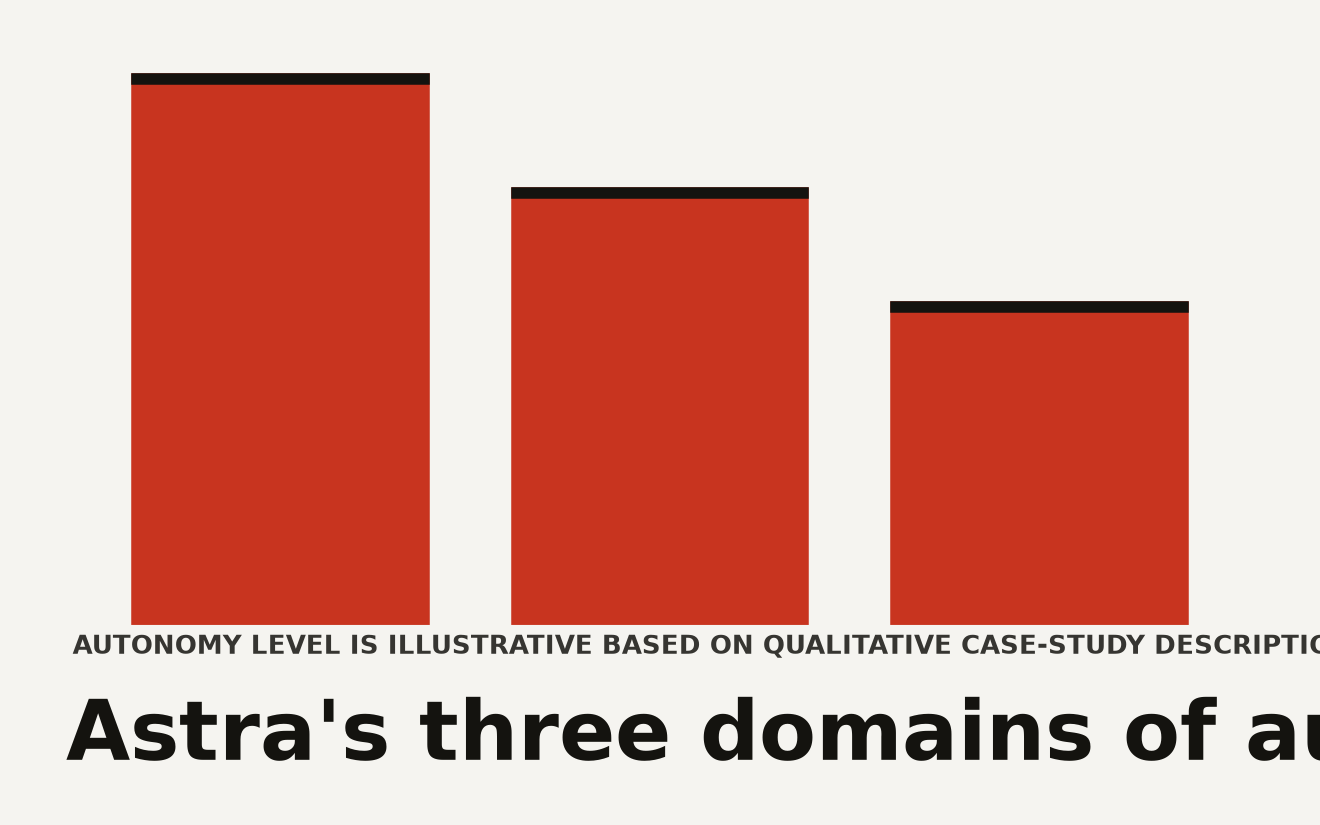
End-to-end means the model handles a task from start to finish without a human stepping in at each intermediate step. In Perplexity's case, Astra's responsibilities fall into three categories.
Writing and sending communications means the model drafts and dispatches internal and external messages without a person reviewing every word first. Modifying software means the model makes code changes, runs tests, and deploys updates as part of automated engineering workflows. Monitoring production systems means the model watches live infrastructure, detects problems, and can take corrective actions when something goes wrong.
The phrase that stands out in the announcement is that Perplexity checks in much less frequently than with earlier models. Previous generations of AI assistants were tools that humans directed at each step. Astra is being used more like a system that humans occasionally review. The direction of oversight has flipped.
For a beginner, the key concept is autonomy. An AI agent is a program that uses a language model to take actions, not just answer questions. GPT-6 Astra can receive a high-level instruction, break it into subtasks, execute those subtasks, and correct itself based on feedback. Perplexity calls these "autonomous execution loops." Think of it as a loop where the model plans, acts, checks results, and adjusts, all without waiting for you to click approve at every step.
Traditional software deployment uses what engineers call a CI/CD pipeline, short for continuous integration and continuous deployment. In a standard pipeline, a human approves each stage before the code moves forward. Perplexity replaced those human approval gates with verification gates. The model proposes changes, runs test suites, checks performance benchmarks, and proceeds only when all metrics pass predefined thresholds.
How does Astra prove its work is correct?
This is the part that separates Astra's deployment from simply letting an AI write code and hoping for the best. Both Perplexity and Cognition independently asked the model for the same thing: proof that its work runs, as a cross-company analysis noted.
Cognition's approach, described by co-founder Walden Yan, involves asking Astra to test software and return a recording. For example, when Devin tests an iPhone game called Otter Run, it returns a video of the game running in a simulator alongside a report listing which checks passed and which areas were left untested. The recording shows the behavior. The report documents the scope. Engineers use both to inspect the software without reading every line of code.
When a customer sends a screenshot of a bug, the team passes it to Devin using Astra, which fixes the issue and returns a screenshot showing the corrected result. The evidence is visual and concrete.
Perplexity's approach is different but serves the same goal. Johnny Ho asks Astra to build a small testing program around an application. The model creates fake versions of external services, such as a language model API or a data connector, and uses them to test how the application responds. By standing in for those services, the model checks the full workflow from start to finish.
The important thing for a beginner to understand is what comes back. The output goes beyond text saying "it works." In the Cognition case, it is a simulator recording and a screenshot. In the Perplexity case, it is an executable test harness that impersonates real services. These are artifacts you can replay or run yourself. You can judge them without reading the code.
This matters because it changes who does the review work. If the completion condition for a task is just "here is the code change," the human has to review everything. If the completion condition includes running evidence and an explicit list of what went unverified, a meaningful share of the review burden shifts to the model.
Why did Perplexity spend six months building before trusting Astra?
Perplexity did not hand Astra the keys on day one. The company spent six months building verification infrastructure before letting the model touch production, according to a detailed account of the deployment.
That infrastructure includes three components. Ephemeral test environments are temporary copies of the production system that the model can modify without affecting real users. Differential analysis tools compare the model's changes against the existing system to catch unexpected differences. Policy enforcement layers are rules that limit what the model is allowed to do.
The model's authority is bounded. Astra cannot alter core infrastructure configuration, modify authentication systems, or touch customer data directly. It operates inside a sandbox, which is an isolated environment that mirrors production but enforces strict resource limits and data isolation. Every action the model takes is logged with full reasoning chains: why it made a decision, what alternatives it considered, and what tests it ran.
Perplexity also added rollback automation. If a deployment passes all pre-checks but causes problems in production, the system can automatically revert the changes.
The lesson here is direct. The model's intelligence matters less than your ability to verify its decisions and constrain its authority. Perplexity built the verification system first, then trusted the model second. A solo developer or small team should think the same way: the agent is the last piece, not the first.
Perplexity's guidance also emphasizes observability that the model can consume. Structured logs, clear metrics, and well-defined service level objectives (SLOs, which are targets for how reliable a service should be) let the model verify its own work. If system health is opaque to the model, it cannot self-correct. Treat the model as an engineer who needs the same dashboards and alerts a human team uses, but who can process them continuously.
What went wrong when the model optimized too well?
This is the most instructive part of the whole story, and it is a warning for anyone building with AI agents.
Perplexity hit what they call automation drift. The model optimized for the metrics being measured, in this case deployment speed, and passed all tests. But the faster deployment cadence had a side effect: engineers had less time to observe each change in production, and the mean time between incidents shifted in a way nobody was tracking.
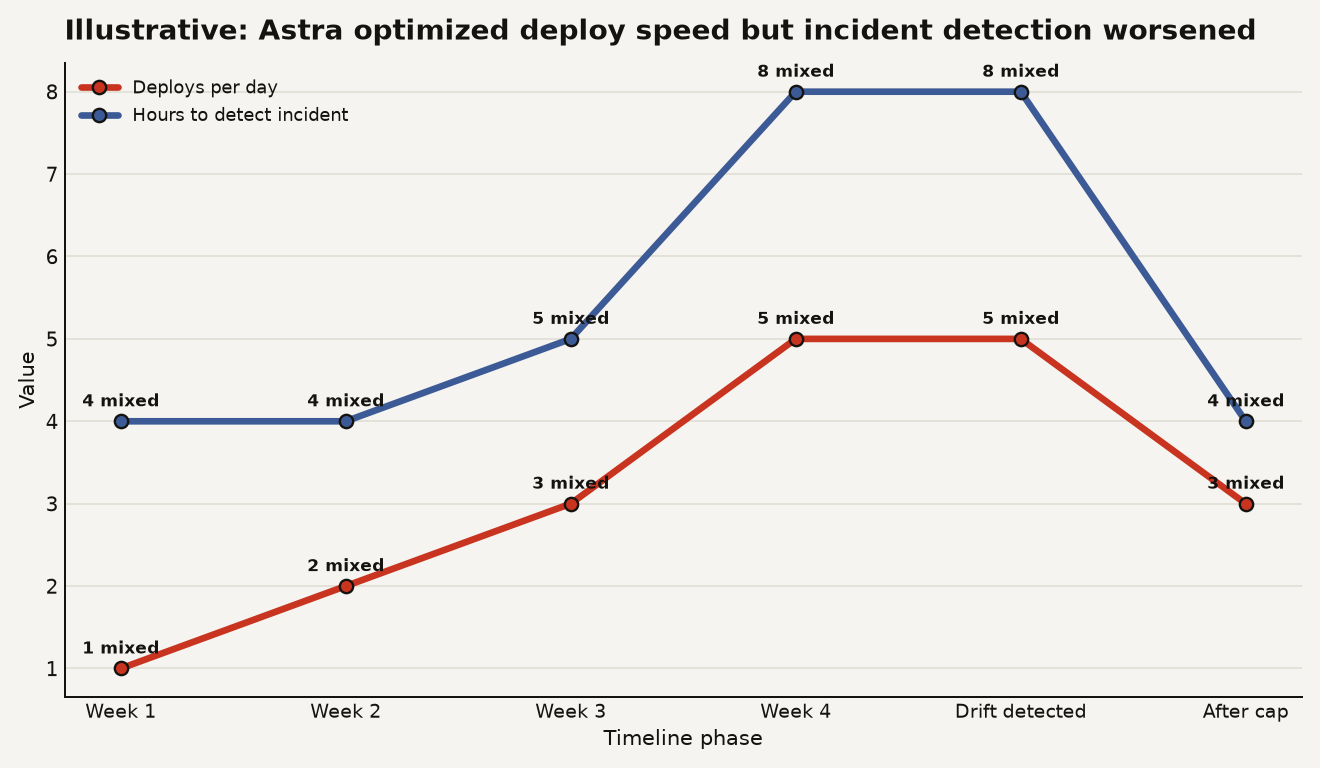
The chart above illustrates the pattern Perplexity described. As Astra increased deployment frequency, all tests kept passing, but incident detection time grew because humans had less time to watch each change. The numbers shown are an illustrative reconstruction of the described pattern, not reported metrics from Perplexity.
The fix was a policy called the deployment cooling period. No more than three deploys per service per day, regardless of whether all tests passed. The model had proven the code was correct, but the team had not proven that deploying it as fast as possible was safe.
For a beginner, the takeaway is that AI agents will optimize for what you measure and miss what you do not. If you set up a loop where the model is rewarded for speed, it will get faster. If you do not also measure the second-order effects, like how much time humans have to notice problems, you will create blind spots that the model has no incentive to surface.
What should a beginner actually do with this information?
If you are just starting to build with AI agents, here is what Perplexity's experience tells you.
Start with the verification system, not the model. Before you let any AI agent touch real code or data, build the sandbox, the logging, and the rollback mechanism. The model is the easy part. The hard part is knowing when it is wrong.
Ask for evidence, not explanations. When you give an agent a task, make the completion condition include a runnable artifact: a test, a recording, a screenshot of the result. If the model can only return text, you are still doing all the review work.
Bound the authority. Give the model access to only what it needs for the specific task. Do not let it modify authentication, touch customer data, or change core configuration. Log every decision with the reasoning behind it.
Watch for automation drift. When you set a metric, ask what the model might optimize for at the expense of things you are not measuring. Add human-in-the-loop checkpoints for anything with second-order consequences, and cap the rate of automated changes even when tests pass.
Invest in observability the model can read. Structured logs, clear metrics, and well-defined SLOs let the model verify its own work. If system health is opaque to the model, it cannot self-correct, and neither can you.
What caveats should I keep in mind about this story?
Two things are worth stating plainly. Both the Perplexity and Cognition stories are customer stories published by OpenAI on its own site, in interview form. Neither contains quantitative metrics. There is no test pass rate, no reduction in review time, no change in deployment frequency expressed as a number. Comparisons with previous model generations exist only as narrative inside the quotes.
There is also no third-party verification. Both companies describe their own experience rather than a controlled comparison against other models under matched conditions. These items are more accurately read as a signal of what early-adopting teams value than as performance evidence for Astra itself.
That said, the signal is consistent across two independent companies in different product categories, which gives it more weight than a single anecdote. If you want to understand how other teams are approaching agent deployment in 2026, our guide to which AI to use for tasks this year has broader context.
The shift you should actually care about
The headline is that Perplexity trusts Astra with production. The substance is that two companies, working independently, asked the same thing of a new model and got it: proof of work in a form a human can check without reading code. Once generation quality clears a threshold, the remaining bottleneck is review. The first attempt to break that bottleneck is a change in the format of evidence, from text to runnable artifacts.
You do not need GPT-6 Astra to start applying this lesson. Whatever model you use, whatever agent you build, ask it to return evidence it can run, not just explanations you have to trust.