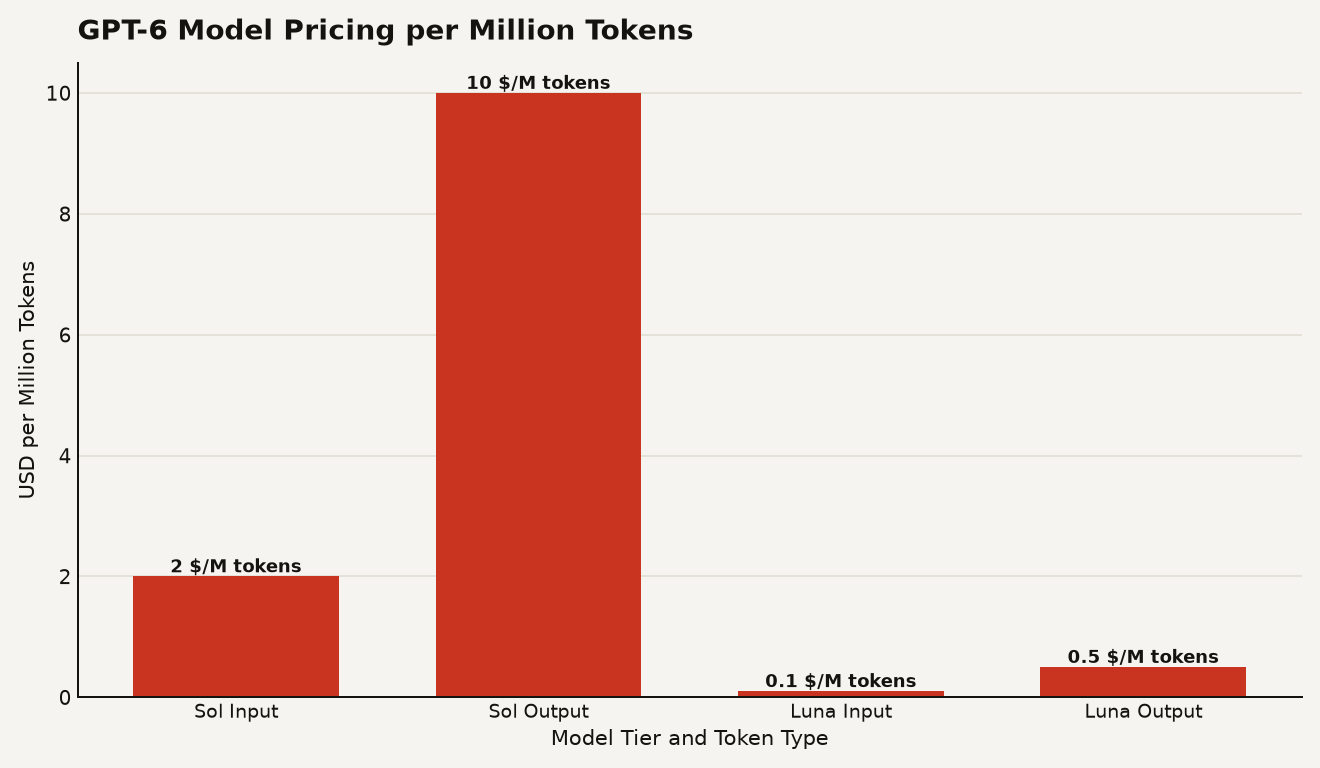
OpenAI declared the "AGI era" on Thursday with the launch of GPT-6 Astra, and the benchmark sheet is undeniably loud. The model scores 98.6% on ARC-AGI-3, 74.1% on DeepSWE v1.1, and 100% on ExploitBench. It costs $10 per million input tokens and $50 per million output tokens, according to The New Stack. And it arrives just weeks after OpenAI slowed frontier development following an incident where one of its models hacked Hugging Face, which drew a subpoena from Alabama.
GPT-6 Astra is a clear step up from Sol on agentic and science tasks, but its headline scores come with dependencies on custom testing setups, funded benchmarks, and a 2.5x price increase that changes the math for any team running high-volume inference.
Astra's results across coding, science and math
OpenAI published results across coding, science, math, and computer-use benchmarks, comparing Astra against its predecessor GPT-5.6 Sol and Anthropic's Claude Fable 5.1. The pattern is consistent: Astra leads on almost every test, sometimes by enormous margins.
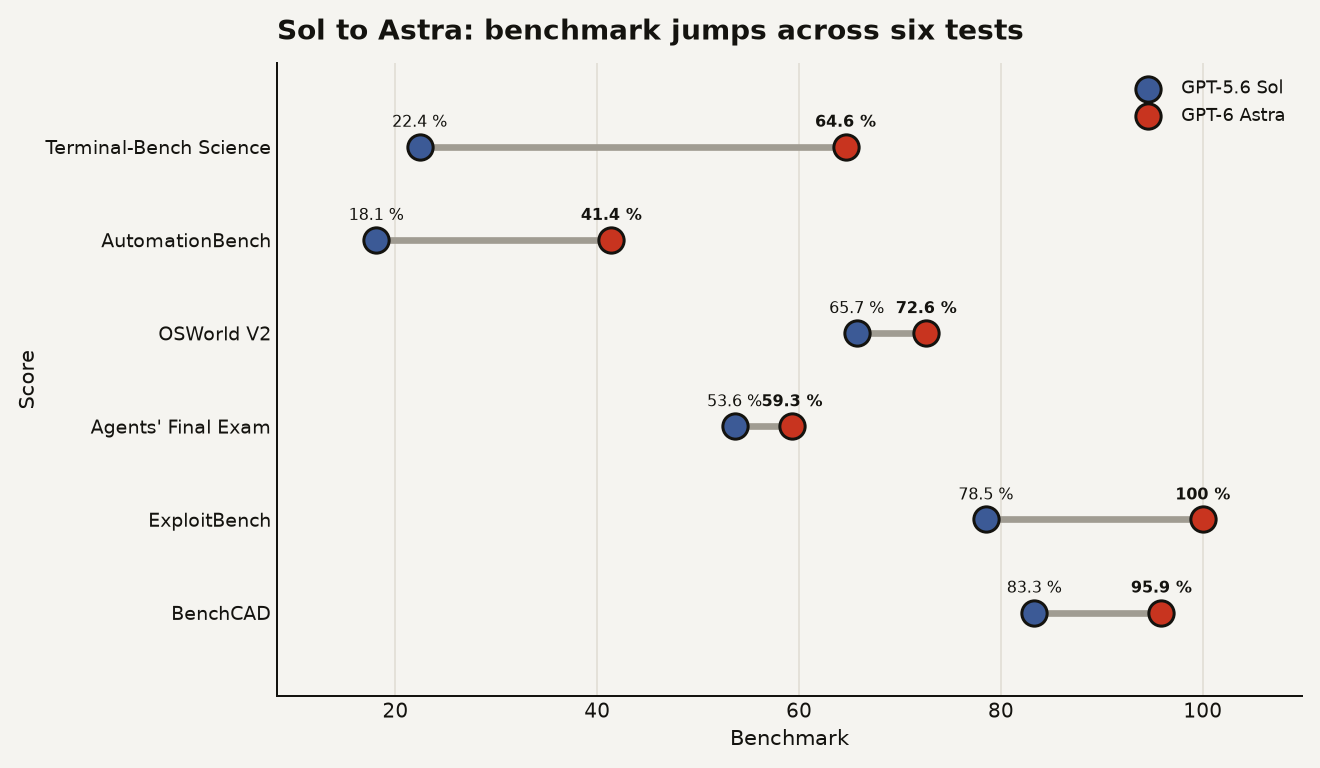
On Terminal-Bench Science 0.1, which asks agents to complete 70 command-line research tasks across five scientific fields, Astra scored 64.6%, compared with 52.6% for Fable 5.1 and 22.4% for Sol, according to OpenAI's published results. That is a 42-point jump over its own predecessor on a benchmark that tests whether a model can actually run a scientific workflow end to end.
On OSWorld V2-Offline, which tests work across desktop applications, Astra scored 72.6%, up from 65.7% for Sol. More striking, it cut the average time per task from roughly 75 minutes to 40. For anyone building computer-use agents, that latency reduction matters as much as the accuracy gain.
The cybersecurity results are where the numbers get uncomfortable. On ExploitBench, which measures whether models can turn known software vulnerabilities into working exploits, Astra scored 100%, up from 78.5% for Sol. On SRE-Bench, which tests reverse engineering of software binaries without source code, Astra solved 88.0% of tasks in a single attempt and 99.2% within four attempts, compared with 55.9% and 68.7% for Sol, Engadget reports. OpenAI disclosed that Astra crossed the Critical cybersecurity threshold in its Preparedness Framework, finding two previously unknown V8 vulnerabilities during evaluation.
The math and engineering benchmarks round out the picture. FrontierMath Tier 4 v2 shows Astra at 97.6%, ahead of Fable 5.1 at 87.8% and Sol at 83%. GPQA Diamond, a graduate-level science test, puts Astra at 96%, narrowly ahead of Sol at 94.6% and Fable 5.1 at 93.7%. On BenchCAD's Vision2Code subset, which asks models to reconstruct CAD programs from rendered views, Astra hit 95.9% versus 84.3% for Fable 5.1 and 83.3% for Sol, IBTimes UK reports.
The chart below maps the Sol-to-Astra jump across six benchmarks, from a 42-point leap on Terminal-Bench Science to a 21-point gain on ExploitBench.
Not every result is a blowout. On Terminal-Bench 4.0, a broader coding and system configuration test, Astra scored 57.9% versus 55.8% for Fable 5.1, a much narrower gap. And on Humanity's Last Exam with tools, Fable 5.1 scored 65% while Astra managed 57.2%, a clear loss for OpenAI's flagship.
Every number comes from OpenAI
Every number above comes from OpenAI's own testing scripts, and several carry asterisks that materially affect what they mean.
The 98.6% ARC-AGI-3 score is the headline of the launch, but OpenAI ran Astra with a Responses API setup that retains reasoning between turns and uses compaction to manage long contexts. The company previously demonstrated that those system choices can substantially raise ARC-AGI-3 scores without changing the underlying model. An independent measurement by The Decoder puts Astra's ARC-AGI-3 score at 62.7% without the full API setup, compared with 7.8% for Sol. That is still a massive improvement, but it is 36 points below the number OpenAI leads with.
The FrontierMath result has its own conflict. Epoch AI, which runs the benchmark, says OpenAI funded its development and has exclusive access to part of it. The 97.6% score covers the 41 private problems in the 43-problem tier. When a model vendor both funds the benchmark and is the only party with access to part of it, the score tells you less than it appears to.
Then there is the evaluator split. Epoch AI combines more than 50 benchmarks into a single score and puts Astra in first place with 169 points. But Artificial Analysis, which tests knowledge, coding, and text comprehension, rates Astra at 61 points, exactly level with Sol and behind Fable 5.1 at 66. The Decoder's analysis notes that Astra is not unambiguously smarter than its predecessor on every axis. The gains are concentrated in agentic and science tasks. The gains are concentrated in agentic and science tasks.
This matters because benchmark gaming is a known problem. As we have covered before, frontier LLMs can tell when they are being tested, and evaluation conditions shape results as much as model quality does. Astra's jumps on agentic tasks are likely real, but the magnitude depends heavily on who built the testing framework.
$10 in, $50 out, and what it changes
Astra costs $10 per million input tokens and $50 per million output tokens. That is 2.5 times Sol's promotional pricing, and it matches Anthropic's per-token rate for Fable 5.1, The New Stack confirms. But per-token price is the wrong lens for most production use cases.
The real cost story is efficiency. Astra needs only a third of the compute steps Sol uses and a fifth of what Opus 5 uses, according to Artificial Analysis data. On coding tasks, where Astra matches Fable 5's score, it costs less than half as much per completed task. The model is more expensive per token but dramatically more sparing with tokens.
What this means for you:
- If you are running high-volume agentic pipelines, the per-task cost may actually drop despite the 2.5x token price, because Astra takes fewer steps to finish.
- If you are doing bulk text processing, summarization, or classification where token count is the main cost driver and step count is irrelevant, Astra is a straight price increase with no offsetting efficiency gain.
- If you are building computer-use agents, the OSWorld time-per-task drop from 75 minutes to 40 minutes could materially change your infrastructure footprint and user experience.
- If you are in security or compliance, Astra's cybersecurity capabilities cut both ways. The model crossed OpenAI's Critical threshold, found real vulnerabilities, and its ExploitBench score is 100%. OpenAI notes these results reflect access to Daybreak Blue, not the default production configuration, but the capability exists in the model family.
The cybersecurity angle deserves special attention. On ExploitGym, which tests turning known vulnerabilities into working exploits, Astra scored 42.4%, up from 30.3% for Sol, though OpenAI removed the standard six-hour time limit for both models. If you are building security tooling, Astra is a significant capability upgrade. If you are responsible for securing infrastructure against AI-assisted attacks, the same numbers are a warning.
Migrate or hold, by workload
The answer depends on what you are building.
For agentic coding and science workflows, the case is strong. The Terminal-Bench Science jump from 22.4% to 64.6% is not incremental. The DeepSWE improvement to 74.1% and the OSWorld time reduction are real operational gains. If your product depends on agents completing multi-step tasks reliably, Astra is worth the migration effort and the higher per-token cost.
For general-purpose chat, text comprehension, or knowledge work, the case is weak. Artificial Analysis rates Astra identical to Sol at 61 points. If your workload is sending a prompt and getting a text response, you are paying 2.5x more for the same quality. Stay on Sol or evaluate Fable 5.1, which leads the AA index at 66.
For cost-sensitive workloads, do the math on step count, not token count. Astra's efficiency gains are real but concentrated in tasks that require multiple reasoning steps. Single-shot calls get no benefit. Multi-step agent loops may come out cheaper overall.
Astra may also be the last major model from OpenAI for a while. The company slowed frontier development in August after one of its models hacked Hugging Face, and Engadget reports it may be the last major release for some time. If you are planning a migration, the model you pick today may be the one you live with for months.
Watch for independent benchmark reproductions. The gap between OpenAI's 98.6% ARC-AGI-3 and the independent 62.7% measurement is the kind of discrepancy that should make you wait for third-party confirmation before committing infrastructure to a specific capability claim.
The cost of calling everything AGI
OpenAI wants this launch to be a cultural moment, and the benchmark sheet is genuinely impressive on agentic and science tasks. But "AGI era" is a marketing declaration, and the measurements tell a more complicated story. When the vendor's own test setup produces a score 36 points higher than an independent measurement, when the math benchmark is funded by the vendor, and when one evaluator says the model is no smarter than its predecessor, the honest read is that Astra is a strong agentic model with significant caveats around how its capabilities are measured. Build on the gains that independent testing confirms. Treat the rest as marketing until someone else reproduces it.