How does an assistant remember what you told it on your phone when it needs a frontier model in the cloud to act on that memory? That question is becoming the central architecture problem for consumer AI, and Google DeepMind just sketched an answer that leans hard on cryptography. On September 23, 2026, the company's Private AI Compute team published details of secure server-side AI memory, a system that stores encrypted personal data in cloud databases but holds the decryption keys exclusively on user devices. The company says even it cannot read the stored data. The architecture combines hardware-enforced secure enclaves, per-user encrypted databases, and device-derived encryption keys, and it ships with a tamper-proof software record so your phone can verify the server code before sending anything personal. The timing matters. AI assistants are evolving from single-turn tools into persistent agents that need continuity across phones, laptops, glasses, and whatever comes next. Every memory layer that makes an assistant more useful also creates a concentrated store of personal data. Apple keeps its most sensitive AI processing on-device. Google's answer is to move the data to the cloud but make the cloud unable to read it.
What did Google actually announce?
The announcement updates Google's Private AI Compute platform, which the company describes as an architecture for bringing on-device privacy standards to server-side AI processing. The new piece is persistent memory: a storage layer that retains information across sessions and devices, encrypted at rest in the cloud, with keys that never leave the user's hardware.
Under the proposed architecture, each user gets a dedicated encrypted database. When the AI model needs to access stored information, the user's device establishes an authenticated, end-to-end encrypted connection to a secure enclave in Google's cloud. The enclave temporarily decrypts only what the request needs, processes it, saves any new context, and re-encrypts everything before the session ends. The cryptographic keys required to unlock the data are generated and held on the user's own devices, not by Google.
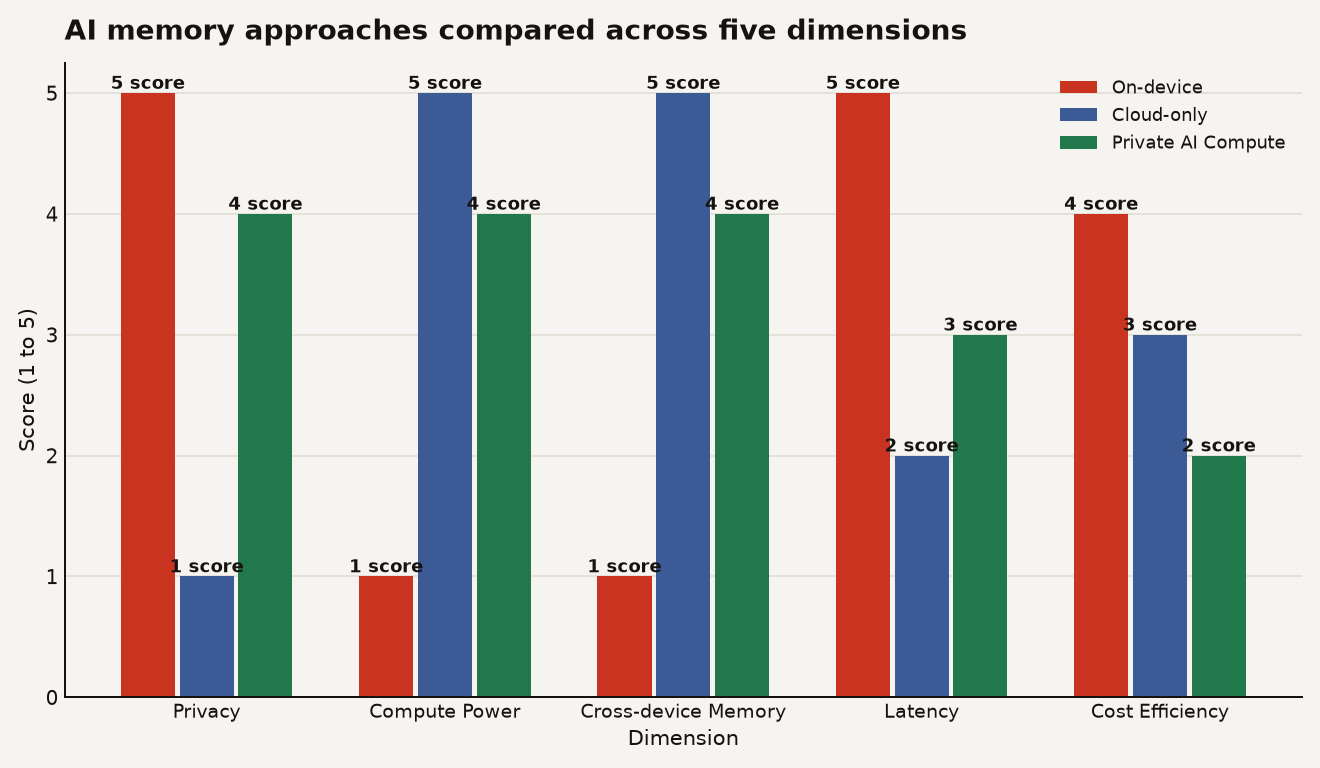
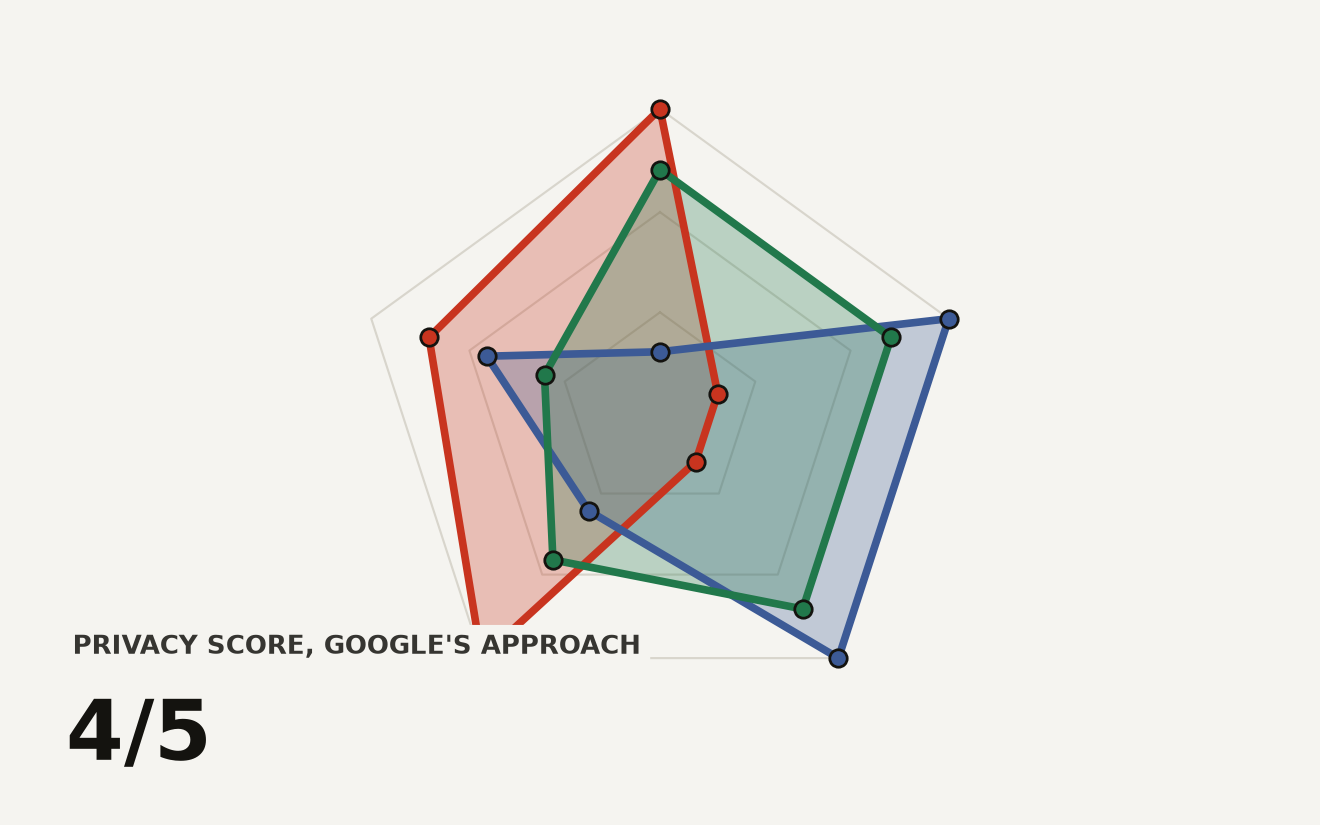
The heatmap above scores three approaches to AI memory across five dimensions on a 1 to 5 scale. On-device processing earns the top privacy score of 5 but bottoms out at 1 on compute power and cross-device memory. Cloud-only processing flips that tradeoff, scoring 5 on compute and continuity but 1 on privacy. Google's Private AI Compute lands at 4 on privacy, compute, and cross-device memory, paying for it with lower latency and cost efficiency scores. These ratings are illustrative, derived from the architectural properties described in the announcement.
Google also said it is publishing a tamper-proof public record of its server software. Devices running Private AI Compute will be able to verify that the server code is authentic and unaltered before transmitting any personal data. An independent cybersecurity firm conducted an audit, though Google did not name the firm in its announcement. The company released an updated technical whitepaper, system architecture details, security proofs, and verification protocols alongside the blog post.
The work was co-developed across Google DeepMind, Platforms & Devices, Core, and Cloud teams. That list tells you this is infrastructure being built into the product stack, not a research demo.
How does the secure enclave keep Google out of your data?
The architecture rests on three pillars, and each one matters for whether you should trust it or build something similar.
First, the per-user encrypted database. Every user's memory is stored in its own encrypted container. The encryption keys are derived from the user's devices, meaning Google's servers hold encrypted blobs they cannot read. If an attacker compromises the server, or if Google itself wants to look at the data, they get ciphertext.
Second, the secure enclave. When a request comes in, the enclave is an isolated hardware environment that can temporarily decrypt the data in memory, process it, and re-encrypt it. The enclave is designed so that even the host operating system cannot inspect its memory. This is the same class of technology behind Google Cloud's Confidential Space, which the company used in its August 2026 double-blind AI evaluation pilot with the Singapore AI Safety Institute, OpenMined, AVERI, and MLCommons. In that pilot, the same cryptographic isolation that protects user memory also protected evaluation prompts from the model provider, proving the pattern works for more than one use case.
Third, the tamper-proof software attestation. Before a device sends any data, it can cryptographically verify that the server is running the exact software Google published in its public record. If the server has been modified, the attestation fails and the device refuses to send data. This is the mechanism that closes the trust gap: the device verifies the software cryptographically rather than taking Google's word for it.
The combination is what makes the architecture notable. Encrypted storage alone is table stakes. Secure enclaves alone are a cloud product. Device-held keys alone are a local security pattern. The contribution is wiring all three together so that server-side memory is functionally useful for AI workloads while remaining opaque to the service provider. If you want to understand why this kind of verification architecture matters, the trust gates Perplexity built around GPT-6 Astra are a useful parallel: both cases assume the model provider cannot be fully trusted with raw user data.
Why does this matter if you build AI products?
If you are building an AI assistant, a memory layer, or any product that calls a frontier model with personal data, this architecture is a preview of the standard you will be measured against.
The trust problem is intensifying. Users are wary of AI systems that remember everything they say. A Pew Research survey covering 34 of 37 countries found broad public unease about AI's impact on livelihoods, and the same distrust extends to data collection. If your assistant stores conversation history in a plaintext database, you are one breach or one subpoena away from a privacy scandal. Google is building a system designed to make that scenario structurally impossible.
For your codebase, the relevant pattern is device-derived encryption keys with server-side enclaves. You do not need to replicate Google's exact architecture to adopt the idea. Confidential computing is available as a commercial product from Google Cloud, AWS, and Azure, all offering hardware-isolated execution environments. The overhead varies by workload and provider, but every memory access through an enclave costs more than a plain database read.
What this means for you:
- If you store user memory server-side, the bar is now encrypted at rest with keys the server cannot access. Plaintext storage or provider-held-key encryption is becoming a liability.
- If you build cross-device AI assistants, device-held keys solve the continuity problem without forcing users to choose between convenience and privacy. A conversation started on a phone continues on a laptop without either device trusting the server with raw data.
- If you evaluate model providers, the same confidential computing infrastructure can protect evaluation prompts from the model provider. If your enterprise needs to test a frontier model on sensitive data without revealing that data, this is a demonstrated pattern.
- If you are thinking about moats, the real advantage is the end-to-end attestation chain: device verifies server, server processes in enclave, keys never leave device. Building that chain is hard. Google has the advantage of controlling both the device side through Android and Chrome OS and the server side through Cloud and TPU infrastructure.
The cost question is real. Secure enclaves add compute overhead because every memory access runs through an isolated hardware environment. Google can absorb that cost across its infrastructure. A startup probably cannot, which is why this architecture favors platform providers who control the full stack.
Should you build this yourself or wait for the platform?
The answer depends on what you are building and who your users are.
If you are a solo founder or small team shipping an AI assistant, do not try to build secure enclaves from scratch. Use a cloud provider's confidential computing offering and focus on getting the key management right. The enclave itself is a managed cloud service. The hard part is the device-to-server attestation flow that proves the enclave is running your code before you send data to it. Get that wrong and the whole architecture is security theater.
If you are an enterprise building internal AI tools, the calculus is different. Your users are your employees, and your compliance team may require this level of protection for sensitive data flowing through third-party models. In that case, the architecture is a blueprint worth studying. Google's published whitepaper and security proofs give you a reference design, and the double-blind evaluation pattern shows how to test models on confidential data without exposing it.
The open question is whether Apple responds. Apple's on-device AI strategy avoids the server-side memory problem by keeping most processing local. But as models grow and on-device compute hits limits, Apple faces the same dilemma Google is trying to solve. A competing architecture from Apple, with its own Secure Enclave hardware and control over the device, would be a serious challenger. The company has not announced a comparable server-side memory architecture as of September 2026.
Another question is audit credibility. Google said an independent cybersecurity firm audited the system but did not name the firm. The company invited the privacy community to verify its protections, but real verification requires access to the hardware, the firmware, and the full software stack. Whether independent researchers can reproduce Google's claims remains to be seen. Tamper-proof software records prove the server runs specific code. Whether that code is correct is a separate question.
The trust tax
Every privacy architecture imposes a cost. On-device processing imposes a capability tax: you cannot run a frontier model on a phone. Cloud processing imposes a trust tax: you have to believe the provider will not read your data. Google is proposing to pay the trust tax in compute overhead instead of in user privacy, and to let devices verify the payment. Google published this architecture on September 23, 2026. Whether the math works at scale, and whether users believe the verification, will decide if secure server-side AI memory becomes the default or a footnote. The architecture is sound. The question is whether trust is something you can engineer, or something you have to earn.
Sources
- deepmind.google , Google DeepMind, "Advancing Private AI Compute with secure, server-side memory"
- deepmind.google , Google DeepMind, "Piloting the world's first double-blind AI evaluations"
- gadgetbond.com , Gadget Bond, "Google DeepMind introduces secure server-side AI memory"